
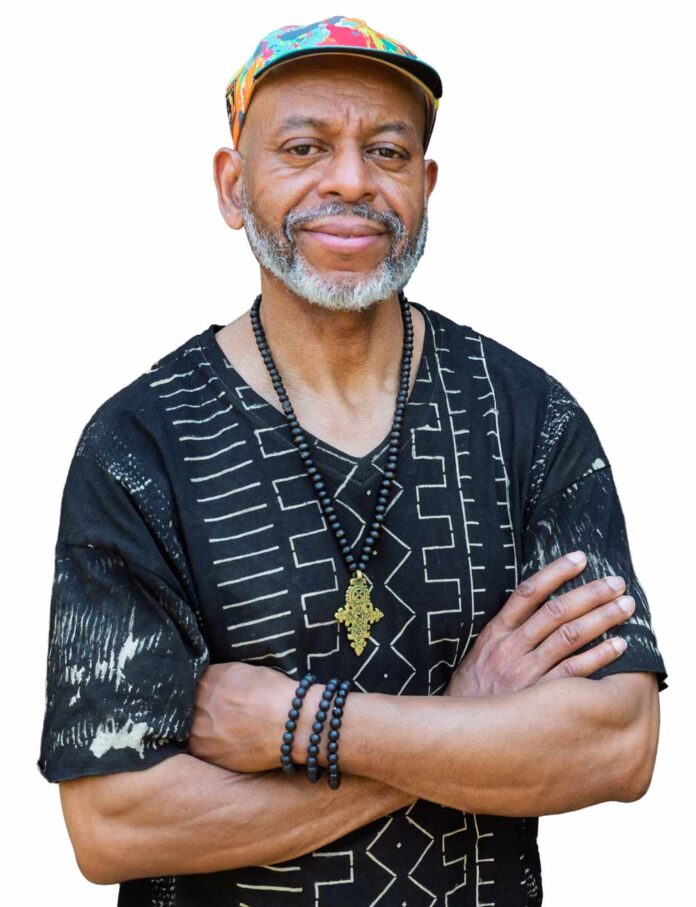

Fern Gillespie
An art class at Long Island University changed Francks F. Deceus’ life. At the time, the Brooklyn based artist was a sociology major. After earning his sociology degree and briefly working with nonprofits, he began to explore a career as an artist.
By the 1990s, the Haitian-American artist received an invitation to the legendary Robert Blackburn Printing Workshop. “That’s kind of how I got started in the whole art making,” he told Our Time Press.
“That initial spot was pivotable in terms of everything that has happened since then. I now work in various formats—collage painting, layers, and colors. I have dependent, figurative elements, but collectively it comes across as more an abstract format.”
During that period, Deceus was known as an emerging artist of note. His vibrant work was exhibited at the Schomburg, Cinque Gallery, Jamaica Arts Center, and others. His artwork went into the permanent collection of the Schomburg and he had major commissions for Medgar Evers College and Brooklyn Academy of Music.
Unfortunately, during the 1990s, there were few major exhibition opportunities for Black artists. “There weren’t a lot of other institutions that one could look to for that kind of support and opportunity,” he said. “A lot of the galleries were very limited in their scope and how much they could offer to an artist in terms of development and establishing themselves.”
Over the last 25 years, the popularity of Black art and collecting has been booming. “I think that it’s exciting in terms of the growing interest of art by people of African descent, and minorities in general. I think that it’s opened so many opportunities and platforms for younger emerging artists and even established seasoned artists,” he said. “Having a platform and having support changes everything. It makes it so much more viable and so much more vibrant. There’s so much more creativity and so much more support. It speaks to the changing times that we went through.”
Now, there are high profile collectors like Jay-Z, who supports emerging Black artists and purchased a Jean-Michel Basquiat painting for $4.5 million. In 2024, Brooklyn Museum hosted a milestone exhibition Giants: Art from the Dean Collection of Swiss Beatz and Alicia Keys spotlighting the couple’s powerful collection of works by Black artists.
Paintings by famed artist Kerry James Marshall have sold at auction from $5 million to $21 million. “For a long time, art by African American artists and artists of African Descent were kind of dismissed. I think, until as recent as the Obama portraits, a lot of people really did not give it the value or the spotlight it deserved for a number of reasons,” said Deceus. “Things like that have changed the whole spectrum of collecting. From those who collect just for the love of it and from those whose collecting is an investment. The inclusion into the commerce side of Black art collecting has opened the possibilities and opened doors.
Since 2000, Deceus has studied at the Atlantis Printmaker Center in France. He’s exhibited at Nnamdi Gallery, UFA Gallery,RUSH Arts, Kenkeleba Art Gallery, Hampton University, Brooklyn Museum of Art, and the National Civil Rights Museum. He is in the permanent collection of HBCU Xavier University.
When Deceus was nine years-old, his family immigrated to the US from Haiti. Currently, he has a major Haiti inspired public work on view at Brooklyn’s MoCADA Museum through April 2027. It’s a 30 foot mural entitled Carib Import #1 on the Greg Tate Art Wall in the Ubuntu Botanical Garden. “This work is a travel suit made up of a number of shapes and patterns and inflatable devices. It kind of metaphorically talks about the effort it takes to migrate to America, and also the challenges and the sacrifices, and ultimately highlighting the kind of energy and vibrancy and spirit and courage that it takes to leave everything behind.
To just take the chance on this journey, hoping that it’ll work out,“ he said. “Myself being from Haiti. it’s important that I channel these experiences and these stories, and draw attention to the conditions and the circumstances that are happening. I hopefully generate the kind of response as needed to kind of help solve some of these issues that’s facing immigrants, especially Haitian immigrants.
Now that things like TPS has been revoked or canceled, and how Haitians are being sent back to Haiti in a time when Haiti has never been more unstable than it is now with the vacuum that’s created after the president was assassinated. I think that it’s important to have markers available so that people can stop, think, and hopefully take action. It’s going to take collective effort to affect any kind of change.”
The exhibition is under the direction of Amy Andrieux, Executive Director and Chief Curator at MoCADA. “As an American born Haitian, I felt a personal duty to have a point of view on the plight of Haitian Americans especially — from anti-immigrant sentiments, fear-mongering, massive spikes in detention and deportation, to the dismantling of critical policies that once supported and protected Haitian lives,” she said. “Franck Deceus’ art has helped me and many others to begin the journey of reconciling what it means to be Haitian and American simultaneously.
Erecting Deceus’ “Carib Import #1″ in our Brooklyn garden has become a cross-cultural ice-breaker in a moment marred by chaos and disinformation. For Haitians, it is a pathway to our collective memories, a place where we convene, nurture ourselves, and re-root our sources of pride.”
Deceus’s degree in sociology remains instrumental in his art. “I do use my background in sociology in my work. I’m interested in people in a collective kind of a way and sociology definitely deals with,” he said. “As a storyteller, I think it’s important that I tell the story that I’m most familiar with. But more importantly, how does that story translate, and how can people relate to it. I’m looking for ways and platforms to reach as many people as possible.”
For more information on. Francks F. Deceus, visit www.deceusart.com