
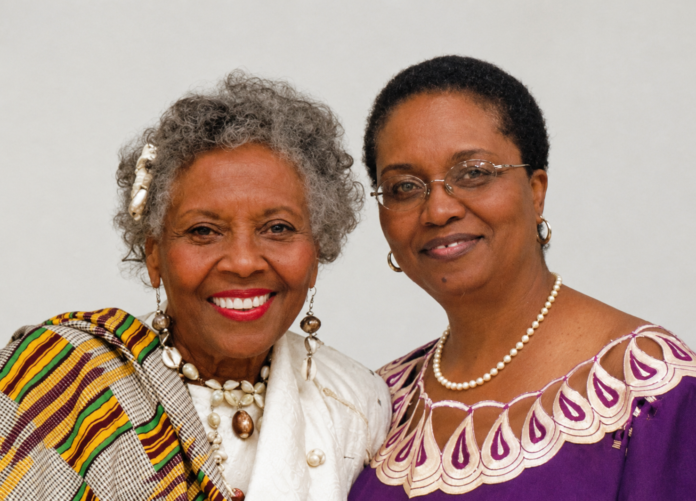

By Dr. Brenda M. Greene
I am the only Black student in my class; the memories flood my senses, and tears come to my eyes as I reflect on sitting in kindergarten, one of three Black children in the entire school. I do not want to be subjected to the marginalization that I felt as a young girl and I determined that I would impact the educational system by becoming a teacher and role model for Black and Brown students. Upon graduation from college, I began teaching in JHS 117 and later at PS 305, both located in Brooklyn, New York. Disillusioned by what I see, I think about beginning my own school.
For various reasons, this does not happen, but I become aware of Dr. Adelaide L. Sanford, a powerful and dynamic woman who embodies all that I am inspired to do as an educator.
Dr. Sanford’s grace, demeanor, and commitment to creating student-centered learning environments that inspire students to read, to write, and to become knowledgeable about their history and culture affirm my lifelong goals as an educator, scholar, and cultural worker in what Dr. Sanford refers to as the Beloved Community. I have watched Dr. Sanford from afar in her roles as principal of the Crispus Attucks School (PS 21), Vice-Chancellor of the New York State Board of Regents, and as an African-centered professor and scholar.
I have been in her presence as she recounts stories of the prominent scholar and Pan-Africanist Dr. John Henry Clarke, speaks about the significance of raising funds for the John Henry Clarke House, and recalls visiting the Edmond Pettus Bridge at its annual gathering to commemorate “Bloody Sunday.” She continually teaches and regales students, educators, and the community about the importance of acquiring wisdom and becoming servant leaders in their communities.
Guiding and educating our youth are central to Dr. Sanford’s core values. Her “Dedication to her Grandsons” in her memoir, From Enslavement to Belovedness: For the Dignity of My People, can be viewed as a message to all young people.
My grandsons, you are today “Freedom Scholars. . . .
At times you are alone in your pursuit to be a Freedom Scholar. . .
Connect with organizations of African ancestry who are in academia. . .
Embrace a system of values that validate and enhance your worth and potential.
In her memoir, Dr. Sanford also speaks lovingly of the regality and elegance of her mother, a consummate breadwinner whose ancestry descended from an Ibo woman and who believed that she had the power to overturn what might seem to be impossible. Her mother instilled this belief in her children and Dr. Sanford has lived by this creed.
All praises to you Dr. Adelaide Sanford, a guiding light and foremother for youth, educators. and the community. Marian Wright Edelman, founder and president of the Children’s Defense Fund, tells us that “the sea is so wide, and my boat is so small.” You have shown us how to navigate the wide-open sea with fortitude and agency.
Dr. Brenda M. Greene is an Author, Professor Emerita, and Founder and Executive Director Emerita of the Center for Black Literature at Medgar Evers College, CUNY. For more information, visit https://www.drbrendamgreene.com
Our Warrior-Queen-Mother Dr. Adelaide L. Sanford
By Dr. Joyce King
When Dr. Sanford calls us “Beloved,” she attends to our woundedness, embraces us as family, and affirms that she is our Warrior-Queen-Mother. Dr. Sanford has fought for us in the long tradition of warrior queens in the African world—from Queen Amanirenas’s defense of ancient Kush, Queen Amina’s military campaign in West Africa, Queen Nzinga’s fight against the colonization of Angola, Queen Mother Yaa Asantewaa’s protection of the Ashanti Golden Stool, Queen Nanny of Jamaica’s Maroons, to Queen Mother Audley Moore, Pan-Africanist, human rights activist, and Mother of the Reparations Movement.
I am deeply grateful for Dr. Adelaide Sanford’s help when I was in a major Black education struggle. I met the renowned Vice Chancellor Adelaide Sanford when I moved to New York in 1988 to work at Medgar Evers College. I told her that my very good friend, Dr. Mary Bacon, who was from New York, and whom I knew at Stanford University, said that I should get to know Dr. Sanford. It has been a blessing to have Dr. Sanford’s trust, her guidance, wise leadership, and her friendship.
In 1999 Dr. Sanford stepped in to help me lead an urgent American Educational Research Association (AERA) initiative: How could this 25,000- member organization—arguably the most influential worldwide professional association of university faculty, school leaders, and researchers—how could AERA researchers more effectively address the global crisis in Black education?
I was asked to take charge of the Commission on Research in Black Education that AERA had established to investigate this crisis. I knew I needed help. I went to see Dr. Sanford at her home in Queens. She listened to my plea and agreed to become the chairperson of the Elders Council that I organized to guide and center the Commission’s work in our culture. First, we convened a libation at John Henrik Clark House in Harlem and prayed for guidance and protection for our work.
Then Dr. Asa Hilliard and Dr. Edmond Gordon, two giants in Black education, and Baba Kwame Ishangi, African folklorist, dancer, and spiritual teacher, joined the Elders Council with Dr. Sanford. With Congressman Major Owens, Susan Taylor, and leading educators who also served on the Commission, we mobilized scholars to examine the state of global Black education and proposed practical solutions to promote academic and cultural excellence.
The Commission published a transformative research and action agenda for AERA in a landmark book that centered Black education in strength-based analyses. The work we did to support Black scholarship was groundbreaking and remains influential.
Recently, Dr. Susan Goodwin and I were able to help Dr. Sanford get her powerful memoir, From Enslavement to Belovedness: For the Dignity of My People, published at Third World Press. What a joy it was to give back to her after all that she has given to us.
Do you know what it feels like when an elder, a Warrior-Queen-Mother answers your call for help? I do. It feels like you are her “Beloved”.
Dr. Joyce King is the Benjamin E. Mays Endowed Chair for Urban Teaching, Learning & Leadership, Professor of Educational Policy Studies, and Affiliated Faculty, Department of Africana Studies at Georgia State University in Atlanta
Meeting Dr. Adelaide L. Sanford
by Dr. Perry Greene
I first met Dr. Adelaide Sanford in 1972 at Public School 21 on Chauncey Street in the Bed-Stuyvesant section of Brooklyn. That encounter set a tone and a direction that would guide me over the next 50 years. I became a professional actor at the age of 5. Not the most studious fellow, my high school guidance counselor recommended that I join Outward Bound, an outdoor education program, instead of attending a traditional college. It was 1968, the Vietnam War was raging, and at eighteen, I was a prime candidate for the draft. I chose college instead.
It was 1972. Still acting, but needing additional income, a family friend, Theresa Merritt, recommended that I apply to the school where her dear friend was the principal. The school was the Crispus Attucks School (P.S. 21), and the principal was Adelaide Sanford.
During the course of our lives, every now and then, we meet someone whose visage exudes grace and wisdom. Dr Sanford is just such a person. She is calm, yet quietly energetic. She is warm and gentle, yet a powerful woman of action and decisiveness. Upon meeting her, you are greeted with a broad welcoming smile, eyes beaming, and a two-handed handshake that is sincere and trusting. Given the scarcity of Black male teachers, particularly at the elementary school level, she saw in me something that I had yet to see in myself. She believed I could make a difference for the students of P.S. 21.
Public School 21 was a reflection of the woman who led it. Under Dr. Sanford’s leadership, the school became a model for what public schools in predominantly Black communities could achieve, communities that the public and politicians had turned their back on poverty to prison pipelines. The school was well-run with committed leadership. Dr. Sanford demanded excellence from teachers, staff, and students. Parents were welcomed and treated with respect. Most importantly, the students were learning. P.S. 21 had one of the highest reading scores in New York State. Her approach to pedagogy was hands-on and student-centered.
One day, I took a sick day from teaching my special education students to act on a soap opera called The Guiding Light. A parent of one of my students was watching that day and shared this revelation with Principal Sanford. When I returned from my one-day malady, I was called to Dr. Sanford’s office. I had been busted! I was a grown man, but I still felt like the kid with his hand in the cookie jar. “Mr. Greene”, she said quietly but firmly, “You are a good teacher, but you must decide if you are going to teach or act.” I chose to teach. Thank you, Dr. Sanford.
Dr. Perry Greene is the retired founding Vice President for Diversity, Equity & Inclusion at Adelphi University and the President of the Stanley Greene Foundation (www.stanleygreenefoundation.org)