
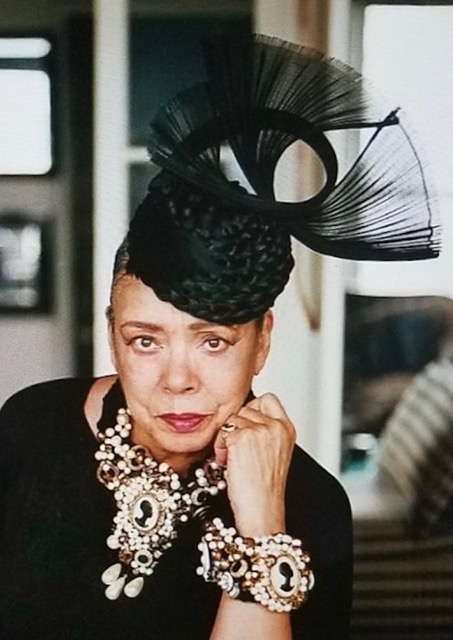

Fern Gillespie
Coreen Simpson is a Renaissance Woman. She’s a renowned photographer, artist, writer, author, and designer of the acclaimed Black Cameo jewelry. Whatever she does, Simpson always does it with a fashionista flair.
Now, at age 83, Simpson, who was born in Brooklyn, is a published author. In her elegant and eclectic coffee table book Coreen Simpson: A Monograph (Aperture), her artistic photos capture scenes from early 1980s hip hop culture at Roxy club to New Yorker boho fashions to a 1978 photo of Toni Morrison casually smoking a cigarette to celebrities like Grace Jones, Muhammad Ali, Eartha Kitt, and Diana Ross. The book spans 50 years, which includes her career as a freelance writer and photographer working for Essence, Unique NY, and The Village Voice.
Last year, she was in Paris on a publicity tour for Coreen Simpson: A Monograph. “I haven’t been to Paris in years. So, when I went there, it was so fabulous. They had a big party for me at Karl Lagerfeld’s library. There were some people on their knees kissing my hand,” she told Our Time Press with a laugh. “My book was sold in all the art stores in Paris. I had a book signing at the Grand Palais for the Paris Photo festival. I’m an internationally known photographer. I’ve exhibited in London. I was in a major museum in Cuba. I’m in the permanent collection in the Belgian photography museum. I’m exhibiting in Tokyo right now.”
The first time Simpson picked up a camera was in the 1970s as a writer for Vy Higginsen’s popular magazine Unique NY. Simpson had already separated from her husband and was a single mom. She had been working in office jobs at NBC and RCA when she started writing. For an article on New York bartenders, she pitched Higginsen to add her work as a photographer. “I wasn’t that good, but I was better than some of those pictures they were putting in my articles,” she recalled. “I called up a friend of mine, and he brought me a camera that I could borrow and showed me how to use a 35-millimeter Canon. He showed me in one hour what to do, how to do it, how to load it, everything. And I took that camera with me and took pictures myself. I made double the money.”
By 1978, she was assistant curator of photography at the Studio Museum in Harlem. She was being mentored by acclaimed photographer Frank Stewart and also working as a photojournalist. “I’m a photographer that does portraiture, documentary, and fashion. I would make jewelry on the side, pre-cameo, to support my work as an artist,” she said. Her turning point was when designer Carolina Herrera saw her selling jewelry on 57th Street as a vendor. “Carolina Herrera
bought 11 necklaces of mine for her resort collection. Then Glamour magazine heard about it and wrote a little blurb about it.”
Top magazine editor Audreen Ballard, who had worked with Essence and Lear’s, told Simpson about Chanel creating a cameo. “Ballard told me: “It’s beautiful, but it’s a White woman. Can you make me a cameo of a Black woman?” she recalled. Simpson searched for a cameo depicting a Black woman. She discovered cameos of Black women made in England and Europe from the 1800s. But those were antiques. “I want to do a modern woman, because Black American women couldn’t find a cameo in the marketplace,” she said.
At the time the Black Cameo premiered in 1990, Simpson was gaining recognition as a mixed media collage artist. Her artwork was exhibited at the Studio Museum in Harlem and the Schomburg. To produce the cameos, Simpson partnered with Black jewelry manufacturer Wilmer Jennings. “When I announced that the Black Cameo was at the Studio Museum in Harlem Gift Shop, people were lined up,” she said. “The first 100 of those cameos, I gave away 100 to the top Black women in New York as a gift. I felt that when they wore it, other people would want to have it.”
The Black Cameo became a special jewelry addition to many Black women. Essence had Janet Jackson and Iman in photo spreads with the Black Cameo. Rihanna has a top-of-the-line cameo ring, in a gold line. “The first Black Cameo has a cornrow-style hairdo. Like a short hairdo,” she said. “The second cameo I designed has a woman with an updo, with her hair piled up on top of her head.”
Simpson has created a glamorous life surrounded by beauty. It wasn’t always this way. “Because my mother and father’s marriage didn’t work, my brother and I were put in an orphanage. Then we were in the foster care system. We didn’t have any clothes in the orphanage. There was only a community closet,” she explained. “That’s why I’m so crazy about clothes and stuff, because I never had that when I was younger. Not until my teenage years when I started working in the summertime and I was able to buy clothes for when I went to high school.” She went on to study at Parsons and FIT.
“I realized that self-presentation is everything. If you want a job, you have to look good. In 1976, Muhammad Ali told me something very interesting. I spent a whole evening with him when he fought Ken Norton. I had my NBC credentials, because I worked for NBC as sort of a secretary, but I would tell people, I’m a photographer for NBC. I was telling Muhammad Ali that I worked for NBC. But I said
sometimes it’s hard to get into different places as a Black woman. He told me, ‘Get yourself a mink coat, and nobody is going to stop you.” That’s all I got that from Muhammad Ali-just look fabulous!”
“Years later, I didn’t even have to show credentials anymore. I would just say I’m Coreen Simpson from The Village Voice, and they would just let me in.
Almost six years ago, she returned to Brooklyn from living in Harlem. She grew up in Brooklyn and graduated from Samuel J Tilden High School. Now, she is living in Crown Heights.
“I document what I’m seeing in the streets, because fashion really comes from the streets. It doesn’t come from these designers,” she said. “I’m always in the streets of Brooklyn. If I see somebody looking fabulous. I just take a picture of them.”
For more information, visit www.theblackcameocollection.com