

By Nayaba Arinde
As advertised, the spending season is here, from Thanksgiving through Christmas to Kwanzaa; there is another call by Black business advocates to harness Black consumer power as a habit, not a seasonal trend.
It’s the economy, Beloved. The average household bill has increased by hundreds this year.
“We underestimate our collective Black dollar spending power, and we do not use our purchasing equity to achieve progress,” Colette Pean, December 12th Member, told Our Time Press. The community should re-evaluate how to empower spending solidarity.
“We have to be intentional about where we are going to spend our money. We can make our social, economic and political points when we financially hurt these big companies when we withhold our money from them.
Kwanzaa is a great opportunity to spend with ourselves. We must support our businesses, our institutions, and our people in these stressful times. Surrounded by growing gentrification, we must prioritize building and maintaining our community. Buying above our means is a debt-fueled exercise. Holding on to our money is a strategy too.”
The Selig Center for Economic Growth said that annual Black consumer spending is in the trillions. BlackWallStreet.org noted that as reported in the Black Wall Street Chronicle, US Black consumer buying power will reach $2.1 trillion by the end of 2026, equal to “the gross domestic product of entire nations.” Yet, the question they pose is “whether this unprecedented spending power will translate into lasting ownership, institutional control, and generational wealth, or continue to circulate outward with limited long-term retention?”
This surge has occurred despite the fact that the advancement of this whole demographic “has long been constrained by systemic barriers—enslavement, segregation, redlining, and unequal access to capital markets…Today’s $2.1 trillion milestone reflects…the resilience of a community that has continuously generated economic value despite structural disadvantages.”
However, data shows “Spending reflects income flow, but wealth is built through ownership of assets—businesses, real estate, intellectual property, and financial instruments.”
Last year saw boycott demonstrations against President Donald Trump’s move to cut Diversity, Equity, and Inclusion (DEI) from various government agencies, with certain conglomerates and national shopping chains following suit.
One action was the 24-hour Economic Blackout on Friday, February 28th, 2025.
Then, Omowale Clay, Chair of the December 12th Movement, told Our Time Press, “Under the centennial force of Malcolm X, Patrice Lumumba and Franz Fanon – we’re Going Black on Feb 28th. Like your life depended on it.”
Forbes said that Target lost 11% in in-store walk-ins, 9% in online visits, and suffered an estimated $12.4 billion drop in stock price.
The first Monday of November–sometimes the day before the general election- Clay and his organization hold their annual community observation of Professor Carlos Cook’s Black Solidarity Day.
It is based on Douglas Turner Ward’s 1965 Day of Absence play, demonstrating the impact of Black people removing themselves from day-to-day activity in society: “No work. No school. No shopping.”
On Monday, 2nd November, 2026, at Bed Stuy’s New Canaan Baptist Church, the Black Solidarity Day Coalition hosted the “In the Fight for Our Human Rights” program of community and culture, where conversations were held about the status quo, grassroots agendas, and the plans to move forward.
There was reflection too on lessons learned. Last year there was the national “Mass Black Out, people’s money week off,” from Tuesday, November 25th to Tuesday, December 2nd, 2025. The ask was to boycott the big chain stores, and instead patronize Black-owned stores, service providers, and small businesses.
Community activist Brownsville-born-and-raised Robert ‘Larry’ Marshall told Our Time Press, “I wholeheartedly feel that modern-day boycotting or remnants thereof is fruitless and a waste of precious time and resources. When our people are halted – voluntarily or involuntarily- from engaging in commerce for a day, a week, or even a month, once the opportunity presents itself, will always spend double or triple what they might have, had the interruption not taken place.
We absolutely positively need a completely different approach and/or strategy which will actually produce change or a desired result.”
‘Bud Brownsville LLC’ businessman Marshall continued, “Dr. Claud Anderson wrote the blueprint on what needs to be done, and how we need to do it.”
The author of the book PowerNomics, his “strategic economic and political blueprint,” economist Dr. Anderson was speaking in Detroit when he stated that the city is bankrupt because, despite being 90% Black, other ethnicities own common amenities like laundromats, hotels, gas stations, wig shops, and nail salons, while “Blacks own nothing in a 90% city, and that’s why Detroit went into poverty,” Black folk instead go out to the suburbs to spend up to $12 billion.
He offered that folks must ‘Strive for Black Group Economics in 2026!!! Stop funding your oppression. Spend with each other and other Black-owned businesses. Support Black-owned banks.”
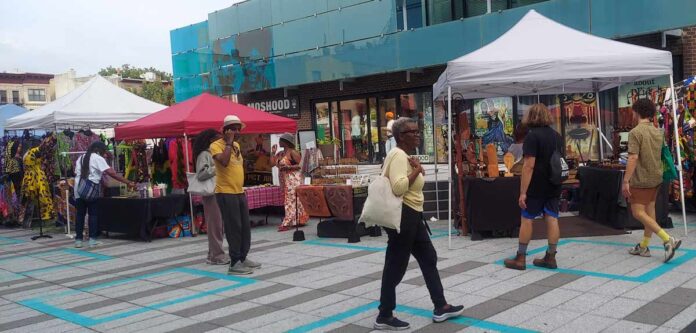
Black dollar power advocates are encouraging consumers to shop with purpose on Black-owned platforms such as shop.buyblack.org, GoShopBlack, Kesaruva, Miiriya, and Blaamazon. Coming up are the citywide Black community and Kwanzaa events, including the Marcy Plaza Bed-Stuy Gateway BID’s Winter Wonderland, the year-long cultural hub Flatbush Central Caribbean Marketplace, Malcolm Shabazz Harlem Market in Harlem, and the Queens Supermarket Initiative organized by Michael Duncan, President General of the Universal Negro Improvement Association. Founded by the Federation of African, Caribbean, and American Restaurant Owners Corporation, this initiative established a “major Black-owned community supermarket.
“We need to center ourselves around our families and community, and ground ourselves and cooperative economics,” concluded Colette Pean.