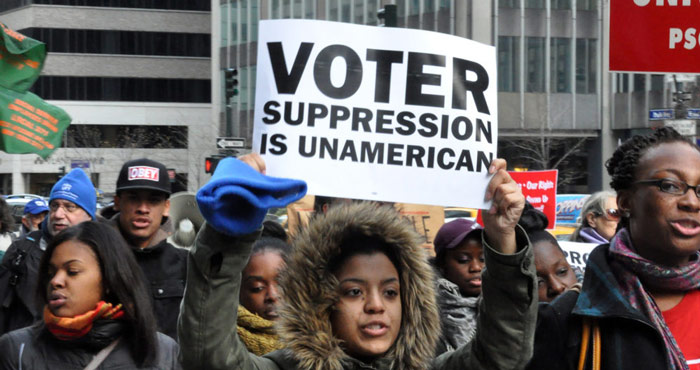
Rarely in United States history have the prospects for fair and honest elections that reflect the will of voters been so dim. That a significant segment of the citizenry, including many elected officials, do not want a truthful accounting and are working actively to prevent one exacerbates the problem, as do new, restrictive state laws and the expectation that they will be rubber-stamped by a sympathetic Supreme Court. This unfortunate scenario has played out before and ushered in one of the darkest episodes of America’s past.
By 1880, the advances of Reconstruction had been turned back and white supremacists had reasserted control in much of the South. Voter rolls were being purged of Black registrants, which in turn led to discriminatory legislation enacted by white-dominated state legislatures. Equal rights advocates saw the Supreme Court as their only hope. In two cases reported on March 1, the court made its position clear.
In the first, Strauder v. West Virginia, the justices ruled that a state law explicitly limiting jury service to white men violated the 14th Amendment and that Taylor Strauder, convicted by an all-white jury of murdering his supposedly unfaithful wife, must be granted a new trial. Although that case is often cited as an equal rights victory, it was anything but. Moments later, the court, in Virginia v. Rives, sustained the murder convictions of two African American brothers by an all-white jury because, although Black people were never called to serve on juries in Virginia, there was no specific law that prevented it.
Southern whites understood the roadmap the court had provided. So long as a law did not announce its intention to discriminate, it would pass judicial muster. During the next two decades, white supremacists attacked voting rights, drafting laws and new state constitutions in which the language was “facially neutral” but, using literacy tests, grandfather clauses, poll taxes, and residency or property holding requirements, specifically designed to keep Black Americans from the ballot box. In theory, these provisions applied to white people as well, but white registrars made certain that the laws were applied only selectively.
Some states employed methods sufficiently ludicrous to be worthy of “Saturday Night Live.” South Carolina, for example, introduced the “eight-box ballot,” equipped with eight separate slots, each designated for a specific candidate or party. To cast a valid vote, a person needed to match the ballot to the correct slot, but obscure labeling made doing so for anyone not fully literate virtually impossible. White people were assisted by poll workers, while Black voters, most of whom could read only barely or not at all, were left to try to decipher the system on their own.
None of this was done in the shadows. James Vardaman, later to be elected both governor and United States senator, boasted of Mississippi’s new Constitution, “There is no use to equivocate or lie about the matter. Mississippi’s constitutional convention of 1890 was held for no other purpose than to eliminate the [obscenity] from politics … let the world know it just as it is.”
Court tests of these new state constitutions went nowhere. In June 1896, Henry Williams was indicted for murder in Mississippi by an all-white grand jury. His attorney sued to quash the indictment based on the systematic exclusion of Black people from voting rolls. Yet although virtually none of the state’s 907,000 Black residents were registered, and state officials had publicly announced their intention to disfranchise them, the court ruled that the burden was on Williams to prove, on a case-by-case basis, that registrars had rejected African American applicants strictly because of race. Justice Joseph McKenna wrote that the Mississippi Constitution did not “on [its] face discriminate between the races, and it has not been shown that their actual administration was evil; only that evil was possible under them.”
The final blow was struck in 1903 in Giles v. Harris, when the court, in a grotesque opinion written by Oliver Wendell Holmes, rejected a challenge to the registration provisions of Alabama’s 1901 Constitution. Holmes agreed that the Alabama Constitution was “a fraud upon the Constitution of the United States,” but observed that if the court ruled in Giles’ favor it would become “a party to the unlawful scheme by accepting it and adding another voter to its fraudulent lists.” By this reasoning, any law that was discriminatory would be a “fraud,” and the court would become party to that fraud by protecting the plaintiff’s right as a citizen.
And so, with the court’s complicity, by 1906, more than 90 percent of African American voters in the South had been disfranchised. The horrors of Jim Crow were quickly sucked into the vacuum.
Similarities to the reasoning of the Roberts Court are both eerie and disquieting. In such decisions as Shelby County v. Holder, disemboweling the Voting Rights Act, and Hawaii v. Trump, upholding a Muslim travel ban, the majority relied on the same tortured logic and the same willing blindness that perverted justice in the past. And, as in the Jim Crow era, dozens of states have recently followed the court’s roadmap and initiated legislative efforts to suppress Black voting. Nonetheless, despite its predilection to the contrary, there is evidence that the Roberts Court will be less successful in preventing votes being cast than its predecessors.
The Jim Crow contrivances, such as poll taxes, literacy tests and grandfather clauses, have since been struck down and, as a result, recent state voting laws lack the bite of previous efforts. Enhancing identification requirements, closing polling places, and limiting mail-in ballots and early voting can make casting a ballot massively inconvenient but, unlike Jim Crow laws, cannot prevent a motivated voter from either registering or going to the polls.
And that is the point. Those attempting to hijack the electoral process want to avoid court challenges entirely. They are attempting to make voting sufficiently cumbersome that enough opposing voters stay home to grant them victory outright, sort of a corollary to Mitt Romney’s “self-deportation” strategy for undocumented immigrants.
As such, the best way to avoid a collapse of the electoral process — and a collapse of American democracy — is for voters to endure any hardship, any inconvenience, to make their voices heard. African Americans in the Jim Crow South risked their jobs, their homes and even their lives to try to cast ballots. We all must do our parts as well.
Goldstone’s most recent book is “On Account of Race: The Supreme Court, White Supremacy, and the Ravaging of African American Voting Rights.”