
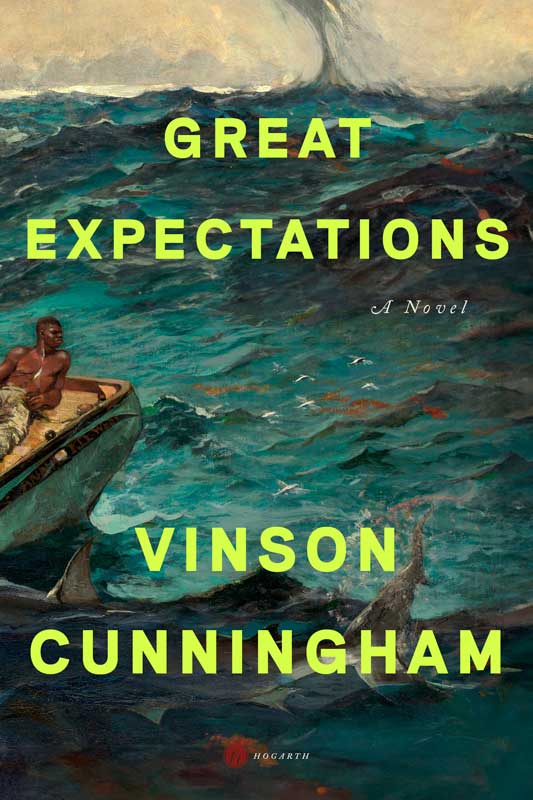

Everybody talks about how he’ll change race in America. Erase it or whatever. By this they mean he’ll change white people, which if it happened, would be amazing enough. But nobody mentions the better thing, Dave. How he could absolutely abolish, all at once, with one big stroke, end black politics forever. -From Great Expectations
by Vinson Cunningham
Vinson Cunningham’s debut novel Great Expectations (Hogarth Press, 2024) explores the personal journey of the protagonist David Hammond, a young Black man who is working on the campaign of a man referred to as “the Senator.” From the very beginning it is clear that “the Senator” is presidential elect Barack Obama. Vinson Cunningham is a former staffer on Barack Obama’s first presidential campaign. He is currently a staff writer for The New Yorker, co-host of the magazine’s weekly arts and culture podcast Critics at Large, and a Pulitzer Prize finalist for Criticism.

Great Expectations, a coming of age novel written in the first person, provides an insider’s description of campaign politics and an analysis of what it meant for a Black man to run for President of the United States. As the narrator, Dave or David as he is sometimes called in the novel, works on the presidential campaign of “the Senator” from Chicago for one year, he reflects on his memories of religion, schooling, parenting, and class and racial politics.
The novel’s title, Great Expectations forecasts Hammond’s symbolic journey as the only son of a teacher and musician who grows up in New York and Chicago.
Having grown up in the Pentecostal church, he interweaves his insights on studying the bible and religion with his experiences in working on the campaign. For example, the passage on his thoughts after observing the glow of the lights from a church reminds him of the setting of Moses and the burning bush. Hammond notes that the figure in the book presents a problem.
The scripture calls him the angel of the Lord and so the straightforward way to understand him is as a mere emissary, neither human nor divine. But I was taught to read the Old Testament in terms of the new and, therefore, to look for traces of Christ centuries before he appears. . . . Maybe the angel, so called another Christ, in this conception, reaches backward through time, stunning the transcriber of the law he’d later fulfill.
Is Hammond, in referencing this passage, thinking about the messaging of “the Senator” as a possible reincarnation of the Christ figure? The possibility of this insight is reinforced by Hammond’s description of a Black preacher he meets at a donor fundraiser.
The preacher whom Hammond had watched on television while growing up was very active in the Civil Rights Movement. However, he now preaches that he is glad to keep his sanctuary away from politics; thus, Hammond cannot understand why the preacher would come to a fundraiser for the Senator and asks him why he had come to the fundraiser? The preacher responds that “the Senator’s” election as president was the work of God.
A central theme in Great Expectations is the circuitous road to organizing and winning a campaign. Readers will come away from the novel with a clear picture of the elements that go into raising funds, coordinating a fundraiser, and campaign messaging. They will also witness that it’s almost impossible to escape some form of corruption and hypocrisy.
“The Senator’s” campaign is an awakening for David Hammond. He recounts: “The longer I worked on this campaign, the more I became aware of how much was hidden from me. How much I totally did not know.”
The projection of “the Senator” as someone who could change racial politics in this country and in doing so create a post-racial society is also a theme throughout the campaign. Beverly Whitlock, one of the major fundraisers for the campaign summarizes what a win for a Black president would mean.
Everybody talks about how he’ll change race in America. Erase it or whatever. By this they mean he’ll change white people, which if it happened, would be amazing enough. But nobody mentions the better thing, Dave. How he could absolutely abolish, all at once, with one big stroke, end black politics forever.
Reading this statement in the midst of what the nation is experiencing makes it very clear that a post-racial society is an illusion. President Barack Obama campaigned on a call urging the nation to embrace a new kind of politics and to have the audacity of hope. Eight years later, hope has been diminished for many citizens.
Great Expectations is a thought-provoking description of the expectations and evolution of a Black man’s understanding of politics and race in this society.
Dr. Brenda M. Greene is Professor Emeritus and Founder and Executive Director Emeritus of the Center for Black Literature at Medgar Evers College, CUNY. For more information, visit https://www.drbrendamgreene.com