

Op Ed written by: Deon Jones, Uniquely Me Creative Arts
October carries special meaning for families like mine because it is both Down Syndrome Awareness Month and Sensory Processing Awareness Month. These observances give us an opportunity to celebrate people with disabilities, increase understanding, and challenge our communities to move beyond awareness toward meaningful action. Children with disabilities need support regardless of race, ethnicity, or background. Every family deserves strong schools, appropriate therapies, quality healthcare, dependable home care, and communities
where their children are welcomed. At the same time, families living in communities already affected by racial and economic inequities can experience deeper consequences when these supports are difficult to access.
According to the CDC, 9.1% of non-Hispanic Black children and 7.4% of Hispanic children ages 3–17 were reported to have a diagnosed developmental disability during 2019–2021. Federal IDEA data also show that Black students ages 5–21 were 2.2 times as likely to receive special education services under the intellectual disability category as students from all other racial and ethnic groups combined. Those numbers matter, but behind every statistic is a child and a family. I have spent 17 years serving New York City Public Schools as a special education teacher, Assistant Principal supervising Special Education, Math, and Science, and now as a District Math and Science
Instructional Specialist.
Throughout my career, I have had the privilege of advocating for children and families, helping ensure that students—especially those with disabilities—have access to the services, supports, and opportunities they need to succeed. But my deepest lessons about disability did not come from a classroom, an IEP meeting, or an administrative office. They came from raising my son, Elijah, and learning firsthand what it means to advocate not only as an educator, but as a parent. Elijah was born with Down syndrome, diagnosed with Autism at five-years old, and also experiences sensory processing challenges. Being his mother has taught me patience, persistence, and what true
advocacy looks like. It has also shown me how exhausting it can be for parents to navigate IEPs, therapies, medical appointments, insurance, funding systems, and community services while simply trying to give their child the best possible life.
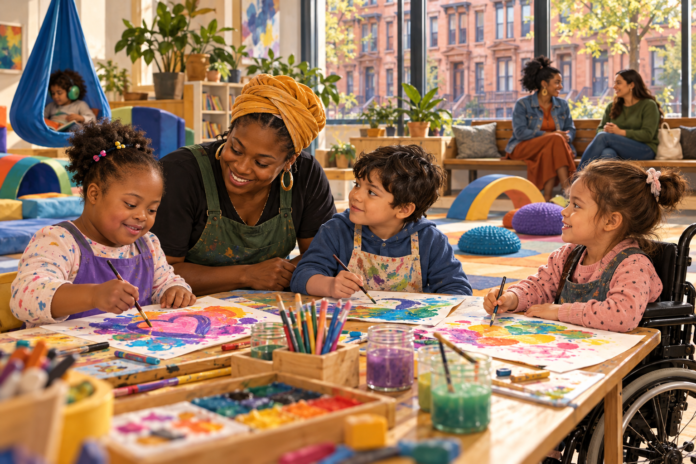
That experience helped inspire Uniquely Me Creative Arts (UMCA). UMCA exists to help close the gaps families experience after receiving a diagnosis. Our Sensory Zone, which opened in Brooklyn in October 2025, provides a welcoming environment where children can move,
create, regulate, explore, and simply be themselves. Sensory equipment, creative arts, movement, music, cooking, and other activities provide children with opportunities to participate in ways that recognize their individual needs and strengths. Yet supporting the child is only part of the equation. We must support the parents as well. UMCA connects families with resources, professionals, parent education, advocacy, and information about services and funding. Parents should not have to become experts overnight or spend years
discovering resources that could have helped their families from the beginning. That need for support becomes even more critical inside the home.
For many children and young adults with disabilities, quality home care is essential. A trained home health aide may help with personal care, safety, daily routines, communication, and independence while providing critical support to caregivers. Families need more than someone assigned to fill a shift. They need professionals who understand disability, sensory needs, communication differences, behavior, and
the dignity of the person receiving care. That is why UMCA is developing its Home Health Aide Initiative and advocating for legislation that
strengthens the quality of home care available to people with disabilities. Our communities should support policies that improve disability-informed training, accountability, workforce development, and the quality and consistency of care families receive. Parent advocacy cannot end when our children leave school. It must extend into healthcare, home care, recreation, employment, and every system they
encounter.
This October, we are also turning awareness into celebration. On Saturday, October 17, 2026, from 12:00 to 3:00 p.m., UMCA will host its 3rd Annual Fundraising Festival, “One Community. Every Ability.” at Bethany Baptist Church, 460 Marcus Garvey Blvd. in
Brooklyn. Families will experience live performances, sensory and creative activities, community resources, disability-focused vendors, haircuts, braiding, and opportunities to connect with organizations that support the disability community. Our goal is simple: create a space where people with disabilities and their families feel welcomed, valued, celebrated, and connected.
Down Syndrome Awareness Month and Sensory Processing Awareness Month remind us to recognize disability. But recognition alone is not enough. Elijah has taught me that disability does not diminish a person’s value or potential. It challenges all of us
to create better systems, better care, and stronger communities.
Awareness should open our eyes. Advocacy should move our voices. And action should change lives.
Deon Jones
Founder & Executive Director, Uniquely Me Creative Arts