

By Mary Alice Miller
The 55th Annual Caucus Weekend was held under the theme of Legacy Forward: Transforming Tomorrow Together. The workshops, coincidentally held on Valentine’s Day, were curated to address the immediate and long-term needs of communities of color statewide.
There were dozens of workshops with topics covering community media, Caribbean Islands impacted by climate change, opportunities for girls in sports, MWBE contracting, food systems, redistricting, gaming casinos, community banking, and digital equity in the era of artificial intelligence.
Assemblywoman Monique Chandler-Waterman hosted a workshop centered on survivors of gun violence.
“I have worked with many parents who are part of a group none of us want to be a part of: their loved ones, their sons, their daughters were murdered due to gun violence. A lot of times, when we meet them at the scene, the blood is still on the ground. The families are asked to clean it up, or we are cleaning it up,” said Chandler-Waterman. “Often, we don’t know what support and resources are out there. We know about Victim Services, but not everybody is touched by that. We have clergy and anti-violence groups. We want to make sure people know services are there.”
“Too many times our families sometimes slip through the cracks and feel there is not enough services for them. We need these organizations,” said Assemblywoman Jaime Williams. They serve as a safe space for our children, make space for survivors and their families, and be a voice for survivors.”
Sigma Gamma Rho held a workshop on Black women in political leadership.
“Black women are exceptional. What does not make sense is that we are expected to be exceptional in order to be leaders in any space,” Freda Foster. “We should be able to go into any workspace, whether public or private, and see people from any walk of life represented in all roles. As Black women, we feel we have to have more degrees, more experience, more time. In the workspace, there needs to be clear pipelines for what is needed in leadership.
When we don’t have standards, bias can slip in. All we ever ask for is a level playing field.”
Regarding the recent increase in Black women’s unemployment, Foster said, “Entrepreneurship is an alternative to federal government employment.” Camille Joseph Barlette added, “A dollar may circulate in other communities for weeks. In Black communities, a dollar circulates for six hours. We need to be intentional about where we spend our dollars in order to support the jobs created through entrepreneurship.”
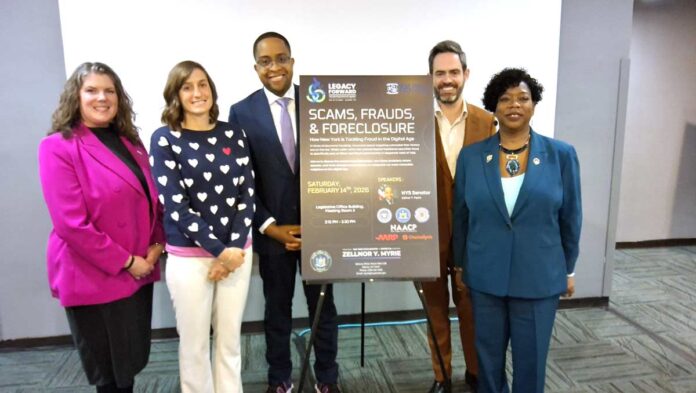
State Senator Zellnor Myrie sponsored a workshop focused on how New York is tackling fraud in the digital age.
“The last time that we updated our scheme to defraud laws was close to 50 years ago,” said Myrie. “A lot has changed in the world in the last 40-50 years. We didn’t have email, cell phones, cryptocurrency, or blockchain. As things progress, bad actors have found new ways to take advantage of people. When we are talking about how to stop people from being victimized, we center our communities because we are often the first people targeted. The biggest tool is education.”
“White collar crime is financial exploitation,” said Bronx District Attorney Darcell Clarke. “With AI, scams are designed to make people trust them to think that they are doing something good for you. Immigrants, older adults, and other vulnerable communities are targeted. What I see the most are deed theft, rent fraud, romance scams, and crypto operations.”
Assemblyman J. Gary Pretlow sponsored a forum on safety in the beauty and personal care industry.
“A lot of the relaxers that people are using are a prime cause of ovarian cancer,” said Pretlow. There have been efforts by myself and others to take some of these products off the market and have them available only to licensed cosmetologists who know the time frames between applications and the chemistry that those at home don’t know. I am concerned with the health issues involved in hair care.
The Beauty Justice Act would ban the worst toxic ingredients in personal care and cosmetic products, focused on those that disproportionately harm women and people of color, including PFAS, formaldehyde, talc, and lead.
“Every day we use many products that result in our being exposed to over 100 chemicals,” said Sophia Longsworth, Toxic Policy Director, Clean+Healthy. We use face wash, body wash, shaving cream, after shave, sun block, and makeup that may contain chemicals that are harmful, especially to Black women. It could be something as noticeable as an allergic reaction, or something as irreversible and long-term as endocrine disruption, infertility, reproductive challenges, or cancer.”
The Natural Haircare and Braiding Act would shift the focus beyond styling to a comprehensive framework of wellness, health, and professional standards specifically tailored for afro-textured hair. This act would address training to prevent traction alopecia, permanent hair loss caused by tightly pulled hair.
Synthetic braiding hair has been tested, and 100% were found to have carcinogens.
‘We took ten very popular brands and tested them for carcinogens,” said Tanya A. Christian, Writer and Senior Multimedia Content Manager at Consumer Reports. “All of these products that are very familiar to Black women are coming up with these levels of carcinogens. These carcinogens are not on the back of braiding hair packages. Consumer Report always wants to make sure that we are making the marketplace more just, more fair, so that consumers are making more informed decisions.”