Home Blog Page 667

Cynthia Nixon Came to Bed-Stuy to ‘Trust Black Women’

Exclusive to Our Time Press

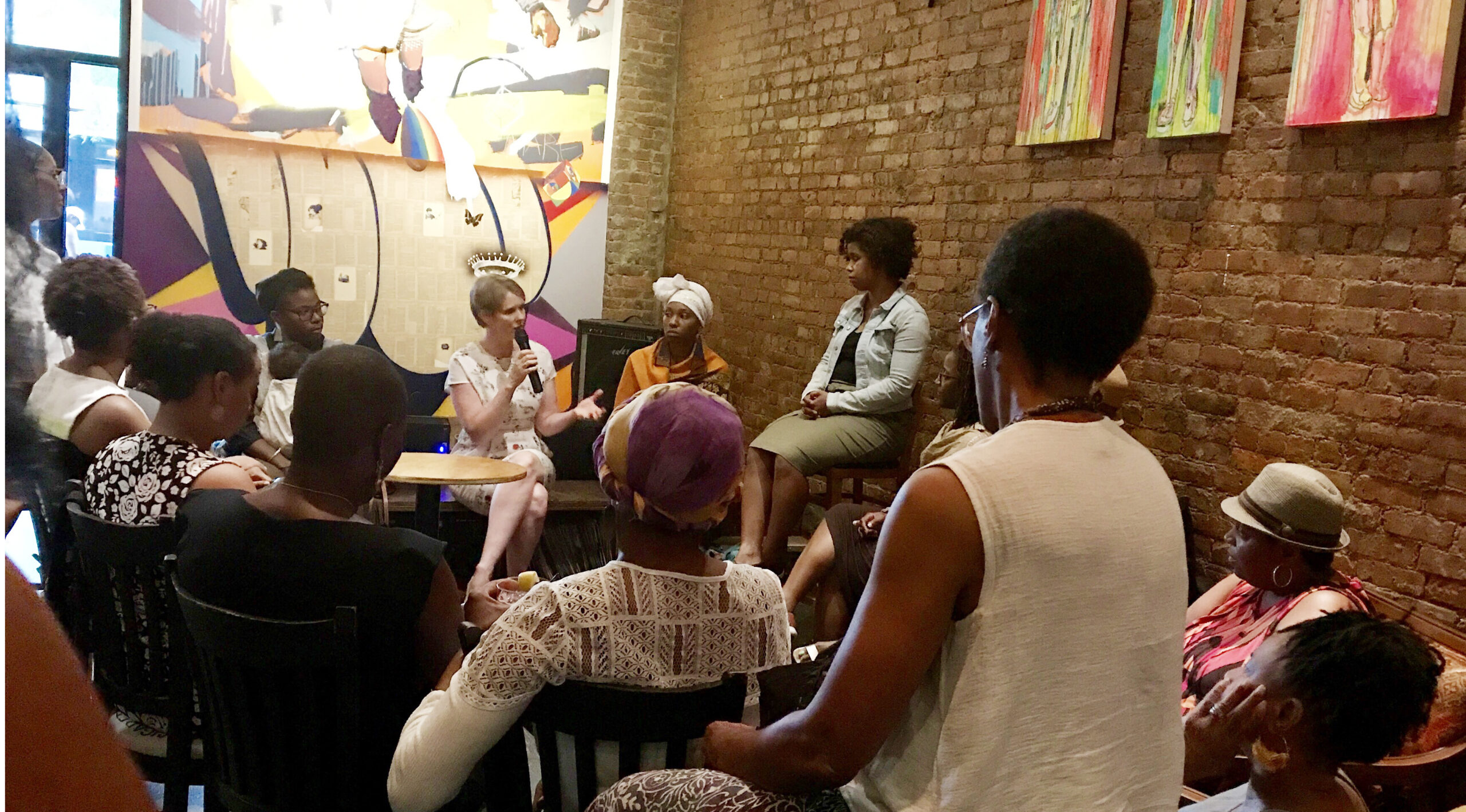
It’s not certain what Cynthia Nixon, candidate for Governor of New York State, expected for her first “State of NY Women” dialogue held last week in Bedford-Stuyvesant. What she got, in any event, was an audience with a multigenerational gathering of informed and discerning Black women – courteous but unafraid to speak their minds. It was a job interview in a relaxed setting and Nixon handled herself well. She revealed a refreshing knowledge of a wide range of issues on this first leg of what will be a series of visits she’ll make statewide to find out what concerns Black women wherever they live.

Nixon’s campaign slogan reads: “A Progressive Fighter: Cynthia for NY.” Supporters tout her decade-long activism around issues affecting average New Yorkers. Education has long been chief among these. She was an early spokesperson for the Campaign for Fiscal Equity, addressing inequities in education in New York City when compared with other regions of the state. And as a member of Alliance for Quality Education, she organized with other public school parents and went to jail after protesting alongside Acorn founder Bertha Hope.

“Black women are the backbone of the Democratic Party,” Nixon told the audience at her appearance on the “Wendy Williams Show.” “Look what Black women did in Alabama! Look at how they supported Hillary Clinton in a way that white women didn’t at all… And do you know what? Black women are going to stop showing up for the Democratic Party if the Democratic Party doesn’t start showing up for them.”

A daily subway rider, Nixon got off the A train at Nostrand Avenue and walked up bustling Fulton Street. (She would later reveal a thorough grasp of the issues surrounding the dismal state of the MTA.) At Basquiat’s Bottle, a spacious bar, café and gathering space with walls displaying the work of local artists, L. Joy Williams, a senior advisor to Nixon’s campaign, joined Zinerman in presenting the candidate to those gathered.

Black women got right to it, and although not all of the questions and answers can be reported in the scope of this article, what follows is an account of some of the exchange:

In response to a question about ending cash bail, Nixon addressed the injustice of the system but did not propose an alternative.

“We have a system right now,” said the candidate, “where whether or not you’re held in jail has nothing to do with whether you’re a flight risk or a threat to the community at large, or to an individual. So in other words, if you’re dangerous, you can buy your way out. It seems to me that if you’re a threat, no amount of money should be able to have you out. What they’ve found in other states is people show up for trial because they plan to, whether there’s bail being held for them or not. It doesn’t actually make any difference.

“I think it’s also really important, also that we stop arresting people for petty crimes, particularly people of color. We have so many people in jail right now for minor offenses. And then they’re held for months and years if they can’t afford bail. It shouldn’t be the deciding factor.”

“We need to fund community organizations that are already doing the work. My education plan is comprehensive from birth through college. One of the things that it allows for is a great increase in home visits for new mothers and new infants. We have a government that – in a desire to cut taxes and to basically leech revenue out of our state – has defunded the most crucial human services that we have. And we need those jobs because of the services they provide and can really be a life or death difference.”

This reporter asked, “What can be done about the inequities where in East New York, for example, homeowners are paying higher property taxes than Mayor de Blasio is paying in Park Slope? And secondly, can there be some teeth in the guidelines so when developers erect buildings and say they have affordable housing – the housing is actually affordable for people trying to remain in their communities?”

“Property taxes are an enormous problem around the state, and they’re really killing people. One of the most important things I think we need to do is that the state needs to take a bigger share of things so that it’s not always so vehemently on homeowners. In communities that are the hardest hit, we should have circuit breakers. We should look at people’s income and their savings and what they’re paying in their mortgage, and if it’s too onerous, we should be funding money so that it’s not impossible for them.”

A question was asked about the IDC (Independent Democratic Conference). Nixon credits her campaign with putting a fire under Governor Andrew Cuomo on several issues and an April New York Times headline said, “Cynthia Nixon has already won by moving the governor to the Left.” The IDC certainly looks like a case in point. Cuomo’s momentum recently advanced dramatically in reclaiming rogue Democratic state senators voting with Republicans as part of the IDC. Cuomo claimed for years that there was just nothing to be done about it, a stance some judged to be a cynical attempt to court Republican favor. But in April, later on the same day that Nixon mentioned Stewart-Cousins’ exclusion by IDC members on the “Wendy Williams Show,” Cuomo magically resolved the issue which had been a major frustration for liberals. Nixon says she would not have stood for it.

One woman’s pain was felt throughout the room as she very directly asked Nixon for a concrete answer to her question.

“I have a brother who’s been incarcerated most of his adult life, and he’s in his sixties,” the woman said. “It was three strikes and you’re out; it was robbery. He’s gone before the Parole Board several times, and he’s done more time than people who have murdered someone. And so talk to me about what complete overhaul of the criminal justice system would look like, and not just say, ‘Well, legalize marijuana, our kids won’t get arrested for it.’ That’s not the solution for me.”

“So sorry to hear that about your brother! It’s awful! It seems to me that one thing we need to do is change the nature of who sits on Parole Boards. And we need to change the point of view with which it’s determined who should be paroled. First of all, someone who’s gone to jail for that long, since that age, should never, unless they’ve committed the most heinous crime, should never be sitting in jail.

“It’s very important that we just stop throwing people in jail for petty offenses. We need to not have people sitting in jail just awaiting trial who are legally innocent. We have to also make sure that parole is not booby-trapped, we have to maximize their chances, give them the support they need to find a place to live and find a job and deal with the trauma. It’s like you’ve come back from a war and you need to make sure a person has the support to deal with the PTSD that they’re overwhelmed with when they try to reenter society. And we don’t want to keep tripping people up on these minor, little, technical infractions that are just yanking them back into the system.”

Paulette Tabb Jeppe, a Bedford-Stuyvesant homeowner and retired educator said, “You touched on corruption in government, in relation to real estate development. I want to know, what do you propose to do about New York’s homeless problem? And also prices for NYCHA?”

“So, some of the homelessness crisis is, of course, due to mental illness, and I think we have to do a much better job with mental health services. But the vast majority of it is due to a lack of affordability. We have to get rid of this idea we have that if we really help people that are homeless into housing, that this is going to cause an explosion of homelessness from people who are expecting to be given housing. I think nothing could be farther from the truth, and that actually if we spend the money to solve the problem, it would also end up costing the city and the state a lot less in the long run.”

“NYCHA has been underfunded by everybody: by the city, by the state, by the feds – for so long. I think it’s good that the city has agreed to put in a billion dollars, that’s a start. The governor has agreed to put in $250 million; that’s too little, too late, and we’ll see if he really comes up with it. One of the things that has been so wrong is when he actually gives a chunk of money, he doles it out in tiny little parcels so that it can’t be used for overarching needs like replacing roofs, fixing leaks, getting the mold out, getting the asbestos out and lead paint.

“We need a wholesale investment and I think it’s important that we have a federal monitor there. My hope is that this person, that committee – will be somewhat objective and will put both the city and the state’s feet to the fire about what is needed. Cutting corners is what happens when you have such a massive institution and you do not fund it and do not prioritize the lives of the tenants.”

Political consultant Stefani Zinerman, a co-founder of Woman-Up Brooklyn, curates State of NY Women. She’ll be doing the same for others going forward – organizing “intimate conversations” between candidates and the constituents they aim to serve.

“Over the past election cycle, Black women have emerged as a crucial demographic for candidates seeking elected office,” says Zinerman. “My role in communities across New York State is to ensure that we get in the room and help set an agenda that meets our needs.” This candidate was game.


WHAT’S GOING ON

BLACK ECO DEV

Bishop Reginald Jackson

Read the good news: “The AME Church and Black Banks Launch Partnership for Black Wealth,” published in TriceEdneyWire.com.   The African Methodist Episcopalian (AME) Bishop Reginald T. Jackson recently announced the initiative with 19 Black bank presidents in the USA. He said, “This initiative will strengthen Black banks across the USA and increase their capacity to lend to small businesses, to secure mortgages, to provide personal lines of credit to offer other forms of credit to Black America.”   Partnership goals are to increase deposits and loans with Black banks, increase Black homeownership and to grow the number of Black businesses from 2.5 million to 4 million and to raise total gross receipts from $75,000 to $150,000. [Check the AME website]

The Harlem Business Alliance’s entrepreneur initiative, the LILLIAN PROJECT, begins its 5th session next month. The LILLIAN PROJECT is a 16-week business intensive for young NYC Black women who want to become entrepreneurs. The W.K. Kellogg Foundation is the initiative’s major sponsor.  Application deadline is July 27. Orientation is August 5 and 7. [Visit thelillianproject.org or hbanyc.org]

USA/MIDTERMS

Charles Phillips

The Sunday 10/25/17 NY Times Business section included a cover essay, “HOW TO GET POWER-Get Organized” by Kate Kelly, was a fascinating piece about Black elites and laser-focused plans for greater political power. Their plan calls for the creation of three structures: 1) a super PAC, 2) a federal PAC to support candidates and 3) a 501©4 group, a social welfare nonprofit that will do a mix of the two. Black millionaires like Charles Phillips (Infor), Tony Coles (Yumanity Therapeutics), Raymond McGuire (Citigroup), Adebayo (Goldman Sachs) and Kenneth Chenault were some of the names dropped as prime movers of the POWER plan. The elites reached out to Sherrilyn Ifill, NAACP Legal Defense and Education Fund, Black local and national elected officials like GOP US Senator Tim Scott (SC) and Congressman James Clyburn (SC). What happened to that political POWER elite group?

ARTS/CULTURE

THEATER: ON KENTUCKY AVENUE: A Celebration of Atlantic City’s famous Club Harlem, a magnet for all great Black talent in the 50s and 60s in the pre-Atlantic City casino era, is back at the CCNY Aaron Davis Hall on Convent Avenue at 135th Street in Harlem from July 12-28. “On Kentucky Avenue,” starring Ty Stephens, is a musical like no other, set in Club Harlem, which was known as the “Black Copacabana,” that titillates all of the senses. Created by Jeree Wade and directed by Lee Summer, ON KENTUCKY AVENUE is a musical tour de force.  [Visit citycollegecenterforthearts.org]

The AFRO-LATINO FESTIVAL of music, film, discussions, food and arts and crafts vendors, in association with the City Parks Foundation and SUMMERSTAGE, is a citywide event from July 13-15. The Schomburg Center hosts Afro-Latino Talks: Identity and Beyond on 7/13, 10-5pm which includes curated panels and workshops. The 7/15 music concert in Brooklyn at The Well, 271 Meserole Street, will include performers from Puerto Rico, Dominican Republic, Colombia and Haiti. [Visit Afrolatinofestivalnyc.com]

The Harlem Book Fair date is July 21st from 10am to 6pm on 135th Street between Lenox and Seventh Avenues. [Visit harlembookfair.com]

African-American Malcolm Nances’ book, “The Plot to Destroy America: How Putin and His Spies are Undermining America and the West,” debuted at #9 on the 7/8 NY Times Books best-seller list. A former US intelligence officer, Nance describes the tools and techniques employed by the Putin posse to affect the 2016 US Presidential elections.

Watch ESPN writer Howard Bryant’s book, THE HERITAGE: “Black Athletes, A Divided America and the Politics of Patriotism,” climb the NY Times best-seller book list.     According to a Journal-ims article Bryant says, “The way you view sports, and it has been this way for a few years, is white owners, white coaches, white season ticketholders, white media and Black players.” Book compares American sports icons and social engagement, from Rodney King to the present, viewing silences among Michael Jordan, Patrick Ewing, Magic Johnson and Charles Barkley with today’s outspoken cagers like LeBron James, Steph Curry et al.

Attend the celebration for publication of a new book entitled, “Elombe Brath Selected Writings and Essays,” edited by Herb Boyd at the CEMOTAP CENTER on Saturday, July 14th at 135-05 Rockaway Boulevard in South Ozone Park, Queens.

Martha’s Vineyard, The Renaissance House Retreat for Writers and Artists in Martha’s Vineyard, MA, begins its 2018 season soon.   Founded by Abigail McGrath and sponsored by the Helen Johnson and Dorothy West Foundation in Oaks Bluff, The Renaissance House Retreat is a haven for writers of color and writers of social justice for a fee.  The retreats are weekly with the first session beginning on Sunday, July 22 and will continue every Sunday until September 23rd. The program includes workshops, trips, classes and talks by local literary lions such as Jessica Harris and Jill Nelson.   McGrath’s life was the inspiration for her aunt Dorothy West’s novel, “The Wedding,” a story about class and interracial love on the Vineyard, which was later adapted into a feature film starring Halle Berry. [Visit renaissance-house-harlem.com or call 917.747.0367] 

NEWSMAKERS

Dr. Sir Prince Ramsey is an Antiguan family physician who played a pivotal role in advocating for HIV patients at the height of the AIDS crisis in the 80s and who pioneered HIV services for pregnant women in the Caribbean region. He was the recipient of the 2018 UN Population Award at a ceremony held at UN Headquarters in NY last month.

SUMMER PLEASURES

The UNCF “A Mind is” Hamptons Summer Benefit will be held on Saturday, August 18 at the Silberkleit Residence in East Hampton. This UNCF Hamptons Summer Benefit honorees are Dr. Johnetta B. Cole, former president of Spelman and Bennett Colleges, former Director of the Smithsonian National Museum of African Art, and entrepreneur Ed Lewis, Essence magazine co-founder. The UNCF Sunday Brunch will be held on August 19 at the Bay Kitchen Bar, East Hampton. [Visit UNCF.org/NYHamptons] Founded in 1944, the United Negro College Fund (UNCF) is the nation’s largest and most effective minority education organization.

A Harlem-based management consultant, Victoria can be reached at Victoria.horsford@gmail.com.

The Fame you find in a Meme

       I went viral last week as a meme.

If this was ten years ago, the previous sentence wouldn’t make much sense at all. Presently however, its meaning is a precursor for a discussion on both the power and the frivolousness of social media. Allow me to explain.

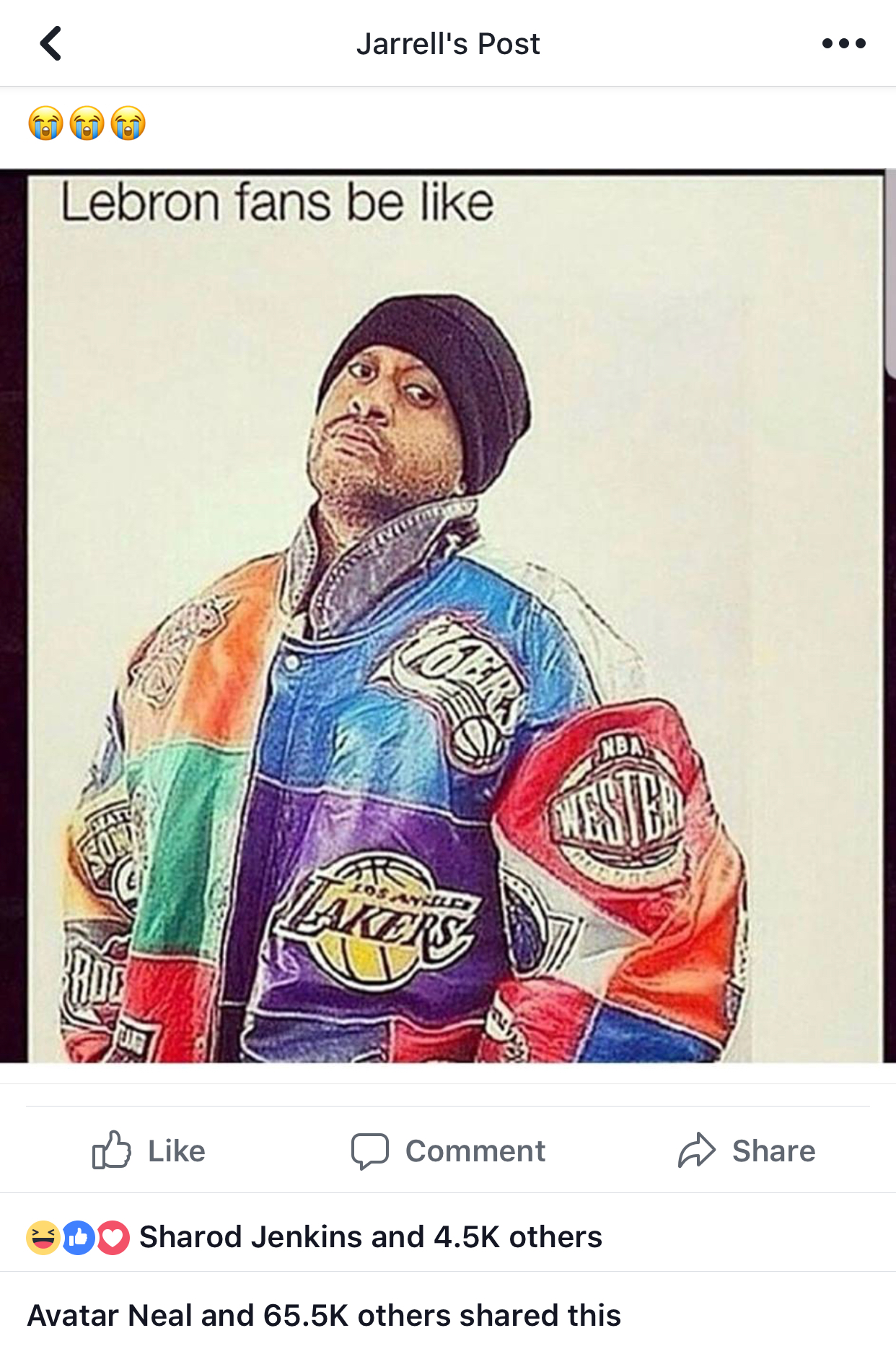
Among the myriad of things that I’ve done in my life, for the better part of two decades, I modeled clothing and outerwear for hiphopcloset.com. The online clothing retail company is owned by some childhood friends of mine, and when they began their business back in 1998, I modeled their wears for the website. One such early photoshoot involved this leather jacket that was adorned with the logos of every basketball team. The jacket was oversized in the way that people were wearing their leather jackets in the late 90’s. The pic that was used to market the coat has me using my best gangster face, a natty black skullcap covering my head, the collar popped, my unshaven beard giving you hipster chic with a twist of thug life. In other words, I looked a complete mess. The pic simply became one of dozens that I took for the website, nothing at all special about it. I don’t even know if they ever sold any of those jackets.

In the late 70’s, ethologist Richard Dawkins defined the term meme as an idea, behavior, style or usage that spreads from person to person within a culture. A more current definition is a humorous picture, text or video that is duplicated, sometimes with slight variations, and spread rapidly by Internet users. Basically, someone captions a picture or a video, usually something they find humor in. They share it with their social media friends, and if it is indeed a funny or an interesting caption then maybe those friends share the meme with their friend list. When a meme is said to have gone viral, this means that the meme has been shared rapidly through an Internet population set. The common benchmark for going viral would be around 100,000 views of a particular meme in a day.

Back in the summer of 2014, amid the sports conversations involving free agency, the biggest talk was about LeBron James and his return from the Miami Heat back to the Cleveland Cavaliers. People were creating all kinds of memes to mock the issue. This was the first time that my meme appeared, in the summer of 2014. Someone found the picture of me in that jacket with all of the team logos and they captioned the picture “Lebron fans be like…”. The humor of the caption stems from the idea that fans of LeBron would root for any team that he played for. Back then, when the meme hit the Internet, it gained a little traffic. I remember a couple of people tagging my name to posts of the picture, laughing at the fact that an old hiphopcloset picture had resurfaced in such a way. It was shared a bit, but it didn’t go viral back then.

Last week, once again the biggest sports talk was about LeBron James becoming a free agent. After 4 years in Cleveland, LeBron was once again going to test the waters of free agency and possibly change teams. This was different than in 2014. Back then, LeBron simply announced he was returning to the Cavaliers. This time, people had no idea of where he would land. Teams were doing the most to garner the attention they thought would bring LeBron to them. The Philadelphia 76ers even flew planes over the Barclays Center in Brooklyn on Draft Day. The planes dragged banners that called for King James to consider bringing his talents to Philly. In the midst of all of this hype, and with perfect timing, someone re-released the meme, 24-year-old me in an oversized leather jacket with NBA logos all over it, the caption reading “Lebron fans be like…”.

I was in Jamaica last week for a family reunion. International phone rates are outrageous, so while my family and I trekked up Dunn’s River Falls in Ocho Rios, my phone was off. As soon as I reached my hotel room and the Wi-Fi, I began receiving dozens of texts from people, all of them sending me snapshots of this meme that had appeared again on social media. I went to Instagram and found that literally scores of my followers had tagged me to posts of the meme. It was the same thing on Facebook. This thing was all over social media. I had gone viral.

I tried tallying up all of the shares of this meme via Facebook by going to every post that someone tagged me in to find how many times that person’s post was shared. I stopped at 350,000. That’s only on Facebook. I figure the meme was circulated at least that many times through Instagram and again through Twitter. We’re talking a million shares easy, with views in the tens of millions. Ten million people viewed a picture of me. Such a thought automatically strokes the ego until your right mind begins to try and quantify exactly what having ten million people viewing a picture of you actually means.

It means nothing. Absolutely nothing!

Going viral as a meme has to be the most meaningless fame in existence. Yeah, everyone sees you. But no one cares. They don’t care because though you are in the picture, you are not the subject of the picture. You are but a mere object. The caption is the subject of the picture. It’s the caption that interests those who press like or choose to share it to their page. The meme is about LeBron James. It isn’t about me. I’m just the punch line.

Marilyn Monroe said, “Fame is like caviar, you know? It’s good to have caviar, but not when you have it at every meal.”

I’ve had my taste of fame. I prefer the taste of a rib-eye steak.

East New York: We Walk in a Field of Dreams

A place called “home” or “my neighborhood” is comforting to those living there. There in the neighborhood people go to the same schools, shop in the same stores and run in the same playgrounds. However, there are institutions that can disrupt “home” and “my neighborhood.” Due to the racial or ethnic background of neighborhood residents, home may be deemed undesirable by the power structure; therefore, property values are lower and municipal services may be minimized.

East New York is one neighborhood that has experienced the lows and highs of neighborhood change. It was once a cozy enclave for Southern and Eastern European immigrants in the eastern corner of Brooklyn. For the Anglo-Saxon Americans, these Europeans were of a different pedigree—somehow beneath them. In fact, color-coded mapping was devised to indicate where different racial and ethnic groups concentrated.

The genesis of color-coded mapping is from One Hundred Years of Land Values in Chicago: The Relationship of the Growth of Chicago to the Rise of Its Land Values, 1830-1933. This is the title of Homer Hoyt’s dissertation published in 1934. Hoyt put different human races and places of origin “by order of desirability.” Anglo-Saxons and Northern Europeans were most desired and were assigned the color green. Next in desirability were the Northern Italians, Czechs, Polish and Lithuanians assigned blue. Greeks, Russian Jews and Southern Italians were the third tier assigned yellow, and African-Americans and Mexicans made up the fourth tier; i.e., the least desired and were assigned the color red.

Walis Johnson, a graduate of Williams College and Hunter College IMA program, is a multidisciplinary artist/researcher. She developed a strong concern for African-Americans creating multigenerational wealth. Johnson comes from a Black family with a history of homeownership in Central Brooklyn. She learned that wealth creation came from owning and maintaining property. When she found the Brooklyn 1938 Red Line Map during one of her investigatory walks, it spurred her to do more research and actual digging to uncover household goods and memorabilia. Johnson, solo and as tour leader, has followed the map through Greenpoint, Williamsburg, Bedford-Stuyvesant, East New York, Crown Heights, Fort Greene and DUMBO. 

Her latest project is collaboration with visual artist Paul Sue-Pat. Sue-Pat attended Edna Manley College of Art in Jamaica and the University of East Anglia in Norwich, England. Johnson and Sue-Pat approached Catherine Green, the Executive Director of ARTS East New York, to discuss their project, East New York: We Walk in a Field of Dreams, as a creative and collaborative project for funding by the Mayor’s Grant for Cultural Impact. East New York: We Walk in a Field of Dreams is a multimedia art installation that pulls together community oral histories, a labyrinth walk and sculptural creations to describe East New York’s changing landscape and culture. The socially charged artistic project is located within ENY Success Garden, an Operation Green Thumb garden and the adjoining NYC Parks Department lawn at 449-461 Williams Avenue.

The collaborators Johnson and Sue-Pat describe in their proposal:

This public art project will explore the past and future of East New York, a predominantly African-American and Puerto Rican middle- and working-class neighborhood in Brooklyn long neglected by the city, now on the verge of enormous change and possibility as a result of rezoning. The project offers opportunity to consider the neighborhood history, hopes and dreams and acknowledge the persistence of residents and institutions who have served as community place-keepers and healers in spite of real estate speculation, crime waves, drug epidemics and their resulting trauma.

A reception was held on July 7 at ENY Success Garden to share the project with the community. What one encounters in Success Garden is a gazebo that contains photographs encased in glass strung around the glassless windows. These images have written text and QR codes which permit visitors to view the photos through cell phones while listening to the person share his or her point of view about East New York’s past and their hope for the future. Near the gazebo is a table set up with instructions on how to engage with the Success Park and Garden, a copy of the 1938 Brooklyn Red Line Map and eight sets of “reflection cards.” Each set has a particular question pertaining to land, community and society. Visitors are asked to write their responses to the “reflections” on the back of the card.

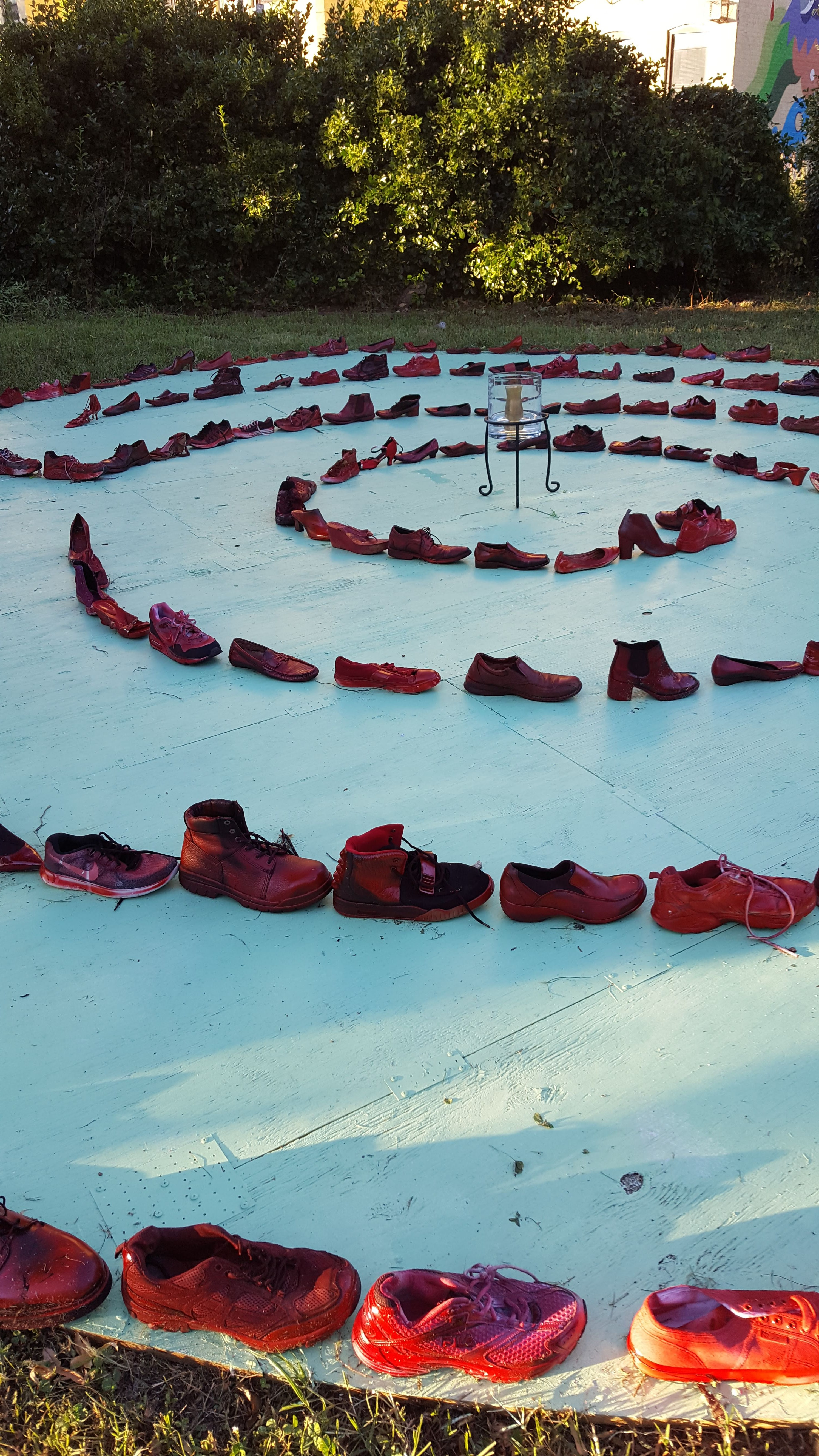
A few yards from the table is the labyrinth, the place where people take a meditative walk around a path constructed of men’s and women’s shoes that are painted red and carefully arranged on top of the wide floor tile. The red shoes are indicative of redlining. In the middle of the labyrinth is a glass bowl filled with water to be used to pour libation.

The labyrinth’s exit leads into an area containing several raised garden beds. Farther ahead is a large storage shed where a wide board is installed. This board is where people tack their responses to the meditative questions. This event closed with Walis Johnson and Paul Sue-Pat giving their individual statements about the process of conceiving and constructing East New York: We Walk in a Field of Dreams. Catherine Green explained the organization’s mission and its programs. Program offerings include Summer Saturdazes and Nightz, a performing arts festival series; Arts East New York University: KIDZ, an arts training program for children between 3 years and 12 years of age; Mural Mile and Installationz, a platform for artists to exhibit their work within the community.

Celebrating the Ancestors with a Family Reunion

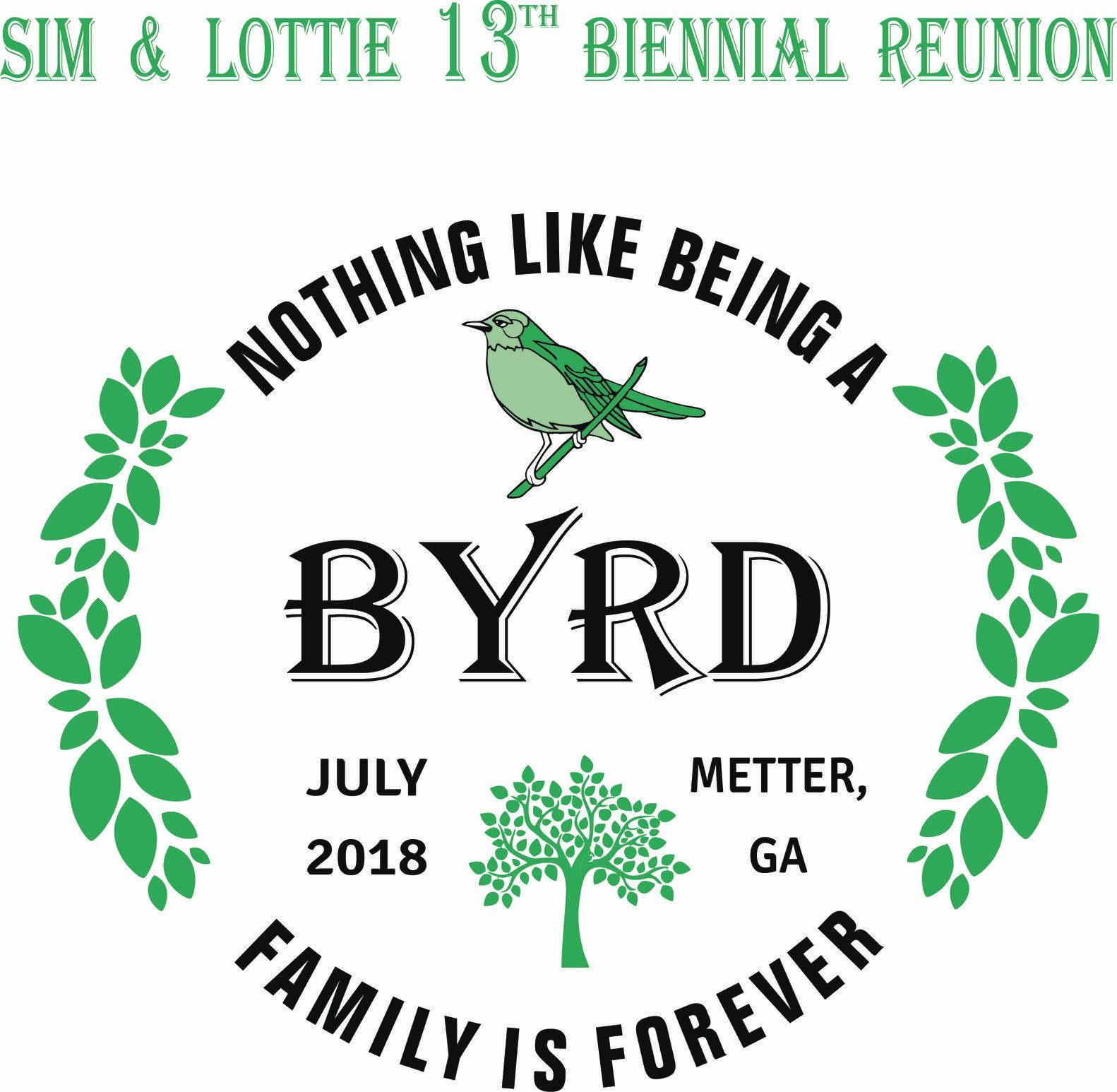
Every two years, Brooklyn resident Fred Price,75, takes a journey to celebrate his family’s ancestral history and recent achievements. Over the years, he’s traveled to cities like Detroit, Pittsburgh, Orlando, Fort Lauderdale and Charleston to see siblings, uncles, aunts and cousins—the descendants of Lottie and Sims Bird. This July, Family Reunion Month, the Byrd family will gather at their ancestor’s homestead in Metter, Georgia.

July is Family Reunion Month and folks nationwide are gathering for special
celebrations. Brooklyn’s Fred L. Price, on right, is seen here with members
of his large family, including Detroit’s Janette Dyer, left, who provided the
photos for this story.

In 1877, the official end of Reconstruction, Charlotty Hendricks and Simeon Bird married. The couple had been born in slavery, yet Lottie and Sims gave birth to 11 children and owned 100 acres of farmland in rural Georgia. The family farmed cotton, turpentine, tobacco and pulp paper. Each child became responsible for a different part of the business. Price, a Higher Education Officer at Medgar Evers College, would recall family stories of his great-grandmother Lottie, a six-foot-tall brown-skinned woman, proudly traveling to market. “She had a big garden with strawberries and was one of the few people in town with a horse and buggy with a top on it,” said Price. “She would ride into town to sell what she grew. That story would always hit me.”

After World War I, the children of Lottie and Sims began to migrate north to Pennsylvania, New York, New Jersey, Michigan, North Carolina and South Carolina and gradually changed the last name spelling to Byrd. By the 1940s, Price’s mother moved to Pittsburgh with her uncle. Other relatives had found jobs working as laborers in steel mills and as cooks in kitchens. When he was 12, his mother had a nervous breakdown, which sent her four children into the foster system. Although he lived in five foster homes until he left for the military, Price remained connected to his younger siblings and Byrd family members. When he was 17, he met his mother’s three older children for the first time. He became close friends with these siblings, who grew up in the south with their father.

“My family has always been central to me—no matter the difficulties and separations. Even when we were in foster care, I would visit my younger brother and sisters. As adults, I became caregiver to two of my sisters—one was learning disabled and the other suffered from breakdown,” explained Price. “I’m close to my mother’s family and I’m still close to my third foster family. I even sometimes spend Christmas with them in Maryland.”

The descendants of Lottie and Sims are achievers. The family includes corporate executives, entrepreneurs, educators, journalists and government officials. “I have a number of successful relatives. We have three and four generations of accomplished achievers,” said Price. “It’s about striving to a higher calling.” The family genealogist was the late Jerry Byrd, a former Bloomberg journalist and executive who published a booklet on the Byrd history. His brother, a former Mellon Bank vice president, Oliver Byrd, was the former president of the August Wilson Center for African-American Culture in Pittsburgh. The movie “Pride” starring Terrence Howard, is a biopic on Byrd family member Jim Ellis, who created a world-famous swim team with Black youth in Philadelphia. Price is a veteran executive at Medgar Evers College and has a career that’s spanned special assistant to City Council President Carol Bellamy, marketing manager at New York Newsday and a volunteer consultant to Mayor David Dinkins.

“The Byrd Family Reunion gives us a sense of history and importance of where we came from. Also, an understanding of how we survived and continue to survive,” he said. “It’s about unity and connection. That you’re not out there by yourself. It’s a support network.”

In the 1930s, the original family homestead burned down. It had been home to Sims, who died in 1920, and Lottie, who died in her eighties in 1931. The current family estate has a main house with a swimming pool and courtyard and the older former main house that replaced the one that had burned down. Today, several senior family members have retired on the 100-acre property by building small homes and installing home trailers. The family church, Sams Creek Baptist Church, is a separate property on 10 acres and holds a community center and cemetery.

Over 200 relatives are expected for the 2018 Byrd Family Reunion titled “Nothing Like Being a Byrd. Family is Forever.” Highlights include: Family Western Night, meet & greet, annual banquet honoring elders, worship service at Sams Creek Baptist Church, family meeting and annual picnic. There will also be horseback riding and a talent show. Price is a poet and at last year’s family reunion the younger relatives helped him with a performance of his rap poem, “I Wear My Pants Up,” from his book “Journeys of Life.”

“I’m very proud that we come together and that we reach out to each other. That we stay connected to each other,” Price pointed out. “Our younger people need to know where we came from. What the history was. How we got to where we are. They need to see the land and to see the history.”