Home Blog Page 534

Prof. Gloria J. Browne Marshall on The Black Vote Part II of Three Parts

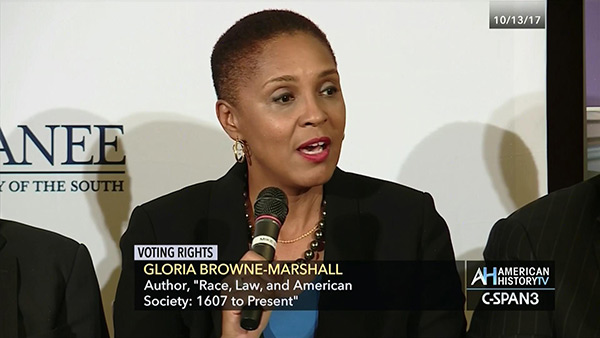
The following talk with Prof. Gloria J. Browne-Marshall, professor, Constitutional Law at John Jay College, and publisher David Mark Greaves, is the second in an Our Time Press series of ongoing interviews and conversations on the state of our times. It is inspired in part by a book Prof. Browne-Marshall is writing entitled: My Sankofa Year. The interview took place January 11, 2020.

Our Time Press publisher David Greaves: Let’s take a look at the upcoming Presidential election: in the democratic field, it’s an all-white contingent and billionaires on stage. How do we keep the passion going for Black voters in the presidential election when there’s no Black candidates?

Professor Gloria Browne-Marshall: There have been no Black candidates for the majority of the elections. So, this is not new. There were no Black candidates as well as no one really speaking to the African American issues for the majority of American history. Frederick Douglass had his name on the Ballot in the 1870s and actually received a few delegates. So, that’s why I said we’ve been in the game for a long time.
I wish we better understood our history and better understood our power. What we should be asking these candidates is, what’s your position on Black empowerment? What is your position on African- American power? It’s going to be on us to embrace, and understand, that we have power and to spread the word to our community that we have power. Voting is one way to exercise that power. Is it perfect? No. But the vote is a voice and one way to exercise the power, not just on the national level but on the local and state levels, is to vote. Once we exercise that power to vote, we understand why they move the locations of places where we get our photo ID. Within days after the US Supreme Court gutted the Voting Rights Act, all these laws pop up on voter suppression. I mean, they’ve been after our vote for hundreds of years. We had our first elected African American official in the 1700’s, NOT the 1800’s.

OTP: I didn’t know that.

GBM: Yes! Wentworth Cheswell, grandson of a former enslaved African, was elected to public office as the Town Constable of Newmarket, New Hampshire in 1768. If we don’t know our history and we think everything is just today, our plans are not forward-looking.
By 2045, this country will be majority people of color. I don’t think a lot of European- American conservatives are willing, able, or can even think through being in a country in which they are not the majority or at least in power.

OTP: Well, that seems to be the thrust of Mitch McConnell’s rush to put as many Federal judges in the judiciary as possible. These folks will be there til… say 2045-2050, deciding on voting rights, and all other kinds of rights too.

GBM: Exactly.

OTP: What can we do with that?

GBM: There’s nothing this country has not done to us. I don’t say that with any type of vengeant spirit. I’m saying that based on history and we know this history. It’s very curious to me how we can know all of these things, even most of them that have happened to us involving the cruelty of slavery, Jim Crow lynching, you know the murder of Black Panthers and murder of any activist. The murder of Martin Luther King Jr. And yet we won’t do basic things to protect ourselves like learn. I’m not even talking about rising up with a weapon. I’m talking about understanding if this is your opposition, when you start to see mobilization don’t think it as MIGHT be occurring. Perhaps, it is. History has shown us that the number of times we’ve been able to rise up and do anything that is progressive for Black people has been met with a backlash, and the reason we’re sitting in the middle of this very conservative stance that’s anti-African American, anti-immigrant, anti-people of color is we had a Black president for 2 terms.

OTP: The reaction to Obama, the backlash to Obama, drove them crazy.

GBM: When he was in office, they lost their identity because they believe that they are superior to black people, in many ways. Even white Liberals. I have encountered this.
The reality of them saying they believe in equality when it actually happens because you can’t have people trained in extensive superiority for hundreds of years and then, when they’re actually faced with the reality of being equal to someone they feel they’re superior to for so long, there is an adjustment.
When you bring in a change like this, different than how they’ve been raised for generations, then you’re going to have backlash, especially some people in power who feel this will erode their power. They feel they’re the only group that knows how to run this country. So, if you look at it from a very reasonable standpoint, even though racism is quite unreasonable then you realize what you’re in.


Given that situation, what are the tools they have. The vote is one. How can that tool be used to not only protect myself, my family, my community but also used to make progress on my side, since they want to use that tool to make progress on their side? That way you can see it very clearly for what it is and then your question goes to, what should we be doing? One of the things we should be doing around the vote is to organize our community in more than just groups. We have to organize people and go out into their communities and tell them the same things we’re talking about, how your vote is power. How your vote is not just a national vote but it’s a vote on all these different levels and how you need to register to vote. In our state, people who are formally convicted of felonies can vote.
People who have ties to the Federal government, churches, community groups, need to be expressing their right to vote beyond their own government agency, community group, or whatever. They need to be making sure that people understand the power of the vote.

OTP: In 1972, William Greaves Productions documented one of the first black political conventions (Nationtime Gary). It was a national organizing effort brought together by Imamu Amiri Baraka in Gary, Ind. Do you see any chance of another nationally organized effort by black folks?

GBM: I’ve heard the whispering of one or two. As a matter of fact there was one planned a year ago and then it was put off. Something like that requires massive organization and the coming together of different black groups, it would have to start right now and have a date probably in the summer so that people could be able to get there. They could plan around it. There could be some real motion and it has to be something that goes beyond, and I’m going to say this… Goes beyond working class energy and you know and middle-class amiability. I’m trying to be nice by that because as you pointed out, there are other people who say those folks don’t want to vote. They dont register. And they’re usually pointing that finger at working class people and working-class people have a lot of responsibility. They’re not making the money they should be making. Everyone knows that the black dollar is a percentage of what the white dollar is. You know, there are all these pressures on all of us and yet we need to get to the working-class voters to say working class person we need your vote because they are the majority in our community.


As much as middle class people want to believe that they have a great deal of power within our sphere, that power is based on a majority and that majority is working class. So, the communication breakdown between the middle class and the working class is having a very harmful effect on our power base. WIthout the working class, the black middle class doesn’t have power to do anything unless they rely on the “masters” of the working class.
The middle class has basically bought into the system that cares primarily for itself and not too much beyond that. So, they may, within certain instances give to their group, their sorority, masons, whomever that group may be. Their particular church if they’re still going to church, there’s this sense that they’ve bought into the American dream and they don’t want to believe American history and they don’t want to take on the responsibility of bridging that gap to the working class.The combination of the middle class and working class is what has always given us progress in our community, and we’re stalled right now because the middle class and the working class are at odds, for reasons I understand. But it doesn’t help us. Classism has never helped a black community. It’s not going to help us now, and it’s going to be our undermining if we don’t get it together and realize that classism is not something that we can afford.


(Part III of this interview with Professor Browne-Marshall will be presented next week.)
Professor Gloria J. Browne-Marshall is a Professor of Constitutional Law at John Jay College of Criminal Justice (CUNY). She teaches classes in Constitutional Law, Race and the Law, Evidence, and Gender and Justice. She taught in the Africana Studies Program at Vassar College prior to John Jay. As a civil rights attorney, she has litigated cases for Southern Poverty Law Center in Alabama, Community Legal Services in Philadelphia, and the NAACP Legal Defense Fund, Inc. She addresses audiences nationally and internationally. Gloria J. Browne Marshall-Marshall, a broadcaster for WBAI-FM, has spoken on issues of law and justice in Ghana, Rwanda, England, Canada, South Africa and before the United Nations in Geneva.


A prolific writer, she is the author of “The Voting Rights War: The NAACP and the Ongoing Struggle for Justice” and “Race, Law and American Society: 1607 to Present.” Her book “She Took Justice” will be out later this year.
David Mark Greaves, CEO, DBG Media, is the award-winning “View from Here” columnist and chief interviewer for the Brooklyn-based Our Time Press weekly, which he co-founded with his wife Bernice Elizabeth Green in 1996. Also, Vice President of William Greaves Productions, Mr. Greaves is an author and former filmmaker. He is a graduate of Syracuse University and received a Masters in Fine Arts from Columbia University.

(Note to readers: This Conversation was edited by Ms. Green from a transcription.)
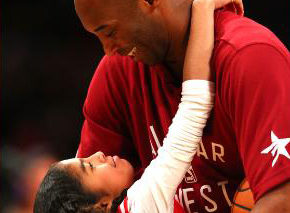
A Father and His Daughter

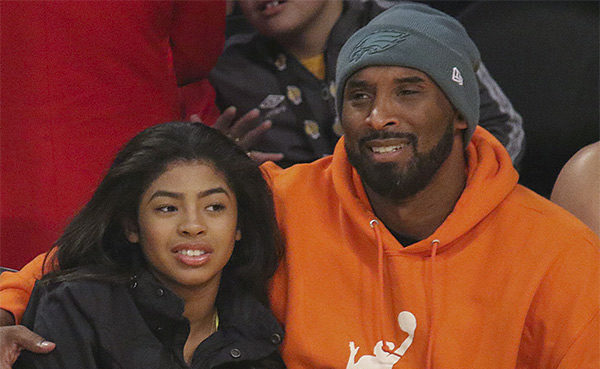
What hurts the most are all of the pictures of them together. The thing that strikes a nerve with me every time is the way he looks at her, the way that she looks at him. It bothers me because I know that look too well.


I had just come from a run. I took a shower and was sitting on my couch when my mother called me. She says, “Marlon, your sister just called me and said that Kobe Bryant died in a helicopter accident. Is this true?” I had no idea what she was talking about. At first thought, I figured my sister had gotten Kobe’s name in the news confused with LeBron passing Kobe on the all-time scoring list the night before. I told my mother, “Nah, he didn’t die. LeBron beat his scoring record is all.” With the intuition that all mothers have, mine replied, “Just check for me and call me back, okay?” Fine mom. I ended the call and went right to the Internet, typing “Kobe Bryant” in the search bar. The results floored me. Kobe Bryant, 41, dead after helicopter crash. TMZ was reporting it, so was USA Today, and MSNBC, and CNN. It was true. Kobe was gone.


He was one of us, not in the sense that we were cool with him or hung out, but in the sense of his presence and spirit has been a part of our social fabric since he was a kid. If you’ve been in any barber shop in this country on a Saturday afternoon, at some point you’ve listened to or engaged in the discussion about who was better, Jordan, Kobe or LeBron. Watched Moesha as a child? Kobe took Brandy to the prom in 1996. He was a Laker in an era when being a Laker was akin to being a Yankee or a Cowboy. He was one of the biggest stars on one of the biggest teams in sports. And he was a Black boy growing up in front of a nation of Black boys growing up. So, yeah, he was one of us.
I pulled myself together. I’m pretty good when it comes to death. I mean, I understand that life is fragile and that the thread between life and death is thin, sometimes too thin for the living to comprehend. I get that. As I’m heading to the car, a text comes through. It’s Sakina. She sends a screenshot of a TMZ report that reads, “Kobe’s daughter also killed in the crash.” I sat in the car, silent, alone. The thought of this beautiful child dying in this horrible crash was too much. I cried hard in my car for a few minutes and at the time I didn’t understand why.


There’s this thing with fathers and their daughters. It’s a love that cannot be explained with mere words. A father should be his daughter’s first love, the man that she will forever set as a standard, this human measuring stick pressing against the qualifications of all other men. But to a father, his daughter is the reflection of his love and commitment to life. She is the one who sits on his lap and listens to his stories. She is the one who eats his cooking, teaches him the new dance moves, sings with him in the car on the way to school. She gets his love wholly and without condition. I know, because I have two daughters. A man can love dozens of women, and not one of them will ever know the depths of his love in the way that his daughter does.

So, when I heard that Gigi was on the helicopter with Kobe, my mind immediately went to how I would feel on a helicopter with either of my daughters when it was going down. My only thought would be to protect her, to save her, to be her dad. It wouldn’t be about me, or about this failing helicopter, or about dying. It would only be about her, in that moment, saving her. We could go all the way down, crash and burn and my final thoughts wouldn’t be about me at all. That’s why I cried. I cried for Kobe because I’m so sorry that he couldn’t save his baby girl.
The whole world will find ways to celebrate the life of Kobe Bean Bryant. He was an incredible athlete and a champion. He impacted the lives of many. But I promise you, for some of us, we will remember his life in a different way. We will honor who he was by hugging our daughters even tighter, by being there for them even more, by holding on to that father/daughter love affair for as long as we can. #girldad

WHAT’S GOING ON


By Victoria Horsford

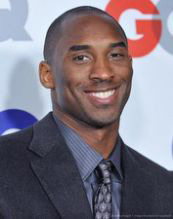
RIP: Kobe Bryant, 41, and his daughter Gianna Bryant, 13, died in a helicopter crash on January 26. An NBA legend and a sports icon who had basketball DNA in his gene pool. Born in Philadelphia, Kobe entered the NBA directly from high school in 1996, recruited by the Charlotte Hornets, who soon traded him to the LA Lakers, where he remained until 2016. He won 5 NBA Championships, was frequently voted MVP and was the youngest NBA player to reach 30,000 career points. Who doesn’t know about his prowess on the court? Kobe had impressive stats off the court as a businessman, investor, mentor, filmmaker and philanthropist. During his short but productive life, he became the greatest NBA player of his generation.

NEW YORK, NY
NYS Assembly member Inez Dickens presents the Second Annual Charles B. Rangel Leadership Awards Dinner Gala, themed: “Fighting for Working Men and Women.” Honorees include New York City labor and community leaders: Kyle Bragg, President of SEIU 32BT; Shaun D. Francoise, President of AFSCME – DC37; Greg Floyd, President of Teamsters Local 237; and H. Carl McCall, former chair of the State University of New York Board of Trustees who served as NYS Comptroller and NYS Senator. Gala will be held at Mist Harlem, located at 46 West 116th Street. Event proceeds will benefit Dickens For New York. [E-mail: Darren@dynamicsrg.com or call 212.531.2858]

Eric Adams


Former NYS Assemblyman and current Bronx Borough President Ruben Diaz, Jr., 46, one of the Latino rising stars in NY politics, was a 2021 NYC Mayoral hopeful, said that he will exit elected politics at the end of 2021 to become a private citizen and spend more time with his family, which includes two adult sons. Recent fundraising for his mayoral race were sluggish. It is a weird call for someone who has been in politics for much of his life.
Brooklyn Boro President Eric Adams attended the Dr. MLK Day celebration at Rev. Al’s National Action Network and addressed a largely Black audience. He railed against gentrification as the source of changing neighborhoods in Harlem and Brooklyn. He continued: “Go Back to Iowa, Go Back to Ohio. NY belongs to the people that were here and made it what it is” was a strange xenophobic message! Two days later, speaking at an Association for a Better NY Breakfast, frequented by a much whiter and more affluent audience, a contrite Adams said that his, “Go Back Gentrification comment was a gaffe.” The remarks have generated so many theories, the most often cited one is that Adams knows that the so-called “gentrifiers” will not be his voters and he was appealing to Blacks, Latinos and white small homeowners who can resonate to his comments. Adams’ remarks were made before Ruben Diaz withdrew from the mayoral race. Will the Diaz withdrawal deliver Latin votes to Adams? Is Adams a super strategist?

BLACK ENTERPRISE
History Professor Marcia Chatelain’s book, “FRANCHISE: The Golden Arches in Black America,” is an examination of the intersection of civil rights and the business community. Chatelain begins with narratives of the fast-food industry in the Jim Crow South and how and where Blacks were served. Then she examines the disruption that attended Dr. King’s death in Black neighborhoods and the resultant changes between Blacks and Corporate America. On the heels of the protests and eruptions after King’s death, there were escalating gasoline costs in the early ‘70s which transplanted fast-food eateries from suburbia to urban America, where most Blacks resided. That reality created an uneasy alliance between franchise operations like McDonald’s and Black consumers against the backdrop of new political realities. Many Blacks bought McD franchises in their neighborhood.

Carlos Swenson

Blvd. Bistro opened about 6 years ago at 239 Lenox Avenue at 122nd Street in Harlem and became an overnight success. Visiting Blvd. Bistro is like entering a world of comfort food delights like fried chicken and buttermilk biscuits, seven cheese macaroni, jumbo shrimps and grits, pork, Cajun Rib-Eye steak, just to name a few. Vegans are welcome to partake in its greens, yams and plentiful salad combinations. Owner/chef Carlos Swepson is the man behind the Blvd. Bistro gustatory pleasures. The new and much larger Blvd. Bistro is located on Frederick Douglass Boulevard at 116th Street. Reservations are suggested for Saturday and Sunday brunch. [Visit Boulevardbistrony.com]

ARTS/CULTURE
FINE ART: The Johnson Publishing Company Art Collection, valued at $1.2 million, will be auctioned at the Swann Auction Galleries in New York on Thursday, January 30. Online bids accepted. The collection includes works by artists like Carrie Mae Weems, Henry Ossawa Turner and Elizabeth Catlett. Auction proceeds will be used to pay back Desiree Rogers, former Johnson Publishing Company CEO, for $2.7 million in loans that she made to JPC. The JPC estate’s cupboard should be absolutely bare. Perhaps not, a John H. Johnson memoir is in order.

FILM: Last week, I attended a screening of “NATIONTIME – GARY, 1972,” a documentary shot at the National Black Political Convention on March 11 in Gary, Indiana, directed by William Greaves. “NATIONTIME” documents Black Democrats, Republicans, Black Panthers donning mountainous Afros, united and invoking the power of protest and the power of the ballot box. Considered too militant for American network TV consumption, “NATIONTIME” never got major distribution. The convention cast of characters included 13 Black congressmen, 70 Black mayors and eminences like Jesse Jackson, Coretta Scott King, Byron Lewis, Walter Fauntroy, Betty Shabazz, Dick Gregory, H. Carl McCall, Harry Belafonte, Sidney Poitier, Amiri Baraka, Barbara Jordan and gracious host, Gary’s Mayor Richard Hatcher.

Rev Dr. LeKeesha Walrond

FEBRUARY EVENTS
Harlem Fashion Week hosts a BLACK GIRL MAGIC Charity Gala which celebrates the accomplishments of transformational women, including Inez Dickens, NYS Assembly; Rev. Dr. LeKeesha Walrond, NY Theological Seminary; Sade Lythcott, National Black Theatre; Angie Hancock, Experience Harlem; and Kimberly Wilson Marshall, Wilson Marshall Public Relations. The candlelight, black-tie brunch is set for February 15 at 3:30 pm at the Museum of the City of New York, located at 1220 Fifth Avenue, Manhattan.

Woodie King’s New Federal Theatre celebrates 50 years of excellence in theater with a new drama, “TWO CAN PLAY,” a story about a lower-middle-class Jamaican couple who scheme incessantly to escape gun crime and violence and grab an opportunity to relocate to live in the United States. Stateside, they rediscover each other. Written by Trevor Rhone and directed by Clinton Turner Davis, “TWO CAN PLAY” stars Michael Rogers and Joyce Sylvester. Play will be housed at the Castillo Theatre, located at 543 West 42nd Street, Manhattan from February 27 to April 5. [Visit www.castillo.org or call 212.941.5800]

A Harlem-based media/branding specialist, Victoria Horsford can be contacted at Victoria.horsford@gmail.com.

Stanley Nelson’s Firelight Media Launches Fund for Mid-Career Filmmakers of Color

0

By Daniele Alcinii,
Realscreen.com


Harlem-based prodco Firelight Media, founded by Peabody- and Emmy award- winning filmmaker Stanley Nelson, is launching an international development fund for diverse filmmakers.

The William Greaves Fund, launching later this year, will offer financial and mentorship support to non-fiction filmmakers of color at the mid-points in their careers. The fund aims to ensure that talented storytellers remain in the field and continue to create important stories focused on underrepresented people and topics.

William Greaves


The William Greaves Fund will comprise of seven to 10 grants of up to US$25,000 annually, which will be used to finance research and the development of film treatments, decks, sizzle reels, and other materials necessary for fundraising.
In addition to financial support, Firelight will provide mentorship throughout the development and production process.

Throughout its inaugural year, the William Greaves Fund will be open to applicants based in the U.S., Mexico, Puerto Rico, Colombia and Brazil. In its sophomore year, the fund will expand to include filmmakers of color throughout Europe and in the Global South.
The call for proposals opens March 1.
Further information on the William Greaves Fund, including submission requirements, will be made available in the coming weeks.

The fund was named after William Greaves, who produced the seminal television newsmagazine Black Journal and 200-plus documentaries throughout his 60-year career.
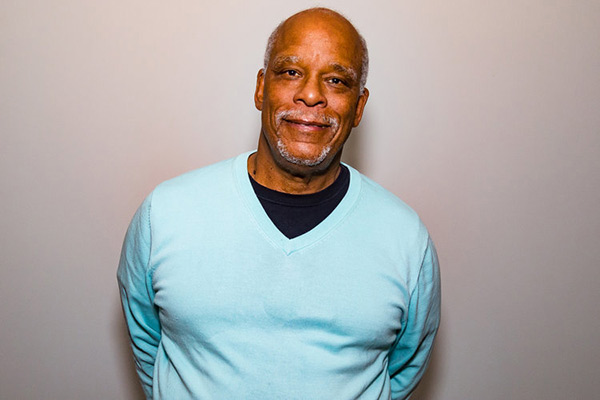
“I was lucky enough to have Bill Greaves as my first and most important mentor,” said Nelson (pictured) in a statement. “He was a giant in the documentary field who was generous enough to share his wealth of knowledge with younger generations. In creating our Documentary Lab program, I felt that it was vital to carry on his legacy of mentorship and I’m thrilled that we are now able to establish this new international initiative in his name.”

“Over the past 10 years, we have seen too many filmmakers of color have to completely abandon the field because they can’t get their next projects off the ground,” added Loira Limbal, SVP of programs at Firelight. “Even after producing award-winning feature documentaries and creating real world impact, they can’t garner the needed support. The William Greaves Fund is Firelight’s response to this persistent problem.”

Kobe Bryant: A Remembrance

0

Biographer Shares Thoughts on Kobe Bryant & Other Iconic Athletes

We phoned Brooklyn’s Boys & Girls High School alum Blaine Robinson for assistance in finding an expert on Kobe. In less than two hours, we were on the phone with Blaine’s friend and Bryant’s biographer Roland Lazenby. Amid dozens of interviews with print, broadcast and social media, Lazenby set aside 35 minutes to offer personal reflections on the Lakers star and other top athletes whose stories he has chronicled in best-sellers. Lazenby, a journalist, a coach and college educator, is the author of several biographies of top athletes in “Showboat: The Life of Kobe Bryant” “Michael Jordan: The Life,” and soon-to-be published “Magic Johnson: The Life.”
Bryant was in full dunk-mode in his NBA after-life: moving deeper into fatherhood and family, overseeing his Granity production company for which the Oscar and Sports Emmy winner won an Annie Award for his short film based on his poem, “Dear Basketball,” and his Mamba Sports Academy athletic training center. He gave tremendous attention to the homeless issue. Just before the accident, he celebrated his friend LeBron James surpassing him on the NBA’s all-time scoring list.

January 28, 2020, Los Angeles, California. Fans gather to mourn KOBE BRYANT outside the Staples Center in Los Angeles, Bryant, his daughter Gianna, and seven others were killed in a helicopter crash Sunday, January 26 near Calabasas, California. (Credit Image: © Justin L. Stewart/ZUMA Wire)


Lazenby offers other details in the vast legacy of The Black Mamba as a top scorer: Bryant, like his friends Jordan and James, are Black Power made real. Kobe, in particular, was driven by more than the career that publicly defined him. He authored a legacy plan long before he turned pro and a legend at age 18.
Following are excerpts of an interview with Roland Lazenby in Virginia conducted Sunday, January 26 by David Mark Greaves and Bernice Elizabeth Green (OTP), in Park City, Utah:

Roland Lazenby:Thank you for being patient. This has been a surreal time. This has come so fast … I learned about his death from my dear friend George Mumford, who was the great sports psychologist and mindfulness expert for the Chicago Bulls and then the Los Angeles Lakers. I introduced Mumford to Kobe, and he went on to become one of the greatest influences in Kobe’s life. Mumford and I were both stunned by the news. After all, Kobe was so much more than all the things he brought to the NBA.

Lazenby:Kobe was a culture wolf. He had tremendous creative abilities and gifts. He brought this sophistication into the League at 18, speaking several languages, having a global view, even a recording contract and more. He was a writer – in fact, his grandfather used to say to him, “Kobe, why do you want to be a sweaty basketball player? You could be a writer.” And he could!
But Kobe was paid millions by Adidas, the European shoe company, to turn professional right out of high school, the first high-school player to be offered such a major shoe deal. Soon products were being designed for him. There were players who’d been sweating it out in the NBA for years that got nothing close to that. All of that was driven by his creativity which he put aside to pursue his relentless goal, of being The Man, of being the greatest player ever.
The number one item on his agenda was to compete. I was there at the beginning of his career. He would always tell me, “I want to be The Man. I’m not going to let them change me. I’m not going to let them change my dream. I’m not going to let them break me. I’m going to get there!
“I don’t know how I’m going to get there. But I am.”

His answer to the question he posed when I first met him at the beginning of his career, was the one he already had been pursuing: to outwork everybody. Yes, we all work hard; we all talk about how hard we work. Kobe lived it. He over-trained constantly, even doing middle-of-the-night lifting sessions. Fortunately, he survived his overtraining. He cared at a deeper level. He was bold, brave, brash enough to say he was going to be great and then he did everything possible to prove it.
And, yes, he became The Man — as the most dominant figure in pro basketball.

OTP:You talk about how driven he was, and the competitive aspect. He’s also been repeatedly described as complicated.
Lazenby:He was immensely complicated obviously. He decided he was going to outwork everyone, as I said. I sat down with Michael Jordan in Orlando at the pre-draft camp. We were way up in the arena by ourselves talking about Kobe and I was just immediately struck by the great affinity and admiration. It was obvious what Michael obviously felt for Kobe. He told me, at that time, “You know we all have a path, and the people who came before us to light the way.” He said, “I did have all these talented people around me — but of everyone who I influenced, Kobe was the one who did the work.”
There’s a whole thing about Kobe’s narrative that’s misunderstood. A lot of people were angry with him when he announced that he was turning pro right out of high school because they thought he dared to want to leave the Charlotte Hornets to go to the Lakers and all these things. None of that was true. He didn’t know anything about that.
Sonny Vaccaro, the main basketball guy for Adidas admitted he began telling Kobe he was the “next Jordan” and so this was a whole thing with Adidas. A whole marketing thing. They arranged that trade. They offered millions — something they’d never done to a high school kid – for Kobe to turn pro right out of high school at age 17. Although Kobe’s father had played pro basketball for 16 years, the family needed the money.
So, as he signed the contract to go pro, Kobe looked at Vaccaro and said, “Mr. Vaccaro, is there a way my parents can have this money and I can go play college basketball?”
Tex Winter, the NBA assistant coach, who taught Michael the Triangle Offense, an offensive strategy he co-invented, said the difference between Kobe and Michael was that Michael had three years at the University of North Carolina at Chapel Hill.
(OTP note to readers: Below is the actual commentary from Lazenby’s Lakernoise blog:
A few years back, the Lakers coaching staff concluded Bryant and Jordan were much alike, almost eerie, in fact, when it came to the alpha male qualities of their competitive natures.
Kobe and Michael were ruthless when it came to winning, everyone agreed.
And their skills were similar.
Except Michael’s hands were larger.
The major difference between the two came with college experience. Jordan had played in a basketball system at North Carolina, thus he was better prepared to play within a team concept.)
Kobe was a super bonus baby. He was viewed as the kid cutting in line at the cafeteria. It created a tremendous void between Kobe and these grown men who were his teammates back in the day when the league was much older than it is now.

OTP:But there are complexities.
Lazenby:He almost destroyed his career. He had criminal charges [He had been charged with rape in 2003], conflicts with everybody, right and left. Perhaps all of this was a reaction to that pressure. The strength of character to rebuild that career after almost obliterating it – that to me is a remarkable human feat.

OTP:The languages, poetry, writing of the books — is that the thing that truly differentiates him from others?
Lazenby:I hesitate to say that because there are so many different narratives in sports. Each of these top players is a Black power story. Each story has its own narrative. These men are not just basketball players. They are large business and economic figures, cultural figures just adored globally, but they are also important figures in the long struggle culturally, racially in terms of justice in America.
LeBron James was born to a 16-year-old alcoholic mother reeling from deaths in her family. The man said to be LeBron’s father was murdered in a card game in 1994 when LeBron was just nine years old. He had none of the advantages. The big moment in LeBron’s life was when the family moved into public housing in Akron when he was 12 or 13.
But what LeBron has done stops you in your tracks. LeBron James, today, owns the NBA.
You don’t think of justice in that regard in terms of Kobe Bryant, who was a child of affluence. But each story is overwhelmingly impressive for different reasons.

OTP:Many of these athletes like Kobe bring something to not only the game, but to life – based upon their experiences.
Lazenby:Each player is a Black power story. Each of these stories has his or her own narrative. The narratives are not what people think they are about – “just basketball players.” We always make assumptions about each other. It’s just what we do. These players also are important figures in the long struggle for justice in America and changing things in ways that are profound.
I’m writing Magic Johnson’s biography now. My Jordan book was 700 pages. I spent time researching sharecroppers to get Michael’s story. Jordan is the richest Black man in the world. His great grandfather lived in an abject situation on the coastal plain of North Carolina.
These narratives run deep and offer displays of fierce character. These major NBA figures are not something that just happened. They are the products of generations and it’s always fascinating to put them into a larger cultural context. That’s what I try to do in these biographies, highlight the people in their families who came before them, people of immense strength and character who weren’t usually valued [during] those deeply racist earlier years.
We come to sporting events for the game, but we’re also seeking deeper meaning. We all are seeking “a better way.”
It’s fascinating to put these journeys of these top athletic figures into larger cultural contexts. That’s what I attempt to do. So, to me, Kobe’s remarkable feat is the strength of character he had to rebuild his career after it was almost obliterated.

Publishers’ note: After 20 seasons and five NBA titles with the Los Angeles Lakers, Kobe Bryant directed his energies to a quest, as he revealed in a CBS podcast interview November 2019, to “impact lives through storytelling.” He told Dana Jacobson, “Nothing in the world happens without a story.”