“Tell me again about the time when people ate fish from the sea, grandpa,” pleaded the 7-year-old sitting at the feet of his great-grandfather looking back at the 2020’s when he was a boy. That was before the year of the conversion, 2050. When the plastic equaled the fish and that was all the fish ate. “Couldn’t eat fish from the sea after that,” said the old man.
“Where did the plastic come from, grandpa?” came the inevitable next question. “Oh, it came from little stuff,” said his great-grandfather. “Instead of carrying a personal bag and utensils pouch like we do, they’d buy food held in a plastic container, get a plastic fork, knife and spoon, put it in a plastic bag, use it all once and throw it away.” “That’s terrible!” said the young boy grimacing, although he had heard stories like this before. “What kind of people would do that?” Oh, just regular folk. “Yes, there used to be elephants, and rhinos and polar bears even, now only animals to eat or pet.”
What kind of planet are we leaving for future generations? The projection is that by 2050, the mass of plastic in the ocean will equal the mass of fish. Every plastic bag from the bodega, Styrofoam clam packaging, plastic straws, knives, forks. Items picked up casually with a lunch at the office and then tossed, adds up to billions of tons a year that will be around for five hundred years.
This is not a far and distant future. 2050 is only 32 years away. Chances are if you’re under 50, this concerns you directly. This is a global crisis, that along with global warming, is another existential threat to life on the planet as we know it.
The young people marching against assault rifles will be even more at odds with the preceding generation that is leaving them with an overheated garbage dump of a planet to go along with the mountain of debt.
Gerrymandering and White Supremacy
Republican gerrymandering has produced enclaves of conservative whites holding on as best they can to the America where their supremacy was unquestioned.
The anti-gerrymandering decisions being made across the country in Pennsylvania highlight the problem with getting gun control legislation through Congress. The Republicans have been so successful at sculpting districts to fit their voting base that they are now trapped by the creature they created. The NRA speaks to that base about their passion and ownership of a gun. The thought of taking away their gun is like taking away their pet. That’s what they care about and that’s what they vote about. They are concentrated in these gerrymandered districts and the rest of the country can scream and stomp their feet and it will make no difference. Politicians want to be reelected and serving the people in these crafted districts is what will get job one done. The rest of the country be damned.
Districts conforming to geographic realities will provide a more diverse voting base where other voices can be heard, giving a moderating effect on extreme views. If the anti-gerrymandering process moves across the country where partisan district lines have been drawn, combined with the predicted “Democratic wave,” we can see another seismic shift in the direction of the country.
Mueller Marches on
The planet is being trashed and overheated while we are trapped fighting the personal delusions of the White House occupant. We can only hope and pray that the Democratic wave comes, and the Mueller investigation does not find that although Donald Trump is a despicable human being and arrogantly ignorant, he’s not guilty of any crime. Just a stupid man who hired bad people and we’ll have to wait until 2020 to get him out.
If you have not caught on by now, in the past boxing’s greatest fighters came from our great Borough of Brooklyn, New York. All-time greats who birthed the careers of great boxers such as Mark Breland, Riddick Bowe, Shannon Briggs, Paulie Malignaggi, Zab Judah and, of course, one of the greatest heavyweights of all-time “Iron” Mike Tyson. You also know what those boxers have in common? They were all World Champions and were at the very top during their prime. It has been a while since those great boxers have been in the ring. However, there is another up-and-coming boxer who is ready to carry the Borough of Brooklyn on his back and leave his mark on the sport as well. His name is Sadam “World Kid” Ali.
The 147-pound Ali, 24, has achieved much success early in his career thus far. In 2008, Ali finished in second place in the Summer Games. He is also a former 2-time Golden Gloves champion. Since making his professional debut in 2009, Ali has posted an impressive win-loss record of 26 wins with only one defeat, with 14 victories coming by knockout. Ali’s biggest victory of date was recently when he shocked the world by defeating the Puerto Rican legend Miguel Cotto last year at Madison Square Garden to capture Cotto’s WBO junior middleweight belt, his first championship as a pro. The fight was Cotto’s last fight and perhaps the “coming out party” for Ali, who is making a name for himself.
If Ali can continue this great success, he will be a part of the Mount Rushmore of great fighters to come out of Brooklyn. Ali’s next fight is expected to be another tough battle when he goes toe-to-toe with the gritty Liam Smith. This will be another great test for the young Ali, who has proven that he can handle the bright lights that come along with a big fight. If all goes accordingly and Ali can pull off a victory, there have been a few household names thrown around that could be potential matchups for Ali. Names such as another legend in Manny Pacquiao, Gennady Golovkin, Canelo Alvarez and fellow Brooklyn boxer Daniel Jacobs. Let’s embrace the moment and not get ahead of ourselves. Those names are currently some of the best in the sport of boxing today; however, who saw Sadam Ali defeating the great Cotto? It’s just another perfect example of how anything can happen in sports. Ali seemed ready and poised to be not only the current feature presentation to come out of Brooklyn, but the next best thing in boxing.
Sports Notes: We are currently a little over a month away until Opening Day for both the Yankees and Mets.
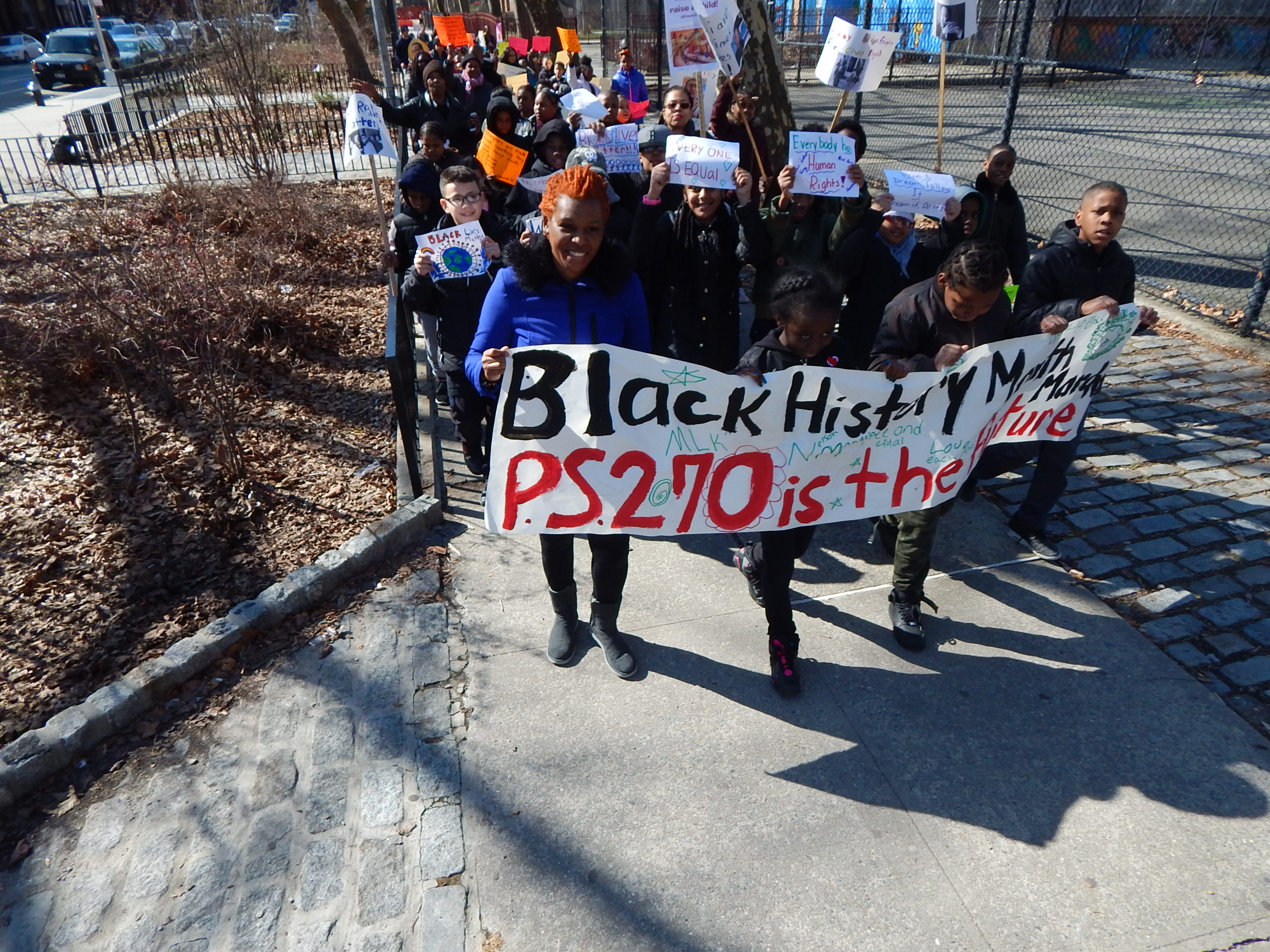
The future looks bright and we can see the signs – which earlier this week were being carried by elementary school students demonstrating pride in their heritage and respect for the forebears who inspire them. During their Black History Month Silent March on Tuesday, students from P.S. 270 walked the streets surrounding their Clinton Hill school with signs featuring the faces and words of heroic and visionary Black people.
Principal Alyssa Roye met with the Student Council, comprised of four fifth-graders, to discuss how the school would celebrate Black History Month this year. Council Treasurer Craig Stevenson proposed the Silent March, feeling it would allow the Pre-K to Fifth-grade students to share the wisdom and accomplishments of their people in an impactful way. The march delivered on its promise with student-created posters. It was moving, meaningful and powerful, and the children felt proud, not only of their history, but of themselves.
Hundreds gathered in memoriam for community activist and culture keeper Dr. Samuel Pinn, Jr. There was no shortage of positive reflection on the life of this highly revered community leader. Politicians, community leaders and clergymen alike all gave testimony to just how much of a community giant, literally (he was over 6 feet tall) and figuratively, Dr. Sam Pinn was. Even the founder of Black Enterprise magazine, Earl Graves, was in attendance and waved in honor of his childhood friend. As was evidenced by those who spoke and came to the memorial decked in their best African garb, Dr. Pinn was a force to be reckoned with and did great work for his community. Dr. Pinn has an outstanding resume filled with decades of much-needed and greatly appreciated community work and social activism.
Opening the memorial was a libation given in a Yoruba dialect. That was followed by a formal prayer where all were asked to bow their heads. Afterwards, longtime friend and mentee of Dr. Pinn, retired Assemblywoman Annette Robinson, remembered him as being a “gentle giant” who was both “loyal and reliable.” She also spoke on his work with Jazz966, a cultural arts program that he founded in 1990 while serving as the chairman of the Fort Greene Community Council. She concluded by saying that Dr. Pinn’s life was essentially “a life well-lived and a life shared.”
Retired Assemblyman and City Councilman Al Vann gave yet another perspective of just how impactful of a man Dr. Pinn was. In some ways, mirroring what others before him had said, Al Vann stated, “It is incredible what one person can do in a lifetime,” in referring to his friend. He also recalled Dr. Pinn being a fearless man who was the go-to guy “when we had a confrontation with the cops,” and that “in Sam I saw no fear, a courageousness, it almost scared me…never before had I seen someone so without fear in such a moment of great peril.” Like the Honorable Annette Robinson, former Assemblyman Al Vann also reflected on Dr. Pinn’s community work, noting specifically that, “He was the founder of a great community institution that still exists today, the Fort Greene Community Council, Inc.” Vann added that Dr. Pinn was instrumental in the creation of “senior citizen centers all across Brooklyn.” Assemblyman Vann concluded by saying, “Sam was a man of consequence…committed to improving lives of others. That’s how he lived and that will be his legacy.”
Sam Pinn’s son Gregory Pinn, also spoke highly of his father. Specifically, Gregory said that his father had been a “dedicated member to the fraternity Omega Psi Phi for over forty years.” Pinn’s son also remembered the “genuine camaraderie that he had with his brothers, Q’s and Omegas.” Shortly thereafter, in breathtaking fashion, Dr. Pinn’s fraternity brothers marched down the aisle of the auditorium where the memorial was held, in honor of their brother. They stood in a long line near the front of the stage and sung “Precious Lord.” The fraternity members present took turns reading personalized dedications to Pinn that varied in content. Some read dedication poems, others spoke to specific examples of how Pinn had touched their lives. From their tribute, audience members learned that Pinn joined Omega Psi Phi, Alpha Epsilon chapter, in Brooklyn, New York on May 9, 1970. Pinn was also described as being a “wise council” and full of enthusiasm. Another one of Pinn’s fraternity brothers likened his passing to a “pearl [that] had shaken loose to rise to even higher heights on Wednesday, December 27, 2017.” Several of the fraternity members said that Pinn was sincerely committed to his fraternity and “exemplified Omega’s cardinal values as a devoted husband, father and grandfather.”
Peggy Washington, a self-described niece of Pinn, sung a solo which she said was one of her uncle’s favorite songs, “The Wind Beneath my Wings.” Candace Pinn, Pinn’s daughter-in-law, spoke, reflecting on, among other things, how Pinn had “lived in the same house for 82 years.” Candace also reflected on Pinn being “super connected to his roots, a road dog, and the only child of his father.” She also spoke about his academic achievements, having been a recipient of the New York City public school educational system. For example, Pinn attended PS 70, JHS 35 and Erasmus Hall High School where he was a basketball star. Dr. Pinn also received a Bachelor of Arts in Sociology from Morgan State University, in addition to a Master’s in Social Work from Rutgers University. Candace also stated that her father-in-law had two Doctor of Law degrees. “Sam began his career in social services 60 years ago,” Candace recalled. Moreover, Pinn was the “coordinator of the Bed-Stuy Mayor’s Activist Task Force and the co-founder of the Black United Front,” added Candace. In general, Dr. Pinn was “against mob and police violence against Black people,” Candace said.
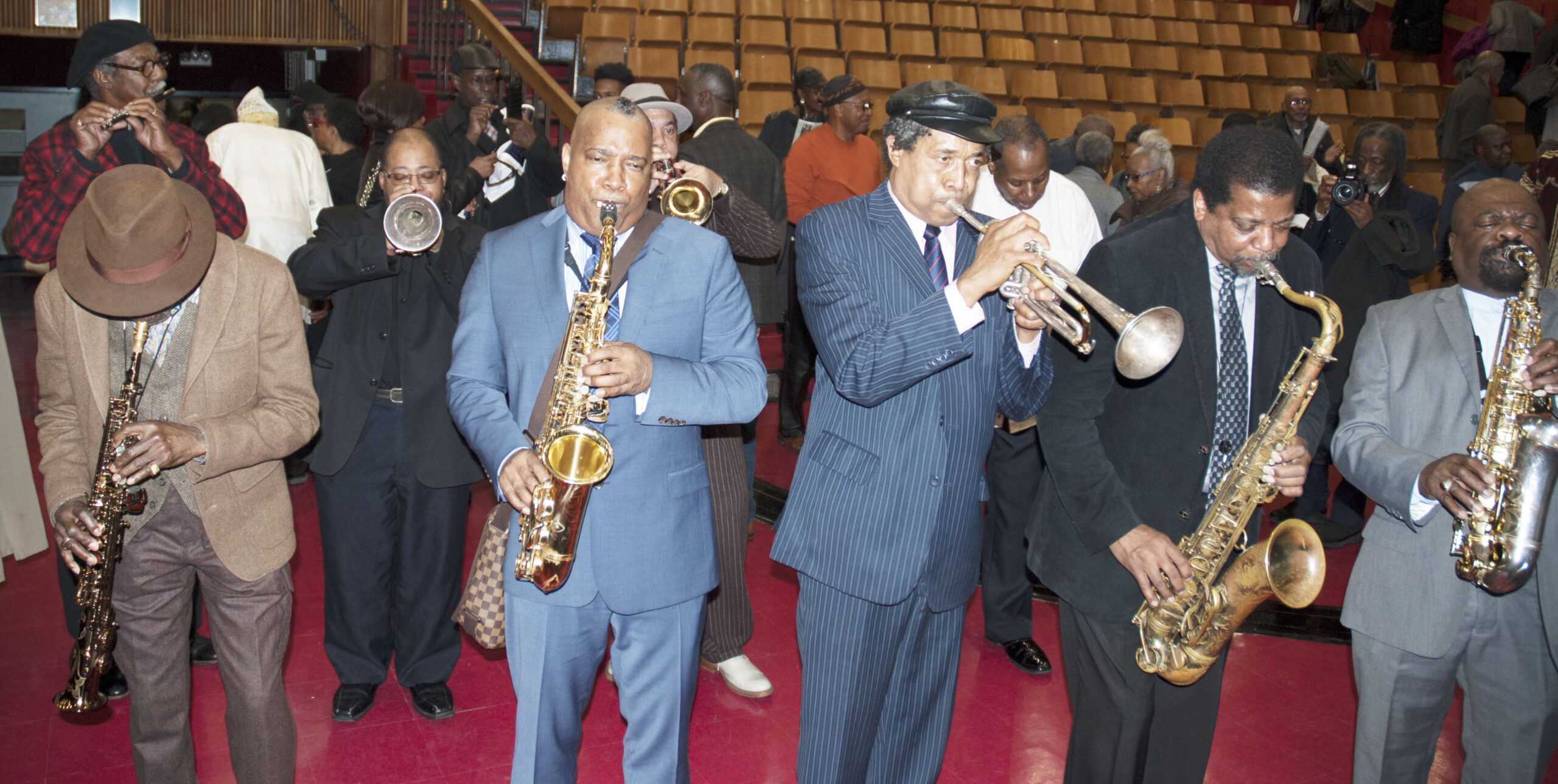
Drake Colley – Soprano sax – Leader of 2nd line. Photo: Lauryn Jackson 2018
Reverend Herbert Daughtry also spoke, having worked intimately with Pinn for many decades on several social activist and community upliftment efforts. He began his tribute with a popular rallying cry dating back decades ago, that he and Pinn utilized to mobilize community members to action. The chant went like this: “We’re fired up,” and many audience members responded, “Ain’t going to take it no more.” After a while, even those who may not be familiar with the chant, caught on and consequently the entire room was, fired up yet again all these years later. Rev. Daughtry reflected on Pinn’s work with the National Black United Front, in addition to his being an independent candidate for the state Senate. Rev. Daughtry also spoke briefly about the moment in history that ignited some of Pinn’s activist work, namely the killing of Randy Evans in November of 1970. In closing, Rev. Daughtry remembered getting news of his friend’s death and said, “If I had my way, every cruise, every school, every car would stop and revere Sam Pinn.” He added, “Some people never die, their memory lives on forever.”
Earl Graves, Sr., center, Founder of Black Enterprise Magazine. is accompanied by his son, Johnnie Graves, left, and Al Vann, former councilman. Photo: Althea Smith
The Honorable Letitia James, Public Advocate and community daughter to Annette Robinson, also gave remarks. She remembered Dr. Pinn being “a man of few words…sturdy, deliberate silence…did not have to fill up the air with empty words.” The Public Advocate also reflected on Dr. Pinn’s “quiet strength, steady gaze and warm smile,” and understanding that “the ties that bind us as a community must never be broken.” She also commented that “spirituality, religion, music and jazz” are all “central tenants in the life of African-Americans.” It is for that reason that Public Advocate James stressed that the Fort Greene Community Council, “a place where you breathe life into Black people,” must remain open. She concluded in saying about Dr. Pinn, in essence, “His legacy must continue, and we children of dreamers must protect these institutions… and [protect] Central Brooklyn against the forces that threaten to destroy us.”
Dr. Pinn also served for 34 years as an esteemed Professor at Ramapo College in New Jersey. As a representative of the college who knew of Pinn’s work, stated, “An endowment will be created in Dr. Sam Pinn’s honor and legacy” at the institution where Dr. Pinn worked for decades. Others that spoke and reflected on the glorious life of Dr. Sam Pinn include Wynton Marsalis, Jr., who gave a statement on behalf of his father, Wynton Marsalis, Sr. and NYS Regent Dr. Lester Young, Jr., who gave a statement on behalf of Dr. Adelaide Sanford. In addition to Pinn’s children and grandchildren, also present were Borough President Eric Adams, State Committeewoman Olanike Alabi, Judge Ellen Edwards, Job Marshariki, co-founder of Black Veterans for Social Justice, NYS Senator Velmanette Montgomery, Roger Green, Councilwoman Inez Barron and Assemblyman Charles Barron, D.A. Eric Gonzalez and Congressman Hakeem Jeffries.
Priscilla Mensah covers topics related to improving health, wellness and overall community empowerment. She is also a former Health Reporting Fellow at the CUNY Graduate School of Journalism and can be reached at pmensahbrooklyn@gmail.com.
On February 24, 2018 at Middle School 61 in Crown Heights, the community was invited to learn how to get their children accepted into Specialized High Schools (SHS). Specialized High Schools are the city’s most academically rigorous high schools that sets the majority of the enrolled students on a “lifelong success trajectory.” These high schools include Stuyvesant High School, Queens Science at York College; High School of Math, Science and Engineering at City College; Bronx High School of Science; Staten Island Technical High School; High School for American Studies at Lehman College; Brooklyn Technical High School; Brooklyn Latin; and the Performing Arts School at LaGuardia High School, which requires auditioning rather than examinations. A quick scan of names reveals that there is at least one SHS in each borough.
The key issue is getting more teens of color interested and prepared to sit for the Specialized High School Admission Test (SHSAT). AdmissionsSquad, Inc. CEO Tai Abrams was the moderator of the SHS panel discussion. Ms. Abrams is herself a graduate of Bronx Science and earned her Bachelor’s in mathematics from Duke University. Abrams sees the need to begin preparing for the exam in the 6th or 7th grades. “Families ought to keep their children one grade level ahead,” is Abrams advice. What it takes to get the students prepared is for their parents to allocate time to learn about the exam, obtain and, at least, thumb through the Specialized High School Handbook and have their teens take a diagnostic exam to see how they are currently scoring. The preparation and actual examination can be likened to what Olympic contenders faced recently. At first, the situation may have seemed insurmountable and one experiences failure. Yet, each practice develops a level competency until, similar to a snowboarder spinning in the air upside down, it is all second nature.
After being introduced on the auditorium stage, Tai Abrams began giving scholastic statistics. “In the 2016-17 school year, 52 students of color attended Stuyvesant High School, 85 students of color attended Bronx Science and Brooklyn Technical High School. Altogether, 637 out of 1 million public school students attend Specialized High Schools. What is the preparation to get children ready for the high school entry exam?”
The conversation opened up to include Sam Adewumi, a Brooklyn Technical High School teacher and an administrator at CASPREP; Ivan Khan, CEO of KhansTutorial.com and graduate of Stuyvesant High School; Eugene Thomas, a student at Brooklyn Technical High School; and Venus Nnadi, also studying at Brooklyn Tech. The panel discussion focused on the experience of students of color at SHSs. Both Eugene Thomas and Venus Nnadi stressed the need to be heard. “Being the 1% within a school, it’s important to have your voice heard.” Ms. Nnadi raised the possible awkwardness of discussing such books as Huckleberry Finn. Both of these scholars are overachievers. Eugene Thomas completed 11 AP courses and has been accepted into Yale. Venus Nnadi completed 9 AP courses and has been accepted at the University of Chicago. Ms. Abrams closed the panel by offering suggestions for promoting SHSs. Abrams believes using social media to promote going to the top high schools would be very effective as would presenting high school assemblies about SHSs as well as using churches and doctors’ offices as places to leave marketing material.
(The community meeting was part of a monthly series held by Assembly member Diana Richardson.)