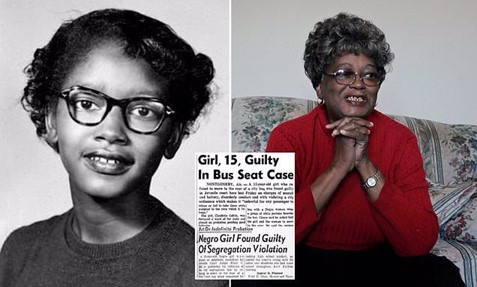
Last month, an Alabama family court judge granted Colvin’s motion to erase the 82-year-old civil rights pioneer record, clearing her name. On Nov. 24, Montgomery Court Judge Calvin Williams signed an order for her record to be obliterated, his office stated. “My reason for doing it is I get a chance to tell my grandchildren, my great-grandchildren, what life was like living in segregated America, in segregated Montgomery,” the trailblazer told the Montgomery Advertiser. “The laws, the hardship, the intimidation that took place during those years and the reason why that day I took a stand and defied the segregated law.”
Credit: Birmingham, Ala., Public Library Archives
Colvin’s attorney Phillip Ensler told the PEOPLE that he’s very grateful that Claudette’s reputation has finally been vindicated after several decades. “Our hope is that she is able to feel a sense of peace and relief. So many in Montgomery and those who believe in justice, freedom and equality throughout the world are moved by this monumental decision,” Ensler added.
Colvin was a 15-year-old student at Montgomery, Alabama’s Booker T. Washington High School in 1955. When she refused to give up her bus seat to a white person, police were called to arrest her. Her actions were inspired by Harriet Tubman and Sojourner Truth.
She earlier told PEOPLE, “I said, ‘I’m not getting up. It felt as though Harriet Tubman’s hands were pushing me down on one shoulder, and Sojourner Truth was pushing down on another. History had me glued to the seat.” She’s made it clear that she’ll remain committed to her clamor for criminal justice reforms in the United States even after her historic victory.
“Double standards still exist in the judicial system,” she told the Montgomery Advisor. “One set of rules for African Americans, and another set of rules for Caucasians.” Colvin was well aware that her actions may have startled some people at the time, but she was equally aware of their importance.
Photo top: Claudette Colvin is seen here as the15 year-old student who refused to give up her seat to a white passenger and was arrested, and now celebrates her 1955 record being expunged. Photo right: Credit: Birmingham, Ala., Public Library Archives
The existence of a school-to-prison pipeline for African-American students across the country has been well-documented by the NAACP Legal Defense Fund and many others. In fact, the largest educational sewer line is running right here in New York. The LDF report on the problem says that “The New York City Department of Education’s ‘Impact Schools’ program is among the most aggressive and explicit School-to-Prison Pipeline policies in the country. Borrowing methodology from the New York City Police Department, schools perceived to have the highest levels of ‘crime and violence’ are labeled as ‘Impact Schools’. A report by the Drum Major Institute for Public Policy shows that the Impact Schools suffer from significant resource disparities, including severe overcrowding and lower per-pupil expenditures. Rather than address the educational inequities that contribute to negative student conduct, the policy floods these schools with police officers and surveillance equipment. As a result, an alarming number of students are removed from their schools and placed in suspension centers, alternative schools and juvenile detention facilities.” These methods of social control originate in the slave codes and the overseer’s whip. A better path to a disciplined learning environment is one that winds its way from those who taught in secret, using a tree stump for a desk, and students with literally nothing except their passion to learn. This is the wellspring of the recommendations in the reports the Commission on Students of African Descent issued between 1994-98 to the New York City Board of Education. We’ve reprinted this summary of the reports, because as this school year begins, we should be doing better than having our children taught only to the test and that done with armed guards walking the halls. After the sacrifices they had made, our ancestors expected better of us. – David Mark Greaves
By Dr. Donald H. Smith Introduction The Commission on Students of African Descent was authorized by the New York City Board of Education, June 22, 1994, based on a resolution introduced by board members Dr. Esmeralda Simmons, director, Center for Law and Social Justice, Medgar Evers College, and Dennis Walcott, president and chief executive officer, New York Urban League. The board’s adoption of the resolution came at the urging of a number of organizations concerned with the welfare of people of African descent. Among those organizations, the African-American Leadership Summit played a prominent role. Members of the Commission were appointed jointly by the Board of Education and Chancellor Ramon Cortines and included public school and university teachers and administrators, parents, students, representatives of civil rights organizations, business persons, corporate executives and a member of the City Council. Board members Simmons and Walcott were among the appointees. Chancellor Cortines’s successor, Dr. Rudolph Crew, later appointed additional members.
The Commission’s purpose is to make recommendations to enhance the achievement of students of African descent, to include policy recommendations in such areas as curriculum, staffing, professional development, parent involvement and resource equity. The Commission held its first meeting November 21, 1994. Dr. Beverly L. Hall, Deputy Chancellor for Instruction, New York City Public Schools, and Dr. Donald H. Smith, Associate Provost and Professor of Public Affairs, Baruch College of the City University of New York, were elected co-chairs. Upon Dr. Hall’s assuming the Superintendency of the Newark Public Schools in 1995, Dr. Smith was elected chair and remained in the leadership until 1998 when Galen Kirkland, Executive Director of Advocates for Children, was elected chair. During its four-year existence, the Commission has met monthly to discuss public education issues, to hear reports from various officials of the public schools, including the several chancellors and deputy chancellors, the State Education Department, university personnel and a member of the State Board of Regents, to formulate policy recommendations. The Commission has also issued position papers and press releases on such topics as school safety, school vouchers and social promotion.
The Commission has authored three reports: Professional Development for Teachers and Administrators of Students of African Descent; Curriculum and Instruction to Support Academic and Cultural Excellence; and Improving Family and Community Relationships. These topics were selected because the Commission believes that each represents a critical element in the achievement of students of African descent. Well-trained educators, familiar with and supportive of the culture of the students, curriculum which celebrates their heritage and inspires high academic achievement and family and community encouragement, are key factors in producing students who excel in school and who feel good about themselves. Students of African descent are capable of high levels of academic achievement, yet few of the children and youth of African descent reach these levels in the New York City Public Schools. They are most often relegated to the lowest-achieving, underserving schools in the city. Their schools represent the highest number of SURR (Schools Under Registration Review) schools in the state and they are taught by the greatest number of uncertified teachers. The Commission holds teachers and administrators responsible for high levels of achievement of students of African descent. The Commission insists that schools must provide educational experiences that facilitate lifelong academic, technological, psychological, cultural and physical development. The professional development we advocate for educators, the curriculum imperatives we urge and the family-community partnerships we suggest will help teachers and administrators fulfill that responsibility.
Draft copies of the reports were circulated to educators, parents, students, politicians, clergy, businesspersons, community and civic organizations. Public forums were held to receive input and recommendations from these groups, and the final reports reflected this input. The Professional Development report was printed and circulated throughout the country, including all members of the New York City Board of Education, New York State Board of Regents and superintendents of major school districts in New York State and throughout the country. Response cards were included in the mailings. All responses were favorable, with the greatest number coming from educators in the State of Texas. There has been no official response from the New York City Board of Education. The other two reports have not yet been printed for circulation. This paper synthesizes the conclusions and recommendations of the three reports.
The report discusses the urgent need for restructuring professional development, including higher education and district-level programs for educators in the New York City Public Schools. Importantly, the report develops profiles of expectations for students, teachers, principals and superintendents. In the case of students, the profile specifies the knowledge, skills, attitudes and characteristics students might be expected to have achieved by completion of the twelfth grade. For teachers, principals and superintendents, the profiles detail the kind of training and credentials these professionals should possess in order to be effective with students of African descent. Traditional approaches to professional development have proved ineffective in meeting the needs of most students of African descent. Too often, there has been a reliance on remediation and strategies corresponding to a perceived condition of student deprivation and Hilliard’s critique of contemporary views about teaching and learning for students of African descent contends that they are said to be more retarded, more emotionally disturbed, more learning disabled than others. Families are said to be dysfunctional, as are the communities from which students come. As a result, remedial education strategies take on the character of therapy, externally designed and implemented. Children are seen as culturally disadvantaged and distorted problem definition, and without recognition or respect for African ethnicity, it is impossible to pose valid remedies for low student achievement, including the design of valid teacher education.
Approaches emphasizing remediation and/or treatment of these interventions have failed to contribute in a substantial way to the attainment of academic excellence overall. In addition, notions of student deprivation and risk are philosophically at odds with the conviction that despite research evidence to the contrary, educational practices often serve to perpetuate the pernicious myth that students of African descent cannot be held to the highest standards of academic success. The assignment of the least-qualified teachers to schools with a majority of students of African descent, and the disproportionate numbers of students of African descent trapped in provide a stark measure of the low level of expectations of what students can achieve. Students of African descent make up more than half the enrollment of New York City’s Public Schools. Their collective educational experiences are replete with many examples of outstanding achievement, of perseverance and determination, and of hard work. But the educational experiences of students of African descent also reflect a tragic story of reports institutional paralysis in the face of the need for change. The themes of this story are neglect, apathy, indecision, inadequate funding for educational and cultural programs, and the well- entrenched legacy of enslavement, racism and low expectations regarding what students can accomplish. That so many students have achieved success in the public schools is a mighty testament to their resilience and strength. Yet, in spite of these successes, public education has exacted a heavy price from the great majority of our children. They have learned, through years of exposure, to master challenging course content. They have learned African heritage is neither valued nor respected; through years of inculcation, that their culture is not considered worthy of inclusion in the curriculum; that the content and methods of education bear little relationship to their life outside the classroom. They have been taught that they must suppress most expressions of their cultural heritage in the classroom.
Recommendations The Board of Education should reorganize professional development at the Central office. Adequate funding and staffing must be provided. The Board of Education and the Chancellor must give direction and resources to the professional development training in the 32 community school districts, as well as high school superintendencies and citywide programs. Central to the professional development of teachers, principals and students is significant knowledge of the history and cultures, and, in the cases of Caribbean students, languages of students of African descent. The Chancellor should meet with deans of education at CUNY, Columbia, Fordham, Bank Street, New York University and St. John’s to discuss the reconstitution of their undergraduate and graduate programs, with special emphasis on the above-described history, cultures and languages of students of African descent. The Board of Education should establish programs to help teachers obtain certification. Special efforts should be made to increase substantially the numbers of teachers and administrators of African descent. Particular attention should be given to the recruitment of educators with Caribbean heritages. The Board of Education should redistribute resources so that elite schools such as Bronx High School of Science and Stuyvesant do not receive a disproportionate share while schools with greater needs are deprived. The Board of Education should utilize the richness of community resources to supplement classroom instruction. This would be particularly helpful to deal with a population of schools whose staffs lack the linguistic skills to deal with a population of nonnative speakers of English or non-standard English.
The report argues that the achievement of students of African descent can be improved through partnerships between families and communities in collaboration with the schools. The report provides current information about New York City families of African descent; describes the long and painful struggle fought by parents to gain respect and recognition for themselves, their children and their communities and influence decision making within the New York City Public Schools; and makes recommendations for improving and strengthening relationships between schools and families. Research has shown that students at all grade levels do better academically and have more positive attitudes toward school when their parents support and encourage school activities. For example, in Family Life and School Achievement: Why Poor Black Children Succeed or Fail (1983), Reginald Clark studied low-income families of African descent, all of whom lived in Chicago public housing projects during the 1970s, and compared data from households whose students were successful in school compared to households whose students were not successful. Clark concluded that parental beliefs regarding their own role in their children’s schooling, parental expectations for students’ behavior at home, the regular occurrence of family discussions on school issues, the extent to which students completed homework, and the extent to which parents participated in home social activities with their children were all positively related to high educational performance. These values were far more important than characteristics such as family income, ethnicity, parental education and parental marital status. Clark believes activities and overall cultural style, not the family units’ composition or social status, children for academic, social and cultural competence. Other researchers have found that parental alienation from schools is a factor contributing to diminished performance by children of African descent. James Comer, Yale psychiatrist, asserts: social and cultural gap between home and school may lie at the root of the poor academic performance of these [poor, minority] children. poor parents of African descent in New Haven, Comer concluded: The need for parental participation is greatest in low-income and minority communities, or wherever parents feel a sense of exclusion, low self-esteem and/or hopelessness. Parents are the first and most important models and teachers of their children. If parents feel excluded, of little value and hopeless, they will be likely to transmit these attitudes to their children. Such attitudeshave behavioral consequences that are the opposite of what is necessary for good school learning or the achievement of long-range goals.
Educational reformers are increasingly more convinced that closer relationships among families, schools and communities are essential for improving student achievement and the quality of education offered in public schools. Communities serve as a third overlapping sphere of influence along with the family and school on children’s development, learning and success in school and later life. School staffs need to find ways to work more closely both with parents of color and with parents with little formal education and their community organizations and resources. Community organizations and institutions can provide valuable information and services needed by children, families and schools.
Although parent involvement is widely acknowledged to be an important factor in children’s achievement and the operation of schools, few comprehensive parent-involvement programs have been implemented. There are many different reasons why few teachers and administrators take any action toward this goal, even though most seem to agree that increased parental involvement is desirable. First, very few professional educators ever receive any formal education or training to help them work with families and so while they express support for partnerships, many don’t know where to begin or what to do. Second, unless improved schools are participating in a specially funded initiative, they rarely receive additional resources to support any parent-involvement activities. In New York City, money for public education has decreased at the same time that pupil enrollment is growing. For education professionals, spending money for parent-involvement activities has lower priority than using within the scarce funds for new textbooks or additional staff to reduce class size. In addition, many educators already feel overburdened and are concerned that increased parent involvement will mean more work for which they will not be compensated. Finally, many educators are reluctant to give up any formal power or authority to parents who want to participate as equal partners in school governance or decision-making.
Unfortunately, stereotypes and false assumptions about families of African descent exist and influence educational thinking and planning, thus making it difficult for educators to respect and accept parents as equal partners in educational endeavors. The history of relationships between parents of African descent and the New York City public schools has been especially painful.
The historic exclusion of and apparent disdain for parents of African descent by the New York City Public Schools finally reached a crisis and open rebellion by African-American parents in 1966. The Board of Education had promised to promote integration by building new intermediate and high schools in fringe areas shared by white and black neighborhoods. When the Board opened a new school, I.S. 201, in the middle of Harlem, parents and community exploded. Despite decades of demanding integrated schools, accompanied by several citywide boycotts, it became obvious to parents that the Board of Education had no plan to desegregate the public schools and probably had little interest in improving education for their children. Out of community rage, the Community Control Movement was born. Instead of trusting the Board of Education to improve their schools, parents and communities of African descent demanded that they be given control of their schools. As a result, three experimental community-control school districts were established, I.S. 201, Two Bridges and Ocean-Hill Brownsville.
In 1969, the state legislature decentralized the New York City Public School system, creating 32 community school districts which were given primary jurisdiction over elementary and junior high schools. High schools and certain citywide programs remained under the Central Board. Though the intent was apparently to make the school system more responsive to the concerns of local communities, the increase in parent involvement failed to occur at a significant level. For one thing, the Central Board continued to determine and control community district finances. In addition, parents were frustrated as they sought to influence community school board elections, which were controlled by special interest groups in and outside of the community.
The distrust and animosity among parents of African descent, community groups and the public school system which escalated during the 1960s, continues to exist today. In public h with hearings and meetings held by different organizations across the city, parents of African descent still report that school employees systematically resist their efforts to be informed and involved.
Parents of African descent still struggle with wide-scale institutional racism as well as individual acts of discrimination by the school system. Three reports by ACORN, a community activist group, document how parents of color are frequently denied information about school programs, that they were treated differently than white parents seeking the same information or opportunity to enroll their children in special programs. The work of the ACORN researchers makes it clear that both policies and practices discriminate against parents of color and their children in the New York City Public Schools. New legislation was enacted by the New York State Legislature in 1996 amending the law which had governed the New York City Public Schools since the school system was decentralized in 1969. The new law requires that every school have a parent association. In addition, each community school district, high school region, and the citywide special education district is required to establish a Presidents’ Council, composed of presidents or designated parent members of each parent association in that district or region, to ensure that parents are represented on a district and regional basis. Yet such an effort to empower parents hardly addresses the de facto discrimination which exists within the system.
There have been Central Board initiatives to involve parents. Chancellor Richard Green established the first Office of Parent Involvement in the late 1980s; the OPI was given cabinet-level status by Chancellor Joseph Fernandez and was combined with the Office of Student Advocacy and the Office of Community School District Affairs. In July 1996, the present Office of Parent Advocacy and Engagement was created under Chancellor Rudy Crew to intensify the work done with parents to help children become academically successful. Parent Advisory Council, a citywide parent group composed of Presidents’ Council representatives from each community school district, high school superintendencies and citywide special education, meets monthly with the Chancellor and Board of Education administrators. The report also lists a number of community organizations and resources which serve as parent advocates. It remains to be seen whether the 1996 state legislation and the various efforts of the Central Board will result in parents having real power in school decision-making. The Commission on Students of African Descent will continue to monitor parent and community partnerships and their effect on the education of children of African descent.
Recommendations The Board of Education should provide staff development for teachers and administrators to acquire the skills and knowledge necessary to work with parents. This would include knowledge of the history, cultures and languages of the communities. The Central Board should provide parent associations with clerical and other assistance which will permit associations to conduct effective outreach and communication that will assist working parents to be involved in a meaningful way. The Central Board should facilitate the involvement of community-based organizations which, in turn, can support school and parental efforts to improve schools. Community organizations also provide a range of services that support families and that foster readiness to learn in children. The Central Board has the responsibility to implement the training of parents in all schools to be advocates for the improved learning of their children. The training should be planned and conducted with the involvement of school-parent associations. Such training should be conducted at the beginning of each school year and be reinforced throughout the year.
The Central Board should address discrimination and institutional racism. An analysis of recent reports, such as those done by ACORN, makes it clear that the institutionalized racism which has plagued the system since its inception, still exists and, as times change, has even taken on new forms. Failure to address these issues will result in continued strained, even painful relations among parents and community groups and the public schools.
The central thesis of this report is that students of African descent must receive instruction by means of a curriculum that stimulates high academic achievement and at the same time corrects omissions, distortions and untruths about their history and culture. High standards for learning must be accompanied by curricular and instructional practices that enable students to develop high levels of academic knowledge and social skills and that help to cultivate both knowledge of and respect for the integral role that Africa and people of African descent have played in the story of civilization. This role does not diminish the contributions of other regions and peoples. The centrality of Africa and its Diaspora in world civilization is a legacy that has been stolen from all in the last 300 years. It is this stolen legacy which robs not only students of African descent, but all students of the true history of the world’s development. For students of African descent, the restoration of their history is an essential element in the development of self-esteem, a belief in the worthiness of their ancestors, in their families and communities and in themselves as capable worthwhile individuals.
Academic and cultural excellence are the twin pillars of healthy intellectual development. Cultural excellence must include a focus on the centrality of African history, culture and civilization as a basis for modern society; the valuation of the culture and learning styles of students of African descent; and the alignment of curriculum content, materials and instruction with accurate scholarship. The curriculum must help students to examine the truth about history and culture, and about inaccuracies, and provide an understanding of the historical violence to which people of African descent have been subjected. Throughout America’s history, schools and “so-called” scholars have helped to shape negative racial stereotypes and images of people of African descent. In the introduction to Rethinking Schools: An Agenda for Change (Levine, et al, 1995), the editors write: Public education in our country has been marked by a cruel gap between rhetorical commitment to democratic ideals and practices that foster intolerance and inequality. This disparity results from both the failure of schools to educate against prejudice and discrimination that emerge from the larger society, and their active complicity in reproducing unequal relationships. Rigid ethnic, racial and gender roles and stereotypes have frequently been promoted by school cultures and curricula.
Schools perpetuate historical and cultural inaccuracies regarding the alleged superiority of some groups and the alleged inferiority of others. In particular, schools reinforce the myth that Africans and people of African descent have contributed little to world civilization. Varied and numerous attempts to redress historical inaccuracies and racial biases in the curriculum have usually been met with vigorous resistance, for example in the cases of the Curriculum of Inclusion and One Nation, Many Peoples, both attempts by the New York State Education Department to create new elementary and secondary school frameworks, well-financed campaigns were orchestrated to prevent the State from making the changes suggested by the task forces which created these reports.
Despite the preponderance of scholarship to the contrary, Africa and its Diaspora have been consigned a peripheral place in the story of civilization. Many critics of an African- centered approach to teaching and learning attack the scholarship which underlies the approach without acknowledging the many distortions, omissions and untruths pervasive in the existing curriculum. Rather than to convey respect for the role that Africa has played in world civilization, school curricula and the media have often portrayed Africa and African culture with disdain. Africa has been called the “dark” continent. In this context, the people of African descent frequently viewed themselves and are viewed differently than they would be if the truth about Africa were acknowledged and affirmed. Not only in New York City and in New York State, but throughout the nation curriculum and instruction must undergo major revision to the benefit not only of students of African descent but all students. America will never realize its potential to be a great nation until it can come to grips with the disparity between the noble goals and preachments of its sacred documents, the Declaration of Independence and the Constitution, and the actual practices of racism and discrimination in the society, mirrored and fostered in the schools’ curricula.
Recommendations The Commission expects that all educators and school personnel who serve students of African descent have high expectations for their students as academic achievers and for themselves as adults capable of instructing high levels of achievement. The Commission endorses the recommendation of the National Alliance of Black School Educators Task Force on Black Academic and Cultural Excellence that a study be conducted of the school curriculum systematically and in detail in all subjects and grade levels to determine if the treatment of Africa and its diaspora is truthful, appropriate and adequate in light of recent scholarship. Information concerning Africa’s primary role in developing civilization, in science, mathematics, religion, politics, and the arts should be interspersed throughout the school curriculum, not solely as a separate, subordinate appendage. The Commission recommends that the Board of Education compile and examine the data reflecting the extent to which students of African descent are suspended, referred for disciplinary action, and placed in remedial and special education classes. Further, the Board of Education should intervene when there is evidence of inappropriate policies and procedures.
The Commission recommends a more extensive system of diagnostic testing to ensure that students are not inappropriately referred to special education. The report of the National Alliance of Black School Educators’ Task Force on Black Academic and Cultural Excellence underscored the importance of considering linguistic patterns as a variable in evaluating the validity of testing programs. The Board of Education should also convene a task force to conduct a review of research on effective strategies and approaches to ensure academic and cultural excellence. Promising models and strategies should be disseminated throughout the system. The Board should also undertake pilot projects to replicate, document and disseminate successful models and approaches.
Throughout the city, there are numerous examples of individuals who possess the knowledge, skills and attitudes required to bring out the best in students. Often, these individuals labor in anonymity. The Board of Education should undertake to identify educators and schools with a demonstrated record of fostering high levels of academic and cultural excellence among students of African descent in order to develop a pool of resources for school improvement. All children need role models in the school who reflect the diversity of the city and nation. The New York City Schools Chancellor should implement initiatives to recruit educators of color at all levels of the public school system. Students of African descent speak a number of languages and dialects. Nonnative English-speaking students often require support that is beyond their school staff to provide. The communities from which these students come offer a rich though underutilized educational resource that can provide various assistance and support. The Board of Education should research and publish a directory of community organizations and institutions that can be utilized by educators to respond to the unique needs of students whose first language is not English.
Currently, there exists a dual system of public education in New York City. One system, ÿincluding the elite schools (for example, Bronx Science and Stuyvesant), receives a disproportionate share of resources. Another system is characterized by substandard physical plants, outdated textbooks and curricula, and inadequate laboratory facilities. The Board of Education should immediately redistribute funding and other resources to insure that schools with the greatest need receive the greatest level of support. Schools should offer all students the opportunity to take rigorous courses in mathematics, sciences and computer technology.
The Board of Education should support efforts to identify curricula which accurately encompass the contributions of Africa and Africans throughout the Diaspora and distribute this material as part of professional development activities. The Board of Education should ensure that teachers, administrators, parents, students and others receive information about the new standards and how they will help students to achieve academic and cultural excellence.
NY STATE OF MIND NYS Attorney General Letitia James, abruptly suspended her 2022 NYS Gubernatorial campaign, a wise decision, and will focus on her 2022 re-election campaign. Her decision will alter the race dramatically since many attorneys would not compete with her. Professor Zephyr Teachout has already withdrawn from AG race.
NEW YORK CITY: Eric Adams is back from his spiritual journey to Ghana where he received a hero’s welcome and a new name. His first high level appointment is Dr. David Banks, who will be NYC School Chancellor. Veteran educator and co-founder of the Eagle Academies,
Dr. Banks said that NYC education culture is fundamentally flawed, and he looks forward to transforming it. Some thoughts for Chancellor Banks: Change name of DOE. Look into more parental engagement in public school curriculum. Find out what happened to almost 200,000 students who disappeared from the DOE roster during the COVID school year. Abolish separate entrances to schools, one for whites, the other for Black and Brown students. Eliminate the $450 per diems for retired principals and other DOE minions. Make reading competency a first-grade imperative.
The NY Post broke the story about Mayor-elect Eric Adams appointing Keechant Sewell, 49, NYPD Commissioner. Sewell is the Nassau County, NY Chief of Detectives. She becomes the first woman to helm NYPD in its 176-year history. She will also be the third Black American named to NYC’s top cop spot. The Nassau County police force is composed of 2,400 uniformed officers while NYPD has 35,000 uniformed personnel. It is America’s largest police department.
Rumors persist that former NYPD brass, Phil Banks, David’s brother, will be named NYC deputy mayor of Public Safety. Question! What motivated two highest ranking Black American NYPD brass, Ben Tucker, 70, who is #2 as Deputy Commissioner and Rodney Harrison, 52, who is Chief of Patrol, to submit resignations effective 12/31. Last week, the NYC Council passed legislation to legalize voting for non-citizens, about 800,000 people, in local elections: mayor, city council and public advocate. Biggest beneficiaries of non-citizen voting would be New York’s Dominican and Asian American communities. Less than 1.1 million NYC residents voted last month. The non-citizen local voting initiative is a practice in Vermont and Maryland. Wonder if it will become an epidemic and flourish in states like Texas, Georgia, and Florida. The NYC Council Speaker race is fluid.
Queens Council member African American Adrienne Adams is new front runner, in the City Council Speaker race. Her rivals Justin Brannan, Diana Ayala, Keith Powers and Gale Brewer announced their support for her. That dashes hopes for Latino Council member Francisco Moya, whom Eric Adams insiders have been quietly arm twisting Council members to elect. Latinos insist that Speaker must be Latino.
ARTS AND CULTURE FINE ART: The Metropolitan Museum recently established the James Van Der Zee archive in partnership with the Studio Museum in Harlem and Donna Van Der Zee. The archive comprises 20,000 prints and 30,000 negatives. The Harlem-based Van Der Zee (1886-1983) is a world-renown African American photographer, the chronicler of Black American life during the Harlem Renaissance and beyond. The Skoto Gallery’s new exhibit MASKED HEADS, which includes 14- mixed-media works by Nigeria-born artist Osi Audi runs through January 8. Audi investigates mask wearing as a Covid 19 preventative. Located at 529 West 20 Street, Skoto can be reached at 212.352.8058.
THEATER: The 2021 Broadway season witnessed the launch of seven works central to Black Americana. THOUGHTS OF A COLORED MAN; CHICKEN AND BISCUITS; CAROLINE, OR CHANGE; SISTAS; SKELETON CREW; TROUBLE IN MIND by Alice Childress; CLYDE’S by Pulitzer Awardee Lynn Nottage. MJ THE Musical, about Michael Jackson, is in preview. Tickets are on sale for the Ntozake Shange classic, FOR COLORED GIRLS WHO HAVE CONSIDERED SUICIDE WHEN THE RAINBOW IS ENUF, which opens March 2022.
MEDIA MATTERS: Olympian gymnast Simone Biles named Time Magazine’s 2021 Athlete of the Year. Biles and fellow Olympians agree to a $380 million settlement for victims of sexual abuse by former team physician Larry Nassar…… Wendy Williams is missing in action for the new season of her eponymous TV Show. She is disabled because of health issues. The show has had a weird assortment of guest hosts, mostly whites, women and men, including Michael Rapaport, Jerry Springer and Steve Bilkos. Huh? Ratings are sinking. Sherri Shepherd, is the one standout guest host to date and had ratings surge to prove it. Perhaps, it is her Black girl magic. She is witty, telegenic, and addictive. She should be permanent replacement host until Wendy returns.
NEWSMAKERS The winter solstice begins and Capricorn birthday greetings to NYC Chancellor designate Dr. David Banks; Bill Burgess, Bill Burgess Group; executive search Attorney Barbara Daniels; IT Executive Laurent Delly, IDEACOIL; Walter Edwards, Full Spectrum real estate developer; Michael Garner, MTA VP, Chief Diversity Officer; Michael Horsford, George Hulse, Emblem Insurance; Writer/poet Mae Jackson; Rev. Dr. Al Johnson; June Kelly, Fine Art Gallerist; LeBron James, Rafee Kamaal, media producer; Byron Lewis, Black media pioneer, UniWorld founder; Dr. Eddie Mandeville; Michelle Obama; Voza Rivers, Harlem Arts Alliance; Dwayne Wade; Denzel Washington; Attorney Maya Wiley; Lloyd Williams, Greater Harlem Chamber of Commerce; and Attorney Nathanael Wright.
RIP: Writer Greg Tate, 64, passed away on 12/7. Man of many talents, he was a culture critic, published in mainstream outlets, and he wrote or edited five books with titles like “Flyboy in the Buttermilk; Essays on Contemporary America” and “Everything But the Burden: What White People Are Taking From Black Culture.” Tate was known as the godfather of HIPHOP journalism. A Howard University alum, he was a musician, who co-founded the Black Rock Coalition; and a visiting Professor at the Columbia University Center for Jazz Studies and at Brown University. Homegoing service: December 18, Park Avenue Christian Church, Park Avenue and 85 Street, Manhattan : Viewing 12 pm to 1 pm. Service: 1 pm to 2 pm.
RIP Barry Harris, 91, world renown jazz pianist and modern jazz ambassador/educator, passed away on December 8. His homegoing service will be held at the Abyssinian Baptist Church, 132 West 138 Street, Harlem, on December 16. Viewing at 10 a.m. Funeral service at 11 am. Event will be streamed Abyssinian.org/worship.
A Harlem based pop culture influencer, Victoria can be contacted at victoria.horsford@gmail.com
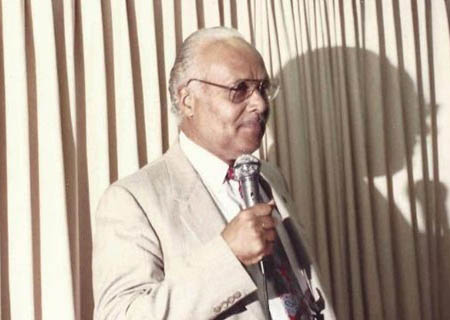
Rev. C. Herbert Oliver’s daughter confirmed that the legendary figure died on November 30 in Brooklyn after being admitted to the hospital for respiratory problems. His daughter, Patrice Oliver, told the New York Times that he had been admitted to a hospital about a week earlier. Oliver was a giant in the fight for Civil Rights in the 1960s. He served as secretary on a board of black ministers in Birmingham, Alabama, who created the Inter-Citizens Committee to document police abuse of black Americans. The group documented 98 cases of suspicious deaths in police custody, many of which occurred under segregationist police commissioner T Eugene (Bull) Connor.
Rev Oliver was a giant in the Civil Rights movement in the 1960s Credit: Wheaton College
Oliver’s work brought national attention to the gravity of the ongoing racism in the American South in the early 1960s, particularly when he documented the bombing of the 16th Street Baptist Church in Birmingham in 1963. Four young girls were killed in the attack. Oliver wrote a brutally candid letter about what he witnessed watching the attack from across the street. “The savage, brutal, murderous, and ungodly bombing has revealed to the whole world the evil of racism,” the reverend wrote. “Those few terrifying moments of the blast said what we have been trying to say to the nation for years, that there exists in Alabama the most unconscionable disregard for man and God on the part of some.” In 1967, Oliver moved on to serve as chairman of a new school board in the Ocean Hill-Brownsville section of Brooklyn. Oliver went on the challenge the way the public school system in New York City separated white and black children.
EARLY LIFE AND ACTIVISM Rev Oliver, whose full name was Claude Herbert Oliver, was born in February 1925 in Birmingham. He studied at the Missionary Training Institute in the early 1940s and later went on the graduate from Wheaton in Illinois with a degree in history. According to The Times, the young reverend returned to Birmingham after police fatally shot a black minister who had been helping voters register. “I went to the funeral home where the reverend was, and I stood over him in the casket,” Oliver once told the Wheaton magazine. “I looked at him and thought, ‘If this is what they do to a minister, if something is not done to fix this system, then one day I will lie down like him, and it will be the end of me.’” Oliver went on to earn bachelor’s and master’s degrees in theology at Westminster Theological Seminary in Pennsylvania. Before returning to Birmingham, Oliver served as the pastor of an Orthodox Presbyterian Church in Maine. He is survived by his daughter Patrice and son Claude, from his first marriage, his wife Lorna, and a grandson.
View From Here By David Mark Greaves We have never given an enthusiastic “Yeah!” for a press conference, but the one held by Eric Adams and David Banks expressed the passion and vision that that are needed, to properly educate a school population already bombarded by every societal roadblock to intellectual development, in the city and in the schools.
Chancellor-elect Banks said Adams told him, “‘We spend $38 billion every year budget in this system, and 65% of Black and Brown children never achieve proficiency.’ That’s a betrayal and we ought to be outraged by that…You could get those results even without a Department of Education.” Here, in the most competitive city in the world, Banks says he has to start at the proper way to teach reading.
“I have a message for a lot of folks down at Tweed (Department of Education headquarters) who think that they know me,” but apparently are in for a rude awakening. “Here’s the question that will be asked of everybody throughout this department: ‘If you left and your job disappeared tomorrow, would that change anything that’s going on in any of our schools? Fundamentally, the job that you have, if it disappeared tomorrow, does it change the life on anyone that goes here to PS 161? Because if it does not, why do we continue to support it? Change is coming. The system will be reengineered from the bottom up.”
Mayor-elect Adams reiterated that later saying that the education budget will be focused on the children and those in the system whose work does not directly impact the growth and development of the children, “should be concerned” about their continued employment. “This is no ordinary announcement,” said Banks, in very much of an understatement. If you are interested in education and want to be thrilled by a press conference, go to YouTube, enter Eric Adams David Banks and watch the One Brooklyn video.
As he moves to remake the Department of Education, we suggest someone check the archives for the Board of Education’s 1994 report, “The Commission on Students of African Descent.” Rather than reinvent every spoke of the wheel, the information in that report, shelved and hidden away, can only be helpful as the new mayor and chancellor “turn over the tables” at the department. Excerpts from the report, reprinted from Our Time Press in 2002, start on page 6.
Keechant Sewell to Become First Woman to Lead NYPD. Wow again! Mayor-elect Eric Adams says Nassau County chief of detectives, Keechant Sewell, has the “emotional intelligence” and the ability to “scale up” her experience to run the 34,000 member NYPD as the first woman police commissioner in the department’s 176 year history. The Washington Post, quoting Adams in the New York Post said, “Chief Sewell will wake up every day laser-focused on keeping New Yorkers safe and improving our city, and I am thrilled to have her at the helm of the NYPD,” Adams told the newspaper, which reported that during her job interview, Sewell had to show she could handle a “mock press conference about the shooting of an apparently unarmed black man by a white police officer.”
Three Against Trump As the extent of the plotting of a coup in the United States is revealed by the Select Committee investigating the attack on the U.S. Capitol, and the acknowledgement that the instigators of the January 6 insurrection, everything leading up to it and all that has followed, the Committee intends to hold the planners accountable for their goal of installing an authoritarian state with Trump at the head.
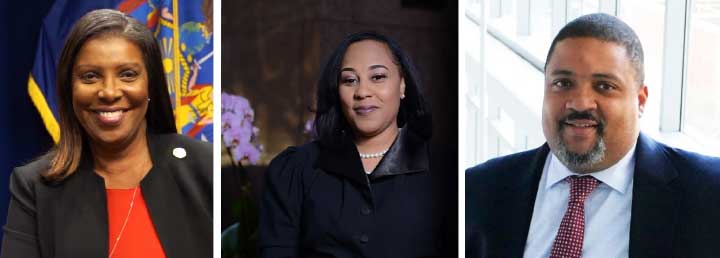
While the Committee continues its work, and plans to hold must-watch TV hearings early next year, there are a trio of legal investigations being led by two, and soon three, African Americans, that the fate of the nation may depend on, as the Committee will itself be disbanded if the Republicans take control of congress after the midterm elections. First up is New York State Attorney General Letitia James and her office of over 700 attorneys. AG James has already said she will subpoena Trump for a deposition in the civil inquiry her office is conducting into his business practices. Second is in Fulton County, Georgia, where the Atlantic Journal reports that “District Attorney Fani Willis is likely to impanel a special grand jury to support her probe of former President Donald Trump, a move that could aid prosecutors in what’s expected to be a complicated and drawn-out investigative process.”
The Journal goes on to note that “Gwendolyn Keyes Fleming, previously a DeKalb County DA. co-authored a Brookings Institution report earlier this fall that analyzed all available public evidence and concluded that Trump’s conduct leaves him at ‘substantial risk of possible state charges predicated on multiple crimes.’” Third is incoming Manhattan District Attorney Mr. Alvin Bragg, who will be taking over that office’s criminal investigation of Donald Trump and the Trump Organization.
As these cases proceed over the months before the 2022 elections and Donald Trump finds himself fighting paper trails that lead straight to him, we will see if so-called Trumpism can survive reality and that we can survive as the nation we’ve all known.