Home Blog Page 26

Mohammad Mosque #7C Commemorates 30th Anniversary of Million Man March

0

By Mary Alice Miller

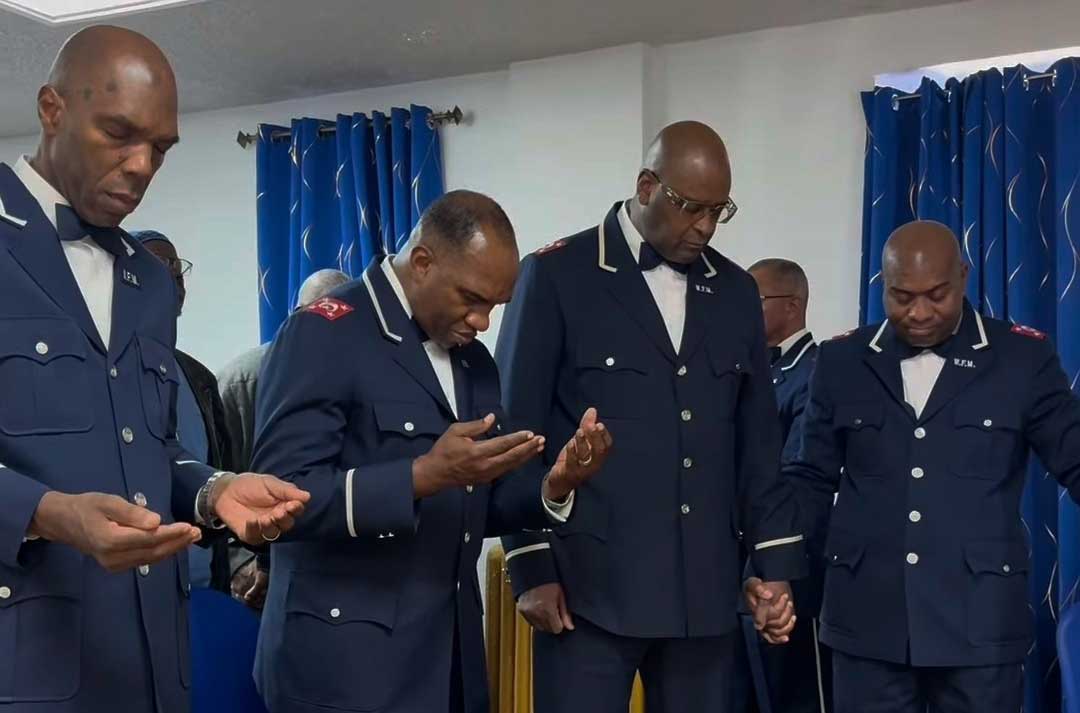
On October 19, the Nation of Islam mosques across the country set aside time to celebrate 30 years since the Million Man March. Brooklyn’s Mohammad Mosque #7C, hosted by Min. Henry Muhammad, was no exception.

Mosque Maryam, the National Center of the Nation of Islam, livestreamed the event.
“It was 30 years ago on October 16, 1995, that as the sun rose on the mall in Washington, D.C., one million Black men were standing together in unity, willing to sacrifice their lives and their time, based on the principles of freedom, justice and equality,” said Student Min. Brother Daniel Muhammad, opening the event.

“On that day we were no longer divided by religion, by class, by organization, nor by geographical location. We all came together, the Black, the brown, the Christian, the Muslim, the white collar, the blue collar, the celebrity, the lay person… all of these different factions were united on this day 30 years ago.”

Sister Asia Muhammad said, “The Million Man March was not just for the men. some of us might have thought it was a march just for the men. And there were some people who were concerned that it was biased against women and strictly for the men. This is not the case. As we are taught in the Nation of Islam that a nation can rise no higher than its women. Women were in full support and present at the Million Man March.

There were many women who helped in the process of organizing. Sister Cora Masters Barry was present, Sister Dorothy Height, Sister Betty Shabazz, Sister Dr. Maya Angelou, Sister Queen Mother Moor, Min. Mother Tinetta Muhammad, Student Min. Ava Muhammad, and our First Lady Mother Kadija Farrakhan.
The Million Man March was never an effort to step away from women, it was an effort to step towards women.”

Brother Ishmael Muhammad, Student National Assistant to the Honorable Min. Louis Farrakhan, gave an eyewitness account of what he called “the greatest assembly of men in the history of the world.”
Min. Muhammad described the social, political, and economic conditions gave rise to the Million Man March 30 years ago.


“The fratricidal conflict raging within our communities, the crime, the violence, the degenerate cultural image of our men that was being displayed throughout the world by the media, the Minister felt that the Black community was being set up for destruction,” said Min. Muhammad. “The world was seeing us as a savage people, unworthy of life, and the media’s portrayal of Black men was justified.”

Min. Muhammad continued, “What we see now happening on our streets, Farrakhan warned us that federal troops, soldiers, officers would be coming into our communities. They are coming in to not just arrest, detain our brothers and sisters from Venezuela, Mexico and other Latin American countries, but now they use that as a pretext. It’s a pretext to come in now and break down the doors of our homes, arrest us on the street.”

Min. Muhammad said, “The Minister, with the Million Man March, wanted to change that image and give the world a vastly different image of the Black male who has been made other than himself. We have been made by circumstances what we did not create: thugs, gang bangers, killers, murderers, thieves, robbers, hustlers, liars, abusers of our women and irresponsible fathers.”

Min. Ismael Muhammad gave a detailed history of the lead up to the Million Man March, then introduced Minister Louis Farrakhan’s speech at the Million Man March.
Farrakhan’s words of atonement, reconciliation, and responsibility were on point then and prescient for today.

The Minister explained the eight point actions of atonement and reconciliation: 1) point out the wrong done; 2) acknowledge it; 3) confess it to God and the person(s) you wronged; 4) repent; 5) atone and make amends; 6) forgiveness; 7) reconciliation and restoration; and 8) perfect union with God.


Closing the Million Man March, Farrakhan gave marching orders to those assembled and those watching.
He called for Black men to go back to their communities and join an organization that is working on the uplift of Black people. Farrakhan asked them to join a church, mosque, temple, etc. for moral and spiritual renewal. He called for 8 million eligible Black people to register to vote.

Farrakhan asked the assembled to join Father Clemens idea of going into a prison and adopt an incarcerated person for the rest of their life by writing to and visiting them to help them reintegrate into society.
On behalf of Mr. Dunston, president of Black Social Workers, Farrakhan called on Black men to adopt 25,000 Black children in need of adoption. Farrakhan called for the formation of a Board to develop a national economic development fund to nurture businesses in the Black community.

To thwart distrust and promote transparency of the use of money donated on the mall that day, Farrakhan called for an outside independent accounting firm to scrutinize every dollar.
Farrakhan closed the Million Man March with a pledge that from this day forward to love my brother as I love myself; will strive to improve myself spiritually, morally, mentally, socially, politically, and economically for the benefit of myself, my family and my people; will strive to build business, houses, hospitals, factories, and enter into international trade for the good of myself, my family, and my people; will never raise my hand with a knife or a gun to beat, cut, or shoot any member of my family or any human being except in self-defense; never abuse my wife by striking her, disrespecting her, for she is the mother of my children and the producer of my future; will never engage in the abuse of children, little boys or little girls for sexual gratification, but I will let them grow in peace to be strong men and women for the future of our people; will never again use the B-word to describe any female but particularly my own Black sister; will not poison my body with drugs or that which is destructive to my health and my well-being; will support Black newspapers, Black radio, Black television, Black artists who clean up their acts to show respect for themselves and their people and the ears of the human family; I will do all of this so help me God.
NYC Mayoral Race Heating Up: New Yorkers set to Make Early Voting Choices, United on “No Kings”

0

NYC EARLY VOTING BEGINS SATURDAY, OCT 25.

By Nayaba Arinde
For those who vote, Saturday, March 25th, 2025, begins early voting for the November 4th, NYC General Election.
“Black people are in some of the most dangerous times we have faced in many years,” Omowale Clay, Chairman of the December 12th Movement, told Our Time Press. “The outcome of the upcoming Mayoral election will play an important role in determining our ability to resist and survive these times.”


Brooklyn Congressman Hakeem Jeffries has still not endorsed his party’s nominee Zohran Mamdani. He told ABC News, “I expect to have a conversation with him at some point this week in advance of early voting, which begins next weekend in New York City. And we’ll certainly have more to say about the mayor’s race and about our Democratic nominee prior to early voting beginning.”

Jeffries did not respond to an Our Time Press request for a response. Meanwhile, Queens-own President Donald Trump has threatened to slash federal funding to his hometown if Queens Assemblyman Mamdani is elected mayor.
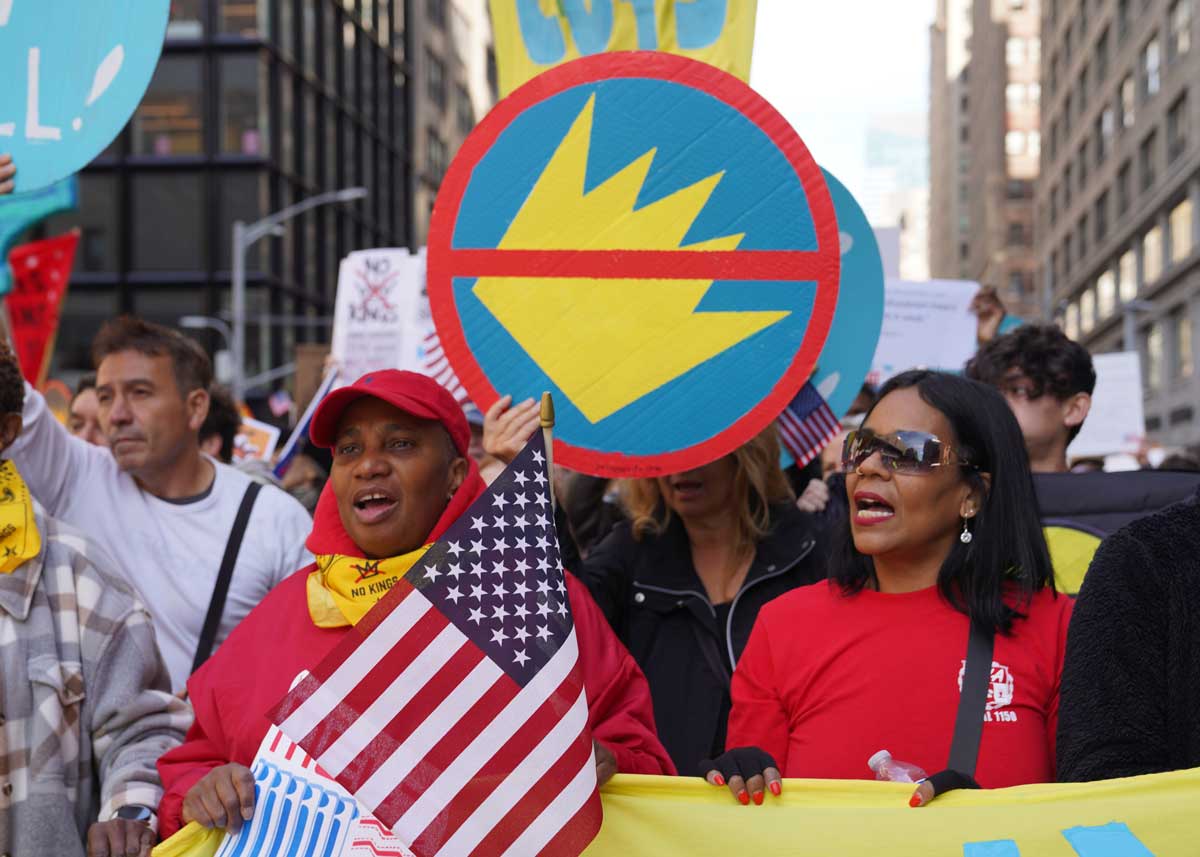
All these political theatrics as this past weekend saw the no tangible demands-asking, 7-million strong, national anti-Trump agenda, reported 2,700 No Kings rallies in New York City and cities countrywide.

There were no mayoral candidates at the rally. While different groups brought different issues, placards, posters and chants, there was not a cohesive ask for the well-publicized, well-organized, some say big money-funded event. Reminiscent in some regards, to the relatively short-lived Occupy Wall Street, and Black Lives Matter campaigns, from observations the attendees seemed to be mostly white. There were pockets of Black groups.
With cheerful hue and cry, and even folk songs, thousands thronged down Seventh Avenue and other streets to yell displeasure for 10 months of deliberately manufactured chaos and disruption.
Online, Jaribu Hill asked, “So, does ‘No Kings’ also mean no settler Colonial Powers? No genocide and no white supremacy? Just asking.”

The NYC multi-block gatherings No Kings rally had no solution put forth per se, but an amalgamation of grievances were aired. Many of the participants, who possibly voted for the very president that they are now publicly protesting, had catchy phrases, quirky signs, demonstrative posters, and t-shirts opposing everything from Trump’s domestic and international policies, from his deployment of troops in US cities, to his use of ICE agents, and his immigration policies, to canceling in-progress transit infrastructure projects, to the vengeful persecution of his perceived political enemies, like New York Attorney General Letitia James.


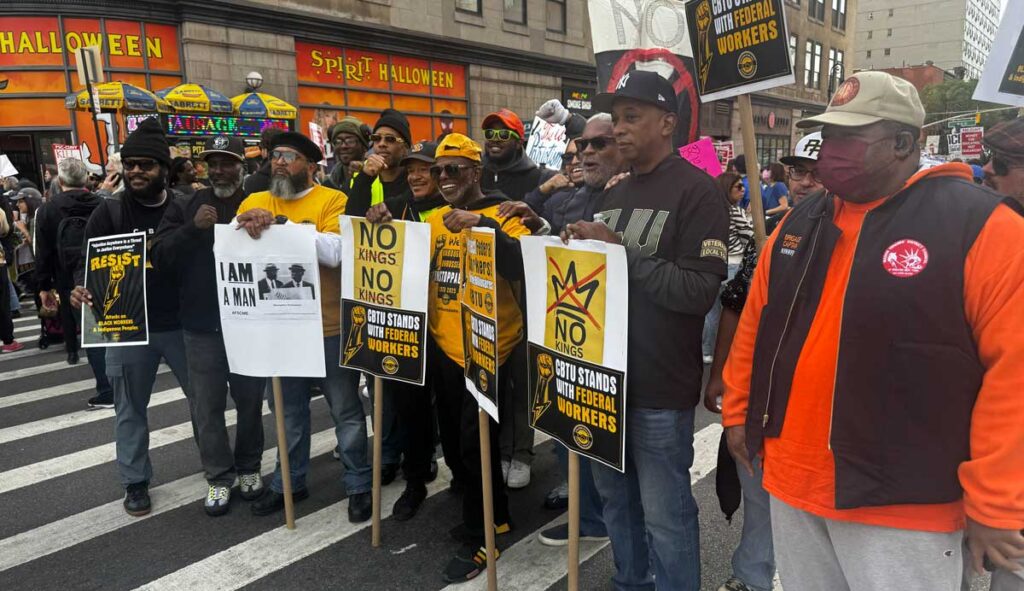
There were groups of Black and Brown protesters present with purpose, however.
Charles Jenkins, President of the New York Chapter of the Coalition of Black Trade Unions, said that at the No Kings, marching rally “over 100 thousand activist community leaders and, workers assembled in the heart of Time Square, while organized labor assembled in lower Manhattan on Canal Street and 6th Avenue joined by 1199, DC 37, CWA, TWU, Laborers 79, Teamster’s, CSEA, PSC Cuny, 32BJ, UFT, AFGE and the Coalition of Black Trade Unionists commemorating the 30th anniversary of the Million Man March joined in solidarity with the No kings March to send a united message in this Nation we are not ruled by Kings.

We have a democracy and branches of government guided by our constitution, which is that of We The People, For The People, came out in historic numbers to defend our democracy, demonstrating to all ethnic groups’ demographics around this nation that we the people remain united.”

“I went to the No Kings rally in Manhattan, with my union brothers, after reconnecting with CBTU, after we had a Zoom meeting the night before to celebrate the 30th anniversary of the Million Man March,” Brownsville Men Elevating Leadership community organizer Daniel Goodine told Our Time Press. “I can recall back in 1995, as a Black man returning to Brownsville, that Mo Better Jaguars football team was started by Chris Legree and Herb Robinson, two co-founders of Pop Warner football…My community heard the call and we answered. Some of those players are teachers, coaches, business people, and brothers who were able to come back and build a bond.”

But, described as “rallies not protests,” and not being an organic or authentic movement, critics like Amanda Seales queried the intent, saying folk should not be “tricked into thinking you are actually resisting. You are actually a part of controlled opposition, not organized opposition…Who’s controlling? When it’s organized, you know who it is and what the goal is.”
She said of the two-hour, 10 am-12 pm, registration-required rally, “There are no clear demands being made, and there are no clear actions that are being asked for…protest is meant to demonstrate the might of the people to the ruling class, to the powers that be…to make them shook.”

But, described as “rallies not protests,” and not being an organic or authentic movement, critics like Amanda Seales queried the intent, saying folk should not be “tricked into thinking you are actually resisting. You are actually a part of controlled opposition, not organized opposition…Who’s controlling? When it’s organized, you know who it is and what the goal is.”
Reports say that some rally attendees were paid like ‘compensated activists’ $200, like hired Crowds on Demand’ to show up.


The controversial media pundit continued, “It’s very important to know the difference so that we actually know the expected efficacy of our efforts…rallying folks around an idea, a team…a concerted celebration or concerted information sharing.”

Citing the historical resilience of Harriet Tubman and Nat Turner, speaking at a “No Kings” rally in Chicago, Mayor Brandon Johnson riled against Trump “tyranny,” and called for a general strike, “If my ancestors, as slaves, can lead the greatest general strike in the history of this country, taking it to the ultra-rich and big corporations, we can do it too.”

Johnson called on everybody “from around this country to stand up…We are going to make them pay their fair share in taxes to fund our school, to fund jobs, to fund healthcare, to fund transportation. Democracy will live on because of this generation. Are you ready to take it to the courts and to the streets?”

Back in NYC, as of press time, there are still three main candidates vying for the attention of the city electorate. Mamdani, now 34, is still the Democratic frontrunner. Despite Independent Andrew Cuomo and GOP heads demanding that Curtis Sliwa, the perceived “spoiler” drop out, the Brownsville-born, controversial Republican maintains that he will not pull out of the race
With the December 12th Movement planning to host their traditional pre-General Election Pre-Black Solidarity Day Citywide Rally at Bed Stuy’s Bethany Baptist Church on Sunday, November 2nd, Chairman Clay said, “U.S. racial capitalism is disintegrating, a fact which makes it more rather than less dangerous. Trump–and the class he represents is rapidly putting in place the legal and militarized superstructure that they think will be needed to deal with the resistance that people will have to the destruction of the quality of their lives- healthcare, housing, jobs, transportation, education.”

The decades-long activist added, “This is why the next mayor must be someone who, like Chicago’s Mayor, is prepared to fight the Trump escalating attack on New York City. That mayor must also be someone whose policies address our communities’ needs.

Zohran Mamdani’s stated policies, which won him the Democratic primary, speak to issues important to our community. However, we do have reservations about other parts of his platform, which temper our support. Our position is that it is important for all registered voters to vote and that no one should vote for Cuomo or Sliwa”


Takeaways from the second general election debate in the NYC mayoral race

Excerpts from Story by David Wright,
Gloria Pazmino, CNN


This time, the gloves came off.
Democrat Zohran Mamdani clashed with independent Andrew Cuomo from the first moments of Wednesday’s second and final general election debate for New York City mayor. Cuomo called Mamdani divisive and said he lacked experience or new ideas, while Mamdani said the former governor, down in the polls, was a “desperate man lashing out.”

Here are key moments from the debate:
Cuomo was looking for a moment to change the race’s contours less than two weeks from Election Day while Mamdani both sought to lock in his lead and establish himself as winning the “battle over the soul” of the national Democratic Party. The two tore into each other in strikingly personal terms on their backgrounds, their policy ideas and how each would address antisemitism.

Republican nominee Curtis Sliwa, meanwhile, reprised his wildcard role as he refuses to bow to a pressure campaign from some Republicans to leave the race. Despite not winning President Donald Trump’s endorsement – and being mocked at times by the Queens-born president – Sliwa said he would work with Trump to protect the city’s interests. He mocked Mamdani as having a resume that could “fit on a cocktail napkin” and Cuomo as having enough failures to “fill a library.”


Cuomo gives Mamdani a dressing-down about experience
In a pivot from his frequent reference to his time in government, Cuomo sought to put distance between his record as governor and New York City’s municipal failures. Notably for someone elected governor three times, Cuomo argued that “the city has been getting screwed by the state, and that has to change.”
But the exchange gave Mamdani an opening to attack Cuomo for his record as governor.
“The governor doesn’t build housing in New York City,” Cuomo said in response to a question on housing policy.

“Not if it’s you,” Mamdani retorted.
That led to Cuomo accused Mamdani of never having “accomplished anything.”
“I did things; you have never had a job,” Cuomo said motioning towards Mamdani and drawing applause from the crowd. “There is no reason to believe you have any merit or qualification for 8.5 million lives. You don’t know how to run a government.”
The three candidates talk about ICE and Trump
Immigration raids in New York City emerged as a flashpoint early in the debate, as all three candidates rejected the federal crackdown and argued over who was best able to deal with President Trump.

Cuomo said that “we don’t need ICE to do quality-of-life crimes,” after a US Immigration and Customs Enforcement raid on Chinatown’s Canal Street in Manhattan Tuesday. Mamdani argued the agency “cares little for the law and even less for the people that they’re supposed to serve.” And Sliwa agreed that “the feds should not have stepped into this situation.”
But the candidates diverged sharply on how they’d approach Trump. Cuomo said that “you’re going to have to confront” him while Sliwa suggested that “you can’t beat Trump, he holds most of the cards,” saying that “you have to try to negotiate.”

Mamdani’s rivals gang up on him about ballot measures
Cuomo and Sliwa briefly ganged up on Mamdani over his refusal to take a position on a set of controversial ballot measures New Yorkers will weigh in this election year.
At one point, holding his hands up in the air and swaying side to side as if to mock Mamdani for talking too much, Cuomo attacked Mamdani for not having yet made his position clear.
There are six ballot proposals covering a range of topics, including significant housing reform, a change to election years and the construction of a sports complex on forest land.

Mamdani sends a clear signal about policing
For months, Mamdani has said he would consider keeping New York Police Commissioner Jessica Tisch if elected but has stopped short of committing to asking her to stay on.
That changed Wednesday. Just before the debate began, two people familiar with the plan confirmed to CNN that Mamdani intends to ask Tisch to stay on the job if he is elected mayor.
Mamdani’s decision, first reported by The New York Times, signals his attempt to moderate as the general election nears and he continues to face criticism, especially on his previous critiques of the police.


“I can confirm that reporting,” Mamdani said on the debate stage.
Mamdani has walked back previous calls to defund the police and has apologized to officers for referring to them as “racist” and “wicked” in social media posts.
But it’s not clear if Tisch, who is highly regarded in the city’s political circles, would stay on even if asked.
Cuomo and Sliwa also said they would ask Tisch to stay on as commissioner.

Mamdani faces criticism about antisemitism
Mamdani again addressed Jewish voters who are concerned about his criticisms of Israel and question his commitment to fighting antisemitism.
“I look forward to being a mayor for every single person that calls the city home,” he said, “all 8.5 million New Yorkers, and that includes Jewish New Yorkers who may have concerns or opposition to the positions that I’ve shared about Israel and Palestine.”
Mamdani’s opponents, however, expressed skepticism and accused him of promoting antisemitism.

“You’re the savior of the Jewish people? You won’t denounce ‘Globalize the Intifada,’ which means ‘Kill Jews,’” Cuomo said, referencing the controversial phrase that Mamdani has discouraged using and noting that hundreds of rabbis had signed a letter criticizing him. “There’s unprecedented fear in New York.”
Sliwa made a personal appeal to Mamdani, referencing his own Jewish family members, saying that members of the community were “scared.”

“Let me speak on behalf of my two sons when they’ve heard some of the statements you’ve made,” Sliwa said. “They view you as the arsonist who fans the flames of antisemitism. They cannot suddenly accept the fact that you’re coming in like a firefighter and you’re going to put out these flames. You’ve got a lot of explaining to do, a lot of apologizing to do.”
He also alleged that Mamdani, who would be the city’s first Muslim mayor, had praised “global jihad.”

Mamdani responded that “there is room for disagreement on many positions and many policies.” But he also pushed back.
“I have never, not once, spoken in support of global jihad. That is not something that I have said and that continues to be ascribed to me,” he said. “And frankly, I think much of it has to do with the fact that I am the first Muslim candidate to be on the precipice of winning this election.”
For more CNN news and newsletters create an account at CNN.com

“From the Office to the Fight: Angelica Barker, OBH Employee and Survivor”

By Amanda Barrett


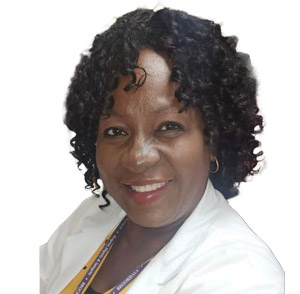
For 15 years, Angelica Barker has been a dedicated member of the One Brooklyn Health (OBH) team, serving as an oncology data specialist. In her role, she registers patients from diagnosis through recovery, reporting vital information that helps the state track cancer statistics and advance research. Her career has been rooted in care, precision, and purpose, qualities that would later take on new meaning in her personal life.

“I’m disciplined because of the field I’m in,” Angelica said. “Every year I do my mammogram and physical. Actually, I do it every September for my birthday, that’s my treat.”
Angelica’s vigilance was partly shaped by family history. Her aunt passed away from breast cancer after a late diagnosis, a painful reminder of how early detection saves lives.


“My aunt on my mom’s side had cancer, and she passed away. The treatment back then wasn’t what it is now. Knowing it’s in the family, I always make sure to get tested and address anything immediately,” she said.

Angelica Barker


In 2020, while the world faced the challenges of COVID-19, Angelica was helping breast cancer patients at OBH navigate their care. But that same year brought personal tragedy: her 34-year-old brother, a police officer in Trinidad, passed away suddenly from an aneurysm. Just one year later, in August 2021, Angelica received life-changing news, she had stage 1A breast cancer.
Her diagnosis came after a biopsy during her annual mammogram revealed a suspicious cyst. Her oncologist, Dr. Shaun Din at OBH Brookdale, confirmed the results.

“The emotions overwhelmed me,” Angelica recalled. “My first instinct was to go home, grab my pillow, and cry.”
Angelica described the outpouring of love and encouragement she received throughout her cancer journey. Her family stood by her side, accompanying her to appointments and reminding her she wasn’t alone. Even in the midst of grief and fear, she found strength in their presence, and in the support of the very colleagues she had worked alongside for years.

“Dr. Simone Mays, Dr. Avezbakiyev Boris, and Dr. Shaun Din, all the physicians on the oncology team reached out to me,” she said. “‘Angelica, it’s okay, we’re going to work it out.’ They really cared.”

On September 9, 2021, Angelica underwent a lumpectomy, followed by radiation treatment from November through December. Throughout her treatment, she continued to work and even supported other patients, including one who was hesitant about radiation therapy.
“The biggest problem I had was that I was bored,” she laughed. “I love to work.”


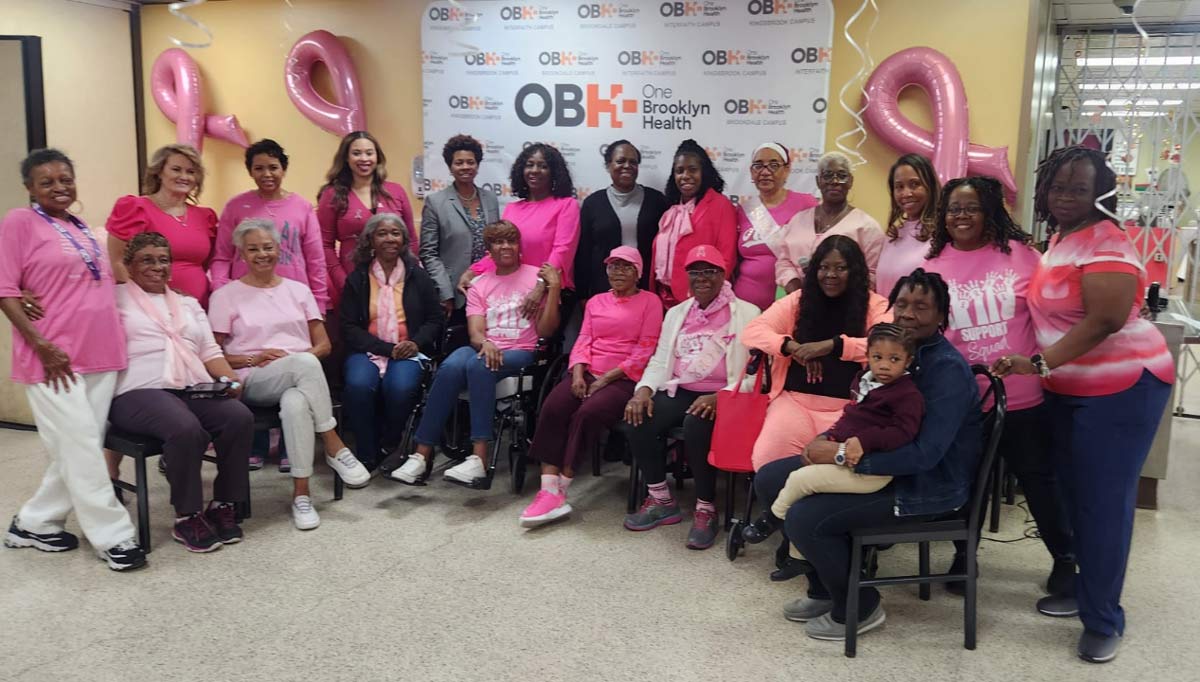
As part of One Brooklyn Health’s commitment to women’s health, OBH takes a patient-centered approach to detecting and treating breast cancer. Its Breast Health Services emphasize early detection and comprehensive care, offering medical treatments, surgeries, and emotional support every step of the way. The OBH team includes reconstructive and breast surgeons, oncologists, radiologists, and other specialists who collaborate to create personalized care plans for each patient.

Treatment options at OBH include mastectomy and lumpectomy, as well as additional procedures such as lymph node dissection (lymphadenectomy) and breast reconstruction surgery. Reconstructive breast surgery helps restore the natural shape and appearance of the breast using autologous tissue, prosthetic implants, or a combination of both, with the goal of achieving a natural-looking result.

Though her doctors helped minimize physical pain, the emotional toll of losing her brother and facing her own diagnosis was heavy, yet her faith and her work gave her strength.
“It doesn’t feel like work for me. It’s my mission, and this is what I have to do, a labor of love for me,” she said.
Her experience changed how she approached her job.
“Before, when I was abstracting cases, I’d input the data for radiation, lumpectomy, surgeries, because that’s what I was trained to do,” she explained. “But now it’s personal. I know what these patients are going through.”


With the encouragement of Dr. Simone Mays, Angelica and Dr. Mays started the One Brooklyn Health Breast Cancer Support Group to provide others with the same comfort and support she had received.
“Dr. Mays and I had that conversation, and she said, ‘Okay, we can start a support group.’ She would contact her patients and invite them. When she later left for New Jersey, I didn’t want the group to die, so I kept it going,” Angelica said.
Her goal was simple, to create a safe, supportive space where patients could feel seen, understood, and empowered.

Today, Angelica is in remission and nearing the end of her five-year hormonal treatment. She describes herself as “normal,” staying active, taking the stairs at Brookdale instead of the elevator, and continuing to support patients through her work and the support group.
“I’m normal. I’m normal. I’m normal,” she said proudly.
Though she still experiences minor side effects, Angelica’s outlook remains strong and faith-driven. This year, she’ll serve as a panelist at OBH’s third annual Breast Health Panel on October 29th, where she’ll join other health professionals in discussing prevention, early detection, and wellness.

Her advice is:
“Follow your physicians, hold on to your prayers and your family, and don’t give up, you have to fight. Cancer can’t rule you. You could rule cancer.”
For more information on One Brooklyn Health’s breast health services, visit onebrooklynhealth.org.

Is 43 Years Enough Time for Paul Biya?Is Issa Tchiroma Bakary Cameroon’s New President?

0

By Jeffery Kazembe Batts
IG: @kazbatts
West of Africa’s most populous country, Nigeria, is the lesser-known nation of Cameroon. Split between an eastern third that speaks English and a western two thirds that speaks French. The west African nation has an Atlantic Ocean coastline and is not far from the equator. Led for 43 years by Paul Biya who is the longest consecutively serving current non-royal national leader. He has been president since Ahmadou Ahidjo resigned in 1982.

The 92-year-old Cameroonian president is running again in a national election held on October 12th. Earlier this year nearby Gabon had an election and results were released within a day. Senegal announced the winner of last year’s election in three days. Elections Cameroon (ELECAM) and the Constitutional Council are scheduled to announce the winner of the Cameroonian election no later than October 26th.

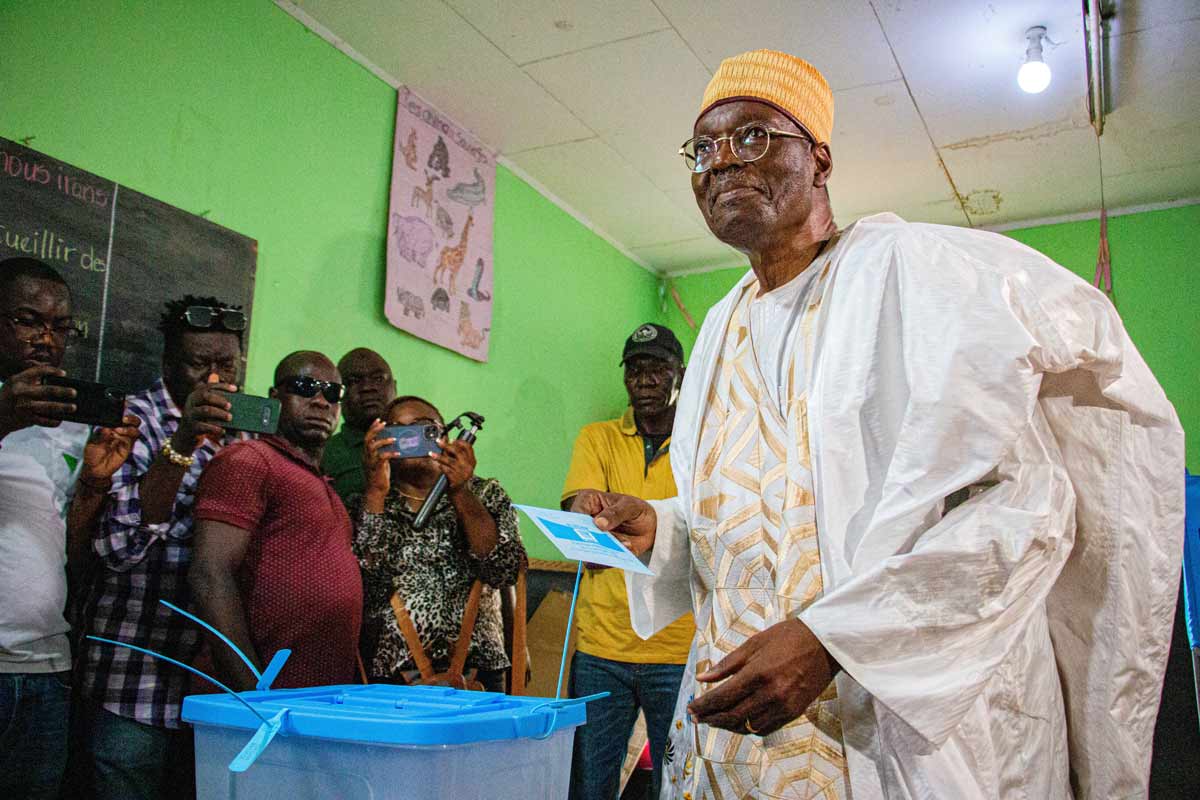
Paul Biya, President of Cameroon and presidential candidate for the Cameroon People’s Democratic Movement (CPDM), casts his ballot at a polling station in Yaounde on October 12, 2025 during Cameroon’s presidential election. (Photo by DANIEL BELOUMOU OLOMO/AFP via Getty Images)


Current President Biya faces nine opponents, including former cabinet ministers. Cameroon National Salvation Front presidential candidate Issa Tchiroma Bakary has already declared himself the winner, saying to President Biya “You have led this country for 43 years, history is watching you, you still have one chance and only one, that is to leave office with dignity as a statesman and respect the will of the people, do not end your reign with such blatant fraud.”

Continuing, the popular opposition candidate urged the international community to not stand by saying “To our neighboring countries especially Nigeria and Chad, to the African Union, to the European Union, France, to the United States, all international partner countries, do not remain silent, your silence condones dictatorship, your voice can protect peace.”

Since Oct 12th, massive protests, led by youth, have filled the streets of Douala and other cities in the northwest where there is a limited insurgency fighting for Anglophone independence. Young people have camped out in front of his residence to thwart any harassment and to protect him.

It is widely known that Paul Biya spends half of the year outside Cameroon, mostly in France, leaving day-to-day government operations to family and party officials. In public Biya appears stiff and seemingly lost around other people.

Statues have been used to hold his place at events. Ronald Reagan was U.S. president when Biya first came to power. Many Cameroonians Have not known any other leader. Although Tchiroma declared victory some are skeptical and him not filing an appeal to the Constitutional Council has caused concern and debate.

Some want him to wait until official results are announced. Meanwhile the government is firm that premature declaration of victory is a treasonous offense and that Tchiroma is playing with fire.


In short time the world will know if the youth of Cameroon have elected and enabled a new leader or of Paul Biya. Win or lose Bakary has challenged not only the people of Cameroon to claim their democracy, but also the nations of the region and world to not have a blind eye during this crucial period in Cameroon’s development.

Have the young people of Cameroon joined other Africans from around the world to demand better government and quality of life? Soon we will know if a new chapter or more of the same is unfolding in the Gulf of Guinea bordering nation of Cameroon.