Home Blog Page 19

When Brooklyn Answered the Call: Remembering Rev. Jesse Jackson

by Binta Vann


“He could motivate and generate movement among people with his preaching and teachings,” my father said when asked about Reverend Jesse Jackson.
He was describing his experience in 1984 when Rev Jesse Jackson asked him to serve as campaign manager for New York State during his presidential run. My father, the late Dr. Albert Vann, a Brooklyn educator, State Assemblyman, and Chairman of the Coalition for a Just New York, had spent a decade building and unifying Black political power throughout Brooklyn and paving the way for stronger representation of Black elected officials in New York City and State. But running a presidential campaign for the first Black man to run as president in America in 1984? That was something else entirely.


Their relationship had begun 12 years earlier in Gary, Indiana, at the National Black Political Convention. This was the largest gathering of Black political leaders, educators, and activists in American history. Rev Jesse Jackson delivered a keynote address that electrified the room, urged the crowd not to wait for permission to grow Black political power.

My father, who was there to advocate for equity in education, walked away from that convention with the understanding that if you want to change the system, you had to disrupt the distribution of power and build coalitions to back you up. Two years later he won his seat in the New York State Assembly and spent the next decade doing just that.
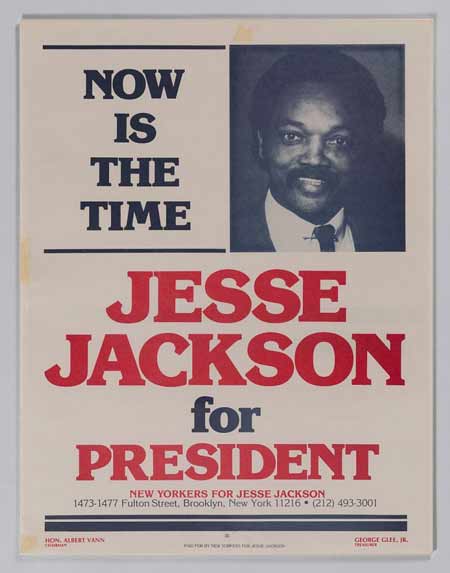

By 1983 my father had become chair of the Coalition for a Just New York, a citywide alliance of Black elected officials, clergy and activists fighting for Black schools and equity in city government. When Rev Jackson came looking for someone to organize the most complicated state in the nation, he found the man who had already proven he could do it.


Rev Jackson and Dr. Vann were shaped by the same conviction: that Black freedom could not be borrowed. It had to be built voter by voter, and institution by institution. Rev Jackson had built the Rainbow Coalition and Operation PUSH. My father had built the African American Teachers Association, was a founder of Medgar Evers College, and had created the Vanguard Independent Democratic Association. Both men knew the difference between talking about change and building the structures to make it happen.


When I learned that Rev Jackson had transitioned on Tuesday morning at the age of 84, I listened again to the recordings I made of my father and felt the weight of what both men understood they were attempting: to prove that a Black man could mount a credible run for the presidency of the United States. Not as a protest, but as a possibility.


In launching the New York State campaign, my father called on the Brooklyn delegation he’d spent a decade building including Major Owens, Clarence Norman, Frank Boyland, Roger Green, Annette Robinson, Velmanette Montgomery, Rev. Herbert Daughtry, Jitu Weusi, Sam Pinn and many others. This wasn’t just a coalition, it was the organizing power that drove voter registration, delivered delegates, and turned Brooklyn into Rev Jackson’s largest base of support in the nation.


That movement produced results no one could ignore. As my father told me with unmistakable pride, “we made a very successful campaign, the largest delegation in the convention.” The borough of Brooklyn drove that delegate count in 1984. Not Chicago. Not Atlanta. Brooklyn.
Jesse Jackson’s campaign changed politics on the national level. It drove extensive voter registration which increased black turnout on election day and changed the Democratic electorate.

It made race and the concerns of the Rainbow Coalition’s marginalized communities including Latinos, Asian Americans, LGBTQ people and the poor, a central agenda item for the Democratic party. And it transformed the Democratic party’s delegation rules by making them proportional rather than winner-takes-all. That change helped make Barack Obama’s 2008 victory possible.


The arc from Gary to Brooklyn to the DNC convention floor took decades. It began in a high school gym in Indiana in 1972, where a young educator and a rising civil rights leader both heard the call of “Nation Time” and understood what it demanded. By 1984, they had built the infrastructure to answer it.

Their work pioneered the way for Brooklyn leaders like Attorney General Letitia James and Congressman Hakeem Jeffries, who came up through institutions and relationships forged during Jackson’s campaign.
That was my father. That was his relationship with Jesse Jackson. And that is the legacy both men leave behind.
We stand on both their shoulders.

“Being close to him was instructive, impressive and one of the many cherished moments I’ve had in my career.” –Dr. Albert Vann

Binta Vann is the daughter of the late Dr. Albert Vann. She serves as Chief Marketing Officer at NPower, a national tech training nonprofit, and sits on the board of Bedford Stuyvesant Restoration Corporation, where her father was a founding board member.

Weather Highlights the Need for Emergency Preparedness

0

By Nayaba Arinde
Editor-a-Large

“Isolation magnifies mortality. Community reduces it. In a storm, we have to make sure that we check on our elders and the most vulnerable in our community,” Aton Edwards, Disaster Manager, told Our Time Press. The creator of Life Protection Directives for the Black community said, “Make sure that you call them, go to their door, ask them before the storm comes what they may need, and go and get it for them, so they don’t try and do it. Check on disabled neighbors, too. We must do the things that are necessary to be prepared for any weather condition.”


Mayor Zohran Mamdani said on Tuesday, “Yesterday, the snowstorm of the decade arrived, with winds of up to 60 miles per hour, and more than two feet of snow falling across parts of our city.”
Now, the Blizzard of 2026 is in the books. Hammering the tri-state area as the storm crept up the coast. It came with Mamdani’s NYC travel ban, students and their parents enjoyed the one snow day. Many decried that it was not extended for two days, with safety concerns over traversing the city in the immediate post-snowfall conditions.


With students just coming back from midwinter break, the Mayor said, “It was not possible to ensure every student had the devices they needed to effectively participate in remote learning,” and public schools are critical to the health and wellness of nearly 900,000 children across our city. Whether it’s a warm meal, essential mental health support, or a source of childcare for working parents—in-person schooling is a resource that our city’s children and families depend upon.”
The pristine white snow from January 15th quickly became dirty, grey, trash-strewn, and obstructive, making sidewalks ice-blocked, bus tops cluttered, and streets difficult to maneuver.


No sooner did the month-long citywide eyesore finally melt with eventual above-freezing temperatures last week than the blizzard slammed the five boroughs and the tri-state with almost 20 inches on February 22nd and 23rd, 2026. While it was beautiful to look at when it first dropped, it was brutal to work, walk, or shovel in, especially with the relentless blizzard wind.


Aton Edwards, a one-time Brooklyn Cobble Hill resident, told Our Time Press, “Winter storm preparedness is essential.”
Seasoned in the work of people preparedness, and well-known on Black radio shows like Imhotep Gary Byrd on WBLS, WLIB, and on WBAI and CNN, Edwards declared, “Winter storms are not seasonal inconveniences. They are infrastructure stress tests. Power fails. Heat fails. Roads vanish. Response times stretch.

What kills people is not snow — it is exposure, carbon monoxide, dehydration, overexertion, and bad decisions made in the first six hours. I have created Afrocentric ‘prepping,’ not the limited individualistic dynamic of the European model. I work from an African perspective so that we as Black people have something of our own,” said Edwards. “That is why, in storms and blizzards, and extreme heat, working with my Life Protection Directive, we say protect your elders. We ask them what they need, and then we go and get it for them. We must look out for the Black seniors.”


This harsh January-into-February has been a Gotham winter story.
While there is scheduled to be a mild snow-melting 40% weekend, the Weather Channel forecasts that in New York City from Monday, March 2nd to Wednesday, March 4th, there is the possibility of rain, snow, and showers, with daytime 30-plus and nighttime 20-plus temperatures.
When you hear about an incoming storm, Edwards said seniors and even younger folk must “fill your prescriptions for your insulin, asthma, pain medication, etc. People usually don’t have a backup plan to power their CPAP or oxygen tank. There are these portable solar-powered mini generators and portable chargers, which they can just put in the window to charge, and they have those tiny refrigerators too to store the medication.”


Though it is melting, tons of snow still cover the city streets. “Sometimes people think they are in shape, but they go out shovelling snow and end up with cardiac strain, asthma attacks, or blood pressure spikes. People must maintain protocols with their medical needs.”
Edwards advised that in bad weather, “You should stay put. Do not attempt to beat the storm, and run one last errand. A lot of people die from heart attacks, exerting too much energy shovelling too much snow.”
New Yorkers have to clear sidewalks, and even bus stops outside their homes, though.
After Mayor Mamdani increased citizen shoveler pay from $19 to $30 an hour after 40 hours, over 1,400 folks eagerly signed up to clear the snow-battered streets this week.


Heat, or the lack thereof.
“Heat loss begins the moment power fails,” Edwards explained. “You must preserve heat because you get a mild case of hyperthermia in those New York apartments. When the temperature is low, your core heat, which is 98%, degrades faster. You want to keep the room temperature in the high 60s or low 70s. Once you start to dip to 64% or into the 50s, your body starts to fight to maintain the heat.” The self-described Physics and STEAM Guy continued, “Stay in one room, hang blankets over doorways, use heavy curtains if you have them, and cover windows with plastic, sealing drafts with towels.” Conserve the heat, have a room where you all spend time in, human bodies generate heat.”


Edwards added that there are little indoor-rated propane heaters, “but you can only use those things if you have good ventilation in your apartment. Never, ever, ever use charcoal grills, or the oven to warm an apartment or generators.”
He added that people must monitor carbon monoxide output in their apartments. “You can’t see or smell it. Make sure your carbon monoxide detector is on, and levels are low or nonexistent. Even with the space heaters, you need ventilation. Carbon monoxide is a silent killer and a real problem during winter storms. Make sure your carbon monoxide detector has working batteries. If you have a headache or are feeling wobbly, you might want to get outside quickly because you could have a carbon monoxide situation.”


Creative and resourceful water securing
“If you get a freeze warning, and if your pipes freeze over you won’t have any way to get water. If you clean out your bathtub and fill it, you will have an emergency supply on hand. Fill every single container in your apartment so you can have water to drink.”
Meanwhile, Edwards advised everyone to keep all phones and battery packs charged at all times, well before the storm hits, just in case there is a power shortage.
The disaster prevention specialist hinted at needing emergency preparedness for the upcoming 2026 hot months, too: “Summer is going to be an extreme time. Let’s plan and prepare now, because of the climate crisis that is on an upward curve, same as last summer, even hotter.”
Anton Edwards can be reached through afroprepnow.com

Jamal Clayton Robinson: Making an IMPACCT in Brooklyn Community Development

By Fern Gillespie
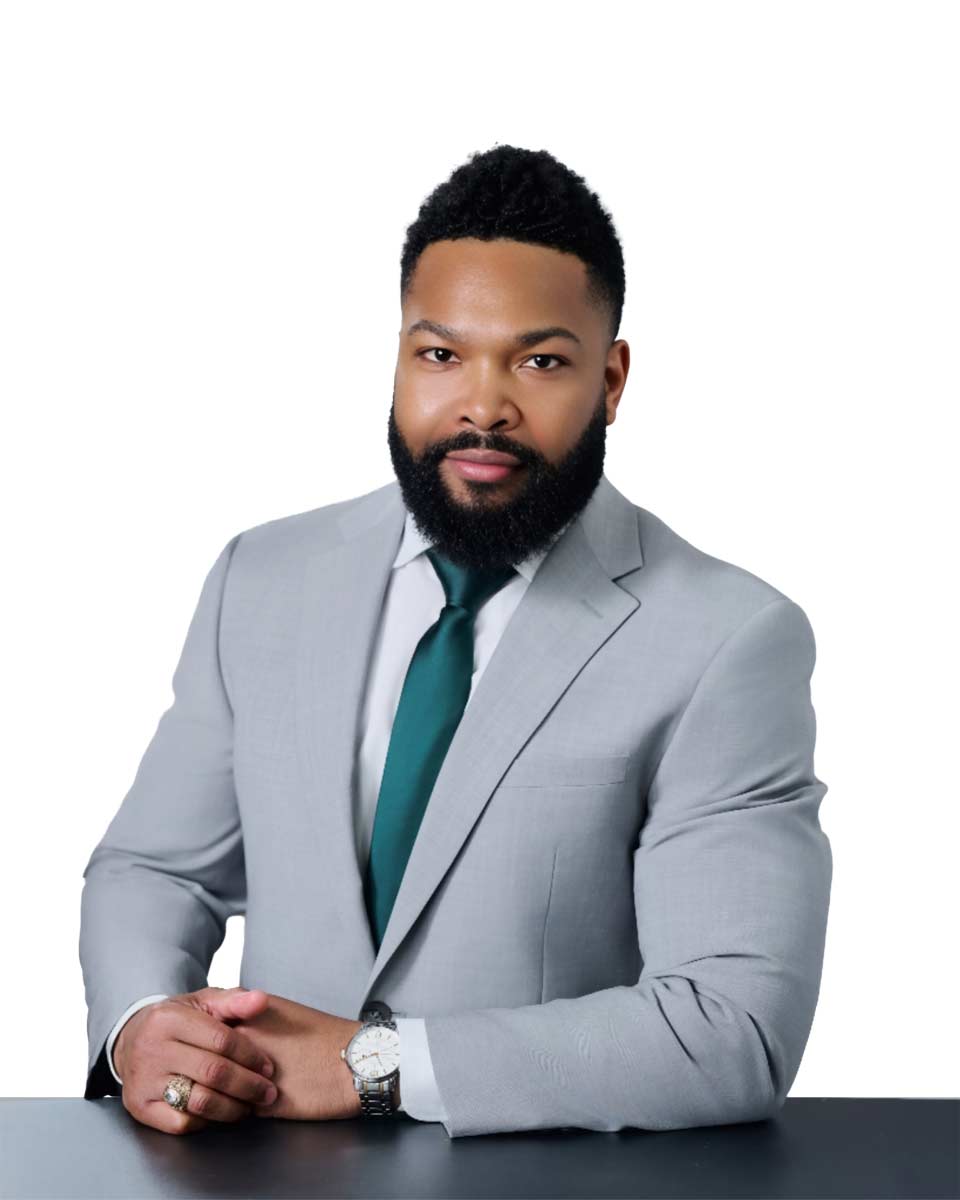
When Jamal Clayton Robinson was appointed Executive Director of community development nonprofit IMPACCT Brooklyn, it was due to the impact that he had made in his career spanning community development and real estate as a JPMorgan Chase executive to his leadership role as a captain at West Point.


For 62 years, IMPACCT Brooklyn has served as a community development nonprofit with a mission to eradicate housing insecurity. Its mission is to strengthen neighborhoods through racial justice, housing, community development and economic opportunity. IMPACCT Brooklyn advocates for Bedford Stuyvesant, Clinton Hill, Crown Heights, Ocean Hill-Brownsville, Prospect Heights and Prospect Lefferts Gardens.


Robinson’s interest in affordable housing and community development began while working at JPMorgan Chase in Community Development Banking and
Commercial Real Estate Development. Pratt Area Community Council was a client. “I learned the affordable housing and community development spaces when I worked on an affordable housing deal for the Pratt Area Community Council,” Robinson told Our Time Press.


Last September, he saw the impact of that deal as Executive Director of IMPACCT. “I did the Ribbon cutting for 778 Myrtle,” he said. “It was the very deal that I was working on at JPMorgan Chase for Pratt Area Community Council. It was a complete full circle moment.”


“It’s allowing folks to have the opportunity to live somewhere and have a roof over their heads. At 778 Myrtle it’s a mix of 60 affordable and supportive housing apartments. At a range of different affordability levels,” he said. “That fact that it is supportive housing within the affordable housing ecosystem means that much more. We have our social services team there helping residents get back on their feet. There are formerly homeless individuals as well. To see people have an opportunity and the right to housing to live is everything to me”


What makes IMPACCT Brooklyn unique as a community development corporation is the nonprofit has the staff to build affordable housing as a developer. It has a social services team that can also occupy and work in that building. Other services include social services, community organizing, tenants’ rights, economic development, financial literacy, foreclosure prevention, energy retrofits for homeowners, small business development, housing lottery training, and home ownership counseling.


“With the home ownership services, we are providing not only financial literacy in general but also financial literacy for home ownership,” he said. “The First Time Home Buyer Program is headed by Pat Julien, who has been with the organization for over 20 years. She has a knowledge and depth in helping folks in Central Brooklyn.”


“Housing affordability is such a problem and an issue for everyone,” he explained. “But, specifically, we’ve lost a lot of Black residents in Central Brooklyn. In 2010 it was 77 percent. Now, we are at about 41 percent. The demographics are changing. We want to help keep our residents from leaving Brooklyn.”


The motto for IMPACCT Brooklyn is Build, Restore and Preserve. “In this moment in time, we had to have a focused mission moving forward,” he said. “We came up with a strategic plan on a mission based on what IMPACCT has done and what it can do on an excellent level. That is to build, restore and preserve quality housing and educational services to keep our residents rooted in Brooklyn.”


Excellence was a word nurtured by his parents. Robinson grew up on the East Side of Cleveland. “It was a drug environment,” he recalled. “Back in the late 80s and early 90s, a drug epidemic was going on in inner cities. I knew something was wrong. I knew that wasn’t normal.”


“My parent were very clear. They said: ‘We can’t afford college. You have to be excellent academically and physically to get a scholarship to go off to school,’” he recalled. “I thought it was a harsh thing to say to an 11 year-old. But, I’m glad they did.”


In high school, he wanted to be a leader and looked at careers and colleges with leadership training. He sought out West Point. “My guidance counselor told me that inner city kids don’t go to West Point. That was deeply profound and did something to me,” he said. “I decided that’s where I wanted to go.”


No one in this family had served in the military. As a West Point cadet, he discovered academic and leadership capabilities. “It was a moment of a lifetime that shifted my perspectives,” he said. “It was grit, ambition and prayers. West Point taught me how to be a leader with character and lead with integrity.”


After graduating from West Point, he served in the Army. Later returning to West Point as a captain. He served as a Company Commander, a top management position working with cadets, officers and staff. While working at JPMorgan Chase, he returned to college earning two master degrees at NYU—a Master of Public Administration in Community Economic Development and Masters in Real Estate Development/Finance.


Real Estate is part of Robinson’s family legacy. His grandfather moved from Alabama to Cleveland and was a real estate investor in the 1940s. “He was one of the first owners in the neighborhood to use home ownership and he rented to other folks in the community,” he said. “I learned early on that you can make a social and economic benefit from real estate.”
“I wanted to go to IMPACCT Brooklyn so I could serve this community.

But, I could serve in a way that I could bring my whole self, my leadership capabilities, my community development and finance background,” he explained. “That I had the audacity to believe that I could work with individuals at legacy organization like IMPACCT to affect change. For me that’s not work. It’s showing up who I am.”
For more information visit: www.impacctbrooklyn.org

Family Photo Album for Bridge Street Church, A Living Legend in America for 260 Years

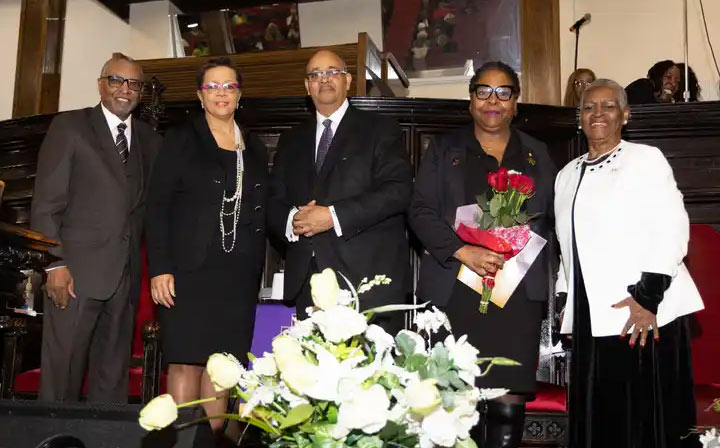
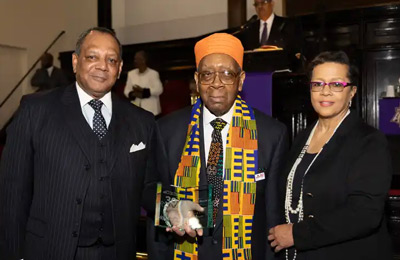
With roots established 10 years before the birth of America, historic Bridge AWME Street Church located at 277 Stuyvesant Avenue in Brooklyn, celebrated 260 years of dedicated service to the Downtown and Central Brooklyn communities, last Sunday, February 22, 2026.


The theme, this year, revolved around “Celebrating a Great Past, Building A Greater Future” with pastoral leaders Rev. David B. Cousin, Sr.; Rev. Valerie E. Cousin, executive minister; the church’s long roster of Bridge Street officers, including the ministerial staff, the Board of Trustees, evangelists, deacons, senior and junior Steward Boards and stewardesses paying homage to the Bridge Street ancestors, the established living legends of today, and young people who are carrying the church’s legacy forward.


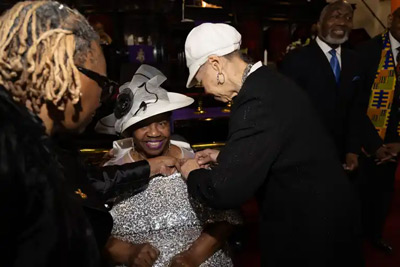
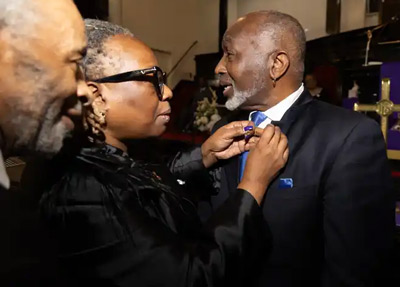
Highlights of the event included inspirational performances by the choirs, musical selections by The Next Generations Youth Choir and the One Voice, One Praise Choir; the memorial tribute to 10 saints who passed during the year; the awards recognition of the church’s outstanding youth for their “Aspire and Founder’s Day” submissions; the rousing speech by guest speaker Dr. DeForest B. Soaries, CEO of DFREE Financial Freedom Movement; a special presentation by Greg Anderson, President & CEO, Bridge Street Development Corporation; and the moving annual Living Legends Pinning ceremony spotlighting those monarchs who reached age 80 and still serve.

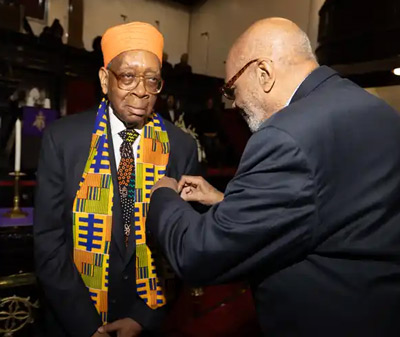
During this special “Pin” moment, Evangelist Carolyn Faye Simmons, Bro. Percy E. Weathers, Sr and Dr. Robert Jay Williams, Jr., Ph.D, MPH were pinned by, respectively, those who were honored last year, Deloris Canty, Paul Wallace and Alonzo Graves.


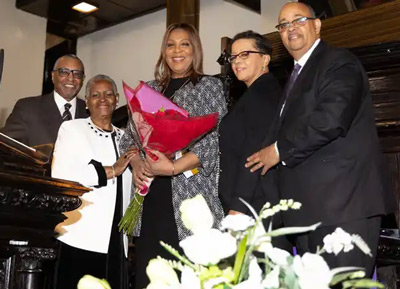
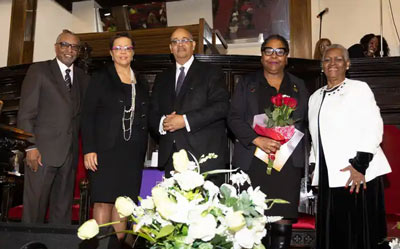
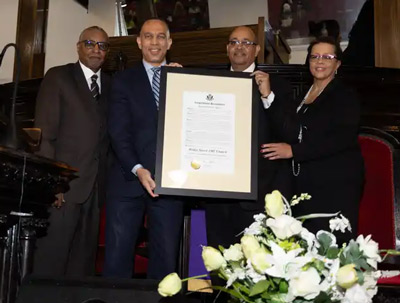
Bridge Street, one of the nation’s few faith institutions with two distinct histories, AME and AWME, was graced also by the presence of dedicated leaders and pioneers in their own right, Minority Leader Hakeem Jeffries (Dem-NY), NYS Attorney General Letitia James, Brooklyn Deputy Borough President Kim Council and Assemblymember Stefani Zinerman (D56th-Dem). All were introduced by community matriarch, Hon. Annette M. Robinson, a Brooklyn living legend and long-time member of Bridge Street.

For more information, visit: www.bridgestreetbrooklyn.org

Bed-Stuy Made Presidential Candidate Jesse L. Jackson

By Jeffery Kazembe Batts
IG: @kazbatts
We know that Black history is world history and it is timeless, but we can still respect the time designated by Dr. Carter G. Woodson as “Negro History Week” back in February 1926 and then officially expanded by President Gerald R. Ford into “Black History Month” in February 1976.

One hundred years after the founding we remember Black people’s glorious history of creating art, culture, and science. New ancestor Rev. Jesse Jackson’s life includes working with many historical personalities like the great Dr. Martin Luther King Jr. and Nelson Mandela. But when it comes to presidential ambitions then Bed-Stuy made Jesse.

A provocative statement, maybe. Chicago, Jesse’s long-time base probably would object to this claim, but follow the connections. During his two Democratic primaries Central Brooklyn voters flooded the polling sites helping Jesse to win the city, although not the state.

Brooklyn delivered not only votes but also advice, logistics, money, resources and experience to assist in spreading the growing chants of “Run Jesse Run” nationwide.


Brooklynites like elected officials Albert Vann, Annette Robinson, Velmanette Montgomery, Roger Greene, Ed Towns, and activists Jitu Weusi, Rev. Herbert Daughtry, Sonny Carson rallied their resources to boost the Jesse for President campaign while the Harlem established political leadership at first supported Walter Mondale and did not back the radical, insurgent Jackson campaign.

Bed-Stuy Restoration Plaza, House of the Lord Church, Bethany Baptist Church are some of the sites where enthusiastic crowds of old women, young men and all, gathered to see and hear the uplifting message of “I am somebody” and “Now is the Time”.

During the summers of 1984 & 1988 Rev. Jackson’s spirit could be felt as you transversed a neighborhood filled with campaign posters and local leaders serious about making change. Bed-Stuy was not new to this energy. Ten years earlier Shirly Chisolm, the first Black woman in Congress, representing Bed-Stuy, ran the first major presidential campaign for president of the United States by a Black person.


When future candidate Rev. Jackson, with his large Afro, was the featured speaker at the 1972 Black Political Convention (BPC) in Gary, Indiana, Congressperson Shirley Chisolm was upping the ante by running for president. Nonetheless she was not invited to speak at the BPC because of sexism and political in-fighting.

Nonetheless back in Brooklyn people were excited because the “Unbossed” Ms. Chisolm was encouraging community consciousness and developing structures that others would build upon later.

With the election of Assemblyman Al Vann, Senator Annette Robinson, Congresspersons Ed Towns, Roget Greene, Major Owens within the Coalition of Community Empowerment, Central Brooklyn and Bed-Stuy in particular, had a formidable and capable operation hat was ready to support a more robust Jesse for President campaign.

Al Vann became State Campaign Director for Jesse’s campaign. Rev. Herbert Daughtry, travelled with Rev. Jackson when he went to Syria in January 1984 to successfully negotiate the release of U.S. Navy Lieutenant Robert O. Goodman Jr.


NYC is America’s largest city. In the 1980’s Central Brooklyn was the largest continuous community of Black people in America. Back then you could walk from East New York all the way to Downtown Brooklyn without missing the presence of Black people in what today are gentrified neighborhoods.

Bed-Stuy in the 80’s hosted the African Street Festival at Boys & Girls H.S, the revolutionary Slave Theater, a thriving Restoration Plaza business and event center, Spike Lee & Mike Tyson loudly representing the hood, Majid Al-Taqa & Concord Baptist Church giving spiritual blessings, people relaxing at Von King Park, or strolling through the busy Nostrand & Fulton intersection.

Bed-Stuy was uniquely situated to assist a Black man vying for the American presidency. Black people were the strongest constituency in Jesse’s Rainbow Coalition and Bed-Stuy was the strongest community delivering votes and organizing capacity. Jesse Jackson never won the presidency, but he changed the rules.

No more “winner take all” after Jesse’s campaign. Proportional representation for delegate allocation is part of Jesse’s legacy. This new formula allowed for Barack Obama to win the democratic party nomination twenty years later in 2008.


Shirley laid a foundation. Al built on it and led Jesse’s campaign. Jesse changed the rules that made it possible for Barack to win the presidency. Jesse walked with Dr. King, met with Yassar Arafat and Fidel Castro, was friendly with Nelson Mandela, led boycotts of corrupt corporations, and much more.

When it comes to his presidential campaigns one can argue that if he had not done well in the NYC primary, his candidacy would have faltered and history would be different. Future mayor David Dinkins was convinced he could win after seeing Rev. Jackson’s vote totals in 1988.

Dinkins did win and become the first Black mayor of NYC in 1989. Sankofa, look back and move forward. Study the past and build the future.