By Mary Alice Miller When Puerto Rico defaulted on its debt a few years ago in the aftermath of Hurricane Maria in 2017, family and friends in New York watched as the territory’s schools and hospitals closed and people lost their pensions. Several high-risk hedge funds had bought much of the country’s assets.
Puerto Rico’s municipal debt is estimated at $74 billion, not counting pension obligations. The crisis was caused in large part by hedge funds that invest in sovereign debt issued by countries in financial distress, extracting billions of dollars in profit from the pain and suffering of people living in those countries.
“What we’ve seen is after these vulture funds purchase all this debt, they go to these countries and force repayment (by suing often in New York courts),” González-Rojas explained.
“We’ve seen public universities de-funded, particularly in Puerto Rico. We’ve seen social services slashed. We’ve seen health care facilities shut down and we’ve seen pensions cut. And it’s happened not just in Puerto Rico, but in places like Venezuela, Ecuador, Peru,” said González-Rojas. “Often, we wonder why there’s a migrant crisis. We’ve allowed Wall Street to destabilize these economies.”
Countries issue bonds to raise money for infrastructure or other public expenses, promising to repay the buyers later with added interest. In recent decades, some hedge funds adopted strategies of buying distressed sovereign debt and then aggressively suing for repayment when countries default, often in New York courts. Puerto Rico is not unique. Argentina, Equador, Panama, Peru, and Republic of Congo have also been targeted by vulture funds under New York State law.
New York State plays a major role in predatory vulture fund ability to extract resources from poor, developing countries, draining countries’ resources and further prevents their efforts to restructure debts.
Champerty is a long-standing legal principle that prohibits buying debt simply to sue and bars profiteering through litigation. In 2004, hedge funds won a carve out in New York law: if the debt claim is over $500,000, champerty doesn’t apply.
The carve out allows predatory investors to seek profit from litigation against debt-distressed countries in New York State courts. Normally, sovereign debt cases are handled out of court, but hedge funds choose instead to sue in New York State. Over half of all sovereign debt bonds are governed by New York State laws. These bonds, representing tens of trillions of dollars worth of debt held by countries around the world, are issued under New York State law.
The state is seen as the best jurisdiction for sovereign debt, but the carve out allow abusive lawsuits to take place, undermining that status. The International Monetary Fund estimates that nearly 70 countries are in or at risk of debt distress. As vulture funds standardize their practices with an extensive network of high-powered lawyers, trade associations, lobbyists, public relations experts, universities, and cultural institutions, increasing numbers of countries are at risk of being sued in New York. But, New York State can disrupt these predatory practices.
In the aftermath of Puerto Rico’s crisis, State Senator Liz Kruger and Assembly member Jessica Gonzalez-Rojas introduced legislation that would prohibit the purchasing of financial instruments solely for the purpose of litigation. The bill would restore champerty protection by 1) removing the safe harbor shielding of $500,000 or greater claims from New York judiciary law, and 2) lower New York’s punitive prejudgement interest rate.
The bill was narrowly crafted to apply only to notoriously litigious investors, ensuring that no impact on conventional or cooperative investors who engage in good-faith workouts. The legislation would impact about $800 billion in debt from developing countries.
State Senator Liz Kruger outlined the purpose of the bill. “It basically says you can’t buy up a country’s debt because they’ve defaulted just because you want to buy it for 10 cents on the dollar or pennies on the dollar and then litigate to try to get a dollar for a dollar out of countries who don’t have the money to pay back,” said Kruger.
Kruger continued, “When we help to destroy other countries’ economies that means they can’t provide education, infrastructure, clean water, electricity, and health care to their people. And sometimes the government then crumbles and collapses, and they go into Civil War situations. Not only do the people of that country suffer but in fact the United States of America suffers because we’re seen as the ones who are responsible for all this all over the world because we’re letting it happen.
“We always wonder why are there all these migrants fighting to get here. A lot of them come from the countries that there is no longer a functioning government or infrastructure for them to be able to take care of themselves and their families,” said Kruger. “The domino effect of this unbelievably selfish model of finance can’t be allowed to continue.”
Kruger concluded by saying, “My father was an international investment banker his whole life. He would be mortified if he was alive. He would go ‘That’s not what banking’s about , that’s not what cross international investment in about. It’s about ensuring that you are building things, that you are adding to the economic prosperity of places outside of the United States of America. You are not doing this to destroy countries, create international nightmares and havoc for a couple of people who figured out how to game our system for personal wealth.’”
Kruger added, “If dad was alive, he would stand here and say ‘Shut them down. Stop this from happening.’ And so we’re shutting them down. That’s exactly what we’re trying to do in the state legislature as much as we can.”
By Nayaba Arinde Editor-at-Large Will Bed Stuy’s beloved Smurf Village become a cut-and-paste condo complex? The Brooklyn neighborhood has been gentrified at an alarmingly shocking pace; multi-decades-old Black businesses and Black-owned or traditionally Black folk-rented homes are being replaced by a new population–some call them transplants.
So, the news that the famed Smurf Village on the important Fulton Street (aka Harriet Ross Tubman Blvd) and Utica Avenue axis is about to be torn down for developers to build yet another condo complex is sparking a palpable reaction amongst established residents and original locals.
Named for its almost cute diminutive three-story style, the word on the Bed Stuy curb is that developers want to take down the low-income apartment complex in favor of over ten seventeen-story buildings with perhaps 2,000 market-rate and “regulated affordable housing.” With its traditional Dutch architectural style of stepped gables, giving the buildings a “village-like” silhouette, hence the colloquial name Bed Stuy.
Smurf Village was built in the early 1980s. Officially part of the Fulton Park apartments, there are 12 three-story walk-up buildings, two interior courtyards with benches, and children’s climbing apparatus.
It sits adjacent to Boys and Girls High School. Across the way is the busy bus and pedestrian hub, and subway station, and a plaza set to be named later this year for Malcolm X. Traditionally, this is a site for many a protest, family events, joyous rallies, and a concrete playground lined by a variety of stores, the sometimes heady spot for afterschool youth congregations. With the Long Island Railroad close by, it has always been under the developers’ watchful eye.
In a community that has been decimated by rapid gentrification, which has seen everything from rent increases to the culture and flavor of the neighborhood slightly tempered, to the edging out of once-established and reliable community-centered staples, prices on many things have risen, including rents and home prices. This is in a Brooklyn area where the majority of people–53%- rent their homes.
Community Board 3 did not have an official response for the paper, but a member told Our Time Press, “We haven’t had a public hearing yet.” Saha Guerrero, Press Secretary for Councilmember Chi Osse, told Our Time Press, “Our office is reviewing the proposal, and Council Member Ossé will meet with residents of Fulton Park Houses this weekend. We’re looking forward to listening to residents and supporting their needs.”
“We have a community in Smurf Village,” former resident, Brooklyn school educator Eric C., told Our Time Press. “People have raised their children here for 3 decades. My people tell me that they have had very little solid information about what is really going on. They should not just leave people in limbo like this.”
“I have met twice with L&M Development regarding the proposed redevelopment of Fulton Park Houses, built by the late Jackie Robinson, also known as Smurf Village, at Utica Avenue and Fulton Street, and shared my concerns about the project,” Assembly Member Stefani Zinerman told Our Time Press.
“A well-designed proposal on paper must also demonstrate responsible execution on the ground. Since then, residents have contacted me to report they have received conflicting information from management about their future housing security. That is unacceptable. No redevelopment should proceed without ironclad, written guarantees of non-displacement, clear timelines, and transparent communication.”
Brooklyn activist Jamell Henderson told Our Time Press that he will be organizing a press conference and rally with Citizen Action, “To put pressure on the elected officials. Was the tenant leadership or association notified, or were they given a false presentation? Many of these developers take full advantage of residents who don’t understand the terminology or the visuals they present. Residents, be ready to organize.”
Assemblywoman Zinerman continued, “The proposed density — including buildings up to 17 stories — would significantly transform an already congested corridor. Before any approvals are granted, there must be a comprehensive environmental impact review that addresses air quality, noise, vibration from the nearby Long Island Rail Road corridor, traffic flow, and the capacity of aging sewer and water systems.
Infrastructure in this section of Bedford-Stuyvesant was never built to support that level of density. Public health and safety must come before private timelines. Development must serve the people who are already here — not displace them or overwhelm the neighborhood. I will continue demanding transparency, infrastructure accountability, and community-centered planning every step of the way.”
“The residents aren’t really happy about what’s going to happen to their apartment complex, especially because some of these apartments have 1, 2, and 3 bedrooms,” said content creator Scourgebliss, as he trudged through the snow in Smurf Village, a couple of weeks back. “When these new buildings go up, I guarantee that they won’t have three bedrooms…and they will be way smaller.”
“They don’t have consideration for the seniors and the handicapped,” said one 20-plus-year resident. “We can’t be for certain that all the people living here will have a new place,” speaking with some “terrified” and irked residents, the citizen journalist, whose other name is Troy–noted that currently tenants have backyards, a park, a car park and tons of benches, “once the buildings go up that will all go away.”
Troy/Sourgebliss concluded, “The City loves to make claims that they will do something, and when the time comes around, we see many injustices happening. I know that change is inevitable, but there could be other ways instead of displacing people who already live here, and putting up brand new buildings in an already established space–especially when you get rid of parking, a ton of space, and you price people out. Let’s keep Black people in Bed Stuy.”
The Incarceration of African American Women from Harriet Tubman to Sandra Bland
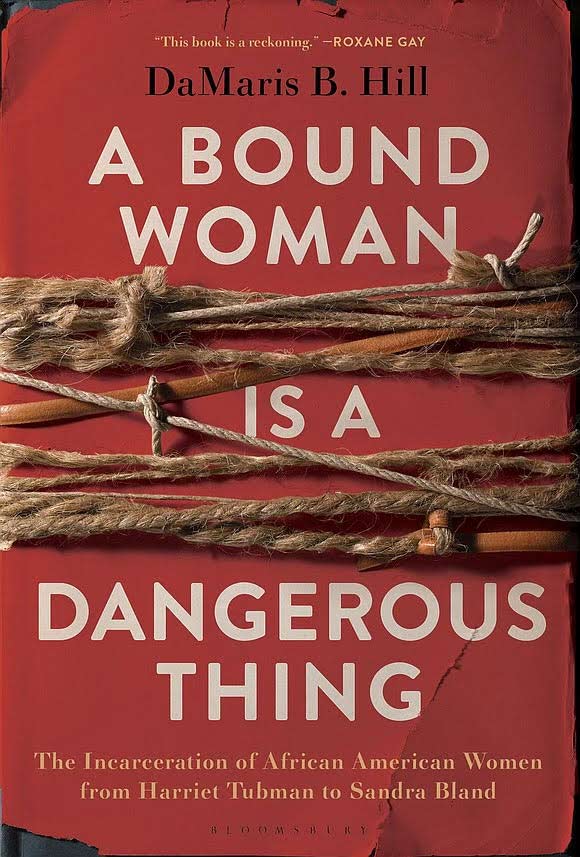
A Bound Woman is a Dangerous Thing: The Incarceration of African American Women from Harriet Tubman to Sandra Bland – By DaMaris B. Hill Bloomsbury Publishing, 163 pages. 2019
“In these poems, the legacy of these women’s lives chases me like a strong wind. This book is a love letter to women who have been denied their humanity.”
DaMaris Hill’s A Bound Woman is a Dangerous Thing: The Incarceration of African American Women from Harriet Tubman to Sandra Bland (Bloomsbury, 2019) is a narrative in poems and prose that is a testament to women who have engaged in acts of resistance as a result of enslavement, domestic violence, rape, incarceration, and the liberation struggle.
Hill encapsulates the stories of these women in poetry, prose, first-person testimonies, and photographs that capture the pain, grief, and determination of Black women who have been wounded spiritually, emotionally, and physically. Some of the women portrayed are from Kali Nicole Gross’s book Colored Amazons: Crime, Violence, and Black Women in the City of Brotherly Love, 1880-1910.
Readers will be witnesses to the stories of women such as Harriet Tubman, Ida B. Wells, Fannie Lou Hamer, Sandra Bland, Claudia Jones, and Assata Shakur. Hill’s poems are testaments to the passion exhibited by these women in their fight against injustice. She is not concerned with their political affiliation or their politics.
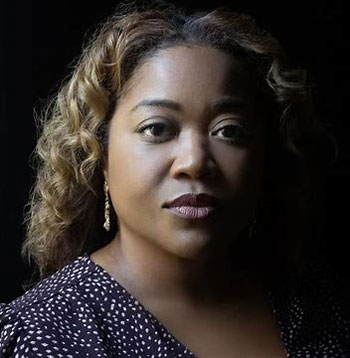
DaMaris Hill
Her lifting of the voices of these women demonstrates her commitment to ensuring that all voices are represented and heard in the struggle for human rights. In response to the question of what it means for a Black woman to engage in resistance, Hill states: “It means that I must give myself permission to love, weep, grieve, call on ancestors, and begin a daily ritual of resistance, even if it is rooted in my fears.”
Hill introduces the women in the book with black and white photographs that symbolize the period in which the woman lived, a short statement on the woman’s life, and a poem or poems that illustrate an act of resistance taken by the woman. Laura Williams, for example, is a Black woman who was convicted and imprisoned in 1887. She dies of tuberculosis one month before her sentence ends. In the poem “Stewing,” the speaker utters her despair.
Tuberculosis fevers stew my pain. Curdle my stomach’s bile. Vomit creeps. I dream of hounds. Their teeth loose in my veins.”
Several verses highlight Hill’s poems on the activism of Ida B. Wells, journalist, educator, and suffragist. “Calculations” exposes the horror and brutality inflicted on Black men who are lynched.
In the 1862nd year of the year of our Lord, there were 241 lynched torn from wives’ arms and wedding chambers Multiply that by the rope. Count the trees they strung from The torches. All of this done under the armor of white supremacy mob violence
One of the women highlighted for her political activism in A Bound Woman is Claudia Jones. A Trinidadian-born journalist and activist, Jones began engaging in activism at the age of 21. She worked with organizations that aided the Scottsboro Boys and later became a member of the Young Communist League, USA.
During her life, she spent time in prison after being falsely accused and found guilty for violating the McCarran Act (a requirement that Communist organizations register with the United States Attorney General). An excerpt from Hill’s poem “Claudia Jones” highlights Jones’s impact as an activist.
Trinidad’s daughter, justice’s town crier and good good girlfriend of Amy Ashwood Garvey . . . . How many ways did you right women?
In “This Granny is a Gangster,” Hill describes the activism of Sonia Sanchez, who at 82, along with eleven other grandmothers, staged a sit-in protest at a large military recruitment center in Philadelphia. She and the other activists disrupted the recruitment station and motivated others to join the protest against the Iraq War. Hill states:
She wields protests like wind. At 82 she marches like she is leading a second line. Awe at her knees. With her cane she cracks blessings and calls your nearest kin. Shespeaks peace in a cadence of prayers.
Hill’s poem in memory of Sandra Bland will resonate with many. She pens the words:
It could have been me, like Sandy, I would have missed them dashes in the road. The ways I skirt around corners under the cover of the sun. I fleeing an interview happy to have some means, pockets fluffy with promises.
The symbolism of A Bound Woman is a Dangerous Thing: The Incarceration of African American Women from Harriet Tubman to Sandra Bland speaks to the many ways that women have been bound and “scarred” in America. Hill’s documentation of these voices in verse creates a space for valuing the humanity of these African American women.
DaMaris B. Hill. poet and creative scholar, is chair of the English and World Languages Department at Morgan State University. A Bound Woman Is a Dangerous Thing is her first poetry collection. Her most recent book is Breath Better Spent: Living Black Girlhood.
Dr. Brenda M. Greene is Professor Emerita and Founder and Executive Director Emerita of the Center for Black Literature at Medgar Evers College, CUNY. For more information, visit https://www.drbrendamgreene.com
Fern Gillespie Lurita (LB) Brown, owner of Clinton Hill Simply Art & Framing Gallery, is renowned in Brooklyn for her high-quality custom framing of visual arts. This year marks Clinton Hill Simply Art & Framing Gallery’s 35th anniversary. However, Brown‘s expertise in visual media predates her career as an entrepreneur.
Although during the 1970s and 80s, she was a corporate sales executive at WABC-TV and 3M, Brown also worked for legendary Black magazine moguls, Earl Graves at Black Enterprise and John Johnson at Ebony magazine. She was an advertising sales manager selling Black culture and images to major corporations.
Both Earl Graves and John Johnson became her business mentors. She admired their entrepreneurial passion. “Earl Graves sat on a lot of boards. I did the foot work and the account work as a manager,” she told Our Time Press. “Whenever he was around his peer group, he would let them know I was coming. He would be the hammer guy. The hard sell guy.”
“Working with John Johnson was fantastic. The man was multifaceted,” she recalled. “He would always say to us, ‘it’s not just about the money, it’s about the people who we represent. This is our culture and we have to take control of it and never let anyone tell you about what we do. We tell them.”
When she first met Johnson in Ebony’s Chicago building, she was amazed. “It was very impressive. There was Black art on the walls on all of the floors,” she said. “I was collecting art then. There were Black master artists on the walls. Wow!”
As a hobby, Brown began selling Black diaspora ethnic posters including Caribbean and Hispanic art posters at art shows, exhibits and trade shows. At that time, both Caribbean and Hispanic multi-cultural posters were more available that Black American art prints.
The success of her sideline job inspired her to explore opening up a poster print gallery. She left Ebony and became an entrepreneur. “The ethnic print market was a small percentage. It wasn’t huge like it is now. A man that I did my framing called me and said he heard that I was opening up a poster print gallery,” she recalled. “He said, ‘are you going to offer framing?’ I said no.
He said ‘If you don’t offer custom framing, and just posters, what’s going to happen is that people are going to buy your posters and come to me for framing.’”
“I never thought about that. I told him I didn’t know anything about framing and wasn’t interested in getting into it. He said, ‘You are the boss. You hire people to do the job.’ I will never forget that. That’s when I realized I had to stop thinking like an employee and start thinking like a boss. “
Since the early 2000s, she’s had display space for early career artists in the gallery. That’s when she started utilizing wood frames for artwork. The gallery began specializing in designing and making wood frames. Early career artists’ original artworks on paper by paint, charcoal and mixed media were framed and sold.
It also is when she became a dealer, representing some of the emerging artists and selling original artwork to customers. “I decided to work with the early career artist, then professionals. I remembered words of wisdom from Mr. John Johnson,” she recalled. “He said: ‘If enough people ask you for a certain thing and you don’t have it, then you need to get that product or tool and sell it because that’s where the demand is coming from.’”
Not only does Clinton Hill Simply Art & Framing Gallery create custom frames for art posters and fine artworks, but also frames a range of objects items encompassing memorabilia to shadow boxes to diplomas. “You get a degree when you graduate from of college. You get it custom framed. You are proud of that,” she said. “Framing is an industry within itself.
It’s not just a structure to hang artwork. But together it changes the value and it also changes how you feel about your artwork if it’s custom framed. Custom framed instills a sense of pride.”
Her customer base in the neighborhood has been changing. It’s also the age of AI artwork. “The Gen Z bunch are the new consumers. They are now two generations into framing. They understand the different levels and different quality of framing. It involves expertise and knowledge,” she said. “Today the business has evolved once again to reflect a younger multi-ethnic buyer for custom picture framing design. Black art on paper from the 1970s and 80s is now considered vintage sales.”
Brown grew up in Queens. Her family members worked in civil service. She is the family’s first corporate executive and business owner. “Affirmative action and being in that era of the 1970s and 80s helped.
There is no doubt that about it. This put me on that path that led me to this journey,” she explains. “I was at the right place at the right time making untested right decisions at each milestone decade. Reaching this 35th anniversary at Clinton Hill Simply Art & Framing Gallery.” x
(Winner 1998 New York Association of Black Journalists First Place in Personal Commentary) By David Greaves The empty buses rolled into Brooklyn early Saturday morning. Across the rain-washed Manhattan Bridge, the Greyhounds came, their empty seats silhouetted against gas station neon, appearing as ghosts through fog-wet windows. The buses were coming to transport the keepers of the maternal instinct of the African People. The Mother Wit. The Women.
It was Saturday, October 25, 1997. And as if to demonstrate the power of the Sisterhood, two women, known only to family, friends and co-workers, gave life to an event which will stand as a milestone for Africans-in-the-Americas.
As they returned from the March, we saw that over a million women had flexed a spiritual muscle that did not involve the usual power players of big-time media, money, national fame or political clout. This March is another stunning achievement in the legacy that Black women have given America.
Whether it was Sojourner Truth, Harriet Tubman, Fannie Lou Hamer, Ida B. Wells, Mary McCloud Bethune or any of the unknown others, March conveners Phile Chionesu and Asia Coney, take their place in the long line of women who saw the need to save the children of our ancestors and acted. It was about women beating a spiritual drum that summoned over a million souls, and by its very existence, told them anything is possible.
This is the spirit that many bring back and put to work in their lives and in their homes. It is a nurturing process, and as the first life-givers, African women have had more practice than most. That shared consciousness of childbearing and nurturing in hard circumstances allows them to communicate and connect on a level that men have to work at to even approach.
During the Million Man March, there was hugging and good feeling, and there is no denying that much personal and practical work was done. But from the women who loom large in my life, I have learned that they communicate differently and, in more detail, than men do. What many men are now learning to do, many women have mastered long ago. Now they are moving to some other level of spiritual connectivity that we will learn more of as we watch it take shape and crystallize into action. And that is what makes this coming together of women so potentially powerful.
Women are convening the Mother Wit. They are focusing on a series of goals. And we at OUR TIME PRESS are not going to miss the opportunity to record embryonic stages and chart the progress. It is necessary that this be done so that proper credit can be given. We have experienced the effects of the Million Man March on the men and on their communities in ways subtle and unknown. Businesses were born, attitudes were changed and lives were touched. This paper itself was helped by the energy after that March.
In urban centers across America, crime has been going down. We know intuitively that the work of the men returning from our March had a large role in that. But because there was little charting of the effects of the individual work that the returning men did: the tutoring, the mentor programs, the lives that they touched, the result of their efforts is a prize that others are claiming.
This will not happen with this Million Woman March. Partly because it follows the Million Man March and lessons have been learned, but mostly because it is women who did it. Over the next few months, there may be profound changes in our communities; and while others will be recording them, OUR TIME PRESS would like to record them also.
Now that the March is over, as plans are made and actions are taken, we will be continuing this mission. Readers may want to write to us about what they have been doing and the results of those actions: whether it is nurturing businesses, or nurturing the diverse elements of the home and the village, write about it. OTP will be taking periodic looks at these efforts, and like a stop-action camera, trained on a flower in bloom, we will attempt to record a small part of the achievement.
As we celebrate the 2026 March International Women’s “Herstory” Month, let us take time to remember, elevate and pay homage to Our Sisters on the ground who are leading efforts nationwide to build and sustain community, while providing support — and shoulders — for each other in these critical times.
Our Time Press pays tribute to women in the community — most barely known — who are carrying on the work of the women who came before them, who helped create them. Ideally, they should be told of their fierceness, talent, beauty, intelligence and appreciated for their works. However, when they rise up warrior-like, ready for action, there are some who would bring them down, and query, “Sister, Who Do You Think You Are?”
Ten powerful sisters declare their Somebodiness and their strength through their strong answers to that question in short vignettes, this week and next.
Brenda Brunson-Bey portrait by Winston Wharton
Those stories remind us that while Sisters face an uphill battle, they’ve been facing it for generations before us. And young Sisters moving up from the rear may face it for generations ahead of us. But either way, all things equal, it’s a win-win. For Strong Sisters.
We will accept real support, the real love, the real camaraderie and the real estates stolen from us. So, this month let’s take the time to celebrate give The Sisters.
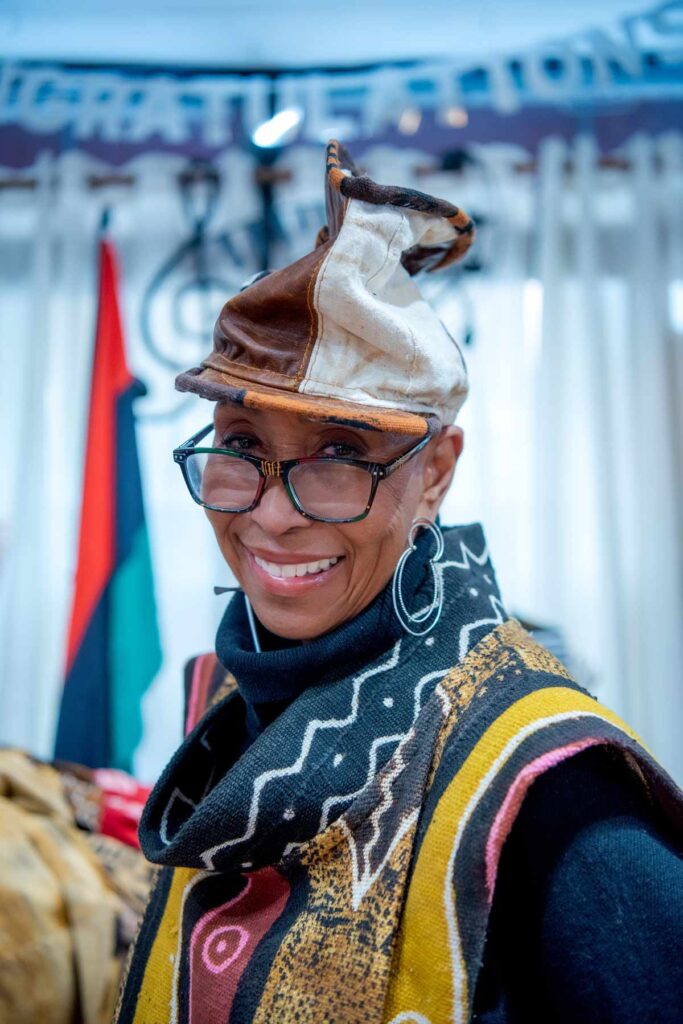
As a young woman growing up in the 50’s and 60’s in Augusta, GA, sewing was always a piece of southern culture. Each girl had to learn to crochet by 8 or 9 years old. By 10 or 11, you had to be able to embroider a pillowcase or sheet edge. In High School, we had a class called Home Economics, where even boys got to know basic hand stitching.
Creating was always a part of my life from drawing and painting to crochet and knitting and sewing. An elder neighbor, Ms. Missy gave me my first foot pedal sewing machine. This gave me the capacity to make garments. I started altering my bought clothing and customizing and redesigning as a teenager. By 16, I was making my and some friends prom and special event costumes and dresses.
Later in life, I found out from my father’s oldest sister, Aunt Ruth Reid, that the Brunson family was raised “post slavery” to creatively sew and tailor. My father, Bill Brunson, Sr., came to New York in 1933. An extraordinary tailor, but because of racism, could only get a job in a Jewish owned cleaners doing alterations.
My Aunt Ruthie migrated here, too and made her living as what was then termed, a seamstress but could design and create any garment from cutting to completion. I always admired her independence and take-charge personality.
If I think about who influenced me most besides the natural education from school, it had to be my Aunt Ruthie. When I went into my first real retail experience, 4-W Circle of Art and Enterprise Collective Store, Ruthie was so proud that I was carrying our “Brunson family,” tradition. She had always dreamed of having a sewing factory and store. After 4W, I opened my own retail store, Tribal Truths Collection, which served me and the community for 16 years.
While I don’t presently have a physical retail space, I continue to create monthly collective Pop-Ups and semi-annual shows and sales, here in New York and other cities. We call these our customized “traveling stores,” which feature from 6-18 other culturally focused artists, jewelers, designers and craft persons.
My advice to others is to study your family creative gifts and traditions no matter artistic, technical, medical, etc., because I believe our ancestry makes you form, understand and carry on your innate and God-given interests. Develop, even as a hobby, if not a career, so these ancestral gifts and dreams can be passed on through “YOU,” to the next and future generations. “YOU,” truly are your ANCESTRAL DREAM-LINK.
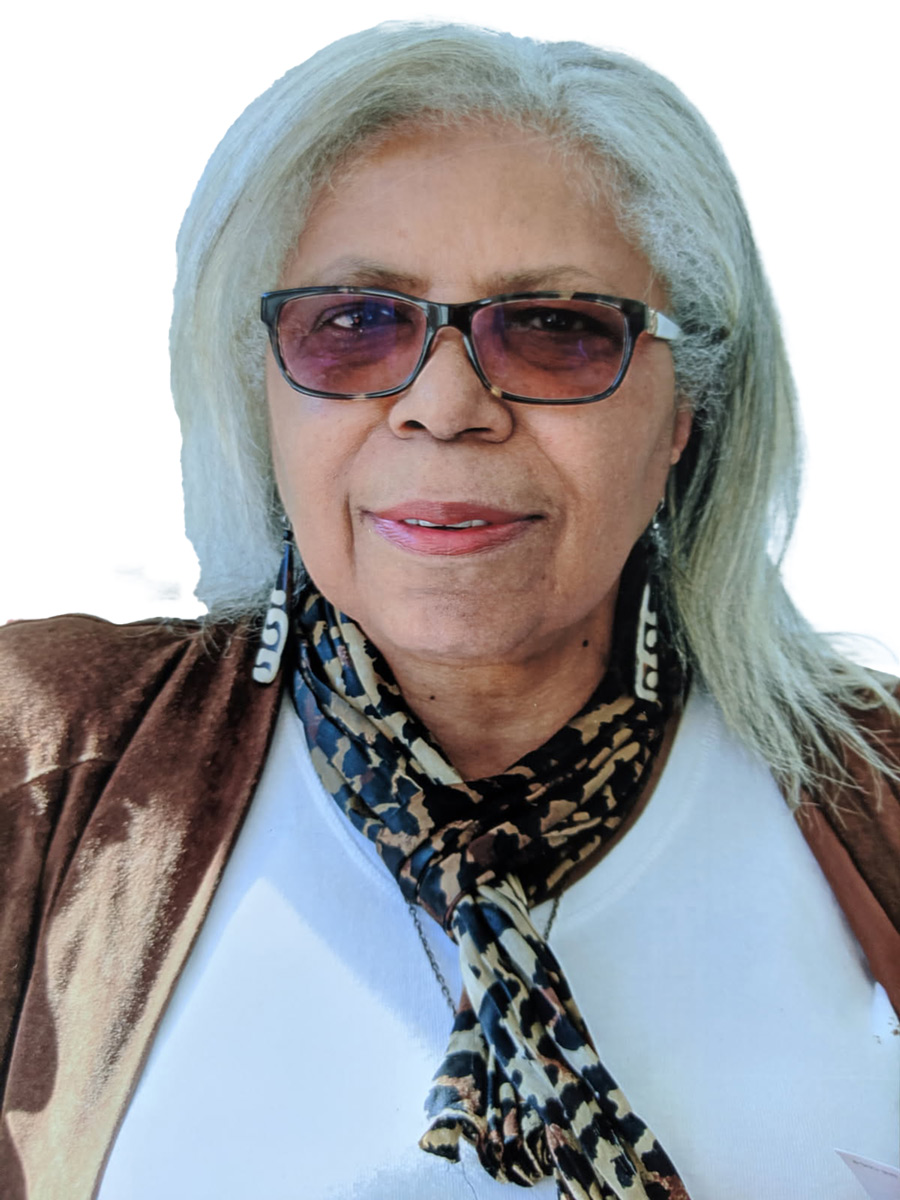
Brenda Brunson-Bey is Founder of Tribal Truths and Guest Editor, Our Time Press 2026 March International Women’s History Month
Dr. Norma Raybon of Spelman College Helped Me Find My Voice
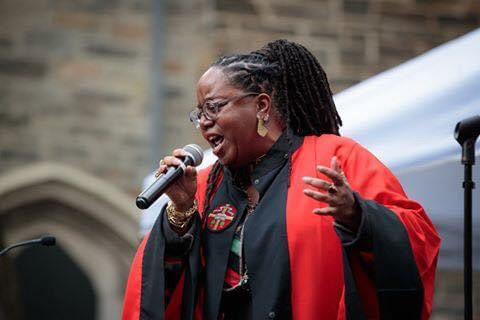
“To inspire” originally carried a literal sense of breathing life into something. Its meaning expanded later to include an external influence animating a person’s mind or spirit. It is the sentiment I apply to my resilient college music instructor, Dr. Norma Raybon, who inspired me to sing by breathing life into my voice.
I first joined my church’s choir around age 11, and from grades 6 through 12 I had an “average” voice. But my church choir was filled with loving, maternal women who were always gracious and supportive. My choir director was my mentor & protector, making sure I always had a ride to and from rehearsal to whichever random foster home the State of Massachusetts had assigned to me.
Hortensia Gooding
Because of my disorganized childhood, I nearly missed my opportunity to attend Spelman College in Atlanta, Georgia. I registered for classes over the phone and most of the required first-year classes were already full.
The registrar asked if I had any hobbies or interests that would translate into courses. I casually mentioned the debate team, working after school at the Red Cross and singing in the choir. I never guessed how important the choir would be. The next thing I knew, I was enrolled in Music Theory and The Spelman College Glee Club (SCGC) under the direction of Dr. Raybon.
Unlike my church choir that rehearsed once a week and learned music by ear, SCGC met Monday through Friday, and I learned music via sheet music. Prior to Music Theory class, I had no idea how to read sheet music. Dr. Raybon seemed not to care. She held us responsible for singing every song with breathtaking beauty and an exhausting amount of power.
Dr. Raybon was different in that she focused on demanding intentional skill instead of rewarding genetic talent. Singing beautifully went from being forever impossible to presently difficult. Becoming an effective and reliable singer meant stacking certain habits until they became instinctive. Singing requires very deep and consistent breathing; the engagement of muscles in my abs and my back; constantly accurate posture; keen listening; uninterrupted observation and a good memory.
I also learned under Dr. Raybon that “singing beautifully” also requires: Punctuality. Organization. Practice. Rehearsal. Articulation. Volume. Precision. I was so busy absorbing these new skills and alien concepts that I had no idea I was finally learning to create art with my own body. All I knew was that Dr. Raybon was always asking for more and I was always willing to give it.
What Dr Raybon did not tell me was as important as what she knew and perhaps intentionally did not share. Dr. Raybon never warned me that singing could take over my identity. She did not promise free travel, billboards, hotels & beautiful clothes. She made no mention of applause, awards or financial gain.
Yet she gave me what she knew I already had inside: tools for life. In the fall of 2000, I was on tour as a professional gospel vocalist singing both lead & background vocals in a whirlwind tour of Australia, New Zealand, Hungary & Italy. Since then, I’ve added many cities in France, Brazil, Argentina, Ecuador, Columbia, Mexico and here in the US.
In New York City, I’ve had the honor to perform multiple times at Carnegie Hall, Radio City, The Apollo, City Center, Lincoln Center, Symphony Space, and Aaron Davis Hall and innumerable sacred spaces and performance venues.
Dr. Norma Raybon gave me tools, and directives and standards. Because of her consistent reminders, I have permanent mental, physical and spiritual habits. Because of her expectations I am always seeking to learn music and to improve how I learn music. Because of her groundedness, being a professional vocalist is a fact instead of a compliment.
Because of her artistic generosity, I can honestly say that I sing to live and I live to sing and to inspire others coming after me. For that, I am eternally grateful.
–Hortensia Gooding
Who Do You Think You Are?
In the beginning, I was extremely insecure. I had no idea—none—that I was talented in any way. I was humble, respectful, quiet, and always smiling. I followed directions well. My mother once told me I was going to be a teacher, and that was that. No debate. No dramatic career crisis. Just a declaration spoken with the kind of certainty only mothers possess. When I graduated from college, many of my friends were headed to law school. It sounded impressive. Important. I told my mother I wanted to be a lawyer too. She listened and calmly replied, “Be a teacher first.”
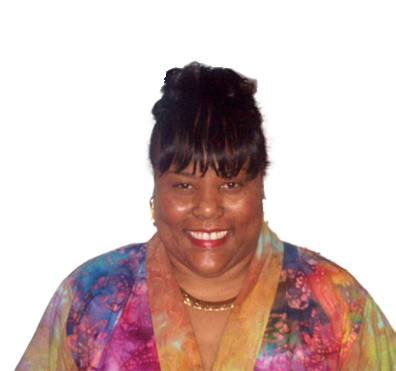
Dr. LaVerne Nimmons
So I did—and I never looked back. Teaching wasn’t just a job. It was my calling. Of all the grades I taught, kindergarten held my heart. The children arrived as blank slates—open, curious, fearless. Together we created worlds filled with joy, brilliance, and love. As they grew, so did I. My creativity expanded alongside theirs. Everything revolved around beauty, growth, and possibility. And yet, despite all of this, there was a quiet question following me: Who did I think I was? The truth is, I didn’t know I was smart until I was in my forties. That realization startled me.
I went back to school and pursued a Ph.D., not for a title or prestige, but to prove something to myself—that I was, in fact, brilliant. That decision changed everything. As an elementary school principal, I became determined that no child under my leadership would grow up unaware of their own brilliance. I made it my mission to ensure that every student, teacher, and staff member knew they were extraordinary.
I didn’t just say it—I built an environment around it. A place where joy, laughter, peace, beauty, and love were not extras, but essentials. Under that leadership, the school became a National Blue Ribbon School of Excellence. It was astounding, but also deeply simple: when people believe in their brilliance and are supported with resources, care, and vision, they rise. That was the artistry—nurturing brilliance and sustaining it.
I thought retirement might slow me down. Instead, it accelerated everything. When I retired, I was so busy I wondered how I ever had time to work. My creativity didn’t stop; it grew exponentially. I founded a tour company called Fantastic Travelers, designed especially for retired seniors. For ten years, I took groups around the globe—to Cape Town, Naples, Andalucía, Lisbon, Athens, Istanbul, Hong Kong, Bali, Singapore, Bangkok, Tokyo, Seoul, Marrakesh, and Dubai. We traveled with a photographer, and together we created magazines and books after each tour. Every participant was featured as a VIP—because they were. Everyone was seen, celebrated, and included in the artistry of the experience. Travel became more than movement; it became affirmation.
My final creative endeavor brought everything full circle: The Art of Living, a book that weaves together my 40-year African American art collection with the design of my home. It is a reflection of a life shaped by intention, beauty, and spirit.
So—who do I think I am? I am a brilliant, creative sister who has been blessed to express herself alongside other like minds. I am someone who has spent a lifetime expanding the meaning of artistry and creativity—through spirit, intellect, and physicality. And above all else, through spirit. Because the spirit is where art begins and ends.
The spirit is universal. The spirit is timeless. And the spirit, ultimately, creates the true Art of Living. We traveled with a photographer, and together we created magazines and books after each tour. Every participant was featured as a VIP—because they were. Everyone was seen, celebrated, and included in the artistry of the experience. Travel became more than movement; it became affirmation.
My final creative endeavor brought everything full circle: The Art of Living, a book that weaves together my 40-year African American art collection with the design of my home. It is a reflection of a life shaped by intention, beauty, and spirit.
So—who do I think I am? I am a brilliant, creative sister who has been blessed to express herself alongside other like minds. I am someone who has spent a lifetime expanding the meaning of artistry and creativity—through spirit, intellect, and physicality. And above all else, through spirit. Because the spirit is where art begins and ends. The spirit is universal. The spirit is timeless. And the spirit, ultimately, creates the true Art of Living.