
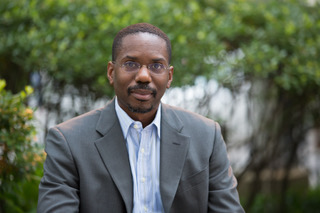

Fern Gillespie
October is the month of Halloween, which creatively spans from sci-fi to supernatural. For Black creatives, this includes Afrofuturism–a cultural and artistic empowerment movement that speculates Black futures through literature, TV and film, dance, fine art, architecture, technology, and the histories of the African Diaspora. Brooklyn legal scholar and attorney Bennett Capers. He is the Stanley D. & Nikki Waxberg Professor of Law at Fordham Law School and the Director of the Center on Race, Law, and Justice. Capers has been compelled to analyze and the contemporary impact of Afrofuturism in law.
In 2019, his study Afrofuturism, Critical Race Theory, and Policing in the Year 2044, published by New York University Law Review was the first legal scholarly paper on Afrofuturism. In 2024 he wrote Afrofuturism and the Law: A Manifesto for Georgetown Law Journal, which sites the cultural impact of Afrofuturism creatives like authors Octavia Butler, Samuel Delany and N.K. Jemisin; singers Janelle Monae and Erykah Badu; the Metropolitan Museum of art exhibition on Afrofuturism, the two TV series Watchmen and Lovecraft Country; movies Black Panther and Wakanda Forever and music legends Sun Ra and Parliament Funkadelic.
He is a renowned legal scholar who specializes in the relationship between race, gender, technology, and criminal justice. Capers has been published in university law reviews including: Cornell, Harvard, UCLA, Michigan, Yale and MIT Press. He has penned op-eds for the New York Times and the Washington Post. Capers is a former professor at Brooklyn Law School and has been a visiting professor at Columbia Law School, University of Texas Law School, Boston University Law School, and Yale Law School. Prior to teaching, Professor Capers spent nearly ten years as an Assistant U.S. Attorney in the Southern District of New York trying several federal racketeering cases. He is a graduate of Princeton University and Columbia University School of Law. Our Time Press spoke with Professor Bennett Capers about his unique insights on Afrofuturism.
OTP: As an attorney, how did you get interested exploring the impact Afrofuturism on Black communities?
BC: I guess I’ve always been interested in science fiction and some Black science fiction. To me, the genesis was really when the film Black Panther came out and I saw the film. I think of Black Panther as an example of Afrofuturism. If you recall, I think that was when the term Afrofuturism became mainstream. All of a sudden, The New York Times and the Washington Post, and other outlets were doing articles on Afrofuturism.
When I saw Black Panther, I immediately started thinking of how it fit in with my thinking about criminal justice issues. I was very intrigued by how the movie begins in Watts and how it ends with them returning to Watts to share their technology, to try to reduce some of the blight and crime. The way the movie was framed, I thought it was very interesting—including everything in the middle of the movie. So, seeing Black Panther, prompted me to write an article called Afrofuturism: Critical Race Theory, and Policing in the Year 2044, which is really my first article on Afrofuturism. It got picked up by NYU Law Review.
I think the other reason Afrofuturism makes sense to me is because I was thinking about policing technologies that can be used in the future. I was also intrigued around the same time about projections coming out that the United States was projected a flip from being majority White to majority minority by the year 2044. So, it just seemed like a perfect confluence of things to think about how people of color, writing science fiction, have imagined a better future for people of color and everyone.
OTP: Why is Afrofuturism an important Black art form?
BC: What Afrofuturism writers are doing is imaging futures where people of color were present. When I talk to younger people about this, I have to add context. When I was growing up, you would look at science fiction and you might have Star Trek’s Lieutenant Uhura. As much as Star Trek was considered ahead of its time, people of color were still on the sort of periphery. I think, at the time, people were imagining futures where White people were still in control. Now, I think that Black writers and thinkers and creatives are imagining futures where people of color have more of a say, more power, more control. They are present as opposed to being absent or relegated to marginal figures. If you remember the movie Minority Report with Tom Cruise. One thing I always thought a lot about that movie is there are no minorities in that movie.
OTP: In your 2025 article for Georgetown Law Review, Afrofuturism and the Law: A Manifesto, why did you discuss the importance of Black creatives being sources for legal scholars?
BC: In my Georgetown article, Afrofuturism and the Law: A Manifesto, I engaged a little bit with popular culture, and I continue to do it. Like, part of the argument, at least the legal scholarship scholars, in their articles rely on case law or either legal scholars are considered legitimate sources. I think part of what I’m trying to do in Afrofuturism is say, “well Octavia Butler is a source.” We should not ignore other thinkers, like Black creatives thinking about the future. We shouldn’t relegate them or say that doesn’t count as legitimate source. So that includes novels, film, dance or music.
It’s really to get all of us thinking. One of my frustrations as a legal scholar is so often in legal scholarship, people focus on here and now. What can we change the next year? We don’t think long term. You know, Trump won’t always be president. Shouldn’t we have a plan for 30 years or 40 years from now? Should we be making that plan right now, and trying to chart a way there? In terms of criminal justice, the police, the courts, and technology, where do you see signs of Afrofuturism? I think part of the Afrofuturism is finding a way to embrace technology and harness technology, that works for the greater good. There’s so many technologies that can make policing more fair. One obvious example is cell phones and surveillance footage.
To at least make us aware and address police violence. That’s a technology that’s benefited people of color. The fact that now it’s not just your word against a police officer, but now you can document it with your cell phone. Now there’s surveillance footage from some camera on the street that you can subpoena and show what happened.
OTP: What are your thoughts on Afrofuturism’s influence on Critical Race Theory?
BC: Let’s imagine something better. I’ve been teaching for a long time. When I’m facing a seminar, one of the things I find frustrating is when I ask students “what does their ideal world look like?” They don’t really know. It seems to me that we should all be thinking—what do we want our world to look like? Like, is there still residential segregation? Are there still the same rates of interracial marriage or has that changed? Is there still crime in the ideal world? Once we start picturing our ideal, then it seems easier to start thinking how can we map a way there.