
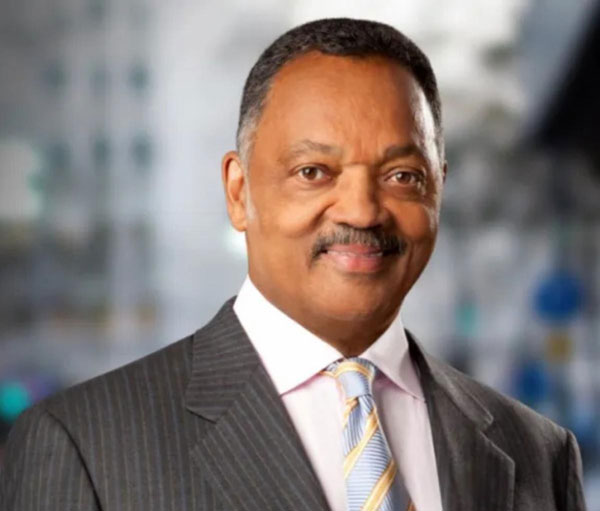

New Yorkers pay tribute to Rev. Jesse Jackson – Protest Power and Racial Resilience, the Brooklyn connection
By Nayaba Arinde
Editor-at-Large
“Keep hope alive, beloved,” Rev. Dr. Karen Daughtry told Our Time Press.
Across the political spectrum, from experienced politicians to grassroots activists, tributes were delivered for Reverend. Jesse Jackson from Tuesday, February 17th, 2026.
“A giant has gone home,” said Jackson protege Rev. Al Sharpton.
After years of battling a neurological illness, his family announced that he passed away aged 84, surrounded by loved ones in Chicago.
“Practically every Black politician in a position of power and influence is a Jacksonian–meaning that they came under the influence of Rev. Jackson to some regard,” Rev. Herbert Daughtry told Our Time Press.
From being a protege of Dr. Martin Luther King Jr., he rose to the pole position as a leader of the Civil Rights Movement. He developed his strategy and leveraged protest power to force corporations to spend money with Black organizations, sponsor programs, and spend advertising dollars with the Black press.
Problematic to the status quo, sometimes controversial, he harnessed that collective energy, with the underlying philosophy of the underused greatness of the Black community. From street corners to boardrooms, through his Operation Breadbasket, Wall Street Project, RainbowPUSH, and his focus on people voting, Jackson encouraged the fight for political, social, and economic justice.
“We ain’t the bottom, we are the foundation,” said Rev. Jesse Jackson. “I am somebody.”
These statements became something of a much-repeated mantra for Black people opposing institutionalized racism everywhere.
His “I am somebody” became a self-affirming slogan recited across the nation and the world, encouraging self-determination, racial pride, and self-belief. Jackson became an international intermediary, bringing home politically-held hostages like Navy Lieutenant Robert Goodman from Syria in 1984, 48 Cuban and Cuban-American prisoners from Cuba in 1984, and hundreds of “human shields” allegedly held by Saddam Hussein in Kuwait and Iraq in 1990.
He was cited as the conscience of the nation, offering ‘spiritual guidance’ to the likes of former President Bill Clinton as he faced crises on a personal level with political and moral implications.
Our Time Press was inundated with tributes for Rev. Jesse Louis Jackson.
Dr. Martin Luther King’s daughter–Dr. Bernice A. King, CEO of The King Center, said, “Rev. Jackson opened doors so Black people and other excluded communities could step into opportunity and dignity. With the Rainbow PUSH Coalition, he cast a bold vision of an inclusive society—uniting people across race, class, and faith to build power together and expand the table of economic opportunity.”
The King Center that a skilled nonviolent negotiator and advocate, Rev. Jackson spoke out against apartheid in South Africa and worked with Randall Robinson to organize an apartheid divestment campaign.
Rev. Herbert Daughtry doubled down, “People running for offices now have been influenced by the works of Rev. Jackson. Present successful leaders can trace the Jackson influence, like Rev. Sharpton, political strategist Donna Brazile, my family, and my daughter, Bishop Leah Daughtry, who was the executive director of the National Democratic conventions. It’s hard to find a person who is a respected leader, who did not benefit from the Jackson era, from making companies hire Black people, to changing how the Democratic Party chooses delegates.”
Local Jacksonian impact
“We’ve lost an absolute icon of American history in this country,” Public Advocate Jumaane Williams told Our Time Press. “Reverend Jackson waged a lifelong crusade for racial justice and social progress, driven by extraordinary courage and unwavering clarity of his convictions. He sat in against Jim Crow laws, he worked alongside Dr. King, and he ran for President on the national stage. He guided the movement from the front lines and fundamentally reshaped America’s political and cultural landscape. He understood the power of uniting the struggle of Black Americans with the Rainbow-PUSH Coalition he founded, which is still arcing through history toward justice.
From marches to sustained and impactful boycotts, Williams said Jackson “in activism, political action, organizational skill, and perseverance through countless obstacles, he was a model and a mentor to many. Without the revolutionary campaign he ran in 1988, we may never have seen the generations of Black leadership to follow, from President Barack Obama to Public Advocate Jumaane Williams to Black elected officials all across this country. In the last decade, I had the privilege to have been able to meet and honor the man I had seen in streets and on screens throughout my life.”
Flatbush-area Congresswoman Yvette D. Clarke said, “I am heartbroken to learn of the passing of Reverend Jesse Jackson, who served this country and his community proudly as an advocate and change agent for civil rights, justice, and human dignity.
“As a daughter of Caribbean immigrants and a public servant representing the vibrant, diverse communities of Brooklyn, I have long stood on the shoulders of Reverend Jackson’s courage and conviction…Jesse understood that civil rights are human rights, and that economic justice, voting rights, labor rights, and access to opportunity are all intertwined.”
City Councilmember Mercedes Narcisse told Our Time Press that Jackson was “a civil rights icon whose voice carried far beyond the United States and reached people across the world, including the people of my birthplace, Haiti.”
Meeting him at City Hall ,she said, “What stayed with me was not just his presence, but his deep concern for human dignity everywhere. As a Haitian-American, I always appreciated how consistently he spoke about Haiti, not as an afterthought, but as a nation deserving respect, stability, and international responsibility…Reverend Jackson reminded us that leadership is measured by compassion and courage. His advocacy, from civil rights in America to solidarity with struggling nations, will certainly leave an indelible mark on generations who believe public service must always center humanity.”
John Jay Professor Gloria J. Browne-Marshall told Our Time Press, “I interacted with him many times over the years. But the first time, I was a high school student. Rev. Jesse Jackson was invited to speak at my high school in the Midwest. By the end of his speech, we were shouting ‘I am somebody,’ and then hundreds of students marched to the principal’s office to present our demands. Jesse Jackson had a special power that connected him to people.”
Attorney Roger Wareham said that the community advocacy organization, December 12th Movement, joins the mourning of an important figure in Black people’s struggle for civil rights and liberation. The Reverend Jesse Jackson, who was early mentored by Dr. Martin Luther King Jr. and went on to create a legacy of his own, has passed. We applaud his many accomplishments in pushing against the white supremacist barriers to Black people’s democratic rights – the Rainbow Coalition, Operation PUSH, the runs for president.
We note that at this time, when Cuba is under furious attack by the United States, Jesse’s meeting with President Fidel Castro helped open the way for the Pastors for Peace caravans, which have brought tons of humanitarian aid to Cuba to mitigate the effects of the illegal U.S. blockade. We remember the nationalist spirit, energy, and pride generated by ‘Run Jesse. Run! and will continue to carry the baton of liberation.”
“As a Black radical, I had differences with Reverend Jackson and Barack Obama. However, I had history with Reverend Jackson,” former City Council and Assemblyman Charles Barron told Our Time Press. “As Reverend Daughtry’s chief of staff, when he announced his historic 1984 presidential campaign, it was at the House of the Lord Church, and I coordinated some of the events. We were on the leadership team with Al Vann, and Jesse Jackson got 3 million votes and 400plus delegates in 1984.”
Barron said Jackson, “Put our issues on the front burner; reparations, freedom for political prisoners. He went to Cuba and released 25 prisoners. He met with Yasser Arafat in the Middle East to support the Palestinian cause. It was Reverend Jackson who traveled to Africa and met with Samora Machel from Mozambique in support of African liberation.
Then in 1988, he ran again. This time he got 7 million votes, and 12 hundred delegates and changed some of the rules in the Democratic Party, so that instead of winner-take-all delegates, they are now proportionally distributed. We had some major contradictions, but I’d rather focus on the positive in that he made great contributions. So, rest in peace, my condolences to the family.”
Speaking on Jackson as a “national legacy–personal loss,” Brooklyn’s House of the Lord Church Pastor, Dr. Karen S. Daughtry, told Our Time Press on Tuesday, “Today, our nation mourns the passing of a giant—Rev. Jesse Louis Jackson Sr., a man whose voice echoed in the halls of power and in the hearts of the powerless. For many, this is the loss of a civil rights icon, a presidential candidate, a prophetic voice for justice. But for our family, and for The House of the Lord Church, this loss is deeply personal.
We have lost a friend, a brother in the faith.
Daughtry recalled how in 1984, Jackson was wrestling with a decision “that would change the course of American politics. Should he run for President of the United States? Could a Black man, a preacher from humble beginnings, dare to reach for the highest office in the land?”
The decision was made in Brooklyn, at the “Fellowship Hall at ‘The House’—fueled by a meeting of leaders called from across the city… It wasn’t just about politics; it was about possibility. It was about showing a generation of young people that they could dream beyond the limitations society had placed on them.”
She added, “My husband, Rev. Herbert Daughtry, had the honor of traveling with Rev. Jackson throughout that presidential race as a close confidant. He witnessed firsthand the grueling schedule, the hostile crowds, the moments of doubt, and the unwavering faith that kept Rev. Jackson moving forward.”
That campaign “didn’t result in a presidency, but it resulted in something perhaps more powerful—it shifted the consciousness of a nation. It proved that barriers could be broken. It paved the way for future leaders. And it reminded us all that faith and politics are not separate spheres.”
Talking of the “Personal Side of a Public Giant,” Rev. K.S. Daughtry mentioned how their families were friends, and “Mrs. Jacqueline Jackson spent time in our home and spoke at our church.”
Alluding to Rev. Jackson’s personal issues, including having a daughter with a staffer, the pastor said, “While he was far from perfect—as he would be the first to admit—he was authentic. He was real. And that authenticity made his message all the more powerful.”
Rev. Daughtry said that far from “naive optimism that ignores reality,” Jackson’s
“signature rallying cry, and enduring message ‘Keep Hope Alive,’ echoes with even greater urgency today, in a time when cynicism threatens to overwhelm us, when injustice seems entrenched, when progress feels slow and uncertain, we need hope more than ever.”
Dr. Karen Daughtry stated, “Rev. Jackson’s hope was forged in suffering. He marched with Dr. King and witnessed his assassination. He faced death threats, political opposition, and personal attacks. He knew what It meant to persevere through hardship. But that perseverance built character, and that character produced a hope that could not be shaken.”
“As we face our own challenges—political division, economic inequality, threats to democracy, and the ongoing struggle for justice—we must heed his call. We must keep hope alive.
She determined, “Specifically, we must continue his work of voter empowerment. Rev. Jackson understood that the vote is sacred—it is a tool for change, a weapon against oppression. We must register voters, educate our communities, and ensure that every voice is heard at the ballot box.”
That translates, she proclaimed, “into living wages, fair housing, and access to capital for minority communities.
We must continue his work of faith-driven activism.”
A visibly sullen Rev. Al Sharpton said, “My mentor, Rev. Jesse Jackson, has passed.
He was a consequential and transformative leader who changed this nation and the world. He shaped public policy and changed laws. He kept the dream alive and taught young children from broken homes, like me, that we don’t have broken spirits. He told us we were somebody and made us believe. I will always cherish him taking me under his wing, and I will forever try to do my part to keep hope alive.”
Praising Rev. Jackson’s “brilliant mind,” Nation of Islam Honorable Minister Louis Farrakhan’s Student Minister Henry Muhammad of East New York’s Mosque 7C told Our Time Press, “His willingness to step into the arena of politics and run for the office of President of the United States showed every Black man, woman and child that we could be more than a sports figure or entertainer in America. We could grow to run the most powerful government in the world. He made us all think on a level that many of us wouldn’t dare think about. It was a bold, fearless move that gave rise to a movement in Chicago. The Rainbow Push Coalition.”
Muhammad highlighted, “Reverend Jackson’s life of dedication to the upliftment of Black people, the poor, and the oppressed people of America will always be remembered through his work as a disciple of Reverend Dr. Martin Luther King, Jr.
However, when he asked Minister Louis Farrakhan to be with him in support of his bid for President of the USA, he exposed Minister Farrakhan to national attention. This also showed the Black Community and the world, Muslim/Christian Unity…
Our dear Brother Reverend Jesse L. Jackson, Sr opened that door, and America wasn’t ready for it. But, like it or not, that door isn’t closed.
Although our brother’s physical presence will be missed, the mark that he made on history will not. There is no grave that can hold down the work that he did while he was among us.”
Sending condolences to Jackson’s wife Jacqueline, children, and family, State Senator Cordell Cleare said that “Rev. Jackson was an icon who set the pathway, and some may say helped further the blueprint which enabled so many Black elected officials to fight for and win elected office. Myself included.
Our Civil Rights leader twice ran for president in 1984 and 1988. With his fighting for the people, and his establishing Rainbow PUSH –People United to Save Humanity, working for societal improvement, Rev. Jackson created a legacy that is world-renowned.
He brought us political progress in the face of great opposition, and by doing so he inspired thousands of young people to take on the challenge headfirst, and go into the electoral arena to represent the people who wanted a path of self-determination and social and economic upliftment.”
Dr. Brenda M. Greene, Professor Emeritus and Founder of the Center for Black Literature at Medgar Evers College, told Our Time Press, “As the first Black man to run for President of the United States, he set the stage for President Barack Obama’s successful campaign for President in 2008. There are also close alignments between Reverend Jackson’s campaign, President Obama’s campaign, and the campaign that Mayor Zohran Mamdani ran in New York City in 2025.”
Dr. Greene said that when Bed Stuy Assemblyman Al Vann became the New York State Campaign Manager for Rev. Jackson’s 1984 presidential bid, she joined the team alongside a coalition of elected officials and community leaders. “His presence was electrifying, and I worked to get people to support his campaign. In 1984, Rev. Jackson garnered a majority of the delegates for the Democratic National Convention.
Common parallels between Rev. Jackson’s campaign, President Obama’s campaign, and Mayor Mamdani’s campaign are the massive voter turnout, the mobilization of youth, and the appeal to an intergenerational group of people (workers, activists, educators, union organizers, students, and civic and political leaders) who represent the diversity of New York with respect to race, ethnicity, and class. Each of these campaigns also stressed that in order to effect change, the entire community was needed to solve the nation’s political and economic crises.”
Somewhat in agreement from Chicago, Yusef Jackson said of his dad’s legacy,”We, his family and the many others touched by him, inspired by him are left obligated to continue his work to make our nation a better place for all through the techniques and tools and policy goals and platforms he championed and left us to use.”