

by Binta Vann
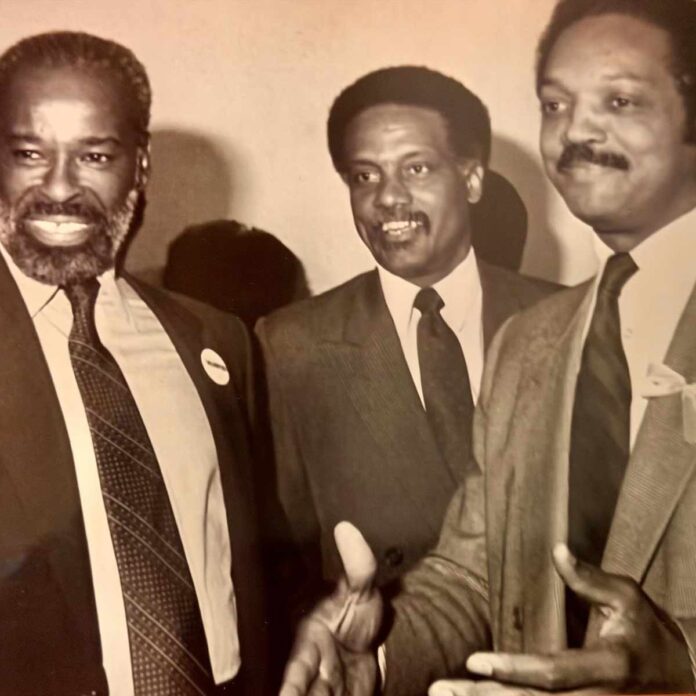
“He could motivate and generate movement among people with his preaching and teachings,” my father said when asked about Reverend Jesse Jackson.
He was describing his experience in 1984 when Rev Jesse Jackson asked him to serve as campaign manager for New York State during his presidential run. My father, the late Dr. Albert Vann, a Brooklyn educator, State Assemblyman, and Chairman of the Coalition for a Just New York, had spent a decade building and unifying Black political power throughout Brooklyn and paving the way for stronger representation of Black elected officials in New York City and State. But running a presidential campaign for the first Black man to run as president in America in 1984? That was something else entirely.
Their relationship had begun 12 years earlier in Gary, Indiana, at the National Black Political Convention. This was the largest gathering of Black political leaders, educators, and activists in American history. Rev Jesse Jackson delivered a keynote address that electrified the room, urged the crowd not to wait for permission to grow Black political power.
My father, who was there to advocate for equity in education, walked away from that convention with the understanding that if you want to change the system, you had to disrupt the distribution of power and build coalitions to back you up. Two years later he won his seat in the New York State Assembly and spent the next decade doing just that.
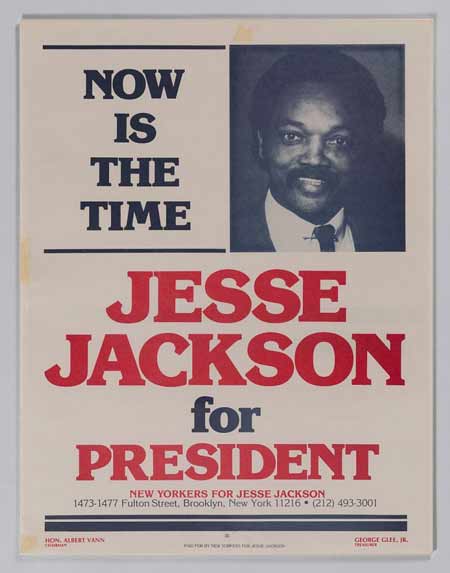
By 1983 my father had become chair of the Coalition for a Just New York, a citywide alliance of Black elected officials, clergy and activists fighting for Black schools and equity in city government. When Rev Jackson came looking for someone to organize the most complicated state in the nation, he found the man who had already proven he could do it.
Rev Jackson and Dr. Vann were shaped by the same conviction: that Black freedom could not be borrowed. It had to be built voter by voter, and institution by institution. Rev Jackson had built the Rainbow Coalition and Operation PUSH. My father had built the African American Teachers Association, was a founder of Medgar Evers College, and had created the Vanguard Independent Democratic Association. Both men knew the difference between talking about change and building the structures to make it happen.
When I learned that Rev Jackson had transitioned on Tuesday morning at the age of 84, I listened again to the recordings I made of my father and felt the weight of what both men understood they were attempting: to prove that a Black man could mount a credible run for the presidency of the United States. Not as a protest, but as a possibility.
In launching the New York State campaign, my father called on the Brooklyn delegation he’d spent a decade building including Major Owens, Clarence Norman, Frank Boyland, Roger Green, Annette Robinson, Velmanette Montgomery, Rev. Herbert Daughtry, Jitu Weusi, Sam Pinn and many others. This wasn’t just a coalition, it was the organizing power that drove voter registration, delivered delegates, and turned Brooklyn into Rev Jackson’s largest base of support in the nation.
That movement produced results no one could ignore. As my father told me with unmistakable pride, “we made a very successful campaign, the largest delegation in the convention.” The borough of Brooklyn drove that delegate count in 1984. Not Chicago. Not Atlanta. Brooklyn.
Jesse Jackson’s campaign changed politics on the national level. It drove extensive voter registration which increased black turnout on election day and changed the Democratic electorate.
It made race and the concerns of the Rainbow Coalition’s marginalized communities including Latinos, Asian Americans, LGBTQ people and the poor, a central agenda item for the Democratic party. And it transformed the Democratic party’s delegation rules by making them proportional rather than winner-takes-all. That change helped make Barack Obama’s 2008 victory possible.
The arc from Gary to Brooklyn to the DNC convention floor took decades. It began in a high school gym in Indiana in 1972, where a young educator and a rising civil rights leader both heard the call of “Nation Time” and understood what it demanded. By 1984, they had built the infrastructure to answer it.
Their work pioneered the way for Brooklyn leaders like Attorney General Letitia James and Congressman Hakeem Jeffries, who came up through institutions and relationships forged during Jackson’s campaign.
That was my father. That was his relationship with Jesse Jackson. And that is the legacy both men leave behind.
We stand on both their shoulders.
“Being close to him was instructive, impressive and one of the many cherished moments I’ve had in my career.” –Dr. Albert Vann
Binta Vann is the daughter of the late Dr. Albert Vann. She serves as Chief Marketing Officer at NPower, a national tech training nonprofit, and sits on the board of Bedford Stuyvesant Restoration Corporation, where her father was a founding board member.