Home Blog Page 721

Why Thanksgiving?

0

Growing up, we never celebrated Thanksgiving in our house. Yes, I did eat my share of turkey, macaroni and cheese and cranberry sauce on Thanksgiving, but we never celebrated Thanksgiving in our house.

My father was raised as a Moorish-American, his father an astute historian who taught his children about the evils of early American history and the lies perpetuated in our history books. My father was his brightest pupil, a precocious child who grew into a walking, breathing paradox. In one sentence, I’ve heard my father tell a person griping about America that we live in the greatest country on the planet, and if you don’t like it you can leave, and then in the next sentence I’ve seen him tell a person how wicked America has been to the indigenous American and to the Black man.

The Pilgrims never had a Thanksgiving dinner with the Indians. That’s a lie! Santa is fake. Ain’t no fat white guy coming down this chimney to bring you anything. We don’t celebrate foolish holidays in this house.

These were my lessons regarding holidays. Short, and to the point. We don’t celebrate foolish holidays in this house. And, we didn’t. My sisters and I never colored Easter eggs and hid them around our home. Every Christmas, while neighbors were hanging ornaments and lights on their homes, we were doing no such thing. A Christmas tree? You better not even mention one, or risk getting a half-hour lecture on how Christmas is a ploy to get the poor to spend money they don’t have to buy things they don’t need. And, we didn’t cook a Thanksgiving dinner in our home. My father wouldn’t even dare eat anything that could be misconstrued as Thanksgiving food on that day.

However, while 192 Greene Avenue was always quiet on Thanksgiving, my mother made sure that her three children were able to experience what it meant to be a part of the holiday. Every year, she’d cook my father some baked fish, spaghetti with marinara and other non-Thanksgiving entrees, and then take us to various family members’ homes for Thanksgiving dinner. Oftentimes, it would be at an aunt or an uncle’s home. We’d go over and my sisters and I would spend the day playing with our cousins, watching football games and eating until our stomachs were full. I can remember how fun it was to be around my family, some of them I wouldn’t see all year until Thanksgiving. I can remember one Thanksgiving at my Uncle Kenneth’s house, his new wife at the time was Puerto Rican and that Thanksgiving was the first time I ever tasted rice made with Sofrito and olives. I learned through my mother’s guidance that Thanksgiving wasn’t at all about what some Pilgrims did or didn’t do to some Indians. It’s about getting together with your family and sharing a space for a few hours where you laugh together, cook together and eat together.

Eating together as a family is a very important thing. There are all kinds of smart-aleck studies that suggest that children are healthier and they do better in school when they eat more with their family. The dinner table is not unlike a meeting table in a conference room. It is a place of communication, a place where we can discuss ourselves and how the world is affecting us. It is a place of understanding. We leave the table satiated and happy, and in the time it takes to finish a meal, we’ve discussed concepts and ideals while laughing at corny jokes and listening to worldly theories. We’ve learned that we aren’t alienated in this world. We’ve learned that we are not alone. This is how eating together can transform children, how it molds those children into loving adults. This is the importance of Thanksgiving. It isn’t about Pilgrims. It’s about family, and being able to eat with family, if only for one day out of the year.

My father still hangs around the house alone on Thanksgiving. He’s 77 now, and you all know the adage about trying to teach an old dog new tricks. Now that their kids are adults, my mother gets to spend Thanksgiving with her children and her grandchildren. She loves that. And we even got my father to start eating Thanksgiving-sanctioned food on Thanksgiving! So, even though he still prefers to be alone at home on that day, he’s eating mac and cheese and turkey with stuffing.

My father taught me what Thanksgiving isn’t. My mother taught me what Thanksgiving is. I appreciate them both for that. Happy Thanksgiving to you and your family!!


WHAT’S GOING ON

NEW YORK, NY

Rev. Ebenezer Aduku

BROOKLYN:   NY1 TV News reports that the economic health of a number of historic Black churches in Bedford-Stuyvesant is on life support! Why, for the same reasons which haunted their Harlem counterparts: gentrification, declining church attendance, rising property values. An aside, remember the story about the Brooklyn bakery that only gave trick or treat items to white kids on 10/31.    Almost a half-dozen Bed-Stuy Black churches are up for sale with asking prices of $2.15 to $6 million. They are Cornerstone Baptist on Madison Street, Antioch Church of Our Lord Jesus on Bedford Avenue, The Living Stone Baptist Church on Pulaski and the Metropolitan Missionary Baptist on Halsey. The John Wesley United Methodist Church is for sale but Rev. Ebenezer Aduku prays for divine intervention and more than 70 congregants.

According to 11/16 Gotham Gazette story, “City Increasingly Paying Back Rent to Keep Tenants from Homelessness”, may explain the flattened numbers of NYC homelessness. Gotham Gazette and other media says that the NYC initiative during Mayor de Blasio’s watch has paid more than $551 million, through the NYC Human Resources Administration, in rent arrears to curb homelessness since 2014.

USA: CURRENT AFFAIRS

President Trump’s Homeland Security Administration will end its Temporary Protection Status(TPS) program, which allows about 59,000 Haitians to live, work and remain in the US after the 2010 earthquake. The TPS ends for Haitians in July 2018 or they will face deportation.   Did Florida-based Haitians bargain with Trump for favors when they called to give him their support last year?  Remittances from the Haitian Diaspora, mostly from the USA, totaled $2.36 billion in 2016, which is about 25% of Haiti’s national revenues.

More than 140,000 Puerto Ricans, who are American citizens, have relocated to Florida since Category 5 Hurricane Maria touched down on their island.  Approximately 10-14% of Puerto Rico’s population of close to 4 million is considering relocation to the US mainland. If the trend continues through 2020, they will outnumber Cuban-Americans as the largest Latino voting bloc in Florida. US energy giant CON EDISON has dispatched a team of 120 NY engineers and tech specialists, headed by Orville Cocking to restore power to Puerto Rico.

INTERNATIONAL AFFAIRS

Robert Mugabe

Zimbabwe President Robert Mugabe, 93, who consolidated power for 37 years there, was placed under house arrest on November 15, stripped of his power by the nation’s army. Action is not referenced as a coup. In a televised message on Sunday, a defiant Mugabe refused to resign. He was expelled as the ZANU party leader. It was the expulsion of Zimbabwe VP Emmerson Mnangagwa two weeks ago to make his wife Grace Mugabe next in line for the presidency that triggered this crisis. ZANU has elevated Mnangagwa to party leader and nominated him as its 2018 presidential candidate. Bowing to pressure, Mugabe resigned on 11/21.

Newly elected Angolan President Joao Lourenco has ousted Isabel dos Santos as the nation’s oil chief. She is the daughter of former Angolan president Jose Eduardo dos Santos, who clung to power for almost 40 years.  An oil economy, Angola is Africa’s second-largest oil producer. Isabel is considered Africa’s wealthiest woman with a net worth of $3.5 billion.

ART/CULTURE

Jesmyn Ward

BOOKS: Congratulations to writer Professor Jesmyn Ward, winner of the 2017 National Book Award for Fiction for her novel, “SING, UNBURIED, SING.” A Mississippi native, Ward is one of the 2017 MacArthur Genius Award recipients. She won the 2011 National Book Award for Fiction for her novel, “SALVAGE THE BONES.”   Ward’s protagonists are usually poor Black American Southerners..

The 11/19 NY Times Best-seller nonfiction book list is filled with stories about Black folk, including OBAMA, by Peter Souza, the President’s White House photographer, which is a 300+ pictorial essay, tops the list at #; “Hacks” by Donna Brazile, who was Acting DNC Chair, dishes insider dirt about Hillary Clinton’s 2016 presidential bid, #6; “We Were Eight Years In Power” is a book of essays by Ta-Nehesi Coates about the Obama Presidency, #10; and “Astrophysics for People in a Hurry” by Dr. Neil DeGrasse Tyson, #15.

Herb Boyd

Herb Boyd, author/journalist/professor, is a nominee for the NAACP Image Awards 2017 for Outstanding Literary Work, Nonfiction, for his book “BLACK DETROIT: a People’s History of Self-Determination.”

WGO BOOK NOTES: President Trump’s recent visit to Asia aroused interest in his ports of call.   VIETNAM:  Enoch Buckery wrote his memoir “FROM HARLEM TO VIETNAM AND BACK, Simply a Black Marine’s Combat Experience in Southeast Asia.”    The B.F. Gaulman novel,  DANANG POSTSCRIPTS, whose protagonist , a Black American Marine, recounts the horrors of his life at DaNang Air Force base during the Vietnam War. Both books are muscular antiwar polemics.

CHINA:    Former National Security Advisor and US Ambassador Susan Rice wrote a NY Times op-ed, HOW TRUMP IS MAKING CHINA GREAT AGAIN. She concludes that his recent Asian tour “has left the U.S. more isolated and in retreat, handing leadership of the newly christened ‘Indo-Pacific’ to China on a silver platter.”

Edgar J. Ridley

MORE READING   1) Read the Alexis Coates’ Black Business Review essay, “ Human Behavior Expert Provides Solution   To Global Racism and Religious Conflict!” about Edgar Ridley.  She is referencing Ridley’s books, “The Golden Apple: Changing the Structure of Civilization,” Volumes 1& 2, which examines “how symbolic thinking impacts human behavior.” Book should be required reading for nations plagued by domestic turmoil and confusion like the USA, the Middle East, Africa and Asia!

2) Read the New Republic magazine essay, “AFTER THE N.A.A.C.P,” a talk with its former president Ben Jealous about his and the organization’s future. An investor/educator and Democrat, Jealous is a candidate for the 2018 Gubernatorial race. A biracial American whose white dad and Black mom were educators in Maryland, who married in 1966, one year before the LOVING case immortalized in the Hollywood film went before the US Supreme Court.

APOLLO HOLIDAYS: The Apollo Theater 2017 compares and surpasses   the best of Manhattan’s midtown shows. Located at West 125 Street, the Apollo boasts a December potpourri of family-friendly entertainment beginning with Ballet Hispanico, 12/1&2, which is followed by the 26th Annual Double-Dutch Holiday Classic on 12/3. Holiday Joy is a Gospel Celebration with uber talents Yolanda Adams, Donnie McClurkin and the Greater Allen Cathedral Choir on 12/16. The Showtime at the Apollo 12/20 Christmas Show, hosted by Steve Harvey with performances by Snoop Dogg, Boys II Men, Fifth Harmony and DMX. The Annual Kwanzaa Celebration with Abdel Salaam’s Forces of Nature Dance Theater and Les Nubians is set for 12/30. And this is just an abbreviated list. [Visit Apollotheater.org]

NEWSMAKERS

Belated SCORPIO birthday greetings to Justin Khan, Kim Weston-Moran and Carrie Simpson.

Happy Birthday greetings to SAGITTARIANS, including Joseph Anderson,   Senator Brian Benjamin, Grace Blake, politico Cordell Cleare, Cornell Professor Carol Boyce Davies, educator Copper Cunningham, arts guru Darryl T. Downing, George Faison, PR executive Fern Gillespie, Karlen Grant, Richard Habersham III, writers Peter Alan Harper and Sheryl Huggins,   Kwaku Horsford, APEX general contractor Robert Horsford, realtor/socialite Joyce Mullins-Jackson, Brownstone’s Princess Jenkins, Mary Leonard, Rosalind McIntosh, fine arts master Otto Neals, Theresa O’Neal, Professor Linda Ridley, Attorney Ernst Perodin, educator Jane Small, journalist Eric Tate, Shawn Walker, Attorney Gail Wright Sirmans and Mapple Walker.

RIP:   Walter Smith, Jr., 83, publisher of the NY Beacon and Philadelphia Observer newspapers, died.   He will be funeralized on Friday, December 1, 2017, Visitation: 11 am/ Service: 12 noon at the St. Forts Funeral Home, located at 16480 NE 19th Avenue, No. Miami Beach, Florida 33162. Telephone: 305.940.1428.

A Harlem- based management consultant, Victoria Horsford is reachable at Victoria.horsford@gmail.com.

Doctors, Community Advocates Brainstorm on Increasing Awareness of Community Health Issues/Solutions

Healthy Marketing at the Heart of the Matter …

Series of Health Symposiums Set to begin January 2018

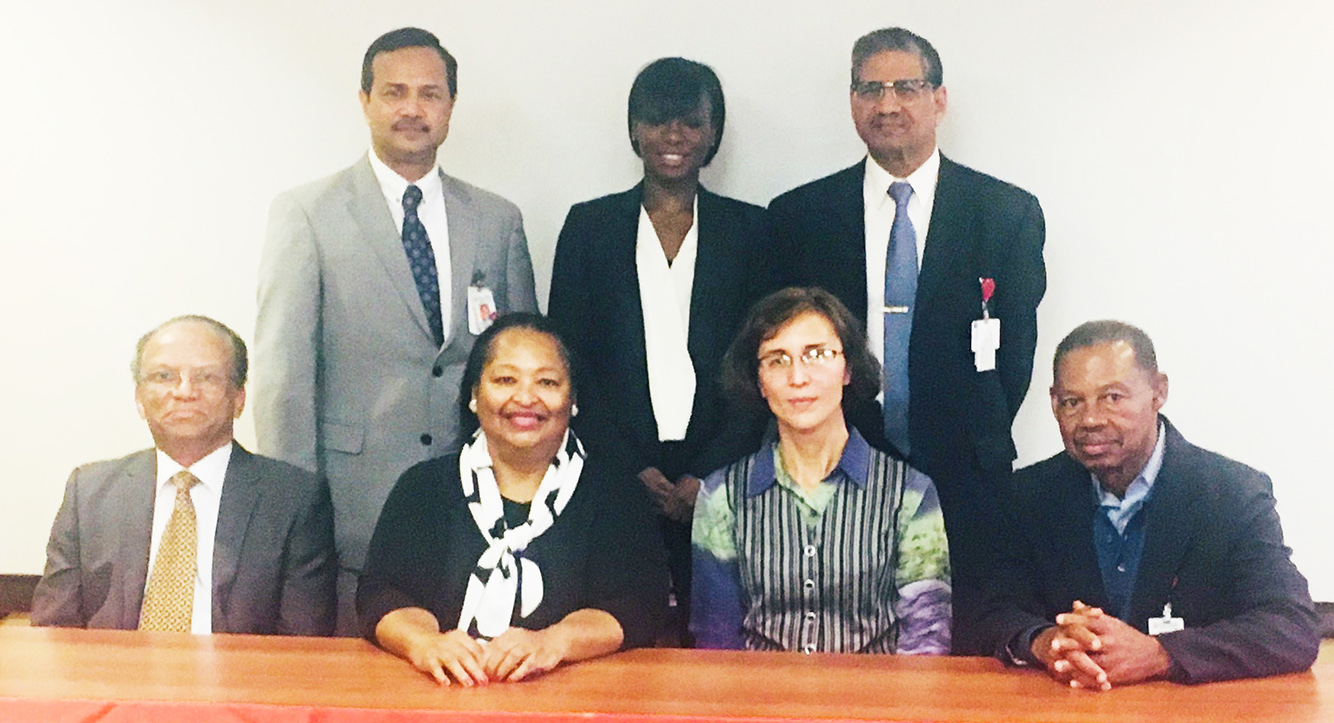
Last Saturday, six medical doctors – with a combined 150 years of training, practice and research – dialogued with neighborhood advocates and leaders about strategies to get information to the community, and involve their participation in information-gathering sessions about health and wellness. The results were an amazing heartfelt — and energizing — good time.

So who would have thought power-medics knew anything about marketing? Well, LaRay Brown, CEO and President of One Brooklyn Health and Interfaith Medical Center, the event site, knew. It’s the reason she amped the planned conversation from medicine to community awareness building.

One Brooklyn Health, the consortium of Interfaith Medical Center, Brookdale University Hospital and Medical Center and Kingsbrook Jewish Medical Center announced the organization’s commitment to engaging area residents in the conversations about widespread health issues impacting the community, and the resources available to cope with them.

Doctors, community residents and leaders, medical administrators participated in the discussion which focused on strategies for increasing the participation of Black and Brown men in events that pertaining to their health, and suggested tactics to attracting target populations to the service providers that care about them and their health.

One doctor pointed out the difficulty in getting people especially men, “to come out” on a Saturday morning. He then offered a sensible solution: go wherever they are: “like churches and schools.” Dr. Pradeep .a hematologist, oncologist,  and Chief Medical Officer of Interfaith Hospital, stressed the importance of the community understanding that One Brooklyn Health centers can do what hospitals in Manhattan do. Dr. Sarga said that women should be included in Men’s Healthy conferences as they are “the sisters, mothers, wives, and girlfriends of the men.

In addition to the medical staff, community leaders Evelyn Collins of Community Board 3, Joe Gonzalez, Russell Carter of HealthFirst and journalist Marlon Rice, Chief Operating Officer at Pomoja House men’s facility.

All in all, all those in attendance had well-informed advice to give on how to best attract men and families to future events. There were many standout opinions such as that of Mr. Rice who stated, “you cannot have a meeting and not involve women” thereby recommending a holistic approach.

Another suggestion was to consider language barriers as not all of those residing in Brooklyn are native English speakers. Another creative recommendation came from Dr. Cynthia Quainoo who recalled enlisting a celebrity in one of her successful outreach efforts.

One Health Brooklyn officially launches its 2018 health initiative with “New Year, New You,” in January. Many of the strategies discussed at Saturday’s event will be activated for that event and throughout the year. Other events include a women’s health iniative in March, and a Men’s Health initiataive in June.

 Priscilla Mensah is a health enthusiast who is also a former CUNY School of Journalism Health Reporting Fellow. Additionally, Priscilla is an avid reader and firm believer in both lifelong learning and community empowerment. 

Stolen Dreams, Broken Promises: Trump threatens deportation of thousands

For over a century, the United States has been seen as the nation that opened its arms to immigrants seeking a better life for themselves. Lady Liberty stands on a pedestal in the New York Harbor holding a torch as if to guide newcomers to the Empire State–to the United States of America. Perhaps, if immigrants and longtime New Yorkers thought about the many immigration laws that have either barred or controlled the number of particular nationals from entering the country, people would reconsider just what huddled masses does the United States accept? How many Americans know that Ellis Island was for the 3rd-class ship passengers? The 1st- and 2nd-class passengers received brief medical examinations on board the ships and disembarked on the piers in New York or New Jersey.

Patrick Buchanan, White House Director of Communications for US President Ronald Reagan (1985 – 1987), stated on public affairs program The McLaughlin Report that the United States was established to be a predominantly white nation. When US President Donald Trump rescinded DACA (Deferred Action for Childhood Arrivals) in September 2017, and began dismantling TPS (Temporary Protected Status) in November 2017, he is executing the conservative Republican playbook.

DACA is a policy created by US President Barack Obama in June 2012 to allow undocumented young people who came to the United States as children to remain in the United States. Some terms for applying for this status include 1) being under 31 years of age as of June 15, 2012; 2) being under 16 years of age at arrival to the United States; 3) being physically present in the United States on June 15, 2012; 4) the individual does not pose a threat to national security and has not been convicted of a felony, serious misdemeanor or no more than three misdemeanors; and 5) currently attending school or about to graduate from school.

With the granting of DACA, people can legally work after applying for an Employment Authorization Document that is valid for two years. The risk involved in DACA is that the status is discretionary and revocable.

TPS is a temporary immigration status given to nationals of Haiti, El Salvador, Honduras and Nicaragua due to civil unrest and armed conflict, natural disasters, epidemics and other extreme temporary conditions. TPS eligibility requires “continuous physical presence and continuous residing in the United States since the date specified for the particular nation of origin”.

On November 18, 2017, local elected and government officials as well as nonprofit leaders took up City Council member Jumaane Williams’ call to march across the Brooklyn Bridge to converge on Foley Square. These actions were in support of New York residents and to take a stand against xenophobia. On January 22, 2018, the US Department of Homeland Security and the US Congress will vote on the TPS status for Haitians.

Holding placards that read “Protect Our Immigrant Community” and “We Want Justice”, the local elected and other dignitaries chanted several rounds of “We are Working People Fighting Back!” and “Yes to Immigration, No to Deportation”. Rally participants included NYC Council member Jumaane Williams (45th CD), NYS Assembly member Rodneyse Bichotte (42nd AD), NYS Assembly member Michaelle Solages (22 AD), Public Advocate Letitia James, NYC Comptroller Scott Stringer, Nassau County Legislator Carrie Solages, Mayor’s Office of Immigrant Affairs Assistant Commissioner Kavita Pawria-Sanchez, 1199 SEIU Vice President Gerard Cadet, HabNet Chamber of Commerce CEO Jackson Rockingster, Haitian-American Lawyers of New Jersey and Haitian-American Lawyers of New York.

The preponderant concern of the body was that people with DACA or TPS status were, in the main, law-abiding contributors to the local economy. NYC Comptroller Scott Stringer remarked, “We have to back up our defense of TPS by using facts: There are 12,000 TPS in New York City paying $200 million in taxes. They are driving the economy. Haitians have always been on the frontlines of DACA and TPS. Now they are going after children.

C.M. Williams, who referred to President Trump as “Agent Orange Man”, said, “The threat of the repeal of DACA is an attempt to sow fear and terror but actually it is bringing the Haitian and Muslim communities together.”

Public Advocate Letitia James opined, “This xenophobic [national] administration would lead you to believe immigrants are hijacking our culture. This country was built by immigrants. Ending DACA is not grounded in factual or intellectual consideration. I am urging the US Congress to have strength in the back to maintain DACA and TPS. Love, hope and faith are stronger than hate”.

Carrie Solages expressed strong concern for people with TPS or DACA status who were returned to their nation of origin. Mr. Solages believes “these people will face torture—physical and psychological terror”.

Immigrant Affairs Assistant Commissioner Kavita Pawria-Sanchez attended the rally with her family. Pawria-Sanchez viewed the rally as “a great example of how our communities cross lines to fight for TPS and DACA. The Trump agenda is immoral and an affront to our city. The Mayor’s Office of Immigrant Affairs has held over 600 Know Your Rights forums in 2017. Congress must extend TPS for Hondurans, Salvadorians and Haitians”. Ms. Pawria-Sanchez went further by pressing the need for permanent legislation becaus

Thanksgiving Special Issue: Stolen Land, Stolen Labor Revisited

The following article, “The Case for Reparations: America’s Real Debt”, updates Our Time Press’ award-winning “Stolen Land, Stolen Labor: The Case for Reparations”, published in December 1997. Inspired by the messages of Queen Mother Moore at the First Black Political Convention in Gary, Indiana (1971) and Congressman John Conyers’ introduction of a reparations bill in 1989, the article examines America’s unacknowledged Slave Age – more important than the 19th century Industrial Age or current Technology Age — as the foundation of the wealth in America.

The original article won the Investigative Reporting Award in 1998 from the New York Association of Black Journalists.

Randall Robinson’s book, “The Debt”, published two years later in the year 2000, continued the argument.

Now, as a new generation of readers discover Our Time Press, this Thanksgiving we offer another look at a story that must continue to be told, particularly in these times when conversations begin to center around the unbanked, the disenfranchised, the poor, the desperate – and what to do about them and where to move them…

Another century is ending with African-Americans still finding themselves called beggars and criminals and locked in the cellar of the very house they built, the America that others call home.

Here at the beginning of 1998, it remains obvious that the question of race continues to be an “American Dilemma”, with no one wanting to admit that America was built on the backs of Africans and at the expense of Native Americans, that Africans in the Americas are full Americans, too.

America’s 400-Year Slave Age: Era of U.S. Wealth-Building

The questions that should be asked are: “What was it like for Europeans to enjoy Affirmative Action quotas of 100% in every area they wished for a couple of hundred years?” “Why did they do it?” “What were the economic benefits to Europeans of owning African-Americans as chattel property?”

Historians talk about the Industrial Revolution starting in 18th-century England, and the Computer/Information Age of today. Left out is the Slave Age, that period of the dark days of the golden age of white supremacy. This was the time when the United States, an emerging nation at the time, dealt most efficiently with the supply and cost of manual labor.

The combination of stolen land, stolen labor and the industrial age made the United States, in those early years, the greatest ground-floor opportunity of all time, a ground-floor that was constructed and financed by the labor of Africans and the land of the Indigenous People.

More money was invested in slaves than all stock in trade, including bank stock, incorporated funds and more. This is indicative of the value placed on an unpaid labor pool and with good reason. The land was virgin territory, which is useless in a money-based value system.   The land had to be worked and transformed into infrastructure like roads, piers and railways; into products like tobacco, rice, cotton and indigo. It was the slave workforce that released the value of the land connected to ports in Brazil, the Caribbean and North America.

According to the U.S. Bureau of the Census, the first estimate of national wealth of the United States is found in “Economica: A Statistical Manual for the United States of America”, 1806 edition by Samuel Blodget, Jr. (See Table 1)

Of the $2,505 million dollars ($2.5 billion) of national wealth, $1,661 million was in land stolen from the Indigenous People, and $200 million was the value assigned to the slaves. Blodget writes, “Slaves are rated too high till they are better managed, everything else is below the mark”.   The Historical Statistics of the United States notes that, “No statement is made by Blodget as to the source material underlying his tabulations”.

By going out of his way to degrade the worth of slaves, Mr. Blodget is telling us he may have something to hide, so we checked his figures.

Stolen Land, Labor and Liberties

Taking the census of 1800 and averaging it with the 1810 census (not available to Mr. Blodget), we find him pretty accurate, and arrive at a slightly higher figure of 1,042,732 slaves. Mr. Blodget may himself have extrapolated from the 1800 census.   In any event, knowing how much difficulty the Census Bureau had counting the descendants of the slave population in 1990, it is possible that these census figures are themselves “below the mark”.

Secondly, we turn to “American Negro Slavery: A Survey of the Supply, Employment and Control of Negro Labor as determined by the Plantation Regime” by Ulrich Bonnell Phillips (1966, p. 370), and find this: “The range for prime slaves, it will be seen, rose from about $300 and $400 a head in the upper and lower South, respectively, in 1795 to a range of from $400 to $600 in 1803…”

By using these figures, we find that the minimum amount of money invested in slaves was $521,366,000 in 1805.   Therefore, the total national wealth could be more accurately calculated as $2.8 billion ($2,826,366,000), adding an additional 300 million to Blodget’s figure.   This means that 77% of the total national wealth of the United States of 1805 ($2,182,366,000) was based on holding African-Americans as property to work the land stolen by Holocaust from the Indigenous People.

By 1856, there were 3,580,023 slaves, according to an average of the 1850 and 1860 census counts.   Bear in mind here that in 1813 Congress laid a direct tax on property, including “houses, lands and slaves”. This meant that there was now an economic motivation to undercount this part of the owner’s property– the fewer slaves reported, the less taxes paid. Slaves were easier to hide than houses or land. This is coupled with the natural inclination of the census to undercount the Black population.   The evidence is clear in the General Population Statistics, 1790-1990.

By 1860, the “percentage increase in Black population over preceding census” averaged 28.8% since 1790. In the 1870 census, the percentage growth was only 9.9%.   So, what happened to the other 18.9% of the expected population? They disappeared in 1865 with the Emancipation Proclamation. No longer having a value attached to them, these 859,000 African-Americans were lost. It’s been 120 years, and judging from the low-count controversy of the 1990 census, the bureau hasn’t found them yet.

We can safely regard these census counts as the way-down-low end of an actual population estimate.

Child Abuse: Broken Backs, Broken Bones

Before a final figure can be determined of the debt due on this slavery phase of the African Holocaust, some account should be taken of the working conditions.   You can get an impression by looking no further than the evidence found in the African Burial Ground in Manhattan, New York. Here, recent analysis of the remains held at Howard University shows that children as young as 7 years old were worked so hard that their bodies were misshapen and their spines driven into the brain from carrying heavy loads.

Ulrich Phillips, in “American Negro Slavery”, says of J.B. Say, an economist working around the turn of the 18th century, “Common sense must tell us, said he, that a slave’s maintenance must be less that of a free workman, since the master will impose a more drastic frugality than a freeman will adopt unless a dearth of earnings requires it. The slave’s work, furthermore, is more constant, for the master will not permit so much leisure and relaxation as a freeman customarily enjoys”.

This is why we include the entire slave population as laborers, and we leave it to others to argue why we should not.

By 1856, the advertised prices for European-owned African-Americans on a Railroad Contractor’s Credit Sale of “a choice gang of 41 slaves” ranged from a high of $2,700 for Anderson, a “No.1 bricklayer and mason”, and $1,900 for George, a “No. 1 blacksmith”, to $750 for Reuben, even though he was labeled “unsound”. The average cost for this lot of people was $1,488.

As a second reference for this number, we can look at the chart for the cost of Prime Field Hands and find that it is pretty accurate.   By multiplying the census count of slaves by the average advertised price, we arrive at a value of $5.3 billion ($5,327,079,968).

This may not look like a lot of money now, but compare it to other figures of the day. The National Wealth Estimate for the entire nation in 1856 was $12.3 billion ($12,396,000,000). [Note: All figures come from Tables in the cited U.S. Bureau of the Census publication] Total Bank Savings Deposits in 1856 were $95.6 million. Manhattan Island, Land and Buildings were worth only $900 million dollars, less than one-fifth of the value invested in African-Americans. The 1855 total capital and property investment in railroads was only $763.6 million dollars.

Why the $5 billion-dollar investment in slaves?

Nation’s 1st Wealth Builders Invested Billion Unpaid Hours

African-American slaves were the critical workers of the Industrial Age in the United States. In the same way that programmers transform computer code into products, so the labor of slaves transformed raw materials and land into products that would allow the Industrial Age to flourish in this hemisphere. Information technology has grown into the largest industry over the last thirty years. Slavery was the largest industry from the time such things were first measured in 1805, until African-Americans were freed to be paid labor in 1865.

At $865 billion a year, information technology represents about 12% of the 1997 Gross Domestic Product of $7,214 billion. In 1805, slave labor represented as much as 20% of the national wealth. By the 1850’s- 60’s, that figure rose to as high as 40%. If a 12% industry like information technology can affect the entire nation, how much impact does a 20-40% industry have? Let’s take a look at the 1850’s and the effect of slave labor on the economy.

According to J.D.B. DeBow, writing in the “Seventh Census 1850 Statistical View, Compendium”, published in 1856, “The total number of families holding slaves by the census of 1850 was 347,525. (See U.S. Census Table XC below). On the average of 5.7 to a family, there are about 2,000,000 persons in the relation of slave owners, or about one-third of the whole white population of the slave states; in South Carolina, Alabama, Mississippi and Louisiana, excluding the largest cities, one half of the whole population”.

In his work, “History of American Business & Industry”, Alex Groner observes, “In the sense that they were large and complex producing units, the big plantations were the South’s factories. The hundreds of slaves included large numbers of production workers -the field hands- as well as such specialists and skilled artisans as carpenters, drovers, watchmen, coopers, tailors, millers, butchers, shipwrights, engineers, dentists and nurses…Because virtually entire families could be put to work in the fields for most of the year, the slave economy proved ideal for cotton culture.

The price of a good field hand, about $300 before Whitney’s invention, doubled in twenty years. Poor whites, who could afford neither slaves nor land at the higher prices, moved West in mounting numbers and soon dominated the Southwest……It was not only the plantations of the South but also the factories, shipping merchants and banks of the North whose economies became tied more and more closely to cotton.

What North and South had in common was the prosperity resulting from the growth of cotton production. The size of the crop climbed steadily, from 80 million pounds in 1815 to 460 million, or more than half the world’s output by 1834, and to more than a billion pounds by 1850… From 1830 until the Civil War, cotton provided approximately half of the nation’s total exports”.1

At an average of 400 man-hours per 400-pound ginned bale of cotton (based on census averages), these billion pounds required a billion hours of unpaid man-hours.   These were supplied by African-American men, women and children, working as slave labor under threat of torture and death.

Banking on Slavery

Thus produced, the cotton crop traded hands on exchanges like the largest one in New York. Longevity counts in business, and many banking institutions trace their founding origins back to that time, including Bank of Boston -1784, Brown Brothers Harriman-1818, Chase – 1799, First Maryland Bancorp – 1808, Fleet Financial Group, Inc.-1791, J.P. Morgan Co., Inc.-1838, to name a few. U.S. Trust of New York (1853) was only a gleam in some banker’s eye at the time, and Price Waterhouse, the famous accounting firm, had just gotten its start in 1849. These banks and other businesses participated in cotton transactions that were all handled as they usually are, for a fee.   And so the brokers, traders, lenders, etc. all profited first. Then came the employees of the firms, the landlords, the washerwomen, the street vendors, messengers, haberdashers, milliners and all their families, and mortgage holders and service providers in an even wider circle.

Slave-Produced Crops Totaled more than 60% of U.S. Exports

Now traded, cotton found its way to 25 of the 35 states and territories for manufacturing. We don’t have to assume how the product was distributed, we can look at the 1850 list of cotton manufactures. (See U.S. Census Table CXCVL) Here, we see there were 1,064 businesses directly employing over 92,000 people across the country. Leading the way is Massachusetts, using 223,607 bales of cotton while employing over 29,000 people. It is also interesting to note that the export of slave crops cotton, tobacco and rice totaled over 60% of all the nation’s exports.   This meant that the shipping industry, the dockworkers and the factories on both sides of the Atlantic, all made a living from the peculiar institution of African-Americans working as slaves.   It was possible for people throughout Europe to work in cotton factories or peripheral industries in their home countries, save their money and book passage to America. Here, the newly arrived immigrant could get off the boat and work selling apples on Wall Street to the employees of the Cotton Exchange. A seamstress from English mills could come and find work making dresses for the wives and mending the coats of the men who worked in the financial district.   Maybe you’ve heard stories like these before.

When an industry produces over 60% of the national exports, it reaches farther than can be seen from the docks or from the fields. And there were other crops as well. There were 2,681 sugar plantations and 8,327 hemp planters.   In 1850, there were over 20 million bushels of sweet potatoes, 3 million bushels of Irish potatoes, 7 million bushels of peas and beans, and 8 million pounds of wool, all produced in slave-holding states. The African-Americans that Europeans called nere-do-well, helped clothe and feed this nation when the Europeans couldn’t.

Money Pump: Government, White Families Profited Most

The government profited most of all. The export of slave-produced crops allowed this emerging nation to import, from the more industrialized countries (with tariffs applied), without incurring a trade deficit.

Also, slave-intensive industries such as agriculture, manufacturing and transportation comprised over 60% of the total private production income at the time. In one way or another, this money was taxed. The slaves themselves were taxable as property beginning in 1815.   The Federal Government profited by first placing a tax on the slave as a unit of property, and again when taxes were paid on the land the slaves improved.   Taxing authorities, whether federal or local, made their money at some point in the trading of cotton and again when salaries found their way into taxable areas.   The government uses a myriad of ways to raise the money it needs to do what it has to do – to build the infrastructure of the nation.   To build the roads, forts and pay the federal marshals. This was done, in a large part, with slave dollars flowing like an irrigating stream, watering national, state and local governments at various stops along the way.

Thus, assets were being used to develop the country for the benefit of Europeans and their heirs.   And now today, the United States stands as a money pump with $7 trillion worth of pressure, creating jobs for Joe Blow in Idaho, and millionaires and billionaires with fortunes that span the globe. But it is a pump that was primed with the blood of African and Indigenous people.

Mother Moore -1971, John Conyers -1998

Speaking Truth to Power

In recognition of the wrong done, in 1989 Congressman John Conyers sponsored a bill to lead to reparations, H.R.40: “A bill to acknowledge the fundamental injustice, cruelty, brutality and inhumanity of slavery in the United States and the 13 American colonies between 1619 and 1865, and to establish a commission to examine the institution of slavery, subsequent de jure and de facto racial and economic discrimination against African-Americans, and the impact of these forces on living African-Americans, to make recommendations to the Congress on appropriate remedies and for other purposes.”

Forty-six years ago, Queen Mother Moore was at the First Black Political Convention in Gary, Indiana.   There she stood in a hotel lobby, crowned with a gold Gele and African dress, handing out literature and accepting hugs while shouting, “Reparations. Reparations honey, get your reparations. They got to pay you”.

The Queen Mother was right. It is in the context of reparations that the nation should be discussing Affirmative Action as part of the mix of options a moral nation would consider paying a long-overdue debt.

And $5 trillion dollars is not a lot of money for the harm done.

This number is only a fraction due for the human hours expended during the slavery phase of the African Holocaust. It does not include the theft of intellectual property rights, inventions and patents.

It certainly does not include damages for pain, suffering and the return of lost lives. Until this debt is acknowledged and paid, America will forever be paying the interest and never touching the principal.