As it is occurring in many Brooklyn communities, the Flatbush community’s main street which is Flatbush Avenue will evolve from low rise residential-over-commercial zoning–where the attached buildings are typically four stories–to much taller and bulkier structures. The case in point is the soon to be constructed Caton Flats Redevelopment Project (Caton Flats). Caton Flats will be constructed where the closed Flatbush-Caton Market and the Flatbush-Caton Municipal Parking Field presently stand on the northwest corner of Flatbush and Caton Avenues. Both the market and parking lot will be cleared to prepare for construction.
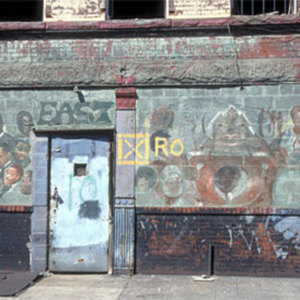
The current Caton Market
Caton Flats will be 14 stories where the ground floor will contain the Flatbush-Caton Market, a business incubator, a commercial kitchen, a digital technology lab, and a textile fabrication unit. Digital technology laboratories or innovation spaces that contain white boards, video projectors, LCD high definition televisions, laser printers, and work stations for public or private access. It is wished in certain quarters that local high school students and local businesses will be trained to use this technology.
The remaining 13 stories are designated for 256 housing units. The square footage of each apartment is not detailed. This 14-story project amounts to 280,000 square feet. Further, Caton-Flats will have underground parking. NYC Economic Development Corp. the lead agency for this project states “All 256 units will be affordable”. 22% of the units are designated for low income households, 30% are designated for moderate income households, and 48% are designated for middle income households. It is not stated whether the AMI or New York City median income is the basis for defining low income, moderate income and middle income.
The Caribbean-American Chamber of Commerce and Industry (CACCI) has nurtured the Flatbush-Caton Market since its inception. It was built in 2001 to provide a formal business environment for the many street vendors who had been selling on Flatbush Avenue. It houses also the Caribbean Trade Center. To maintain the vendors’ business activity during construction, Flatbush-Caton Market was re-located temporarily to 2184 Clarendon Road on January 26, 2017. This is five blocks south of the original location. This one-story, aqua-colored building features a yellow canopy and offers adequate space for the vendors’ stalls, the business office, bathrooms, and the small sit-down restaurant.
On March 19, 2018, this reporter contacted Dr. Roy A. Hastick, President and CEO of CACCI to ascertain his thoughts on the Market’s progress. Dr. Hastick said,
The redevelopment of the Flatbush Caton Market is a critical step in strengthening Brooklyn’s Caribbean small business community. The creation of CACCI’s Caribbean Trade Center within the new development will provide a permanent home for CACCI’s programs which promote small business opportunity and trade relationships for New York City’s Caribbean community. I am pleased with the development team’s focus on enhancing the market and look forward to working with BRP and Urbane to offer new training and business development programs.
The complete development team includes NYC Economic Development Corporation (EDC), Caribbean-American Chamber of Commerce and Industry (CACCI), Magnusson Architecture and Planning, BRP Companies/BRP Development (BRP), and Urbane Development. Given the land is owned by the City of New York, EDC is designated the lead agency. BRP is a real estate development company known for constructing affordable housing. Urbane Development describes itself as “a community development venture that cultivates innovative solutions to build dynamic neighborhoods and positively impact underserved communities.” This means Urbane Development focuses on sustainable social development and urban design. Magnusson Architecture and Planning specializes in “designing housing projects that bring people of different incomes together to collectively raise the standard of living for all.
Given the wide spread displacement of long time residents in communities such as Flatbush, East Flatbush, North and South Crown Heights, Bedford-Stuyvesant, Fort Greene, Bushwick and Williamsburg, it is understandable that there is a level of concern and doubt that Caton-Flats will live up to the expectation of affordability for the current residents of Flatbush and the surrounding communities.
On March 20, 2018, MTOPP’s Alicia Boyd assessed, “This property (Caton Flats) was owned by the City and again, is another give away to developers at the expense of the community. It also shows that the developers are now going into the heart of Flatbush…This building is simply the beginning of a major shift in the landscape of this community.”
Recent articles in the Bed-Stuy Patch and the New York Post have quoted former East members, highlighting their disdain for the recent vote to name Jefferson Avenue between Claver Place and Franklin Avenue after FBI agent Edwin Woodriffe. Agent Woodriffe was shot and killed back on January 8, 1969. He was born in Brooklyn in 1941, became an FBI agent in February 1968 and was killed before being able to reach one full year on the job. Woodriffe’s significance to Jefferson Avenue and Claver Place is that he used to be an altar boy at St. Peter Claver’s Church, a small Catholic church that sits right on the corner of Jefferson Avenue and Claver Place. The church supported the renaming of the block. In the wake of this, members of The East, the cultural Pan-Africanist organization started at 10 Claver Place in 1969, are moving forward with plans to rename Claver Place between Fulton Street and Putnam Avenues after Jitu Weusi, the founder of The East and one of this community’s greatest cultural icons. Their feeling is that Weusi is a much more appropriate renaming, given his lifelong service to his community. “The FBI agent did not serve this community. Baba Jitu did, for over half a century.” Attika Torrence is an independent filmmaker and a member of The East family. He was one of the people quoted in that inaccurate and polarizing Post article. “In the 60’s, when agent Woodriffe enrolled into the FBI, there was a concerted effort to open up recruitment for Black agents. The reason for this was due to the increase of Black Nationalist organizations. So they opened their recruitment to Blacks in order to infiltrate these organizations, organizations like the Nation of Islam, like the SCLC, like the Black Panthers, like The East. Sam Greenlee wrote a book about it, it’s called “The Spook Who Sat by the Door.” Ironically, the Ku Klux Klan is still thriving. There has been no concerted effort to disband their organization. They are still thriving.”
The irony of the possibility of having Jitu Weusi’s name intersected at a point by Agent Woodriffe’s name is not lost on Attika: “The intersection for many Black Nationalist organizations was the Counterintelligence Program. That’s where the rubber met the road, the Counterintelligence Program. So now, this intersection is happening where the headquarters of The East, one of America’s preeminent Pan-Africanist organizations, and right at the intersection of that is the name of an FBI agent that didn’t even serve this community.”
Dr. Segun Shabaka was the last Executive Director of The East. He is the current Chair of the Board of Directors at the International African Arts Festival, a festival started over 40 years ago at The East. He sees the fact that the move to name Jefferson Avenue after Agent Woodriffe was never met with pushback as an indictment on where we are as a community, specifically The East family. “This brings questions as to where we are as a community and a people. We know the state is organized, and we know that they continue to be organized against the people. But as for our communities, especially The East family community, no one has come together to say how we can pull together against this and organize. People have sent e-mails, but we have to go back to sitting face-to-face like we used to do and talk about how we solve this problem and people take on assignments. That’s what we used to do at The East, and a lot of things didn’t pass us.” Dr. Shabaka thinks the renaming of Claver Place in honor of Jitu Weusi is more than needed. “It is very deserving. It would be a monument to one of the greatest figures that Brooklyn has produced.” He also worries that this issue speaks to the lack of organization in our community, but also the lack of consciousness in our community. “We should have networks that tells everyone in this community that these things are happening, going door-to-door if they have to. But that takes consciousness, and you can’t have but so much consciousness if you live on Jefferson Avenue or Washington Avenue. These names are all enslavers. These block names are people who have oppressed us. Our people need to know that. Our blocks should all be named with our heroes and heroines, our community builders, the people that sacrificed in our community. It’s the whole process that we should be bringing into question.”
BP Adams progressive efforts are highlighting potential of urban farming to revolutionize borough’s relationship with food and the environment
Thanks to Borough President Eric L. Adams spring has come early to Central Brooklyn. In fact, it started in the fall, six months ago when the BP announced major funding for STEM programs at several schools.
We visited some of those schools and many others, this past week as part of preliminary planning for an upcoming schools tree-planting initiative of the Magnolia Tree Earth Center of Bedford Stuyvesant.
The walk throughout District 16 and District 13 revealed some surprises, along with the latest announcement that District 16 is bringing in a new Brooklyn Green school to co-locate in the Granville Woods school building near The Weeksville Heritage Center.
But let’s go back six months to November 28, five days after Thanksgiving.
On that date, BP Adams unveiled over $7 million in his capital budget investment for this Fiscal Year (FY18) to add seven new schools to his “Growing Brooklyn’s Future” initiative. His progressive GBF program has brought cutting-edge technology to cultivate urban farming education in classrooms across the borough.
He made the announcement at the co-located PS 56 Lewis H. Latimer and Urban Assembly Unison School in Clinton Hill, where he and Councilmember Laurie A. Cumbo joined students in touring the site of a future state-of-the-art greenhouse jointly funded by Cumbo, to which Adams is allocating $2 million.
It was announced that the courtyard facility will have a growing capacity of 25,000 pounds of produce annually and will be constructed as an addition to the existing third-floor classroom farm at the school.
It is being created through a partnership with Teens for Food Justice, a non-profit organization that works with teens to build their knowledge of healthy eating and growing food. At the November 2017 press conference, Adams emphasized the positive impact that teaching young people about urban agriculture will have on their health and wellness as adults.
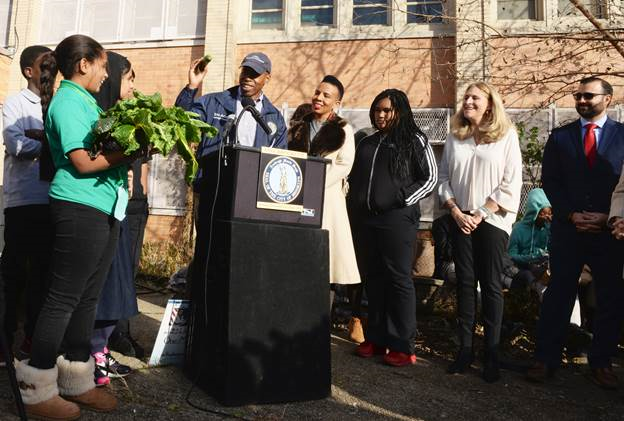
Jane (left) and Star Magnolias are two of the trees that will be given to some 25 public schools in District 16 and 13 by the Magnolia Tree Earth Center of Bedford-Stuyvesant as part of the organization’s annual April Earth Month efforts to bring community awareness of the community as an urban laboratory and learning center. BP Adam, architect of the “Growing Brooklyn Futures” movement, kicks off the effort, funded by DYCD and Councilman Robert Cornegy.
Brooklyn Borough Hall’s additional funds have created aquaponic and hydroponic classrooms, school greenhouses, and rooftop gardens at schools in Bedford-Stuyvesant, Bergen Beach, Brownsville, Gravesend, Mapleton, and Sheepshead Bay.
Adams progressive and pioneering efforts are not only highlighting the potential of urban farming to revolutionize the borough’s relationship with food and the environment, and the importance of having children and young adults gain first-hand experience with the power of growing their own food. They are setting the example for cities around the country.
“Young people across the borough will now have the opportunity to learn about growing fruits, vegetables, herbs, and plants that will empower them to make healthy choices, taking care of their bodies and minds as well as our shared environment,” said Borough President Adams, four months ago. “This is about keeping Brooklyn’s kids at the forefront of innovation and growing their futures. Growing Brooklyn’s Future is a green revolution that starts in our classrooms and winds up changing lives in living rooms across our borough, leading to healthier children and families.”
“Every dollar spent to improve our schools is a worthwhile investment into the education of our scholars,” said Council Member Cumbo. “I was proud to allocate more than $1 million toward this state-of-the-art greenhouse that I believe will cultivate a deeper appreciation for our environment and urban agriculture amongst the next generation. It is our collective responsibility to ensure that every child has access to a world-class education and an equal opportunity to achieve academic excellence.”
“This greenhouse will make a lasting impact on our community by inspiring the students of Urban Assembly Unison School to pursue a more eco-friendly lifestyle and non-traditional careers,” said Emily Paige, principal of Urban Assembly Unison School.
“Our partnership with Teens for Food Justice has opened so many doors for our students to engage in hands-on, powerful, and deep learning about community service and the technologies needed to create sustainable food options. This gift is a game-changer for Unison on so many levels, and we are proud to continue our tradition of offering engaging and enriching curriculum with our new greenhouse. We want to ensure that every student has access to innovative programs and the opportunity to be change agents in the world around them.”
“Teens for Food Justice could not be more thrilled to be expanding its partnership with Unison in this profound way,” said Katherine Soll, CEO and founder of Teens for Food Justice. “The positive impact that the program has already had on student confidence and leadership as well as on student and community behavior shifts around healthy food consumption will be greatly expanded through a farm with a capacity this size. We are extremely grateful to our local leaders for providing us and Unison with this opportunity to develop this key gateway to improved local food equity and community health.”
Additional FY18 funding that BP Adams added to Growing Brooklyn’s Future included $2 million to fund an urban rooftop garden at Brownsville Collaborative Middle School in Brownsville; $1.5 million to expand a green roof project at PS 40 George W. Carver and Gotham Professional Arts Academy in Bedford-Stuyvesant, following previous allocations of $350,000 in FY16 and $450,000 in FY17; $1 million to create an urban farm and greenhouse at PS 312 The Bergen Beach School in Bergen Beach; $500,000 to construct a green roof at PS 146 The Brooklyn New School in Carroll Gardens, which follows a previous allocation of $115,000 to the school in FY17; $200,000 to establish a healthy gardening hub at LIFE Academy High School for Film and Music in Gravesend; $200,000 to support a greenhouse for life sciences, health and wellness at PS 121 Nelson A. Rockefeller in Mapleton, and $167,000 to furnish a hydroponics lab and urban sustainability center at Origins High School in Sheepshead Bay.
Growing Brooklyn’s Future, launched by Borough President Adams in 2015, started with 12 schools receiving $167,000 each to build out hydroponic classrooms furnished by non-profit organization New York Sun Works, including PS 21 Crispus Attucks in Bedford-Stuyvesant; Brooklyn Democracy Academy in Brownsville; Academy for Environmental Leadership, Academy of Urban Planning, IS 383 Philippa Schuyler, and PS 377 Alejandina B. De Gautier in Bushwick; High School for Medical Professions, IS 211 John Wilson, and PS 279 Herman Schreiber in Canarsie; Brooklyn Lab School and Multicultural High School in Cypress Hills, and IS 292 Margaret S. Douglas in East New York.
In 2016, BP Adams designated an additional $560,000 to support greenhouse studies at four institutions. The schools earning funds for this effort were PS 599 Brooklyn Landmark School in Bedford-Stuyvesant, which obtained $200,000 for a STEM lab and greenhouse; PS 146 The Brooklyn New School in Carroll Gardens, which took in $115,000 for a green roof classroom; Franklin Delano Roosevelt High School in Mapleton, which received $200,000 for their greenhouse project, and IS 278 Marine Park in Marine Park, which got $45,000 to transform a science classroom into a hydroponic farm.
Additionally, Borough President Adams established a partnership with the New York Power Authority (NYPA) to support the deployment of New York Sun Works’ educational curriculum at several Brooklyn schools, including Edward R. Murrow High School in Midwood.
This allocation, it is reported, aims to address the growing public health crisis of preventable disease including rising incidences of diabetes, heart disease, high blood pressure, and high cholesterol in many parts of the borough, particularly in underprivileged central and eastern Brooklyn. These areas have been classified as food deserts due to a dearth of fresh and natural food sources for fruits and vegetables. Cultivating urban farming at schools is part of Borough President Adams’ vision for addressing this scarcity and revolutionizing the borough’s relationship with food and the environment, as well as empowering children and young adults with the ability to grow their own food.
Responding to these multi-million dollar investments in our schools and children, Michael Mulgrew, president of the United Federation of Teachers (UFT). “Our students are learning about the environment — and how to protect and nurture it — with these funds.
“We are growing the next generation of biologists, conservationists, and green urban planners, and I want to thank Borough President Adams for his ongoing support for these projects.”
Following a tour of the school’s existing classroom farm, which utilizes aquaponics and hydroponics, Borough President Adams presented funding recipients with honorary checks with the seal of Brooklyn Borough Hall, as well as an oversized check, made out to “One Brooklyn,” for “Growing Brooklyn’s Future.”
Our recent tours of some of these schools over the past few weeks reveal that BP Adams’ continuing investments in our schools is paying off in many ways.
For one, it has inspired renewed commitment to the community joining the quest to plant strong seeds for the future.
During this April Earth Month, the Magnolia Tree Earth Center programming for children and families, will take the “tree” to the schools with an initiative, supported by DYCD and Councilman Robert Cornegy, to plant Magnolias and provide ecology and environmental information to some 25 schools in Districts 16 and 13, with the emphasis on K-2nd grades.
The annual Flower Bed-Stuy initiative of Bridge Street Development Corporation’s Bed-Stuy Alliance is expanding its annual plant giving project. (Information compiled by Bernice Elizabeth Green, who runs Project Green Global, a volunteer program-development program for organizations that support community-based ecology and environmental programs for children and families.)
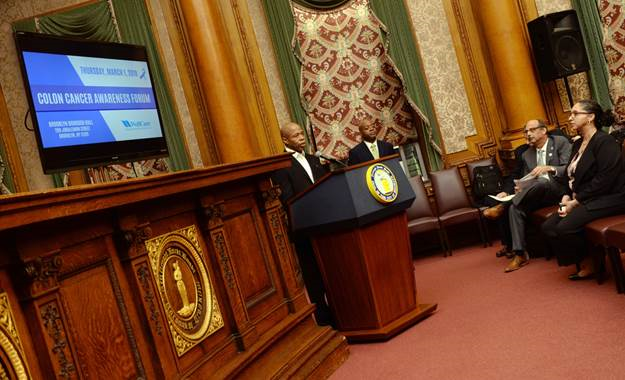
Brooklyn Borough President Eric L. Adams kicked off Colon Cancer Awareness Month by hosting a community forum in the Courtroom of Brooklyn Borough Hall where he joined colon cancer survivors, gastroenterologists, and oncology nutritionists in highlighting that the disease is curable, treatable, and preventable.
Central and eastern Brooklyn, in particular, have been hit particularly hard by colon cancer, especially among African-Americans; men in East New York have the highest death rate for this disease in the entire borough. Symptoms can include change in frequency of bowel movements, change in consistency of stool or any blood in one’s stool, weakness and fatigue, or unintended weight loss.
Colon cancer is the third-deadliest cancer in the United States, and the third-leading cause of cancer death in Brooklyn. The forum, sponsored by WellCare with partnership from Burger UrWay, P.C. Richard & Son, Target, and Whole Foods Market, included a discussion of the latest research on the disease, and important information on the impact of factors such as genetics and nutrition. In discussing the importance of preventive health, Borough President Adams also promoted his month-long #NoButtsAboutIt campaign to encourage mass participation in free colon cancer screenings being held for uninsured or underinsured persons, in partnership with the American Cancer Society, at 10 hospitals across the borough throughout the month of March. Borough President Adams emphasized the importance of early detection and getting screened in the fight against colon cancer.
“Colon cancer is one of only two cancers that can actually be prevented through regular screening tests,” said Borough President Adams. “We have lost too many lives across Brooklyn across every community to this debilitating disease, even when there are steps we can all take to proactively combat it. I urge all Brooklynites to get screened.”
Borough President Adams’ #NoButtsAboutIt campaign was inspired by his special assistant Gerald Marcus Harris, who survived a battle with colon cancer last year. In recent weeks, he has traveled around the borough to speak about the importance of getting screened, with an emphasis on the fact that he was diagnosed with the disease at 37 years of age; many medical professionals, including the American College of Gastroenterologists, recommend Black men be screened starting at age 45.
“Screenings are important because this disease is curable, treatable, and preventable,” said Harris. “I hope people can learn from my story and take control of their health. Thanks to Borough President Adams for amplifying my voice, and the voices of all colon cancer survivors, through this public awareness campaign.”
Free colon cancer screenings will be made available for uninsured or underinsured persons throughout March, as part of the #NoButtsAboutIt campaign, at Brookdale University Medical Center in Brownsville, The Brooklyn Hospital Center in Fort Greene, NYC Health + Hospitals/Coney Island in Sheepshead Bay, Interfaith Medical Center in Bedford-Stuyvesant, NYC Health + Hospitals/Kings County in East Flatbush, Maimonides Medical Center in Borough Park, New York-Presbyterian Brooklyn Methodist Hospital in Park Slope, SUNY Downstate Medical Center in East Flatbush, NYC Health + Hospitals/Woodhull in Bedford-Stuyvesant, and Wyckoff Heights Medical Center in Bushwick. To schedule a free screening at one of the participating hospitals, interested persons can call (718) 802-3847.
“I applaud the efforts of Borough President Adams in bringing people together to start this very important discussion on colon cancer,” said Dr. Cynthia Quainoo, internal medicine specialist at Brookdale University Medical Center. “Too many people have died from a very preventable and treatable disease. As an African-American gastroenterologist practicing in central and eastern Brooklyn, I have a unique perspective on seeing how colorectal cancer affects our community.”
“Thanks to Borough President Adams for leading this effort to raise awareness of colon cancer to the people of Brooklyn,” said Dr. Iuliana Shapira, chief of the Division of Hematology and Oncology at SUNY Downstate Medical Center. “Our data suggests that compassionate and candid explanations of the value of a screening visit increases participation in screenings for both primary and secondary colorectal cancer prevention.”
“At WellCare, we believe healthy communities help people make healthy choices,” said John J. Burke, state president at WellCare New York. “Through partnerships with Borough President Adams, the American Cancer Society, and others, we can address barriers our communities face to live better, healthier lives. One example is our commitment to join the American Cancer Society’s ‘80% by 2018’ pledge to increase colorectal cancer screening for our members, our associates, and the residents of Brooklyn.”
“We believe that a healthy body begins with the food we eat,” said Brendan Zanetti, metro marketing team leader at Whole Foods Market. “Our food quality standards emulate that philosophy — no artificial preservatives, sweeteners, colors, flavors, and hydrogenated fats are found in anything we carry.”
In what was surely intended to be an impressive and reassuring appearance on 60 Minutes, Education Secretary Betsy DeVos instead drew wrath and ridicule from a diversity of quarters. Print and broadcast media, parents and educators were left incredulous and outraged after her revealing interview with Lesley Stahl on Sunday night.
The most widely quoted DeVos response has been the one in this exchange about low-performing schools in her home state of Michigan:
“Have the public schools in Michigan gotten better?”
“I don’t know. I can’t say overall that they’ve gotten better… Michigan schools need to do better. There is no doubt about it.”
“Have you seen the really bad schools?” Stahl asked. “Maybe try to figure out what they’re doing?”
“I have not. I have not – I have not intentionally visited schools that are underperforming.”
“Maybe you should.”
“Maybe I should. Yes.”
Her cavalier demeanor in a time of crisis caused many to question anew DeVos’ commitment and her fitness for the position she holds. When schools fail students, personal trajectories are altered. Communities take the hit as well – sometimes for generations. Yet, DeVos also appeared not to know basic statistics about U.S. public schools in general. She tells Stahl at one point:
“We have invested billions and billions of dollars and we have seen zero results.”
“But that really isn’t true,” Stahl relied. “Test scores have gone up over the last 25 years. So why do you keep saying nothing’s been accomplished?”
Apparently, DeVos is parroting propaganda with not a modicum of research. This also characterizes her grasp of the issues concerning Black and brown students in her charge.
Not all “low-performing” schools are in urban areas or predominantly Black neighborhoods. But although Black families are disproportionately impacted by the failures of DeVos’ agency, she has yet to demonstrate that she comprehends – or cares to comprehend – their plight. Case in point: the time she attempted to make an argument for charter schools by saying that, “HBCUs (Historically Black Colleges and Universities) were “pioneers of school choice,” rather than born of necessity, courtesy of racial segregation.
Under DeVos’ “leadership,” the Department of Education is one of the agencies heeding Donald Trump’s call to repeal those Obama administration initiatives that Trump sees as “regulatory burdens.” The department repealed 63 Office of Special Education Program guidelines, including some helping parents attain due process in advocating for their children. Others of these were created to prevent programs receiving federal money from discriminating against people with disabilities, for example.
One of the most troubling of these directives is DeVos’ decision to have her newly formed Federal Commission on School Safety – which she will head – consider the repeal of President Obama’s “Rethink School Discipline” policies. Under the guise of “hardening schools,” a process that will allow teachers to carry guns, the commission would do away with safeguards protecting students of color and disabled students from disproportionate discipline and suspensions.
If DeVos follows through with her push to repeal Obama’s policies, schools will once again be allowed to report students deemed problematic directly to law enforcement, further entrenching the school-to-prison pipeline. Federal reports verify the validity of complaints about white students being sent to the principal’s office while other students get a police report.
Stahl asked DeVos about this in the 60 Minutes interview. Her response:
“We are studying that rule. We need to ensure that all students have an opportunity to learn in a safe and nurturing environment. And all students mean all students.”
“Yeah, but let’s say there’s a disruption in the classroom,” Stahl persists, “and a bunch of white kids are disruptive and they get punished, you know, go see the principal, but the Black kids are, you know, they call in the cops. I mean, that’s the issue: who and how the kids who disrupt are being punished.”
“Arguably, all of these issues or all of this issue comes down to individual kids. And—”
“Well, no,” said Stahl, interrupting. “That—it’s not.”
“Do you think that teachers should have guns in the classroom?”
“That should be an option for states and communities to consider,” said DeVos. “And I hesitate to think of, like my first-grade teacher, Mrs. Zorhoff – I couldn’t ever imagine her having a gun and being trained in that way. But for those who are, who are capable, this is one solution that can and should be considered.”
“Do you see yourself as a leader in this – in this subject? And what kind of ideas will you be promoting?”
“I have actually asked to head up a task force that will really look at what states are doing. See, there are a lot of states that are addressing these issues in very cohesive and coherent ways.”
“Do you feel a sense of urgency?” Stahl asked.
“Yes.”
“Because this sounds like talking – instead of acting.”
“No, there is a sense of urgency indeed.”
Could the urgency be to head up a task force and then approach officials in various states, not with a plan for safeguarding their children, but to take crib notes about what you should do?
It’s reported that the 60 Minutes segment is causing Republicans to be nervous about the optics for their party. The term “uniquely unqualified” has been used to describe DeVos by more than one media outlet since the airing of this interview. But it seems she’d have to share that title with the man in the White House who appointed her. Given her disastrous performance thus far, she could just answer to the name Betsy DeBacle.