Home Blog Page 68

Jeffries Calls ‘Big, Ugly, Immoral Budget,’ Reckless Immoral Document

Jeffries Continues the Fight, Focused on 2026 Midterm Elections

By April Ryan
(written before the bills’ passage)

BlackPressUSA Washington Bureau Chief and White House Correspondent
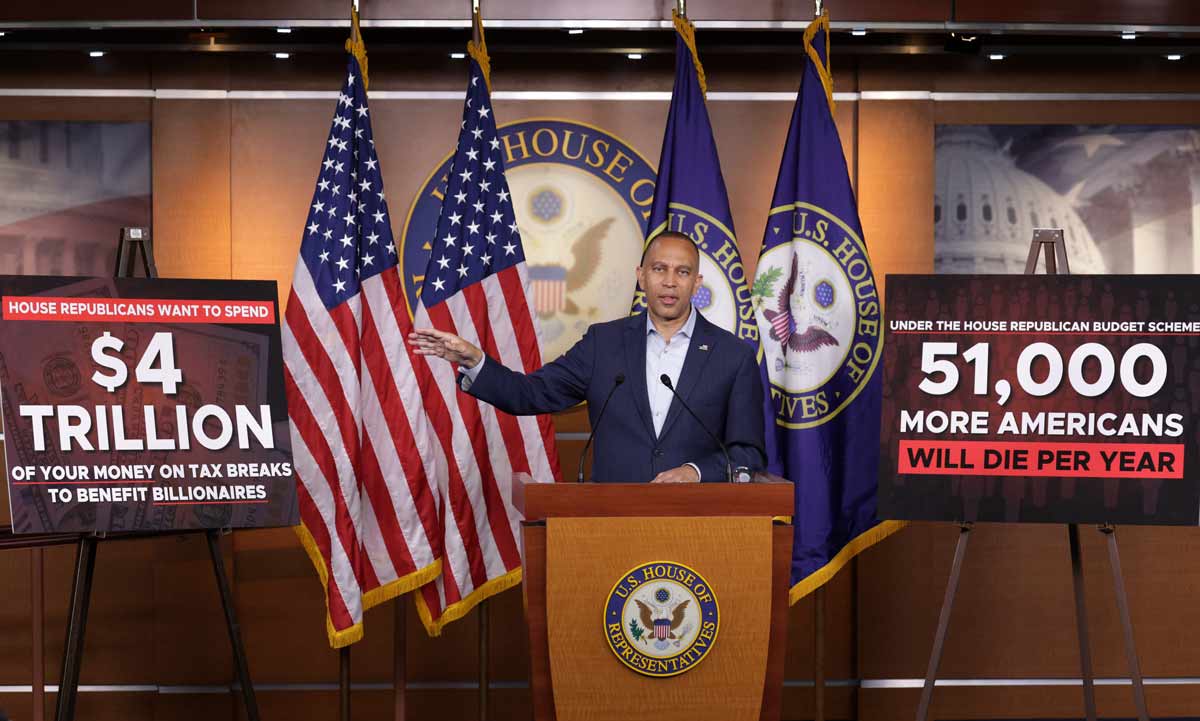
“Ripping health care away from more than 17 million people. That disgusts me,” admonished House Minority Leader Hakeem Jeffries during a speech before the House vote on what he calls “The Big Ugly Bill.”


During Jeffries’ speech, Democrat Congressman Kwesi Mfume of Maryland told this reporter that “Johnson and Trump think they have the votes.” Jeffries notes that Democrats only need four Republicans to stand with them to defeat the legislation.


President Trump called all the Republican holdouts who were planning to vote against his “Big Beautiful Bill,” which the Congressional Budget Office says will add $3.3 trillion to the deficit.
The legislation’s provisions cut Medicare or Medicaid assistance for 16 million Americans as well as SNAP funding that provides food assistance to those in need, while codifying tax breaks for the wealthy, who need no assistance at all.

US House Minority Leader Hakeem Jeffries, Democrat of New York speaks during a press conference on the steps of the US Capitol after the Senate passed the “Republican Mega Bill” earlier in the day in Washington, DC, on July 2, 2025. The Republican-led US Senate approved President Donald Trump’s mammoth domestic policy bill July 1, 2024 by the narrowest of margins, despite misgivings over delivering deep welfare cuts and another $3 trillion in national debt. Republican leaders had struggled to corral support during a record 24-hour “vote-a-rama” amendment session on the Senate floor, as Democrats offered dozens of challenges to the most divisive aspects of the package. (Photo by JIM WATSON/AFP via Getty Images)


“The eligibility for the children’s health insurance program will also be diminished,” said Jeffries. He stressed that the legislation negatively impacts nutritional assistance programs and the nation’s farmers and is “an all-out assault on the healthcare of the American people.”
Congresswoman Sydney Kamlager-Dove of Los Angeles told this reporter, “The righteous indignation of these Republicans who are stealing taxpayers’ hard-earned money to give to the richest of the rich is beyond the pale.”

She feels Republicans rushed this bill for votes. “A bill this large and impactful should have been given longer than 15 minutes in committee. It should have been given longer than the days we had to review it.”


In addition to her peers on the Hill, Dove wants more time for everyday Americans to discuss the legislation and its impact. “My hope is that we have special sessions across the country so that constituents across the nation know EXACTLY how they will be screwed by Trump and his sycophants.”


Jeffries issued a dire warning as he worked to galvanize those who were ready to vote, telling the membership that “all of us as leaders have a responsibility to make life better for the American people.”


Pointing an oratory finger at his peers across the aisle and the current presidential administration, Jeffries said that what we have seen from Republican leadership for “the first six months of the administration has been characterized as chaos, cruelty, and corruption that is not real leadership.” He notes instead that the leadership on this bill failed to demonstrate “courage,” “compassion,” or “commitment.”


The Big Beautiful Bill would also impact the Affordable Care Act, better known as Obamacare, which was signed into law by President Barack Obama.


Obama issued a statement in the lead-up to the House vote, stating, “More than 16 million Americans are at risk of losing their health care because Republicans in Congress are rushing to pass a bill that would cut federal funding for Medicaid and weaken the Affordable Care Act. If the House passes this bill, it will increase costs and hurt working-class families for generations to come. Call your representative today and tell them to vote no on this bill.”


According to Jeffries, Republicans are supporting a “reckless budget that is an immoral document” that tears people down — it is “an all-out assault on the American people.” The congressman from Brooklyn encouraged fellow Democrats and his Republican colleagues to “vote no” against the bill.


Shavon Arline-Bradley, President and CEO of the National Council of Negro Women, had this to say while Jeffries was addressing the nation. “We are in the fight of our lives. The Black Caucus, Black institutions, and leaders in media, politics, and civil rights are working diligently to hold the line on this Bill. The collective power of every mobilizing voice has held strong, resulting in some necessary ‘No’ Votes. If we can stop the bill, we can stop the health and economic burden on our most vulnerable.”


“Stand and Fight for the Future of America”
The following official statement from Democrats condemns President Trump’s Big, Beautiful Bill:
“We believe in an America where hard work is rewarded, not punished. Where families can afford health care, put food on the table, and live with dignity.
“This fight is about more than budgets and numbers—it’s about whether we lift people up or leave them behind.


“We will stand and fight for the future of America. For working people. For families. For the next generation.


White House Correspondent April Ryan has a unique vantage point as the only Black reporter covering urban issues from the White House – a position she has held for over 28 years, since the Clinton era. She is the longest-serving Black White House correspondent in history. Her position as a White House Correspondent has afforded her unusual insight into the racial sensitivities, issues, and attendant political struggles of our nation’s past presidents.
April is the Washington D.C. Bureau Chief for BlackPressUSA.com.

Supreme Court Enters Ultimate Culture War

By Mary Alice Miller
The tumultuous 2025 Supreme Court term saw the court vacillate towards eliminating Congress and itself in deference to a unitary executive. But on the trans ideology issue, the conservative majority was firm on its stance regarding trans ideology.


The Supreme Court allowed a ban on transgender individuals serving in the military while legal challenges continue. The ban came from a Trump executive order banning individuals with current or past diagnosis of gender dysphoria and those who have undergone hormone replacement therapy or transition-related surgery from enlisting or serving in the military.
The policy cites military readiness, medical costs, and disruptions to unit cohesion as reasons for its implementation.


The ban leaves transgender service members with two options: voluntarily leave rather than face involuntary separation, or serve in their biological sex.
And in the Skrmetti case, SCOTUS sided with a Tennessee state law banning puberty blockers and hormone therapy for the treatment of gender dysphoria in minors, citing the law did not violate the Equal Protection Clause of the 14th Amendment. The Court decided that the classification of patients was based on age and medical diagnosis, not sex or transgender status.


Gender-affirming care for minors is now banned in Tennessee, though legal challenges based on other grounds, like parental rights or state constitutions, may still occur.
As of June 2025, twenty-seven states had enacted bans on gender-affirming care for minors. The ruling allows bans in 25 states to remain in place.

Bans in Arkansas and Montana are currently blocked by court order. Montana’s challenge related to the state’s constitution, not federal law. Bans in New Hampshire and Arizona ban only surgical care, which was not at issue before the Supreme Court, and remain in effect.


Days after the term ended, the Supreme Court announced it will consider whether states can ban male-bodied transgender athletes from participating in girls and women’s sports during the upcoming term. At issue is whether state laws in Idaho and West Virginia violate the 14th Amendments Equal Protection Clause or Title IX, a federal statute that prohibits sex discrimination in educational programs. Lower courts sided with the transgender athletes.


The Idaho law considers that state’s Fairness in Women’s Sports Act, which draws “an across-the-board distinction based on sex,” barring trans-identified males from competing in girls and women’s sports leagues. The law was challenged by a transgender student.


The West Virginia case concerns that state’s Save Women’s Sports Act, which bars athletes who were born male from participating on girls’ sports teams in competitive and/or contact sports. That law was also challenged by a transgender student.


Meanwhile, the University of Pennsylvania recently reached an agreement with the Trump administration to block transgender athletes from female sports teams and erase the records set by swimmer Lia Thomas. The federal government released $175 million in frozen federal funds from UPenn that were withheld due to transgender participation in women’s sports at the university.


Lia Thomas participated in the UPenn male swim team and achieved a mediocre record. Thomas transitioned and then joined the UPenn women’s swim team. Thomas then won the 2022 NCAA championship in the women’s 100-meter, 200-meter, and 500-meter freestyle.
Thomas intended to participate in competitive swimming in the 2024 Olympics, but was barred from international events under World Aquatics rules that only allowed transgender athletes who had not experienced biological puberty to qualify.


The U.S. Dept. The Office for Civil Rights of the Department of Education investigated and found UPenn violated Title IX by “permitting males to compete in women’s intercollegiate athletics and to occupy women-only intimate facilities.”


Under the agreement, UPenn will adopt biology-based definitions for the words ‘male’ and ‘female’ and apologize to female student-athletes who lost to Thomas during the 2021-2022 swim season. UPenn also agreed to restore all individual Division I records and titles to female athletes who lost to Thomas.


This week, the Federal Trade Commission (FTC) hosted a workshop titled “The Dangers of ‘Gender-Affirming Care’ for Minors.” The FTC has broad authority to protect consumers from unfair or deceptive acts or practices. The workshop was conducted to help the FTC “understand whether consumers are being or have been exposed to false or unsupported claims about ‘gender-affirming care’ and to gauge the harms consumers may be experiencing.”


During the workshop psychiatrist Dr. Miriam Grossman, author of “Lost in Trans Nation: A Child Psychiatrist’s Guide Out of the Madness”, presented examples of what she called “fraudulent” practices regarding medical records designed to bill insurance companies for gender-affirming treatments.


During a panel on The Politicization of Science, the World Professional Association for Transgender Health (WPATH) was highlighted as an example of establishing Standards of Care based on an agenda as opposed to medical standards.
Presenters included doctors, medical ethicists, whistleblowers, de-transitioners, and parents of de-transitioners.

Left-of-Center Millennial Mamdani, Conservative Gen X Adams, and Moderate Boomer Cuomo: The Generational and Policy Divide

By Nayaba Arinde
Editor-at-Large

“I think the difference between Mayor Eric Adams and Assemblyman Zohran Mamdani–is largely a generational divide, as well as a policy divide in terms of one being more moderate, and the other being far more progressive,” political strategist and Columbia Professor Basil A. Smikle Jr. told Our Time Press. “I think there is a generational divide in the support he gets from African American voters. Mr. Mamdani does need to do some more work with older voters who are tied to traditional Democratic Party politics. And, there are older and more moderate voters who still like Eric Adams.”


On Monday, former Governor David Paterson held a press conference with some fellow Democrats who focused on Queens Assemblyman Mamdani. He said that he was inexperienced and that either the current mayor or the former three-term governor should drop out of their independent races and let folks coalesce around one main opponent.


“Some of the things Zohran Mamdani says are very difficult to deal with, including for the Black community,” Governor Paterson told Our Time Press. “He sees himself as the next mayor. My point to Adams and Cuomo is that if they both run against him, they are going to split the vote. He is on the Democratic line. They are not. Both of them are on independent lines. So he is in pole position and able to win.”


Cuomo lost the primary last month, with the frontrunner beating him by 12 points. Adams weighed up the fallout from the reaction to President Trump dismissing his five federal corruption and bribery indictments, and pulled out of the Democratic primary race, and decided to run as an independent.


With Mamdani battling Republican, Presidential, independent, and Democratic challenges, he says he will not be distracted from his five borough affordability agenda. As Trump has stated that he will pull money from his hometown, should Mamdani win, former Democratic State Chair Paterson said that, “It’s a job for someone who can make a plan work, and it’s got to be someone who is going to consider the people in the city and not single them out for some type of retribution.”


Cuomo’s campaign said, “We do not see any path to victory for Mayor Adams. This is the time to put aside the usual political selfishness and agree to do what is truly best for all New Yorkers.”
At the same time, Adams slammed the “arrogance” of Cuomo’s phone call request asking him to step aside.


“I’m the sitting mayor of the City of New York, and you expect for me to step aside when you just lost to Zohran by 12 points?” he asked on CNBC.
Mamdani’s campaign said that more than 545,000 New Yorkers voted for him, “The most votes any Democratic primary candidate has received in 36 years. In the coming months, Zohran looks forward to growing this coalition and reaching new voters with his vision for an affordable New York City and his plan to deliver universal childcare, fast and free buses, and a rent freeze for more than 2 million New Yorkers.”


In the media this past week, Adams and Cuomo have demanded an investigation, charged fraud, and disrespect, as they challenged the Ugandan-born, Indian-by-bloodline, South African and New York-raised Mamdani for his unsuccessful 2009 Columbia application self-description as a African American and Asian – as he ticked the designated race/ethnic description boxes.


“Eric Adams and Andrew Cuomo want you to believe that the biggest scandal amongst them is Zohran Mamdani and a denied college application,” said Public Advocate Williams.
The 2008-2010 NYS Governor Paterson said, “Adams has come a long way. Last year, we thought he might be convicted of some crime or something, but everything was dropped, and he has a free hand to run in this race any way he wants. Cuomo thought he won the primary, he says it wasn’t the polls, it was the turnout…whatever.. He got turned out. So now he is trying to be the candidate.”


Paterson said he does not see either of them dropping out. “In 2021, Adams got the people and mowed everybody else down. In 2025, because of his problems, the community is moving back towards him, but perhaps maybe not as quickly as he would like, because there is sort of a sense of a Trump connection. Then, that situation with Thom Holman, the immigration czar, when he was sitting next to him on Fox. He says if he doesn’t get things done, he will put his foot up his rear end, and Eric just sat here, and didn’t do anything. That was terrible. It made Eric look like a houseboy.”


Looking at the busy political landscape, Paterson added, “So, I made the gesture. None of the candidates seemed to be interested, which I respect. They want to stay in. If they want to talk about this later in the year when things are different, I am available..
“I wanted to raise the possibility of the candidates consolidating, but as it stands now I think Mr. Mamdani would win the General Election,” said the former governor, adding that concern is “his capacity to run the City, and in what direction…we don’t know enough about him to say one way or the other.”

Mamdani’s massive ground swell
“He certainly created a movement around his candidacy, because he is young, and relatively new to politics, certainly at this level, he has an opening to develop a narrative for himself that is more open and encompassing, and not tied to a specific or significant legislative record,” Smike determined. “I think it is likely that Mamdani will win because he is a Democrat in a predominantly Democratic city…There’s a lot of attention around wanting New Yorkers to stand up against Donald Trump.”


“If he does win, I’ll be the first to say ‘Give him a chance,’” declared Paterson. “I think, at this stage, Mayor Adams or former Governor Cuomo would be an easier fit. We are stuck because neither one of them wants to back down, and I don’t blame them.”


Mamdani recognized that visiting that old staple election move–Black churches, “I was able to reintroduce myself…So these next few months are an opportunity to continue to do just that.”
Smikle said, “I think a lot of African American voters have supported him, it’s just not the ones who are tied to traditional Democratic Party politics in New York City. So, he does have some work to engage with older African American voters. There’s time to do that.”


This mayoral race has also taken on national and even international standing, with Trump threatening to take away the Ugandan-born Queens assemblyman’s citizenship and deport him.


“The more the President attacks him, the more it raises his profile, and voters feel the need to rally for him as likely the next mayor of New York, and protect New Yorkers against threats by this administration,” said Smikle. “The attacks against him serve a very specific constituency of the president, but ultimately it can only serve to bolster Mamdani’s candidacy and within the party nationally.” (The President has said that if Mamdani “the communist” wins, he and the federal government will takeover.)

L. Joy Williams Leads the Legacy of NAACP New York State Conference

0

By Fern Gillespie
This week, veteran NAACP official L. Joy Williams is traveling to the national NAACP convention happening in Charlotte, NC from July 12 – 16. Although she’s been a panelist and a NAACP National Board Member, this time she’s attending as the President of the NAACP New York Conference of Branches, continuing the legacy of Spingarn Medal winner Hazel Dukes. Williams, an expert political strategist, has worked for over 20 years with the civil rights organization in fighting for social justice and racial equality. She made a memorable mark as President of the award-winning Brooklyn NAACP branch and host of the NAACP Image Award-nominated podcast “#Sunday Civics. Our Time Press recently spoke with L. Joy Williams about her new role leading the NAACP’s 54 New York branches as President of the NAACP New York Conference of Branches.

OTP: Hazel Dukes, the longtime president of the NAACP New York Conference, was your mentor. What advice did she give to you over the years when you were working with her on advocacy issues?
LJW:
Hazel Dukes had appointed me as legislative director for the NAACP New York State Conference. We were working alot hand in hand. I was engaging in legislative work on the state level, on behalf of the state conference. I was putting together legislative agendas for about five years. Organizing our Albany advocacy, among other things. So the advice was really focused on how to navigate those leadership roles. When there are times to speak loudly and firmly and when there are times to observe and speak softly and encourage and help guide things in a way rather than to directly have your hands on them. That is certainly advice that I use every day. Not only as we chart our course legislatively in the state, but also in engaging and building the NAACP’s 54 branches in New York State to ensure that we can be a stronger advocacy arm for Black people in the state.

OTP: In your role as the President of the NAACP New York State Conference, how are you dealing with the controversies facing DEI and diversity issues that are affecting Black residents in in New York State?
LJW:
Whether they are in government, public sector, or the private sector, a large portion of things targeted towards Black communities were classified as diversity, equity and inclusion programs. So, our focus is there still needs to be an investment in our community to ensure that there is equity across the board. So, we’re very much engaged not only in our school system, but also in corporate America. While we have New York State, who is not rolling back, as opposed to places like Florida that is rolling back their investment in diverse communities. Recognizing that the diversity that we have is our strength. But there’s still pockets of places across the state where that is not happening. Whether it’s the western part of the state or Long Island, which has also been increasingly conservative. There are places that we’re watching and that our branches are engaging in battle with as well.

OTP: Is the NAACP New York State Conference involved in migrant advocacy, especially in terms of the ICE deportations?
LJW:
One of the things during this process is people are under the impression that the people who are harmed and are targeted are only from Spanish speaking countries. Not that there are Black people who are also subject. Recently, a judge ruled in favor of ending the Haitian temporary protective status. That was also a population that the Trump administration was targeting. As you know in New York State there is a population of people from continental Africa and the Caribbean. And so, we are meeting in coalition with those groups that serve a Black immigrant population to ensure that their rights are protected and we uplift the issues of concern.

OTP: The national NAACP challenged the “big bill.” What is the NAACP New York State Conference doing in dealing with the Trump administration?
LJW:
The “Ugly Bill,” we know has disastrous impact on New York State in terms of Medicaid dollars as well as the SNAP cuts. The reason why I’m focused on building up the health and the infrastructure of the branches in New York State is so that we have an army of advocates who are continuing to push back not only on this administration, but then as these cuts trickle down to states. We’re looking ahead to the next state budget in the next state legislative cycle. We’re making sure that those cuts that may come is not on the backs of already vulnerable communities.


OTP: Why should Black New Yorkers across the state join their local NAACP branch?
LJW:
As President of the Brooklyn NAACP, we had success in building the largest branch in the state. It’s the most intergenerationally diverse. That was intentional in order for our community to advance forward. It’s not that we need one particular generation or just one solo leader. It requires all of us to bring our bricks and help build a hedge of protection around our community. But to also build and invest in our communities. And so, you want to be a part of it the NAACP because this is the entity that is going to litigate, agitate and advocate on behalf of Black people in this state. You don’t have to do it alone. Joining with us allows us to push forward an agenda. Whether it’s on a local level in cities like New York City, Buffalo or Rochester to the state level, and then combining our power with those across the country to push back on this administration.

What Is Your Soul’s Signature?

By Udhedhe Ojile

My soul signature or rather the unique rhythm of my life is soft.

Not soft in the lazy, passive sense. Soft like soil that holds roots. Soft like slow mornings. Like depth over speed. Before the “soft life” trend, softness was already my instinct, my resistance to unnecessary pressure and haste. Not because I fear ambition, but because I sense that what is meant for me doesn’t arrive through force. It flows.
I don’t move fast. I move deep.

That depth explains why I don’t take everything seriously, not in the cynical sense, but because I know I don’t have to grip life tightly to receive its gifts. I believe what’s mine will find me in divine timing, not societal timing.


But softness doesn’t mean smallness. My soul craves creativity and authenticity not just surface-level beauty, but the kind that explores the entire range of being human. My soul wants to feel all of it: grief, joy, heartbreak, elation. It’s drawn to the strange, beautiful complexity of human connection; across generations, cultures, and contradictions. I’m not interested in neat binaries. I want the grey. The nuance. The messy middle where truth lives.

Why I Don’t Set Goals
(And What I Do Instead)

Discovering my soul signature led me to a rather shocking revelation – I can’t set goals. For a long time, I thought something was wrong with me because I couldn’t stick to goals. I’d make elaborate plans and abandon them. I’d try to follow systems that worked for others but felt like shackles on me.
Eventually, I realized: it wasn’t a failure. It was a misalignment.

My soul doesn’t chase end goals. It moves through intention. I prefer to set rhythms over rules, practices over milestones. Intentions allow me to evolve. They’re spacious enough to hold change. And most importantly, they let the process be the point.


It’s not that I’m directionless, I’d say rather that I’m deeply guided. But I’ve never been able to name exactly what the destination looks like. And that’s because my soul needs room to become. My life has always unfolded like a series of breadcrumbs, not a straight path.


Last month, I tried to ignore that. I tried to live fast. I forced timelines. I abandoned rhythm. And I paid for it — loudly. I burned out, emotionally and mentally. Everything in my spirit said: This is not your way. I cannot do speed. I do planting. I do long-haul. I do sacred pace.

Soul vs. Society
Of course, there’s tension between my soul and the world. The world rewards hustle. Grind. Metrics. Viral success. It tells you to be everywhere, do everything, and win fast.
But I’m wired for the slow burn; tugging gently at my dreams, trying things out, pivoting when needed, and nourishing what’s real. The garden of my life grows slowly but meaningfully. And in that garden, mental health is the sunlight. Without it, nothing blooms.

To others, that may look undisciplined. But discipline isn’t just about rigidity, it can also mean protecting your peace. It can mean saying no to the algorithm and yes to alignment.
I remember something my father once told me on visiting day in boarding school. He looked up at the sky and said:
“See how vast it is? Everyone has their own lane, each with its own pace, trials, and victories.”
That stayed with me. Whenever I feel off-track, I remind myself: I am not behind. I’m just growing at my own rhythm.

On Soul Gardening
I think of soul signatures like plants. Some people are cacti. Some are monsteras. Some are wildflowers. They all need care; water, light, nourishment, but the dosage varies. What overfeeds one starves another.
So why do we garden our souls like everyone else?

Why do we take literal advice from people with completely different soil or care plans?

The work of life is to figure out what you are and how you grow. To study yourself like a garden. The universal principles may apply — rest, joy, nourishment — but the specifics are yours to discover.

The Role of Experimentation
Living in alignment with your soul signature doesn’t mean sitting idle. It means moving intuitively. Saying yes often. Trying things out. Figuring out patterns. Learning what sticks. You can’t know what works for your soul until you’ve tested it.


I’ve said yes to things that didn’t work — jobs, friendships, routines. But even those “wrong” turns taught me something. They helped me build the manual of me. They showed me my yeses and my hard no’s. They introduced me to amazing people who cracked me open and people who were purely lessons in passing. They gave me data.
Unfortunately, we don’t arrive in life with handbooks. We curate them as we go.

In Closing
If you’re in the middle of your own tug-of-war between the world and your soul — especially in a place like New York, where speed is a currency — I hope you pause.
Before you say yes. Before you commit. Before you compare. I hope you ask yourself; Does this feel right to my soul?


I don’t have it all figured out. But lately, I’ve started to see a shadowy outline of my soul’s signature. And I know it’s not fixed. It will morph and change. But I’m ready to stick around and watch it bloom.


And if you’re still in the fog, keep going. Keep observing. Keep experimenting. Life will whisper back eventually.


You’ll recognize your rhythm when it starts to feel like home. Happy soul searching!

Udhedhe Ojile is a Nigerian-born writer and creative based in Brooklyn. She explores identity, emotion, and everyday beauty through personal essays and her evolving food project, Didieats. She’s currently in a season of planting — experimenting, observing, and documenting as her work takes shape.