Film Screening – Hudson Guild, 7:30PM 441 W. 26th St., MANHATTAN, FREE
Documentary on living poetic legend and activist. Screening as part of “Selabrayson!” presented by Caribbean Film Academy in collaboration with the Luminal Theater. 212-760-9837
Tuesdays in June
Ntozake Shange Play Reading Series
“Family Night by Cassandra Medley” 6/12
“Baby Doll” by Judi Ann Mason on 6/19
“The Carelessness of Love”
by Michael Dinwiddie on 7/26
NFT in association w Castillo Theater 543 W 42nd St, New York
212–353-1176 This series is dedicated to Ntozake Shange, living legend, American playwright and poet. 212-941-1234
Wednesday, June 13th
Negritude Art Show
ARTS ENY 10AM-5PM
534 Livonia Ave. FREE
Our exhibition sparks conversations around how we dispel stereotypes, discrimination and oppression, and ways in which we can bring light to a new Black consciousness. Our gallery is open to the public M-F from 10am-5pm free of charge! 718-676-6006
Saturday, June 16th
Fort Greene Brooklyn – Juneteenth Arts Festival Cuyler Gore Park 12-6PM 2 Greene Avenue at Fulton St.
Music! Dance! Poetry! Artistry! Fashion! Food! Community! History! Presented by the Cooperative Culture Collective
Brooklyn District 16’s Intergenerational Men’s Health Experience P.S. 21 180 Chauncey St. 10-2PM
Epic Theater Ensemble Performance, Film Screenings, Fitness Demo, Health & Wellness, Bring your youth, your father, the men in your life, and yourselves – Enjoy dynamic opportunities to engage your mind, body and spirit through: yoga and meditation; basketball clinic; Literacy, Inc. Discussion: Effect of police brutality on youth and on a father-son relationship.
Sunday, June 17th
“In Recognition of Juneteenth & Father’s Day Cultural Caravan Community Forums Taped live @ CEMOTAP
CEMOTAP Center FREE 135-05 Rockaway Blvd., So Ozone Pk QNS Debut taping of live weekly Community Engagement Forums before a studio audience by Cultural Caravan Productions. Louise Dente, host and exec producer, invites the community. 718-804-5810
MARK YOUR CALENDARS
Sat., June 30th – Wednesday, July 4th
47th Annual International
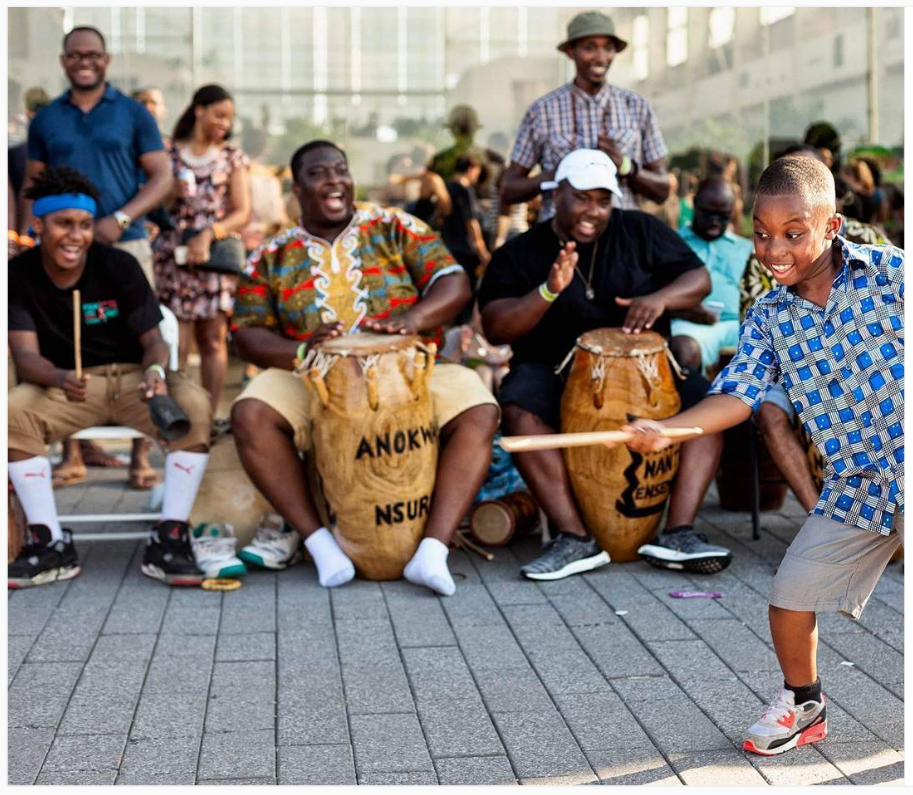
African Arts Festival – Commodore Barry Park, Navy St., Flushing & Park, Sugg. donation: $5/adults, $2/children 10AM-9PM, Rain or shine = This 2018 theme is “Dekawowo” (solidarity) from the Ewe people of Ghana and Togo. David Rudder, Muntu Dance Theater of Chicago; Rene McLean, Ballet Folkloric; Cutumba, Neil Clarke-Mongo Santamaria Project and lots more. 718-638-6700 www.iaafestival.org
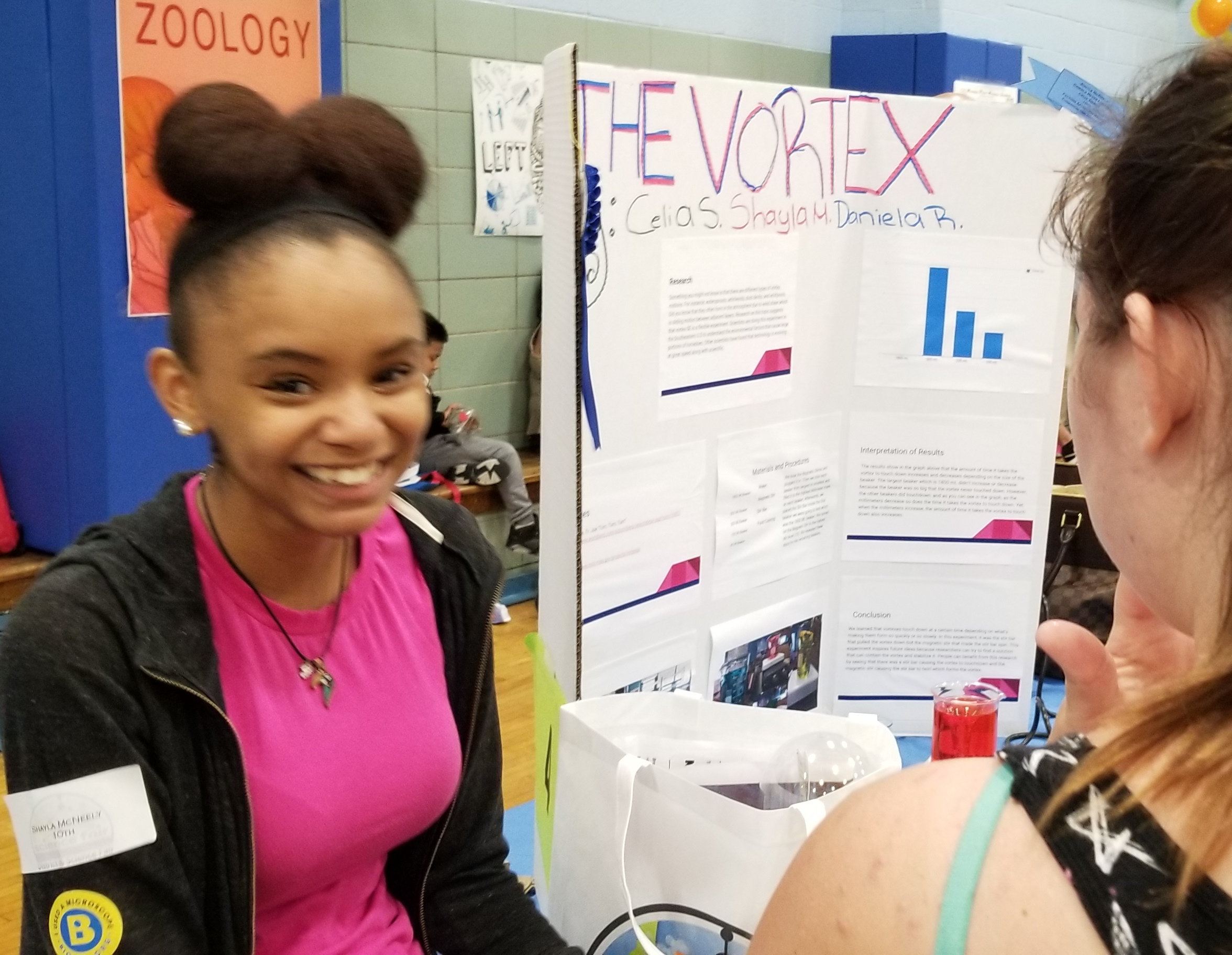
More than 60 exhibits were showcased at D16 Science Fair.
Have you ever imagined what it would be like if the world’s smartest individuals gathered in one area to share their knowledge? Well, wonder no more because this very moment was created on Thursday, May 31st, 2018 at Madiba Prep School in Brooklyn, New York! It was here where the District 16 Annual Science Fair was held. Through the doors of the school building was nothing but bright students and their even brighter science experiments. There were children that created their own hovercrafts using nothing but balloons and old CD discs. There were also students that built robots and created their very own crystals.
Every child, whether in elementary, middle or high school, had magnetic energy that allowed anyone to gravitate to their tables. At these tables, in addition to learning about the experiment itself, judges and spectators were informed about what made the student choose their particular project and what they learned from doing it. Their responses were precise and focused. Their passion was unmatched as their eyes lit up after every word they spoke regarding the experiments. District 16 continues to have a positive impact on the community. These science fairs give children an outlet to truly express themselves in such a positive way. Jeremiah Martin, Yeny Alvarez and Tracy Davis, former Bed-Stuy public school students, were a few of the many observers at the fair. They are living, breathing testimonies of the district’s efforts to ensure that every student has a strong academic foundation. When asked to expound upon the instructional imple
A Brooklyn Tech student, left, and gifted and talented scholar share knowledge.
mentation of District 16 schools, Davis’ comment spoke for all three alums when he said, “It was a great experience. The program was very stringent, but the rigorous curriculum definitely helped in the long run. Overall, it was just an awesome system.” Awesome is also one of the many adjectives that can be used to describe such an eventful day!
The Hanson Place Seventh Day Adventist Church, in partnership with MDG Development Group, is seeking to rezone their land at 142-150 South Portland Avenue from R7A zoning (7-9 stories) to R8A zoning (12-14 stories).
Last week, the NYC Council Subcommittee on Zoning and Franchises hosted a public hearing where local community members voiced their opinions in favor and in opposition of the project. More than a dozen came out opposed, and twice as many in favor.
As historical context, the 2007 Fort Greene/Clinton Hill rezoning protected the neighborhood from out of context towers and established height limits relative to the existing scale of the neighborhood. With the 2007 rezoning, South Portland Avenue was zoned R7A, with a height restriction of 7-9 stories. The church’s proposal asks for a rezoning to R8A, which would allow them to develop a building that provides 33% more square footage to accommodate 100% rent-regulated housing (100 units) and maintain community space for use by the church and local organizations.
This proposal is an opportunity to bring much needed 100% rent-regulated housing to our community. It is also an exceptional circumstance in which a longstanding faith-based community organization is pursuing a rezoning application. The Hanson Place Church argues that the R7A zoning does not provide a financially viable opportunity to fit its existing community space within an affordable housing development, while community members who are concerned about this proposal argue that private rezoning applications like this one will chip away at the protections of the 2007 Fort Greene rezoning that the community fought so hard to achieve.
Let me assure you that I’ve heard you all. This moment calls for a delicate balance between observing the fabric of our neighborhood and addressing the dire need for deeply affordable housing. I am mindful of all of the concerns and varying points of view, as well as the detailed recommendation in favor of the rezoning offered by Brooklyn Borough President, Eric L. Adams. As I consider potential paths forward, I do understand the community’s concern that the Fort Greene/Clinton Hill rezoning should be respected and development pressure from Downtown Brooklyn should not be allowed to undermine these protections.
The Draft Lottery is complete, the order is set and that means it is time for everyone’s mock draft to become a reality. The NBA Draft is just a little over three weeks away and for our beloved Brooklyn Nets. The Nets are coming off yet another disappointing season in which they missed the playoffs. However, it should be noted that since the departure of players such as Deron Williams, Brook Lopez and Joe Johnson, just to name a few, recent Brooklyn teams have not had the talent on their roster to compete with stronger playoff-caliber teams in the Eastern Conference. The Nets are trying to re-create a winning culture they once had back in 2012. The process will begin in the draft.
With a lot of talent coming from the college scene this year, here are a few players that may hear their name called when Brooklyn is up to make their pick. Let’s start with Villanova shooting guard Donte Divincenzo. Arguably the hottest name being connected with the Nets, Divincenzo emerged into the national spotlight after his tremendous performance in the National Championship game this past March where he dropped 31 points against Michigan. Divincenzo spent three years with the Wildcats. Another player on the team’s radar is Boston College guard Jerome Robinson. The 6-foot-6 guard started every game he played for BC over three seasons. His best year was his junior year where he averaged 20.7 points per game on 48.5 percent shooting from the field and, oh yes, the kid has some range to his game as he also shot 40.9 percent from the three-point line. He finished second in the voting for the top ACC Player of the Year to Duke’s Marvin Bagley who could potentially go No. 1 overall in the draft. That could very well be appealing for Brooklyn with the 29th pick. Another player to watch for is Kentucky’s young phenom Hamidou Diallo. Diallo is a 6-foot-5 guard who played just one season for John Calipari. He is a New York City kid hailing from Queens. In his single season with the Wildcats (of Kentucky), Diallo averaged 10.0 points a game, shooting 43 percent from the field and 34 percent from the three-point line.
Of course, these mock drafts will change drastically as the “real” draft approaches. Although the Nets first-round pick is a high one, they could very well get the steal of the draft based on who is the best player available at No. 29 overall. Yes, this Brooklyn team has a long way to go as far as returning a winning atmosphere to the Barclays Center. Only time will tell as far as what direction the team will be moving in with the draft and free agency looming.
Sports Notes: (Basketball) With LeBron James, Chris Paul, DeMarcus Cousins and Paul George looming their futures as restricted and unrestricted free agents, does a New York-based team have the chance to grab one of these top stars on a max contract? E-mail me at Castroeddie714@gmail.com and let’s have the conversation.
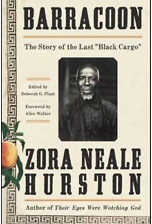
Barracoon is the story of how over 100 people were sold into slavery after slavery was declared illegal, their lives destroyed over a bet.
Zora Neale Hurston in photo by Carl Van Vechten, circa 193Barracoon is the story of how over 100 people were sold into slavery after slavery was declared illegal, their lives destroyed over a bet.
Timothy Meaher, a wealthy Alabama steamboat captain, shipyard owner and owner of the ship “The Clotilda,” bet a Yankee from New England that even though it had been illegal to import slaves since 1807, he would be able to smuggle them into the United States despite the fact that slavery was over.
One man lived to tell about it. Zora was there to listen.
As a social scientist, Ms. Hurston carefully documents her work, yet it is a story, nonetheless.
What a splendid opportunity this gives us to peek inside the belly of the beast and see what the transition from freeman to slave to freeman was like from the slave’s perspective. From the eyes of a man whose life was so tragic that it is difficult for many of us to read without wincing or swelling up with emotion. Yet, he persevered and gave us a firsthand look into the bowels of the slave system. With this insight, we all can see the basis upon which America was built.
In 1927, Ms. Hurston, a young, unpublished student of anthropology, took a research trip to Plateau, Alabama, also known as “Africa Town” since it was founded by these Africans from an illegal slave ship, who were eventually set free.
Through the voice of Kossola, the African name for Cudjo Lewis, the griot of the story, we learn that a whole community of slaves were discovered, by chance that slavery had ended and that they were free, after having worked for over five years without knowing that they were no longer captives.
Ms. Hurston pulls the painful story out of Kossola. Kossola tells us of the soldiers, both men and women, who came to their village and swooped them up.
“Derefore, you unnerstand me, dey come make war, but we doan know dey come fight us. Dey march all night long and we in de bed sleep. We doan know nothing.”
“It bout daybreak when de folks dat sleep git wake wid de noise when de people of Dahomey breakee de Great Gate. I not woke yet. I still in bed. I hear de gate when dey break it. I hear de yell from de soldiers while dey choppee de gate. Deerfore, I jump out de bed and lookee. I see de great many solders wid French gun in de hand and de big knife. Dey got de women solders too and dey run wid de big knife and make noise. They ketch people and dey saw de nek lak dis wid de knife, den dey twist de head so and it come off de neck. Oh Lor’ Lor’.”
“I see de people gittee kill so fast! De old ones dey try run ‘way from de house but dey dead by de door, and de women soldiers got dey head. Oh, Lor”!
“No man kin be so strong lak de women solders from de Dahomey
Cudjo wept sorrowfully and crossed his arms on his breast with the fingers touching his shoulders. His mouth and eyes wide open as if he still saw the gruesome spectacle.
He talks of his journey on the Clotilda, the last slave ship to kidnap human beings and haul them across the Atlantic under inhuman circumstances.
“De boat we on called de Clotilde. Cudjo suffer so in dat ship Cudjo doan know, seem lak it move all de time. One day de color of de water change and we see some islands, but we doan come to de shore for seventy days.”
Over casual days blanketed by the warmth of sunshine and fed by fresh juicy peaches, Kossola drips out story after story about his African family, his capture, his own family and how his community was formed. Sometimes he is forthcoming, sometimes he holds back. He is always elegant.
It is pleasing to see the ever-playful, ever-amusing Ms. Hurston stick to her scientific side and not give opinions or comments on Kossola’s narrative.
Barracoon is neither playful nor amusing. Often, history is written by the winners, not Barracoon. It is an historical account of slavery from the point of view of the slave. It should be a part of every American history curriculum; it should be placed right next to Howard Zinn’s “A People’s History of The United States.”
Some literary people are getting hung up on if Zora “lifted” information from primary sources, what was actually said and what was “created.” Those people are putting their energies in the wrong place. Barracoon is a story, not a textbook. Did Kossola embellish his stories as he told them to Zora? Did Zora embellish Kossola; stories to make them more pungent? There is no way of knowing. What we do know is that nobody asked Melville about the sailors’ diary he cribbed from, not a word is mentioned about Harriet Beecher Stowe and “Uncle Tom’s Cabin,” Margaret Mead is still heralded as an accomplished anthropologist despite the haze of ambiguity surrounding her work; yet Zora, because of her personality (I think), is chastised for bringing something to light which was gathering dust in a museum.
It is easy to see why Zora became so disenchanted with the progress of her works. Imagine how one must feel after having written such a remarkable tome, to have people not want to publish it, not want it to disseminate this information for everyone to read.
Some publishers said that they woulda, coulda, shoulda published it but the dialect was too difficult to understand. Some were more truthful and just outright refused it.
Some might say that a piece which excoriates the origins of our nation was too advanced for readers of that time. Had the information in this book become mainstream, the image of “America The Beautiful” would have been tarnished. Perhaps, had it become mainstream, an honest look at the history of this country would have started a movement of mending fences almost 100 years ago; maybe not. Excluding people from history, from written history, from being a part of the fabric of America is dangerous business and that is what this country has chosen to do. Instead of embracing this book for the priceless knowledge it imparts, the establishment tried to cover it up, why?
This country was not founded on life, liberty and the pursuit of happiness, it was not founded by people fleeing for religious freedom, it was founded on greed, pure and simple.
So, when Zora talks about “the universal nature of greed and glory,” she breaks those lofty Americanisms which we all learned in school. She scares us. That is what she does in Barracoon.
The more we hear of Cudjo’s life, his being kidnapped and sold at the age of 19 in Africa, his passage over in a ship which knew it was carrying illegal cargo, his not learning of his freedom until five years and six months after slavery was over, the more we see how wretched the moral compass of this country was.
Zora was saddened by the fact that, through Cudjo Lewis, she learned that there was Black-on-Black crime at that time. “The inescapable fact that stuck in my craw was: My people had sold me and the white people had bought me. That did away with the folklore I had been brought up on…that white people had gone to Africa, waved a red handkerchief at the African and lured them aboard ship and sailed away.” She lamented.
Man’s inhumanity to man has been going on for some time. There are some facts that might have made Zora feel better. The Africans who sold other Africans into slavery did not know what kind of slavery existed in America. Americans from Europe had “chattel slavery,” which is slavery for life, in perpetuity with no rights.
In Africa, a slave could own land, get married, even own other slaves or work in government administration. They could become free after a period of time. Some narratives of people who were slaves both in Africa and America such as Ottobah Cuguano, remember “being well-fed …and treated well.” Sometimes they were taken for a debt payment or POWs. The key thing here is that it was a system with human proportions.
The other thing which might make Zora feel better and which Cudjo brings up is that the slavery thing was mostly wealthy Africans enslaving poor Africans. What ethnic group doesn’t do that? Was it not the wealthy Jews of Germany who aided in Hitler’s heinous “solution?” Did the poor Mafia members attack the wealthy ones? Did the English Shanghai kids from Eaton? I think not.
Cudjo Lewis outside his home in Alabama in the 1930s. Considered to be the last surviving victim of the Atlantic Slave Trade between Africa and the United States, who was born in what is now modern-day Benin Republic, Cudjo Lewis was originally named Kossula. He was 19 years old when members of the neighboring Dahomian Tribe captured him and took him to the coast. There, he and about 120 others were sold into slavery and crammed onto the Clotilda, the last slave ship to reach the Continental United States. Clotilda arrived in America just a year before the outbreak of the Civil War. The International Slave Trade was outlawed in America officially in 1808, but the final recorded shipment of enslaved Africans to US shores were brought into the states secretly by the captain of the schooner Clotilda. Cudjo Lewis and other Africans established the small community of Africa Town (also known as Plateau), three miles north of Mobile, Alabama, in 1860. Cudjo Lewis died in 1935. (Photo: Erik Overbey Collection, The Doy Leale McCall Rare Book and Manuscript Library, University of South Alabama.)
Cudjo’s language is so lyrical and poignant that it’s easy to think that Zora touched it up a bit. But as far as I can see, what she didn’t take down word for word she unearthed in the Mobile Historical Societies’ dusty records including “The Voyage of Clotilda” (sp) or “Historic Sketches of The South” by Emma Langdon Roches’ historical accounts which are still languishing in underused stacks covered in dust.
It is really insulting to Cudjo to assume that because he was undereducated, he was not bright enough to speak in poetic language which touches the heart.
When Zora pushes him to be more current–“But Kossola (Cudjo’s African name), I want to hear about you and how you lived in Africa,” he comes back at her with “Where is de house where de mouse is de leader?
“In de Affica soil I cain tellee you bout de son before zi tellee you bout de father; and derefore, you unnerstand me, I cain talk about de man who is father (et te) till I tellee you bout de man who he father to him, now, dass right aint it?”
His prideful stories of his band of the last slaves to immigrate and how hard they worked to form a co-op to buy land and develop a community are inspirational. Seldom do we hear stories of Black people banding together to create a society that they control.
And Cudjo himself knows how valuable his information is to Zora, that’s why he can occasionally afford to be standoffish or to string her along, he knows she needs his knowledge. We all do.
Because Cudjo’s story was not told in the same manner as Johnny Appleseed or Paul Bunyon or any of the folk heroes we learned in the traditional school curriculum, we have missed out on learning the culture and mores of a very accepting society.
“In de compound I play wid all de chillum my father got.” He goes on to say how much fun they had playing as an extended family.
It must have been difficult for Zora to write this book strictly by the numbers. She absents herself, her sense of humor, her personality from the historical facts.
Some critics have gone out of their way to be catty and point to the negative aspects of the piece. We must not lose sight of the fact that Zora is the only one to bring this story to light. There may be other stories just as good, but nobody else wrote about them and if they are buried now, then go after the primary information which still exists and write it yourself. Why make Zora the “onliest?”
It is easy to put down Zora because of the antics in her personal life. Zora oftentimes “acted a fool” just to get over. It was a way of getting white people to accept her.
Her raucous laugh and thigh-slapping conduct was a great embarrassment to intellectual Blacks at the time, but it was her way of surviving. She was one of the most prolific writers of the Harlem Renaissance despite all of the setbacks. If people had taken this work seriously which she wrote when she was quite young, imagine the volume of work she could have put out in later life.
Imagine how history books could have given a full picture of the period. Imagine how generations after generations of people would have had pride in knowing how much their ancestors had contributed to this country.
A simple bet allowed Timothy Meaher to bring about unspeakable pain to people who are still hurting today, many generations later. No harm has come to him or his family in all these generations. His story shows us how privileged a white life can be. Cudjo’s story shows us how noble a Black life is. _________________________________________________________
Note:
My mother, the poet Helene Johnson, and my aunt Dorothy, Dorothy West, the novelist and short story writer, subleased Zora’s Harlem apartment when she went away on this trip.
The girls were staying at the Harlem Y and somehow Zora talked them into taking her place while she was away.
The girls leapt at the opportunity to live in Harlem, they lied to their parents, kept their room at the Y and moved into Zora’s residence. Zora explained that she would be away for months and that she needed to have three months’ rent in advance. The girls gave it to her. She left and the girls had their first night unchaperoned in NYC.
The next night there was a knock at the door. It was the landlord. Zora owed three months’ rent and was about to be evicted. The fact that she was out of town did not cut any ice with the landlord. So, the Boston girls paid up the back rent assuming there was some sort of error which Zora would correct when she returned. Because of Zora, they became true members of the Harlem Renaissance and it was worth it, no matter the price. ___________________________________________
Helene, Dorothy and Zora
My mother, the poet Helene Johnson, and my aunt Dorothy, Dorothy West, the novelist and short story writer, subleased Zora’s Harlem apartment when she went away on this trip to Alabama.
The girls were staying at the Harlem Y and somehow Zora talked them into taking her place while she was away.
Helene and Dorothy leapt at the opportunity to live in Harlem. They lied to their parents, kept their room at the Y and moved into Zora’s residence.
Zora explained that she would be away for months and that she needed to have three months’ rent in advance. The girls gave it to her. She left and the girls had their first night unchaperoned in NYC.
The next night there was a knock at the door. It was the landlord. Zora owed three months’ rent and was about to be evicted. The fact that she was out of town did not cut any ice with the landlord. So, the Boston girls paid up the back rent assuming there was some sort of error which Zora would correct when she returned.
Because of Zora, Helene Johnson and Dorothy West became true members of the Harlem Renaissance and it was worth it, no matter the price. – ARM