Home Blog Page 676

Rediscovering Lost Values 2018- On the Road with 8 Scribemasters

Last months, eight Brooklyn-based students, ages 12-17, and their 10 guardians visited three states in three days for a journey through the hidden chapters of American history omitted from classrooms, textbooks and core curriculums.

They toured the battlegrounds of the Civil Rights movement; spoke to people who participated in the struggle; toured institutions where  images, texts, art and relics are on display;  and even walked in the footpath of The Rev. Martin Luther King Jr.

The experience enlightened them in a way that has changed their lives, their thoughts, aspirations and even habits. They vowed to share their discoveries with friends, other family members and their schools, through the various media forms.

Daily open discussions and debriefings, organized by community activist couple Rev. Taharka W. Robinson, founder of “The Rediscovering Lost Values Tour” — now in its 11th year —  and his wife and “Values” partner Bianca Robinson offered daily opportunities for the students to express their feelings and share their thoughts on their experiences — within the context of today’s world.  There was a collegial air about the journey, but it was more than a field trip.

He and his team which included Bruce Paul Green, head of the Brooklyn Anti-Violence Coalition,  lectured at the foot of the Selma Bridge; offered reminders of each day’s place in history, like the May 17th (1954) anniversary of the Brown vs Topeka Board of Education; and permitted their charges to query “visiting professors” —  real people in various positions, from Miss Kim, a hotel culinary chief to the communications chief of the Equal Justice Institute,  and “Rediscovery’s” accompanying dean, the Hon. Annette Robinson. who framed the stories, and provided the “value” of prayer and song.

Our Time Press deputized the students as jr. journalists with Bianco Robinson as their editor.  The series begins today with scribemasters Shelby Hudson and India Cordero’s commentaries. – Bernice Green

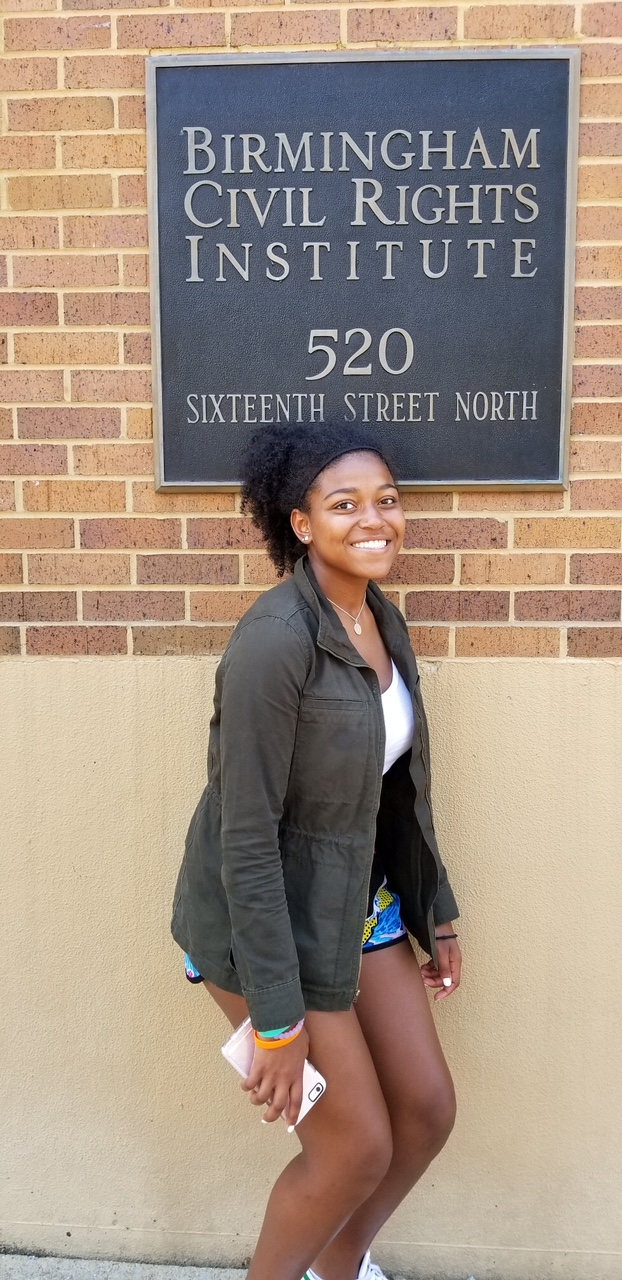
Birmingham Civil Rights Museum

Once we entered the Birmingham Civil Rights Museum, we were directed to a room to watch a film before we went on the self-guided tour. The film depicted the horrific treatment Black people endured during Jim Crow between the 1920’s and 1950’s.  After the film was over, we entered an exhibit and the very first showcase was two water fountains. One fountain was labeled “colored people” and the other was labeled “whites only.” The fountain which was labeled colored people looked old and was covered with rust and the whites only water fountain was clean, more urbane and aesthetically pleasing.

Another showcase that stood out to me was a 1953 illustration of a classroom for Black students and a classroom for white students. The classroom for white students was clean, had a new chalkboard which was green, new desks and had bright lights.  The classroom for Black students had an old black chalkboard, dull lights, old desks and looked dark and dirty.

These two exhibits really impacted me. To think that people created laws that allowed Black people to be treated unfairly because of the color of their skin and to put forth the belief that white people were superior to Black people because of the color of their skin was evil. However, despite the brutality and laws working against them, our ancestors fought for equal rights.  I am thankful they did not give up!

-India Cordero


16th Street Baptist Church

SHELBY D. HUDSON, 17, attends the Academy for Careers in TV & Film in New York City.

As we walked inside of the 16th Street Baptist Church, I could not help but to imagine the traumatic day on September 15, 1963 when the church was bombed and 4 young girls were killed. There were actually 5 girls in the bombing. The youngest, Denise McNair (11), Addie Mae Collins (14), Carole Robertson (14), Cynthia Wesley (14) and another girl, Sarah Collins, the sister of Addie Mae Collins. Sarah Collins was in a stall in the church’s bathroom when the blast occurred. The stall protected her from the blast above but not from the glass that flew in her right eye. Doctors had to remove her right eye and replace it with a prosthetic eye.

Though renovated, the church still keeps its features from before the bombing. A very interesting fact about this church is the Jesus-stained glass. After the explosion, the body of Jesus was not destroyed; only the face was blown off. The thought of the blast being on the same side as the stained glass but only Jesus’s face was destroyed left me in awe. One of the new features added to the church was a blue stained glass that has an African-American male dressed in all-white with his arms spread apart reaching to the sky. One of his hands is faced towards the sky while the other is opened towards the worshippers, revealing his palm. As told by our tour guide Mr. Bragg, one hand represents “Oppression” while the other shows “Forgiveness.”

ThE CARETAKER: This vet grew up in the 16th Street Baptist Church in Birmingham. He was at work a few blocks away on the day the church was bombed. When he left the city for A tour of duty in Vietnam, he took with him the memory of a family friend — one of the four girls murdered on that fateful day.

The last point I would like to share is about the bomber, Rob Chambliss, a white supremacist who terrorized, murdered and injured young girls that were preparing to worship the Lord in a church, a place that is supposed to be sacred and safe. I was outraged when I learned that it took 14 years for Chambliss to be tried and convicted for killing 4 young girls.

The 7 young people and I felt very sad and disturbed after watching the short documentary of the 16th Street Baptist Church Bombing and speaking with our tour guide Mr. Bragg–we were all speechless.

To know more information about this historical moment and church, I recommend you to travel to Birmingham, Alabama and see this for yourself. This is a place that everyone should experience.

-Shelby D. Hudson, 17
 

Never Forget

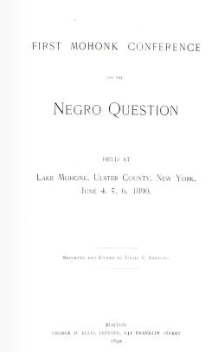
Judge A. W. Tourgee speaks for the Negro at the First Mohonk Conference on the Negro Question, held at Lake Mohonk

in Ulster County, June 6, 1905

Judge Tourgee. — So much has been said this morning about the industrial deficiencies of the colored people of the South that I have been greatly surprised at the omission of any reference to the other side of the question, — their industrial excellences. I have always been less impressed with the industrial needs of the colored man than his industrial achievements. From 1865 until 1880, I had a peculiarly good opportunity for observing his qualities both as an agricultural and mechanical laborer, having first and last had some hundreds in my employ, and during much of the time each year travelling in different parts of the State in which I then lived. As a result of constant study of their conditions since emancipation, I do not hesitate to say that the colored people of the South have accomplished more in twenty-five years, from an industrial point of view, than any people on the face of the earth ever before achieved under anything like such unfavorable conditions.

The manner in which they live and the things they do not do have been alluded to here as if they were racial qualities, and not fortuitous, resulting conditions. I was much impressed with the suggestions of more than one who has spoken, as to what they should be taught to do, as if they were industrial babes. I would like to see any of their advisers give the colored man lessons in the management of a mule, or teach him to raise a crop of corn or cotton or tobacco, or work a bad hillside at the South. In those forms of industry which they have had an opportunity to acquire, they have shown an aptitude and success which are simply amazing, when we consider

their previous lack of opportunity to learn management, thrift, and economy. The Northern man is always prompt to criticize their agricultural methods; yet the Northern farmer who goes South and relies upon his own judgment and his own labor is very generally a failure.

So, too, in comparison with the ” poor whites ” of the South, the landless cropper-class, it is unquestionable that the Negro has excelled them greatly in industrial progress since his emancipation. In five of the heaviest cotton-growing counties of five States of the South, it is estimated that from four to six per cent, of the heads of families among colored people live now under their own roof-trees.

In the regions where agriculture is more varied, the proportion is much greater. Probably six per cent, is a fair average. Now, if, under the conditions prevailing in 1865, two in a thousand had

housed themselves in twenty-five years, it would have been regarded, by the observant political economist, as nothing short of an industrial miracle. I have no doubt that five times as large a proportion of them have become home-owners and self-employers as of the ” poor whites,” who most nearly approach them in educational and financial conditions, and with whom alone they can be justly compared.

Indeed, they already stand above the average of the white race in some industrial conditions. There is only half as large a percentage of paupers among them as among the whites of the eight States of the ” black belt ” of the South, and the proportion of paupers among the whites of the South is much less than at the North. It has been claimed that the reason of this is that the old masters support the aged and infirm who have been slaves. No doubt, this is sometimes true ;

but, even in slave times, it required special statutes in every Southern State to prevent the masters from abandoning such infirm slaves to live by their own devices, and it is not reasonable to suppose that the white man would support the infirm freedman and send the disabled ones of his own race to the poorhouse. It is simply a remarkable economic fact which establishes beyond controversy the remarkable economic value of the colored man as an industrial element of American life.

Something has been said about the frequent absence of the surname among the Negroes of the South. In ” Bricks without Straw,” I fully discussed the cause and character of this, to us of the North, singular feature of the freedman’s character. It is a terrible unconscious testimony against the treatment American Christianity has accorded our “brother in black.” It was natural that the freedman should be a little lax in the matter of names. The slave had never been allowed a surname,— could not have one, indeed, because he had no father. The law expressly forbade it. He was always a nulliusfilius, and was indicted, tried, and hanged simply as Jim or John.

And it must be remembered that indictment and trial was the only legal privilege the slave enjoyed. He could be hanged, but could .not be married; and his master changed his name as often as he chose. Why should not this man, new-born to self-control, make some experiments in nomenclature? He was a good way behind us, who have been fooling with our names for centuries, and have not always gotten them entirely satisfactory even yet. This is not anracial peculiarity, but an eternal testimony against injustice.

At the close of the war there were set free 5,000,000 of men, women, and children, without a husband, a wife, a lawful father, a legitimate child, or a legal family name among them all ! They were without homes, without monev/ without lands, tools, seeds, or stock, without education, without experience, without inheritance, without the impulse of generations of thrift and intelligence. Yet, without a family name, except one of his own selection, with wages hardly one-third those of the agricultural laborer of the North, the Negro accomplished industrial results which must make any observer of facts who can lay aside prejudice and forget theories, utter, with profound amazement, those words first of all flashed through the electric wire, “What hath

God-wrought!”


On Education: Black and Latino students can compete to gain entrance to NYC Specialized High Schools

Part 1: The dangerous under-expectations of the ability of Black and Latino students
to compete with any group of students.
By Michael A. Johnson

Let me assert a strange and perhaps not well believed (or at least not presently popular) position; and that is, I believe that Black and Latino students, in NYC, and anywhere else on the planet; can effectively compete with any other students on the planet. Further, I believe that these students can perform well on the NYC Specialized High School Admissions Test (SHSAT), given the resource opportunities and the proper preparation. There is nothing inherently wrong with the brains of these children, all they need is a quality K-8 educational experience, courageous, strategically-smart, and imaginative principals, and highly-skilled teachers who are willing to efficaciously ‘leave it all’ on the classroom ‘playing field’!
Doing well on any form of assessment, is all about what happens prior to the student encountering that assessment model. And that is why professional educators know (even if the public does not); that testing a child on concepts and skills for which they have not been taught, is fundamentally unethical. Also unethical is the solitary use of standardized exams to deny admission to a quality learning experience, rather than using them for diagnostic purposes, to inform instructional practices, or to improve and expand the child’s learning opportunities. Parents of color may want to be careful of a demoralizing message sent to their children that says they can’t compete, simply because of who they are.
The SHSAT should be eliminated because it is ‘ethically challenged’. The exam proponents claim it is a fair measure of the principle of meritocracy; but in fact, that is a lie. The majority of students of color in NYC have not received the prerequisite skills training, information and knowledge that would allow them to do well (or less well) based on their own personal educational merit.
If the governing stakeholders want to change the present admissions system, then change it. But change it because it is flawed for all children (including non-affluent White students), not because of the subtle or overt reason that it is impossible for Black and Latino students to compete and win under the present rules. They in fact could compete, if only the conditions leading up to those rules were fair, which they are not, and thus one of the major flaws. A single criterion admissions process is always problematic in any educational context (K-Graduate School), and it is worthy of an informed debate among knowledgeable professional educators. But with ‘politicians’ leading the ‘admissions’ conversation, what could possibly go wrong? Well, everything!
There is always the problem in public education, of political concerns overtaking educational concerns, of utilizing symbolism instead of substance. There is this recurring bad idea in public education, that we must always sacrifice one group of students for another, We know (and have known for a long time), how to adequately educate all students to their optimum potential, we even know how to successfully educate the children of poverty, the offspring of illiterate and/or non-English speaking parents, we just choose not to do so, for political reasons. The main one being that NYC Black and Latino parents lack the political entitlement power that would demand that their children receive the education they deserve.
We also know that in the absence of a strong ‘parent-push’ informal education (out of school) component in a child’s life, the odds are that they will struggle in school (and on standardized exams); and therefore the school must step up and step in as an informal educational parent, if that child is to be successful. This would include offering students real and serious test prep, after-school, weekend and summer learning opportunities. And of course, the best test-prep being a rigorous K-8 learning experience. But that takes a systemic financial investment matched and created by political will.
Part 2: The school Integration, Diversity in Specialized Schools and Programs Debate: The wrong conversation, the wrong conversationalists leading that conversation, leads to and guarantees poor outcomes.

Michael A. Johnson has served as a public school teacher, Science Skills Center director, principal, and a school district superintendent. He also served as an adjunct professor of Science Education in the School of Education at St. John’s University. He recently completed a book on school leadership: Report to the Principal’s Office: Tools for Building Successful High School Administrative Leadership… http://reporttotheprincipalsoffice.net/

After 40 Years, is There a Victor in the “War on Drugs?”

The 40-year War on Drugs was examined during the May 24, 2018 BRIC-TV #BHEARD Town Hall. Dubbed “Whose War on Drugs?”, Brian Vines moderated a panel consisting of:

Eric Gonzalez, Brooklyn District Attorney; Kassandra Frederique, NYS Director for the Drug Policy Alliance; Chino Hardin, Field Director of the Center for NuLeadership on Urban Solutions;

Tom Robbins, Investigative Reporter for the Village Voice and Contributing Writer for The Marshall Project; Dr. Hillary Kunins, an Assistant Commissioner for the NYC Department of Health & Mental Hygiene.

Brian Vines explained that The War on Drugs was so named and initiated by President Richard Nixon’s Administration in the 1970s. Presently, $51 billion is allocated annually to this effort. Vines asked the panel to answer who are the combatants of this war? D.A. Gonzalez stated: “The War on Drugs is a failed effort. I have personal knowledge of people being cycled through the criminal justice system due to drug use. This is because the justice system gets the conviction but there is no help with the addiction.”

Kassandra Frederique said it is the people of color of lower incomes who lack access to health care and education, and it is “whiteness” that created the war.

Chino Hardin contended “The War on Drugs” is a war on Black, Brown and poor folks. After 40 years, there are no solutions to the distribution and illegal sale of [these controlled substances].

Tom Robbins turned the tables a bit by asking, “Who is the bad guy?” At this stage of the struggle, new battle lines exist in that it was clear previously that the distributors of the drugs were the bad guys. Now the green light has been given to the pharmaceutical companies; therefore, the lines are blurred. Robbins is alluding to the fact that pharmaceutical salespeople had promoted opioids as good medicine that was not addictive.

Dr. Kunins said, “There is a need to build whole people and whole communities. Blocking access to health care, medicine and education exacerbates the problem.”

One portion of the Town Hall focused on the considerations into legalizing marijuana and another portion examined narcotics. D.A. Gonzalez, who has more than twenty years in developing drug policy, stands behind decriminalizing marijuana sales and usage. People who have been arrested, imprisoned and/or supervised by the NYC Department of Probation would be recompensed for time in jail or prison and their criminal records would be expunged.

Ms. Frederique stated there was a developing legal economy in marijuana–medical marijuana and recreational marijuana. Frederique’s concern is that people of color will get into this legal industry. Currently, there are nine US states and the District of Columbia that permit adults over the age of 21 years to smoke the plant. There are 29 states and the District of Columbia that permit the sale of medical marijuana at designated businesses. However, what persists, according to Frederique, is the belief that marijuana is the “gateway drug” to other mood-altering substances. The “Marijuana Battle” within the “War on Drugs” created a generation of people who were raised by their grandparents or in custody of the NYC Administration for Children’s Services. Further, adults are having difficulty obtaining legitimate work with livable wages due to being arrested for possessing small amounts of marijuana.

During this portion of the event, a number of people came to the microphones to object to the smoking of marijuana in public spaces. They objected to the aroma of burning marijuana. Unlike liquid and solid substances, marijuana pervades wide areas. The panel of experts acknowledged that fact.

The #BHEARD Town Hall then transitioned to looking at narcotics. This was done by following a man named Mike who devoted himself to reducing the risks of narcotic usage by operating a needle exchange program. Mike is a middle-aged African-American man who walks through Washington Heights’ woodlands to detect areas where drug use occurs. He carefully collects used syringes to put them in a storage container. Mike leaves sealed packages of unused syringes in places he believes drug users will detect.

Mike came upon a man in the woods who was under the influence of a drug. He tried to engage the man in a conversation to learn of his circumstances. His tone of voice and word choices was accepting rather than harsh or judgmental. Mike left a few packaged syringes with the man. Mike’s compassion comes from having been an active user of narcotics. Dr. Kunins and Tom Robbins commented on the slang terminology associated with using addictive substances. Words such as “junkie,” “crackhead” and “shooting gallery” are seen as effacing by Kunins and Robbins.

Dr. Kunins called out health professionals to treat drug users with dignity and follow the treatment model rather than the punishment model. Kunins realized that professionals in the medical and health fields can be as stigmatizing and punishing as criminal justice. An audience member asked for a strategy for teaching children about drugs. Dr. Kunins suggested rather than discuss pharmacology and watching dramatizations of withdrawal systems, a model that encompassed developing emotional intelligence, negotiating skills, cultivating self-esteem and other human development techniques were affective in keeping children and adolescents far less inclined toward drug experimentation.


Vanguard Calls for Education Evolution

The Vanguard Independent Democratic Association (VIDA) of Brooklyn started a revolution in the New York City public school system 45 years ago. Today, the organization is raising a loud, strong and clear voice again for community empowerment:  a call for “an evolution” of the current system to meet 21st century needs of students and schools.

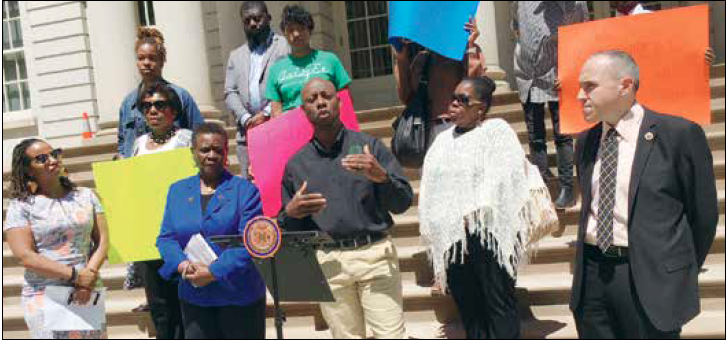
Last Monday, District Leader Annette M. Robinson, VIDA Executive Board Member and other VIDA members  held a rally on the steps of City Hall to call on Mayor de Blasio and Chancellor Carranza to address School District 16 concerns: the staggering  loss of 7, 145 (59%) students to schools outside the district due to low-performing schools; lack of resources  based on need and insufficient focus on students’ success.  Seventeen percent of the current school population is homeless; 41% are chronically absent; 58% of IEPs and only 45% graduate.

“The Mayor and the Chancellor must realize that their policies are not working and they need to make a change. Our children can’t wait for the adults to get it together,” added  District Leader Robinson.

VIDA says the basic solutions include, but are not limited to: additional supportive services; an increase of after-school programming in the district with a high percentage of working families; a cessation of the ongoing  practice of co-locating children and adult students in the same building and using elementary schools to house preschool programs; allocation of emergency funding to deal with the crisis of underperforming schools;  holding educators accountable for student success; and removing administrators receiving consistently poor performance evaluations BEFORE the 2019 school year begins.

“From Boys and Girls High School to the alternative education programs at Old Boys High School and our transfer schools, our children have proven to us time and time again how they can succeed when given the resources they need,” said state Senator Velmanette Montgomery in a statement. “All schools deserve equal access to the resources they need to help their students thrive, regardless of the communities they serve or the composition of the student population.

Assembly member Tremaine S. Wright agrees: “Schools in our community must be adequately funded in order to provide adequate education.  Our schools, our children, our parents and our educators deserve the same investment of resources as their peers.”

Speaking for Bedford-Stuyvesant families, NeQuan McLean, President, Community Education Council 16 said: “After over a decade of being the forgotten district, with declining enrollment and underperforming schools, Bedford-Stuyvesant families are still here. Our district is on the road to extraordinary. And we demand equity for the educational excellence of our students.

“We need an educational evolution,” said Stefanie Zinerman, Civic Leader and Vice President of Membership at VIDA. “The BOE has to recognize that we no longer live in a 19th century agrarian society but rather a complex technological one, which requires our schools to respond in ways that they never imagined. The structure of our families, where and how we work and society at large has advanced. Therefore, it is imperative that we employ 21st century tools and methodology to the districts, like 16, that need them most.”

City Councilman Robert Cornegy in a statement said, “We have made important strides over the past few years in increasing education equity in our schools, particularly by expanding access to Gifted & Talented programs in more districts. However, there is much work left to be done to reverse decades of segregation in our school system to ensure all our children receive a quality education, and so it is critical we continue to demand educational equity in our schools and hold those responsible for providing it accountable.”

Council member Mark Treyger, Chair, City Council Committee on Education says, “If we are going to have an education system that is equitable for all of our city’s students, we need to hold government accountable when schools in some of our city’s communities are not receiving enough resources to provide equitable, quality educational opportunities. Because public schools in Bedford-Stuyvesant’s Community School District 16 are not being equipped with enough tools to empower Bed-Stuy students, an alarming 59% of CSD 16 students are attending schools in other communities. The time to step up and support District 16 students and schools is now.”

To a question posed by Our Time Press about the loss of neighborhood-based students to schools outside the district, Mr. McLean announced, “This summer, the CEC will conduct a deep-dive analysis of students who are eligible to attend district schools but do not. We will convene a Town Hall, to hear from these parents, showcase the district programs that meet our standards and ask for their support in demanding better resources from the administration.”