Home Blog Page 6

Cafe con Libros Steeped in the Solidarity of the NYC Black Woman Bookstore Crawl

By Enoch Naklen
The inside of Cafe con Libros is a bibliophile’s dream where floor-to-ceiling shelves line the left and right walls to create a corridor of stories. Nestled among the mixed names of literature, colorful handbags hang from racks with their textures adding a domestic warmth to the room. The newly released handbag was added at the beginning of Women’s History Month as a collaborative graphic bag with the labeling NYC Black Woman Bookstore Crawl.

This bag serves as a physical testament to a movement that was catalyzed by Jeannine A. Cook, the founder of Philadelphia’s Harriett’s Bookshop. Cook, a curator and author, is widely credited with providing the blueprint for the modern bookstore crawl. Her mission to celebrate women authors and activists through “literary tourism” sparked a viral template for solidarity that directly influenced the New York City scene. Saige, one of the bartenders and administrators of the Cafe con Libros team, explains that the crawl was born from that specific energy of togetherness.


“It was at that event that a bunch of the bookstore owners were like, ‘Oh my God, is this the first time that we’ve all been in the same room together?’ And it was,” Saige tells Our Time Press. “From that momentum and from that energy, it was sort of just like, we need to do something with this.”

Beyond the marketing, Saige emphasizes a deeper necessity for the alliance that Cook’s model inspired. “I feel like there’s times where we’re all struggling and we want to build a space in a community where we feel like we can support each other because we’re the only people who kind of know what it’s like to go through what we’re going through.”


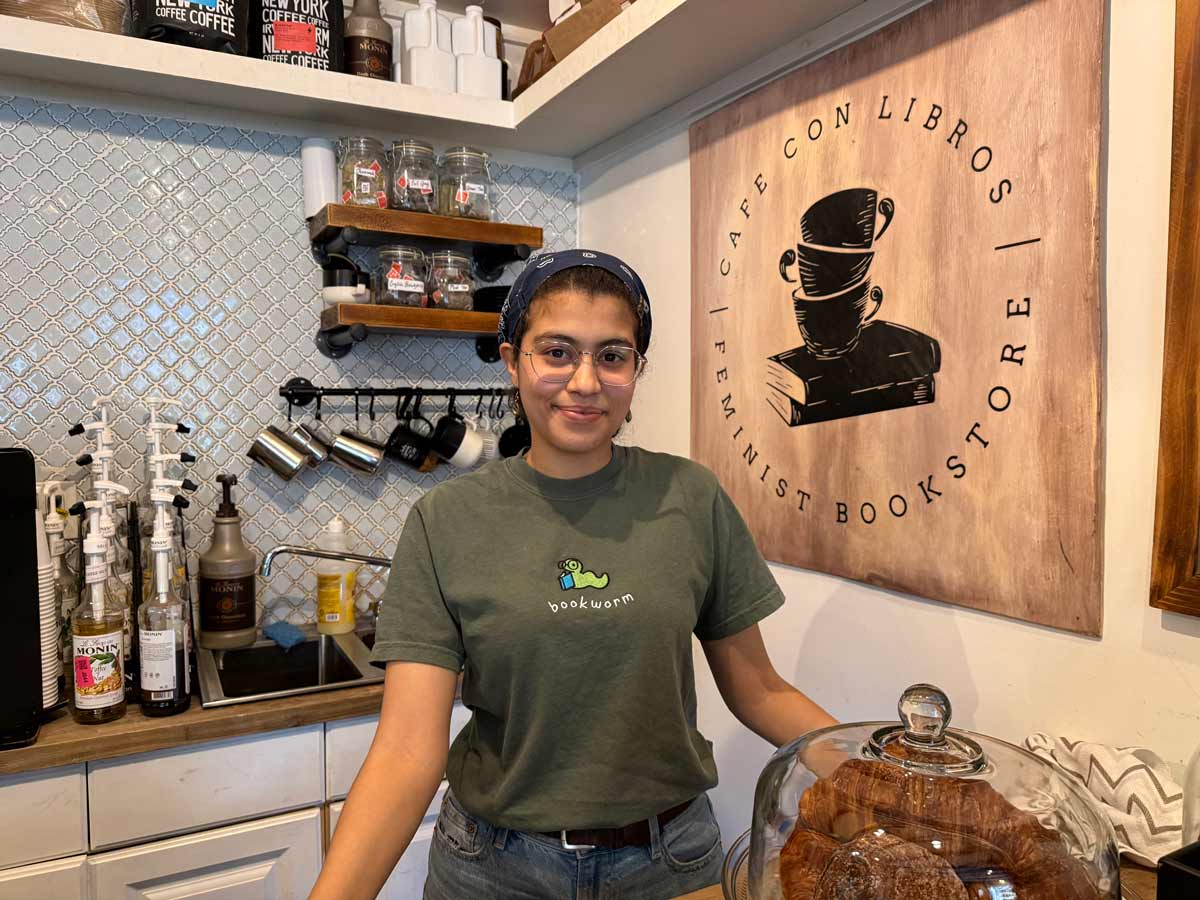
Saige can be seen opening the cafe and setting up the pastry display before grounding coffee beans in a handmade grinder, the silver machine whirring as she prepares a fresh brew. She moves with precision, roasting and tamping the grounds before pouring a choice of milk to complete a cappuccino or a steaming hot chocolate.

This sensory experience is set against a backdrop of comfort; chairs are positioned conveniently to look out into the city streets, while others face inside for a panoramic view of the books. Located on Rogers Avenue in Crown Heights, the shop is positioned conveniently next to a K-12 school, two bus routes, and a couple of newly opened apartment buildings on the block, leading to a diverse customer base of teachers on lunch breaks and crossing guards.
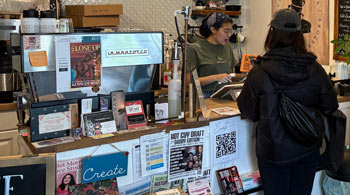

This vision of a community living room was central to why Kalima DeSuze founded the shop. Saige explains that DeSuze noticed her own family “don’t really read as much,” and so “she just wanted to build a space for people like her to come in and have community and be able to share the stories and get to know them.”

The intersection of a bookstore and a cafe was a natural extension of her heritage. “Coffee is a huge part of the culture,” Saige says. “Morning, noon, at night, you’re always drinking it. So that’s a combination of the traditions of her culture with her compassion [for] community.”


However, navigating that identity comes with the challenge of resisting categorization. Saige mentions that DeSuze often struggles to get support as who she is authentically because “she either has to align herself as being a black bookstore or being a Latina bookstore owner with the realities that she’s both.”

DeSuze envisions Cafe con Libros as a niche third space for the community and by the community. By keeping the space small and intentional, she has rejected the desire to become a big chain, opting instead to maintain a “cult classic” environment where neighbors can find themselves represented on the shelves and welcomed at the counter.
All photos by Enoch Naklen
“We the People Org” Provides Food and Clothing

0

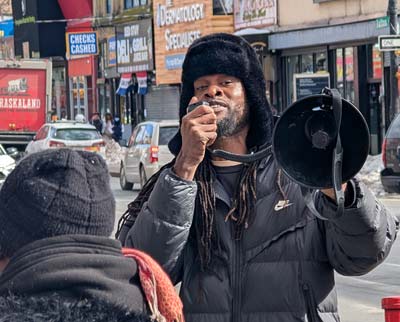
In his own words, Terrel Duval Harper aka: Relly Rebel

Interviewed by Kazembe Batts
IG: @kazbatts


Tell us a little about yourself.
I used to be a comedian, just living in the neighborhood. I’m from New Jersey. Before I came and started doing activism I’ve been locked up over 100 times and worked three jobs before I came to NYC in 2020. I came for my kids. They wanted me to get a dog to protect myself during the uprising of George Floyd and I been here ever since.

I wanted my activism to be protesting and also to practice what I preach and that is why I started doing mutual aid, I didn’t want to just be outside protesting cops and I wanted to also do more and try and create the system we want to see.


Tell us about your organization.
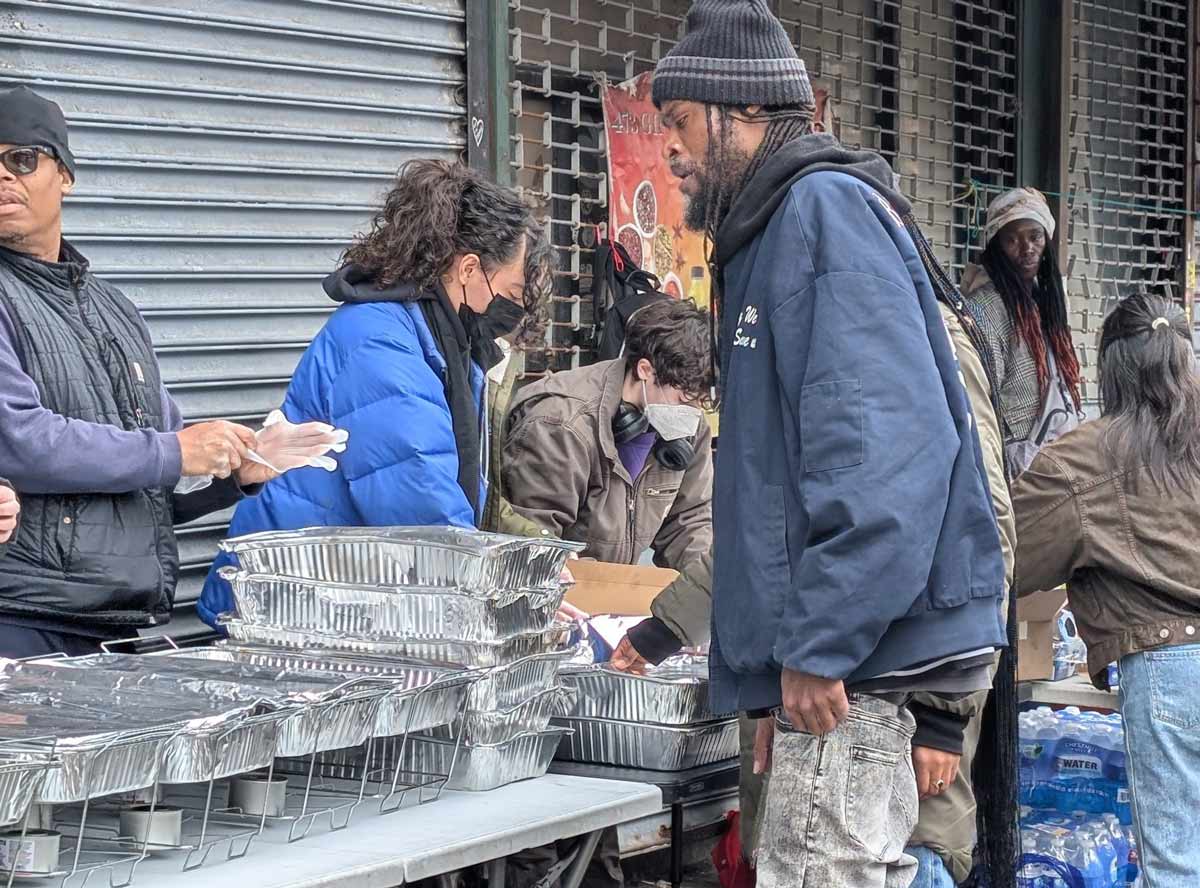
“We the People NYC” org started towards the end of 2020. It was an idea in November 2020 and I put the idea into motion in January 2021. We started doing mutual aid before protesting, It just started off with us buying food. We just wanted to produce food so the houseless people could get a good meal, a good hot meal without it being a bagged lunch.

We wanted houseless people to eat good. It expanded from there with me connecting with another comrade. and all our ideas coming together to be a support system for our neighborhoods and provide everything we need for each other.


How did you come to set up at Nostrand & Fulton?
We started as a coat drive. The coat drive was supposed to go and touch every borough, but I live in Bed-Stuy. My first stop was Nostrand and Fulton cause there is a high level of people there, and we figured its right down the block from me. We started there as a coat drive. We saw so many people, so we bought over $600 worth of items, coats and blankets. Everything left in a half hour, we didn’t even make it to the other boroughs, so based on that we decided to come back out next week and bring our food.


How do you get the food? Is the organization self-sufficient, has key partners, or get government grants?
We started distributing food with myself. I took $200 and just cooked some food with my own money. Once we posted the pictures on social media, we posted flyers for the next week people saw what we were doing and donated money and we kept going from there, then we got large sums of money ands now not to get caught up with the government and taxes and all that, we partnered up with Pact Collective which is a grassroots org out here.

They are a fiscal host for groups that do mutual aid. They take care of all the paperwork. Our money gets donated to Pact Collective and to receive the money we have to show receipts. We don’t get government grants. We are not a 501c-3. We want to see if we can make this sustainable off people power without going to the government, see if we could do it through the community, we been going on five years now. So its been sustainable. We have been able to start a new distro in Harlem.


Who are your key teammates and what new plans do you have?
Some of my key teammates are Che, Krispy, Rudy, Sarah, Koren, Marissa, so many more are heavy organizers and key players in the organization, but we try to make everyone an organizer. We have a mobile distro coming. We’re stationery in Bed-Stuy and Harlem but now we are putting the mobile distro into effect in the afternoon, possibly calling for bikers or using the trains, giving people a opportunity to help us out, hitting different areas weekly. The mobile distro should start in April


Incidents have happened with the police. What is the relationship on the street?
We had a couple of run-ins with law enforcement. I feel they do it at least once a year. Sometimes it’s new cops and they don’t know so we have to break them in and they panic and call for backup, so backup cops would pull up and let them know who we are. You don’t have to have a permit to give out free food and stuff. One day cops got physical and tried to take stuff off our table and locked up two comrades. The most powerful thing is we never stopped the line.

We had people handle that situation and deal with the cops when they come but the line keeps going. They ended up locking up eleven people all together but we say that is the fight to show them that we coming back out next week. We showed that we gonna do for our community no matter how they feel about it. We’re trying to strengthen our community, and we don’t need permits to do that. Our eleven people have heavy lawsuits on hand.

Photos by Kazembe Batts

Free Agent Frenzy 2026: Giants Bring the Heat, Jets Bet Big on Defense and Geno

By Eddie Castro
Aside from the actual NFL games themselves, if football fans had to pick a No. 2 exciting moment, it would be two things. The release of the NFL schedule, which reveals who your favorite NFL team will be going head-to-head with throughout the year, and the start of free agency. For the New York Giants, the team is looking to make a splash in free agency after an abysmal 2025-26 campaign, in which they finished in last place in the NFC East division with just four victories.

Before free agency kicked off, the Giants made a few changes to their coach staff. The team was able to come to terms with former Baltimore Ravens Head Coach John Harbaugh, who was sought out to be the hottest coach on the market after 18 seasons in Baltimore.

The team also hired a new offensive and defensive coordinator for the upcoming season in Matt Nagy and Dennard Wilson. With the coaching staff now in place, General Manager Joe Schoen wanted to make a statement that “Big Blue” is serious about taking the next step forward in building a winning culture.


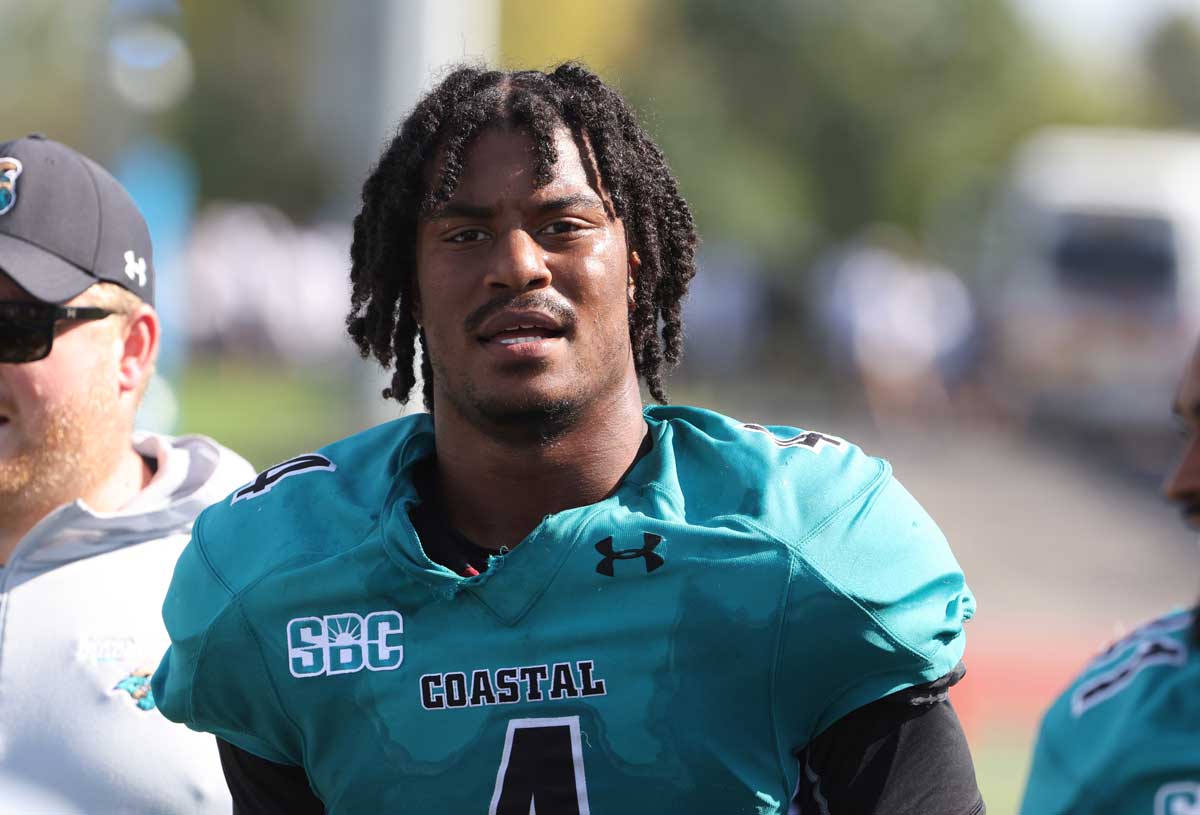
As we go to press, the Giants wasted no time adding talent to the roster on day one of the legal tampering period. The team signed Tight End Isaiah Likely to a 3-year/$40 million deal, the first player to reunite with his former coach. He becomes another weapon for quarterback Jaxon Dart with Wan’Dale Robinson leaving the team and signing with the Tennessee Titans on Monday. Other notable signings are Tremaine Edwards (3 years).

The former bears linebacker will now be the “quarterback” for the defense. Cornerback Greg Newsome II and punter Jordan Stout were other pickups for New York. The Giant’s next move should be on the offense seeking a No.2 receiver to compliment Malik Nabers, who is returning from a Torn ACL he suffered early last season.


As for the New York Jets, on day 1 of the NFL’s legal tampering period, the Jets signed six players on defense to free agent deals highlighted by a trade they made with the division rival the Miami Dolphins that sent Minkah Fitzpatrick to the Jets in exchange for a 2026 seventh-round pick. A potential high reward with less capital Gang Green had to give up.

The Pro-Bowl safety went on to sign a 3-year/$40 million extension with New York. The Jets are also bringing back linebacker Demario Davis(2-years/$22 million). Davis returns for what will be his third stint with the Jets. He brings leadership to a defense that has not had that signature voice on that side of the ball since C.J. Mosley retired.

At 36, Davis is still playing at an elite level as he is coming off a career-high in tackles in 2025 with the Saints. The Jets would add more to their defense adding former Bengals defensive end Joseph Ossai (3-years/$36 million) and two other players on defense on 1-year deals. On the offense, as we go to press, the Jets are bringing back a familiar face to play quarterback for the team in 2026 in Geno Smith. Smith was acquired via trade with the Las Vegas Raiders now returns to the franchise that drafted him back in 2013.


Free agency officially kicked off yesterday (Wednesday March 11). It is expected that but the Giants and the Jets will still be wheeling and dealing as they attempt to put a stop to the bleeding that has seen the Giants not make the playoff since the 2022 season and their neighbor Jets franchise not make a playoff appearance since 2010.

Free agency and of course the draft are many ways our beloved New York Football team can end their respective droughts and stop us from turning away from our televisions. We shall see what the rest of a busy football week brings.


Sports Notes: (World Baseball Classic) As we go to press, Team USA Baseball is 3-0 and more than likely on their way to the knockout stage of the tournament with wins against Brazil, Great Britain, and Mexico whom they have not beaten in 20 years until this past Monday.

The match ups for the Knockout stage have not been announced at this time with the round Robin round still in progress.

New York State Legislators Propose Change to Law that Allows Predatory Vulture Funds to Target Developing Countries

By Mary Alice Miller
When Puerto Rico defaulted on its debt a few years ago in the aftermath of Hurricane Maria in 2017, family and friends in New York watched as the territory’s schools and hospitals closed and people lost their pensions. Several high-risk hedge funds had bought much of the country’s assets.

Puerto Rico’s municipal debt is estimated at $74 billion, not counting pension obligations.
The crisis was caused in large part by hedge funds that invest in sovereign debt issued by countries in financial distress, extracting billions of dollars in profit from the pain and suffering of people living in those countries.


“What we’ve seen is after these vulture funds purchase all this debt, they go to these countries and force repayment (by suing often in New York courts),” González-Rojas explained.


“We’ve seen public universities de-funded, particularly in Puerto Rico. We’ve seen social services slashed. We’ve seen health care facilities shut down and we’ve seen pensions cut. And it’s happened not just in Puerto Rico, but in places like Venezuela, Ecuador, Peru,” said González-Rojas. “Often, we wonder why there’s a migrant crisis. We’ve allowed Wall Street to destabilize these economies.”


Countries issue bonds to raise money for infrastructure or other public expenses, promising to repay the buyers later with added interest. In recent decades, some hedge funds adopted strategies of buying distressed sovereign debt and then aggressively suing for repayment when countries default, often in New York courts.
Puerto Rico is not unique. Argentina, Equador, Panama, Peru, and Republic of Congo have also been targeted by vulture funds under New York State law.


New York State plays a major role in predatory vulture fund ability to extract resources from poor, developing countries, draining countries’
resources and further prevents their efforts to restructure debts.


Champerty is a long-standing legal principle that prohibits buying debt simply to sue and bars profiteering through litigation. In 2004, hedge funds won a carve out in New York law: if the debt claim is over $500,000, champerty doesn’t apply.


The carve out allows predatory investors to seek profit from litigation against debt-distressed countries in New York State courts. Normally, sovereign debt cases are handled out of court, but hedge funds choose instead to sue in New York State.
Over half of all sovereign debt bonds are governed by New York State laws. These bonds, representing tens of trillions of dollars worth of debt held by countries around the world, are issued under New York State law.


The state is seen as the best jurisdiction for sovereign debt, but the carve out allow abusive lawsuits to take place, undermining that status.
The International Monetary Fund estimates that nearly 70 countries are in or at risk of debt distress. As vulture funds standardize their practices with an extensive network of high-powered lawyers, trade associations, lobbyists, public relations experts, universities, and cultural institutions, increasing numbers of countries are at risk of being sued in New York.
But, New York State can disrupt these predatory practices.


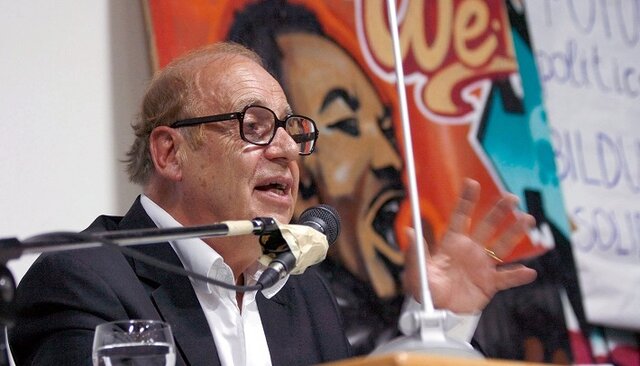
In the aftermath of Puerto Rico’s crisis, State Senator Liz Kruger and Assembly member Jessica Gonzalez-Rojas introduced legislation that would prohibit the purchasing of financial instruments solely for the purpose of litigation.
The bill would restore champerty protection by 1) removing the safe harbor shielding of $500,000 or greater claims from New York judiciary law, and 2) lower New York’s punitive prejudgement interest rate.


The bill was narrowly crafted to apply only to notoriously litigious investors, ensuring that no impact on conventional or cooperative investors who engage in good-faith workouts. The legislation would impact about $800 billion in debt from developing countries.


State Senator Liz Kruger outlined the purpose of the bill.
“It basically says you can’t buy up a country’s debt because they’ve defaulted just because you want to buy it for 10 cents on the dollar or pennies on the dollar and then litigate to try to get a dollar for a dollar out of countries who don’t have the money to pay back,” said Kruger.


Kruger continued, “When we help to destroy other countries’ economies that means they can’t provide education, infrastructure, clean water, electricity, and health care to their people. And sometimes the government then crumbles and collapses, and they go into Civil War situations. Not only do the people of that country suffer but in fact the United States of America suffers because we’re seen as the ones who are responsible for all this all over the world because we’re letting it happen.


“We always wonder why are there all these migrants fighting to get here. A lot of them come from the countries that there is no longer a functioning government or infrastructure for them to be able to take care of themselves and their families,” said Kruger. “The domino effect of this unbelievably selfish model of finance can’t be allowed to continue.”


Kruger concluded by saying, “My father was an international investment banker his whole life. He would be mortified if he was alive. He would go ‘That’s not what banking’s about , that’s not what cross international investment in about. It’s about ensuring that you are building things, that you are adding to the economic prosperity of places outside of the United States of America. You are not doing this to destroy countries, create international nightmares and havoc for a couple of people who figured out how to game our system for personal wealth.’”


Kruger added, “If dad was alive, he would stand here and say ‘Shut them down. Stop this from happening.’ And so we’re shutting them down. That’s exactly what we’re trying to do in the state legislature as much as we can.”

Say It Ain’t So–developers Target Smurf Village In Bed Stuy

0

By Nayaba Arinde
Editor-at-Large

Will Bed Stuy’s beloved Smurf Village become a cut-and-paste condo complex?
The Brooklyn neighborhood has been gentrified at an alarmingly shocking pace; multi-decades-old Black businesses and Black-owned or traditionally Black folk-rented homes are being replaced by a new population–some call them transplants.

So, the news that the famed Smurf Village on the important Fulton Street (aka Harriet Ross Tubman Blvd) and Utica Avenue axis is about to be torn down for developers to build yet another condo complex is sparking a palpable reaction amongst established residents and original locals.


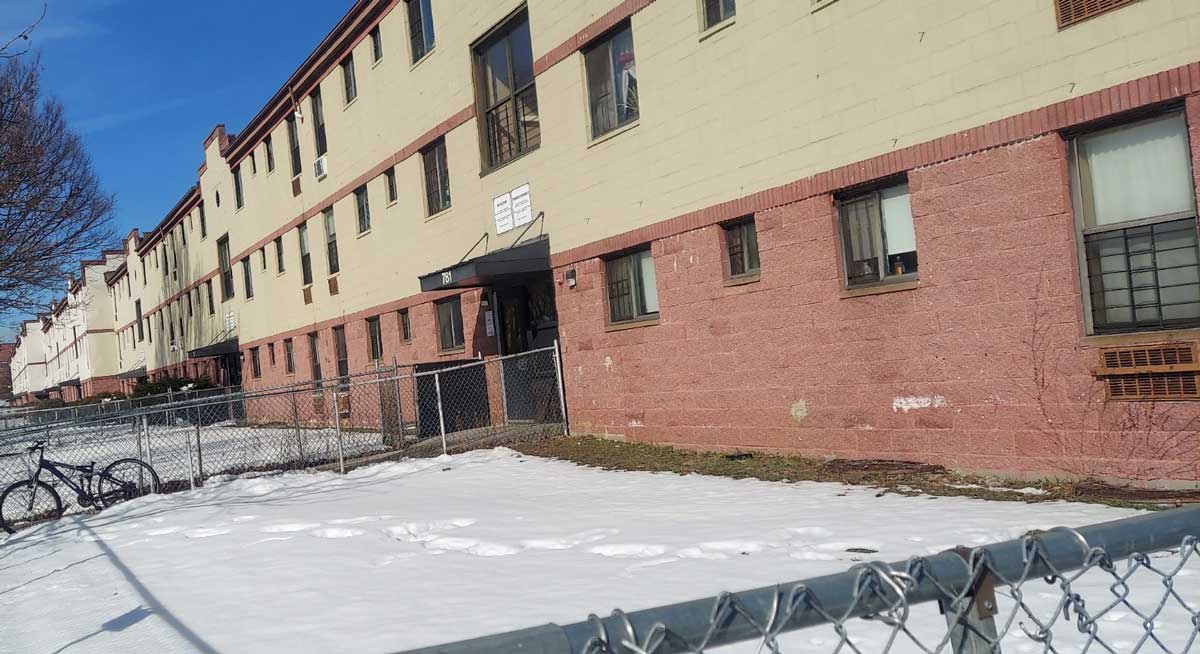
Named for its almost cute diminutive three-story style, the word on the Bed Stuy curb is that developers want to take down the low-income apartment complex in favor of over ten seventeen-story buildings with perhaps 2,000 market-rate and “regulated affordable housing.”
With its traditional Dutch architectural style of stepped gables, giving the buildings a “village-like” silhouette, hence the colloquial name Bed Stuy.


Smurf Village was built in the early 1980s. Officially part of the Fulton Park apartments, there are 12 three-story walk-up buildings, two interior courtyards with benches, and children’s climbing apparatus.


It sits adjacent to Boys and Girls High School. Across the way is the busy bus and pedestrian hub, and subway station, and a plaza set to be named later this year for Malcolm X. Traditionally, this is a site for many a protest, family events, joyous rallies, and a concrete playground lined by a variety of stores, the sometimes heady spot for afterschool youth congregations. With the Long Island Railroad close by, it has always been under the developers’ watchful eye.


In a community that has been decimated by rapid gentrification, which has seen everything from rent increases to the culture and flavor of the neighborhood slightly tempered, to the edging out of once-established and reliable community-centered staples, prices on many things have risen, including rents and home prices. This is in a Brooklyn area where the majority of people–53%- rent their homes.


Community Board 3 did not have an official response for the paper, but a member told Our Time Press, “We haven’t had a public hearing yet.”
Saha Guerrero, Press Secretary for Councilmember Chi Osse, told Our Time Press, “Our office is reviewing the proposal, and Council Member Ossé will meet with residents of Fulton Park Houses this weekend. We’re looking forward to listening to residents and supporting their needs.”


“We have a community in Smurf Village,” former resident, Brooklyn school educator Eric C., told Our Time Press. “People have raised their children here for 3 decades. My people tell me that they have had very little solid information about what is really going on. They should not just leave people in limbo like this.”

“I have met twice with L&M Development regarding the proposed redevelopment of Fulton Park Houses, built by the late Jackie Robinson, also known as Smurf Village, at Utica Avenue and Fulton Street, and shared my concerns about the project,” Assembly Member Stefani Zinerman told Our Time Press.

“A well-designed proposal on paper must also demonstrate responsible execution on the ground. Since then, residents have contacted me to report they have received conflicting information from management about their future housing security. That is unacceptable. No redevelopment should proceed without ironclad, written guarantees of non-displacement, clear timelines, and transparent communication.”


Brooklyn activist Jamell Henderson told Our Time Press that he will be organizing a press conference and rally with Citizen Action, “To put pressure on the elected officials. Was the tenant leadership or association notified, or were they given a false presentation? Many of these developers take full advantage of residents who don’t understand the terminology or the visuals they present. Residents, be ready to organize.”


Assemblywoman Zinerman continued, “The proposed density — including buildings up to 17 stories — would significantly transform an already congested corridor. Before any approvals are granted, there must be a comprehensive environmental impact review that addresses air quality, noise, vibration from the nearby Long Island Rail Road corridor, traffic flow, and the capacity of aging sewer and water systems.


Infrastructure in this section of Bedford-Stuyvesant was never built to support that level of density. Public health and safety must come before private timelines. Development must serve the people who are already here — not displace them or overwhelm the neighborhood.
I will continue demanding transparency, infrastructure accountability, and community-centered planning every step of the way.”


“The residents aren’t really happy about what’s going to happen to their apartment complex, especially because some of these apartments have 1, 2, and 3 bedrooms,” said content creator Scourgebliss, as he trudged through the snow in Smurf Village, a couple of weeks back. “When these new buildings go up, I guarantee that they won’t have three bedrooms…and they will be way smaller.”


“They don’t have consideration for the seniors and the handicapped,” said one 20-plus-year resident.
“We can’t be for certain that all the people living here will have a new place,” speaking with some “terrified” and irked residents, the citizen journalist, whose other name is Troy–noted that currently tenants have backyards, a park, a car park and tons of benches, “once the buildings go up that will all go away.”


Troy/Sourgebliss concluded, “The City loves to make claims that they will do something, and when the time comes around, we see many injustices happening. I know that change is inevitable, but there could be other ways instead of displacing people who already live here, and putting up brand new buildings in an already established space–especially when you get rid of parking, a ton of space, and you price people out. Let’s keep Black people in Bed Stuy.”