Home Blog Page 53

Brooklyn’s Global Community Activist A.T. Mitchell Looking for a Pardon in a Decades-long Case

By Nayaba Arinde
Editor at Large

Brooklyn’s global community activist and founder of the social services agency Man Up Inc. USA (MUSA), A.T. Mitchell-Mann, is advocating for pardons and clemency for eligible formerly incarcerated citizens, including himself.


While he is well known for his Cure Violence and anti-gun violence advocacy, Mitchell-Mann is asking Gov. Kathy Hochul to pardon a crime he said he was wrongfully convicted of 40 years ago.


“A lot of people do not know that I am a formerly incarcerated person,” he told Our Time Press. “I was convicted of a crime that I did not commit when I was 18, and was given a 15-year sentence.”


He now determines that it was to “prep me for the work that I am doing now, and to be very relatable with transferable skills to lead that population as I’m doing throughout the world, and to be able to represent formerly incarcerated people, recently released, returning citizens.”


Mitchell-Mann is turning to Gov. Hochul through social media and community outreach to “get as many signatures as we can from the general public and from people who know me and the work we have done, or have relatives that are like me, have come home, and have put in as much work as we have, and have made a big difference in our communities and in our societies.”


Born and raised in Brooklyn, he is busy with his offices set up in East New York, Brownsville, Bed Stuy, and Canarsie. Mitchell-Mann told Our Time Press, “Man Up Inc. has national acclaim and global recognition.

With the summer heat, with the lack of things to do, and some people having access to things that they shouldn’t have, it creates a powder keg. We make sure that we have resources to pour into the community all summer. We also have three summer camps.”


In June 2022, Mayor Eric Adams appointed Mitchell-Mann as the New York City Gun Violence Prevention Czar.
The leading figure in New York’s Crisis Management System is wearing a ‘#FreeAT’ T-shirt and asking the governor to grant him a pardon.


“I grew up in Brownsville and in East New York, the two feeding grounds for the criminal injustice system,” said Mitchell-Mann, “and so I too at the age of 18 years old I was approached by homicide detectives, and questioned about a homicide that I had no involvement in; and because I guess I did not confess to a crime that I did not commit, they charged me with the homicide at 18…my first run in with the law ever in my life.”


Born in the projects, with 7 siblings, “We lived in a poverty-stricken, drug-infested, and violent neighborhood,” said Mitchell-Mann, an alumnus of East New York’s Thomas Jefferson High School and a teen father.


He insists that he was a victim of mistaken identity when he was picked up in the case, which was actually a Brownsville neighborhood dispute between two individuals where there was a jewelry robbery, and a subsequent shootout occurred.


“We had no money for a legal defense. I had to rely on a public defender and was just put through the system. At that time, I had faith in the system and thought I would be proven innocent and be let go. I quickly learned that the scales of justice do not weigh in favor of Black and brown boys, and I took my case to trial to prove my innocence, but the jury came back with a manslaughter verdict.

I was sentenced to a maximum security prison at nineteen.”
After his five years in prison, he served 10 years of parole. “That was the worst part of serving time, because now you’re back in society. When you come home with a stigma, when you are a felon or a convict, trying to get employment or housing is hard.”


Saying that he came home, and quietly sought ways to get back into society with alternative to incarceration programs, saying “prison isn’t cool,” and no glorification, because for me it was a nightmare going to a prison for a crime that I didn’t commit.

I was traumatized. My mother passed away during the time that I was incarcerated, and she believed in me and was there every step of the way.” Mitchell-Mann recently took on his late mother’s surname as a sign of respect.


So he said he came out “doing the work, mentoring young people,” and thought his journey “was a curse originally, but I see it as a blessing in disguise for 40 years. I was 18 years old when I was arrested–I’m 58 years old now. When men and women come home from prison, they have a lot of restrictions that are placed on them. They can’t leave the country. They can’t leave the city. They have a lot of restrictions.


After applying for my Certificate of Relief from the State of New York, it was issued back in 2011. But, it’s almost like the 13th amendment–all slaves shall be free, except for those that are convicted of a crime–and on mine it says that I have been given all of my relief except for my right to bear arms and my right to run for public office… for the rest of my life for a crime that I did not commit.”


Mitchell-Mann, the former Chief of Staff to former Councilman Charles Barron, said, “I think that people who have done exceptional work in the community, even though they might have been formally incarcerated, should be given a pardon and clemency by the state because they’ve earned it. I believe I’ve earned that right, just looking at the work that I’ve done in the last 30-something years.”


New York State determines on the official website that, “Anyone who has been convicted of a crime under New York State law can apply for a pardon…for applicants who have successfully completed all court-imposed requirements connected to their conviction and sentence…

Applicants should show that they are contributing members of their communities…for example, through accomplishments in employment, education, or through family or community service.”

Mitchell-Mann founded the social service agency Man Up! Inc. in 2004 when an 8-year-old Daesean Hill was shot and killed by a stray bullet as he walked home from school.


“I’m going to keep doing what I’ve been I’ve been called to do, but at the same time now I really do want to be free of these bars, that are placed on people like me, there are so many formerly incarcerated people that are doing amazing things throughout this city, and throughout this nation and that should account for something.


“Gov. Hochul has the signature power to grant pardons and clemency. I want to present her office with thousands of signatures, and she will see that this is something that is rightly earned and deserved.”


Governor Kathy Hochul’s office did not respond to an Our Time Press request for a response by our deadline.
MLK, Jr. Center Statement on Release of FBI Files on Civil Right Leader

Each year, the nation and the world pause to remember the assassination of Rev. Dr. Martin Luther King, Jr. and to reflect on the impact of his teachings on true peace, the dignity of all people, and nonviolence – a philosophy that continues to have a profound impact on the global landscape.


Dr. King provided critical leadership to facilitate the passing of foundational legislation that helped to address division in this nation—including the Civil Rights Act of 1964, the Voting Rights Act of 1965, and the Fair Housing Act of 1968.

The King Center, which was founded by Mrs. Coretta Scott King, stands as the official living memorial to the enduring influence of her husband’s life and legacy. It is a legacy that disinformation connected to unjust government surveillance cannot corrupt.


Dr. King’s assassination was investigated by the FBI in 1968, by the House Select Committee on Assassinations from 1976 – 1978, by the Department of Justice in the 1990s, and again with a wrongful death trial, brought by the King Family, in 1999.

The Memphis civil court’s unanimous verdict in 1999 found that James Earl Ray was not that shooter. The verdict also validated the family’s belief that Loyd Jowers, a Memphis businessman, along with other parties, including various government agencies, conspired to murder Dr. King and frame Ray.


The wrongful death trial verdict begs the question, ‘Why would these entities conspire to murder Dr. King?’ Ensuring economic justice and racial justice, particularly in the areas of employment, livable wages, and voting rights, was the work in which Dr. King was engaged when then FBI Deputy Director, William Sullivan, described Dr. King as “the most dangerous and effective Negro in the country.”

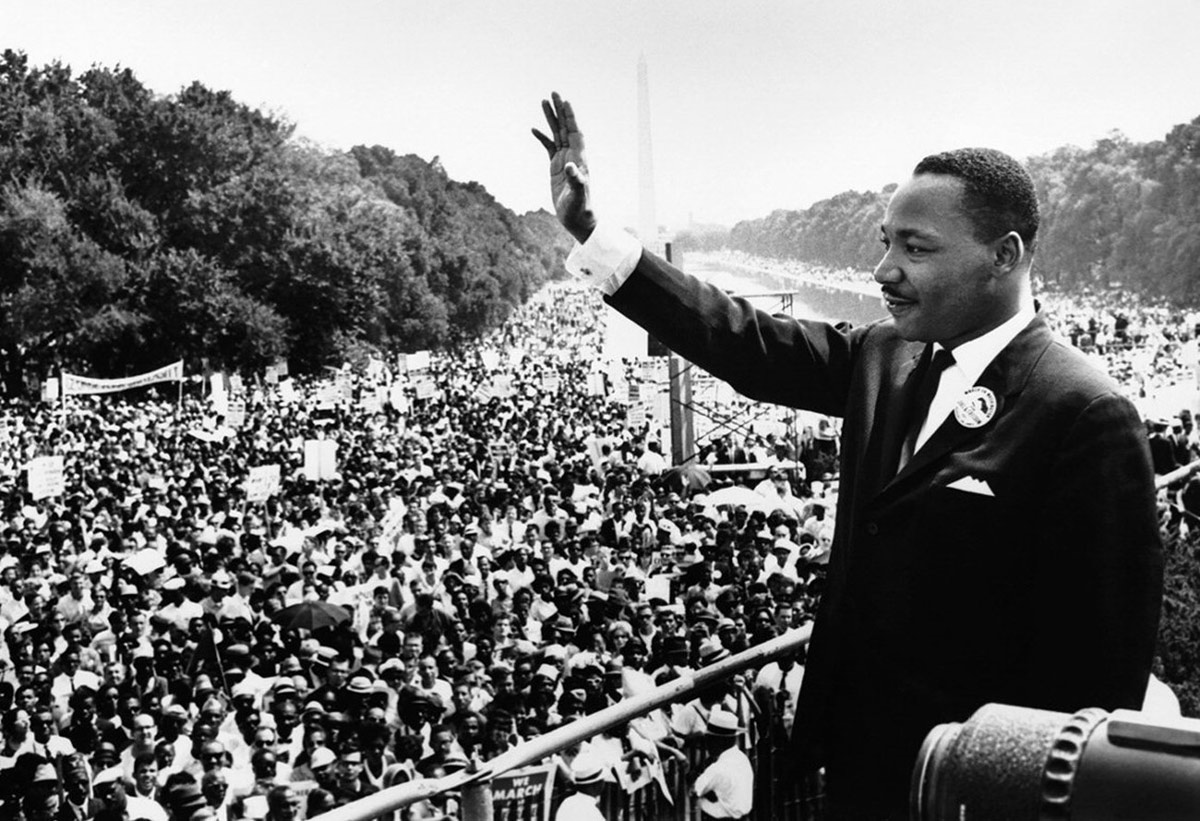
Deputy Director Sullivan wrote these words in a memo dated September 25, 1963, a month after the March on Washington for Jobs and Freedom, during which Dr. King delivered his prolific ‘I Have a Dream’ speech.


Government discontent with and malignment of Dr. King deepened with his public opposition to the Vietnam War, as most profoundly expressed in his speech, ‘Beyond Vietnam: A Time to Break Silence.’ The speech was delivered at Riverside Church in New York City on April 4, 1967, exactly one year before Dr. King was assassinated and included his rebuke of the United States, calling the nation “the greatest purveyor of violence in the world.”


And so, as we prepare for a heightened focus on Dr. King, we underscore the work central to Dr. King’s dream: engaging Kingian Nonviolence, which The King Center has rebranded as Nonviolence365, for the strategic eradication of the Triple Evils of racism, poverty, and militarism.

We invite the global citizenry to join us in working to rid our “World House” of these interconnected, debilitating conundrums. This righteous work should be our collective response to renewed attention on the assassination of a great purveyor of true peace.

The King Center believes it is unfortunate and ill-timed, given the myriad of pressing issues and injustices affecting the United States and the global society, to distract from the critical needs and traumatic outcomes resulting from these issues and injustices.

Further, we cannot afford to be diverted from how we each can contribute to changing the trajectory of our “World House.” If we are not careful, that is what the release of the FBI files could precipitate for many.


As Dr. Bernice A. King, youngest child of Dr. and Mrs. King and CEO of The King Center, stated upon the conclusion of the 1999 trial, “The reality is that it is not who killed Martin Luther King, Jr…but what killed Martin Luther King, Jr. Because whenever we get to what killed Martin Luther King, Jr., then we will deal with the various injustices that we face as a nation and ultimately as a nation that leads this world.”

Honoring a Northern Struggle:

0

Abolition Commemoration Day Marks History and Legacy

By Lyndon Taylor
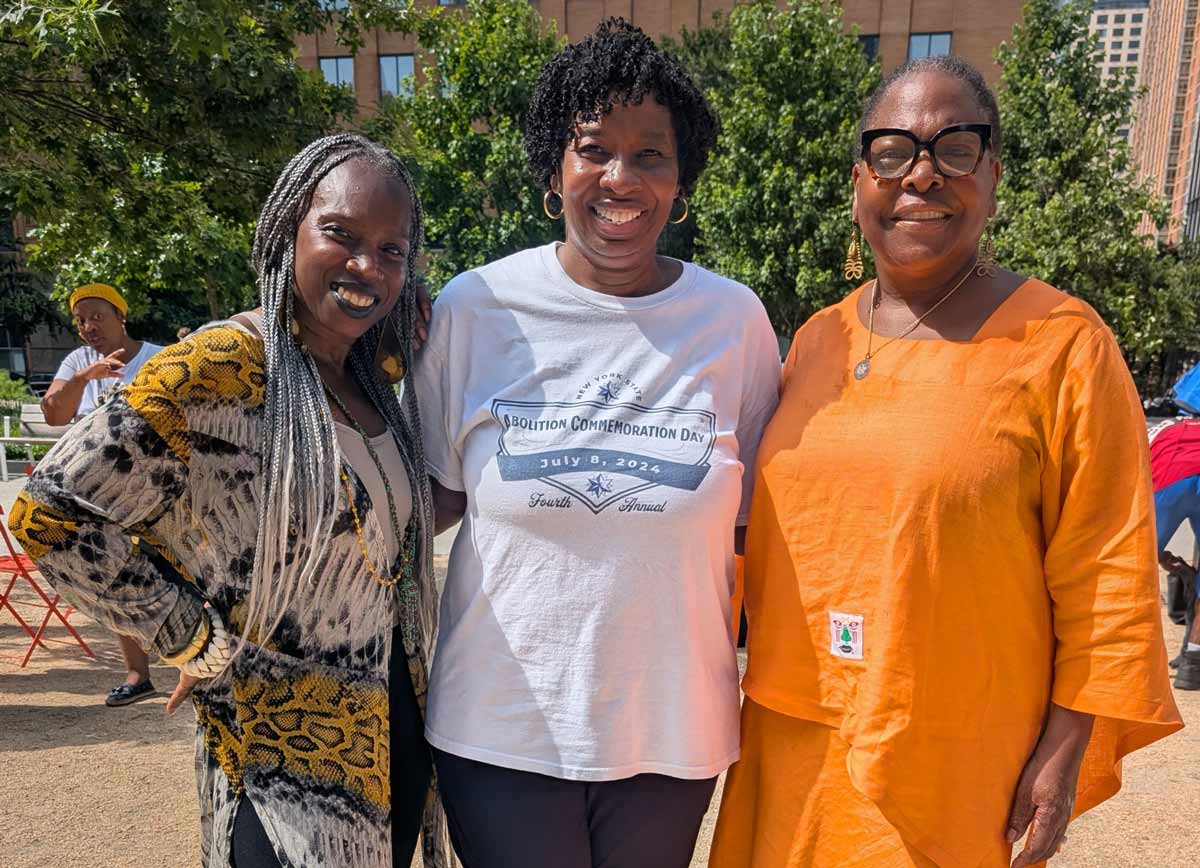
On Monday, July 14, community members, activists, and elected officials gathered for an afternoon of reflection and education during the Abolition Commemoration Day program, curated by Bridget Yolanda Smith of the Manhattan Branch of the Association for the Study of African American Life and History (ASALH).


The program, held in the spirit of reverence and resistance, drew support from organizations such as Friends of Abolitionist Place, Liberation Farms CORNERS Community, entrepreneur Ernee Peppers, and several civil and community groups. Together, they underscored the enduring relevance of New York’s abolitionist legacy — a history that many still overlook.
In an interview with Our Time Press, Smith emphasized why the event is critical.


“Many people don’t realize that slavery was up north and think it’s down south…all over really,” she said. Her words reflect a common misconception that New York and other northern states were merely bastions of freedom — when in fact, New York was one of the largest slaveholding colonies before it began gradual abolition in the late 18th century.


Smith and fellow organizers see Abolition Commemoration Day as an opportunity to correct that narrative, shining a light on the legislation that abolished slavery in New York and honoring those who fought for freedom.

“We do this throughout Brooklyn, Manhattan, and the Bronx to bring awareness to the fact that the abolition happened, highlight the legislation that supports the commemoration, and give it a similar reverence as Juneteenth — with the goal of making Abolition Commemoration Day a Federal Holiday,” Smith said.

Joy Chatel at the Drummers Circle at Prospect Park.


The program also paid homage to Joy Chatel, affectionately known as Mama Joy, whose legacy looms large over Brooklyn’s abolitionist history. “The work that Mama Joy has done is significant,” Smith said, particularly her successful campaign to have part of historic Duffield Street renamed Abolitionist Place.


Duffield Street itself carries the weight of history. In the 19th century, it was home to abolitionists Harriet and Thomas Truesdell at 227 Duffield Street — believed to be a stop on the Underground Railroad — and William Harned, another conductor who lived nearby. Oral histories tell of other homes on the block playing a part in the clandestine network that helped enslaved people reach freedom.


Duffield Street was likely named after John Duffield, a Revolutionary War-era surgeon, but over time became more deeply associated with the abolitionist struggle thanks to the efforts of Brooklyn’s Black and allied activists.


Joy Chatel’s own home at 227 Duffield became a symbol of that struggle. When the city sought to seize it through eminent domain for redevelopment, Chatel mobilized the community, organized protests, and prevailed in preserving the site. As a member of Families United for Racial and Economic Equality (FUREE), she also fought against unjust zoning policies and development that threatened to erase Brooklyn’s Black history.


On Abolition Commemoration Day, participants not only honored her contributions but also reaffirmed a commitment to keeping that history alive for future generations.


The July 14 gathering reminded everyone present that the fight for freedom and justice in New York was — and still is — a northern story, too. “It’s about giving this day the recognition it deserves,” Smith said, “and making sure our children know this history happened right here — not just in the South, but here in our own backyard.”

Historian Dominique Jean-Louis:

Tracing Black Families Back to Slavery in Brooklyn

Fern Gillespie
Slavery in New York City began 400 years ago in 1626 when 11 enslaved African men were brought here by the Dutch West India Company. By 1786, Brooklyn had 2,669 white residents and 1,317 Black people enslaved. Although New York State’s abolition law was passed in 1799, human bondage remained until 1827. The exhibit “Trace/s: Family History Research and the Legacy of Slavery in Brooklyn,” on view through August 30, is curated by Dominique Jean-Louis, Chief Historian of The Center for Brooklyn History (formerly the Brooklyn Historical Society) at Brooklyn Public Library.

It explores the current descendants of Black Brooklynites who were enslaved and the wealthy white slaveholders who built Brooklyn. Our Time Press spoke with Jean-Louis about the exhibition and the impact of slavery in Brooklyn.

OTP: The “Trace/s” exhibit focuses on Black Brooklynites whose ancestors were enslaved in Brooklyn. What do you want the public to understand about the historic impact of slavery in Brooklyn?
DJL:
There are three big takeaways from the exhibition. One being there was slavery in Brooklyn, which I think a lot of people don’t know. It’s not as though we have monuments announcing that there was slavery in Brooklyn or that it’s taught in the schools. I wanted to bring that awareness to people. Takeaway two was that so much of the Brooklyn that we’ve recognized is a result of 200 years of slavery.

That slavery was incredibly prevalent in Brooklyn. A lot of our street names and subway stops that we maybe don’t give a second thought to–Bergen and Lefferts and Vanderbilt. All of these places that you encounter just moving around the borough. These are from a legacy of slave owning specifically from those old Dutch families.

When you look at Brooklyn’s growth– the ports, waterfronts and the land– all of it is super tied to slavery. And so with this exhibition, we really wanted to demonstrate how the borough we recognize today was really shaped by these 200 years of enslavement. And then the third take away and the other piece of the exhibition is really highlighting how important family history is for doing the research about Brooklyn’s history of slavery.

Also just making it meaningful that so many Brooklynites have this kind of a legacy in their ancestry, whether that’s being descended from enslaved people or maybe even being descended from slave owners. On display are two large scale oil portraits.

OTP: Mildred Jones, a retired Bed Stuy teacher, is the great-great-granddaughter of a man who was enslaved in Flatbush. How did she get involved the Trace/s exhibition?
DJL:
When we decided to do an exhibition on slavery in Brooklyn, we thought how interesting and useful it would be to connect a family story. So, we started working with the Afro American Historical and Genealogical Society and reached out to Stacey Bell at the local New York chapter, and asked if they encountered folks that trace their ancestry back to slavery in Brooklyn. The legacy of enslavement is a very present thing for Mildred Jones.

She has heirlooms from her family that belonged to her enslaved ancestors. Mildred’s brother Gus had been a genealogical member before he passed. He had uncovered his ancestor, Samuel Anderson, who was enslaved in Brooklyn and was the subject of an 1898 newspaper article. We have his firsthand account of what he remembers of slavery.

The story was so compelling. It was really sad that Gus had passed away before we started the work on this exhibition. His sister, Mildred, stepped up and was willing to do the portrait. We also did an oral history with her as the portrait was being painted.

So we got not only her image to put in the exhibition, but her whole family story. It’s not just being descended from enslaved people, but about that family’s journey through a changing Bed Stuy, a changing Brooklyn. She talks about her childhood in Bed Stuy and her work as an educator really fleshes out the story of generations since slavery.

OTP: Why did you decide to have a major portrait painted of Mildred Jones?
DJL:
In our collection, we have quite a number of oil portrait paintings of slave owners in Brooklyn. That’s one of the things that this exhibition really underscores: who has access to generational wealth and privilege in Brooklyn. When we connected with Mildred, we were able to identify a portrait from our collection of John Lott, from the family who had enslaved her ancestor. John Lott has a large scale portrait.

It’s almost life-size. So, we wanted to paint one of Mildred Jones at the same scale to address the disparity in who has access to this kind of representation and who doesn’t. These are two stories and two shared histories. John Lott’s portrait has been preserved and conserved by this institution for more than a century.

His portrait also hangs at Borough Hall and in Albany. If you think of an oil portrait, a face like his is what comes to mind. A well-dressed older white man. Mildred’s portrait by artist Rusty Zimmerman is with her AKA pearls and her more contemporary apartment with Afrocentric statues she’s acquired from West Africa.

It says a lot about determining who built Brooklyn, whose stories that we should be looking to for the history of the borough. Having it painted in the same medium and in the same scale was important to visually level the playing field between these two family’s stories before we get deeper into the documents, bill of sale and other materials from the collection.

OTP: When you were researching for the exhibition, what were some of the outstanding situations and experiences of enslaved Brooklynites that you discovered?
DJL:
I think people to the extent know that slavery took place in northern states like New York. They know domestic slavery. Like maybe you had a household servant, enslaved person. The thing about Brooklyn is that Brooklyn is New York City’s breadbasket. That the slavery that took place here in Brooklyn was plantation slavery.

You had larger farms where crops were being grown to be sold at market to turn a profit. This wasn’t just enslaved people belonging to one household and upkeeping the household. These are plantations. We were lucky enough to have a painting in our collection. It shows one of these plantations. The farm of a man named Cornelius Van Brunt in what today would have been Gowanus.

The painting shows Black laborers on the farm. We’re kind of introducing people to visually, and also with the archives that we have on display, that it was hard agricultural work that these enslaved people were doing here in Brooklyn on the ground where we stand. And of course, it’s very hard to imagine our kind of like concrete high-rise in Brooklyn as rolling hills of farmland. But that’s precisely what it was. Also, the important role that slavery played in building Brooklyn as a striving urban center.


“Trace/s: Family History Research and the Legacy of Slavery in Brooklyn” is at the Center for Brooklyn History at the Brooklyn Public Library through August 30. Dominique Jean-Louis hosts a weekly tour every Friday at 3:00 pm. On August 21, there will be a special genealogy research program. For information on the exhibit visit www.bklynlibrary.org/exhibitions/traces

“Monument to Love” in Great Barrington

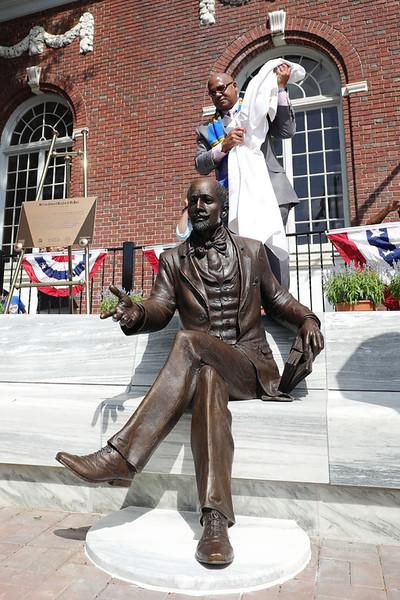
A bronze sculpture in honor of the great legacy of Dr. W.E.B. DuBois and created by the famous artist/sculptor Richard Blake, was unveiled Saturday, July 19, 2025, in Great Barrington, Mass, the site of the scholar’s birth (in 1868).


Hundreds attended the event, overseen by The Sculpture Project co-chairs Ari Zorn and Julie Mitchell, which took place outside the town’s Mason Library where the life-like artwork sits on a stone bench.


DuBois’ great grandson Jeffrey Alan Peck called Blake’s masterpiece an homage to peace.
Dr. Imari Paris Jeffries, President & CEO of Embrace Boston, said of the town’s memorial to the founding member of the NAACP and creator and first editor of the human right’s organization’s historic Crisis Magazine, a “monument to love.”


Dr. David Levering Lewis, the historian and Dr. DuBois’ two-time Pulitzer Prize winning biographer, reflected on the social activist’s past, revealing that scholars of 80 years ago considered the Great Barrington native, a “national treasure.”


As is the character of the event’s hometown, the two-hour event was an amalgam of multicultural preferences. The official monument dedication program not only listed the Top Legacy Sponsors & Donors (called Legacy contributors), it gave weight to those individual supporters (Souls), who contributed $10 to $240, and all those who were listed, according to donation amounts, as Justice, Freedom, Democracy and Equity donors.

Gratitude was extended to Great Barrington in-kind donations from the community market to the churches to the librarians and to the SoCo Creamery where a popular ice cream flavor was renamed DuBoisenberry.


Gwendolyn Hampton Van Sant, CEO and founder of Multicultural Bridges, is an expert in cultural diversity. She also is a board member of the W.E.B. DuBois Sculpture Project. She led the audience in a remembrance tribute to those special persons, now deceased who, like DuBois, did the work of forging a path to make it easier for those who came after to navigate. Van Sant incorporated an emotional Ancestral Calling into the program.


In addition to Mr. Peck, scholars Lewis and Jeffries and Ms. Van Zant, the speakers included Former Massachusetts Governor Deval Patrick, and State Representative Leigh Davis -3rd Berkshire District.

The Sculpture Project event co-chairs Ari Zorn and Julie Michaels delivered the welcome for the project which they brought to fruition and culmination over several years, which included selecting Mr. Blake to sculpt the monument.

It is hoped that monies will continue to be raised to help with the development of a museum in Accra, Ghana, where DuBois, passed in 1963, a day before the Dr. Martin Luther King Jr’s March on Washington.


The program included rousing musical presentations with selections and stylization presented in a way that commented on the times, as much as the speeches did: Wanda Houston performing “Life Every Voice and Sing. Gina Coleman & the Misty Blues band, performing “This Little Light of Mine” and “Hold On”; Randall Martin’s Sweet Life Project featuring Carla Page on Steve Wonder’s “Higher Ground”, Burt Bachrach’s “What the World Needs Now,” and Marvin Gaye’s “What’s Going On” – all the latter seeming like a commentary on the immediacy of DuBois message.


It was evident that event producers were aware of the music Du Bois loved during his lifetime, and current music espousing his lifelong messages that he would love if he were alive today.
The speeches drew the parallel with current events.


Mr. Peck quoted from his great-grandfather’s “The Future of the American Negro,” published in 1953. He emphasized the need for today’s generations to uplift his great-grandfather and be inspired by his (example) in times like these.


The event did remember the children, as DuBose remembered them in his “Credo” read by Luna Zander. “I believe in the training of children … for Life lit by some large vision of beauty and goodness and truth.”


After the performance by the Berkshires’ “Youth Alive Step & Dance Team”, the anticipated pride in performance took a back seat to their collective awe in seeing Richard Blake’s sculpture work up close. The youngsters took turns sitting on the marble bench next to the sculpture and grasping DuBois’ open palm.


Peck said, “It’s fitting (my grandfather) sits here (at the entrance to the town’s library) and welcomes townsfolk to a place of knowledge, a home of books, and a sanctuary of truth.”
Bernice Elizabeth Green, with Joanna D. Williams and Chelsea Jo Williams

All photos on this page are by photojournalist Stephanie Zollshan for the Berkshire Eagle.