Home Blog Page 504

The Good in it All

Protesting has become the new social outing

After three months of being quarantined into a bubble that consisted of the people you live with and a few close friends or family, the dozens of protests in our city haven’t just been an opportunity to express our collective outrage. They have been an opportunity to just once again be part of a collective. Social interaction is a part of natural human development. Science will tell you that social interaction lowers stress and anxiety, and even increases our endocrine immune systems, but you don’t need to be a scientist to know that children crave the ability to interact amongst other children. It’s a necessary part of a child’s upbringing, their adventures with other children.

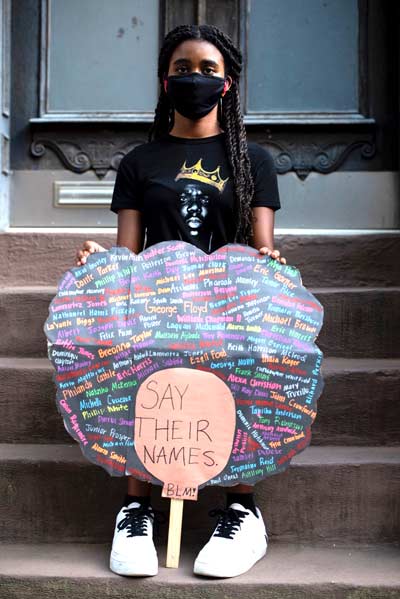
I went to two protests this past week. The first one was on Sunday, a well-kempt unit of Bed Stuy residents marching from the park on Stuyvesant and Fulton over to Restoration. The second was a much larger representation that began in Fort Greene Park, traveled to Borough Hall for a set of speeches and then walked over the Brooklyn Bridge and onto City Hall. In both cases the youth were prominent in the crowd; the second protest was actually a youth protest. The children of our borough displayed enormous creativity in their design of their protest posters and signs. They displayed that sparkling youthful energy in maintaining loud chants and a swift pace as they walked for miles under the early-summer sun. They displayed a working knowledge of the issues — police brutality, systemic racism, oppression in all forms. They are aware of who George Floyd was, and Breyonna Taylor, and Ahmad Aubrey and Eric Garner, and Emmit Till. White and Black alike, these kids know the stories and they understand the perspective enough to form a rational opinion.

I was 14 years old when Keith Mondello and his friend Joseph Fama murdered Yusef Hawkins in Bensonhurst. I remember being hurt, confused and angry. Yusef was around my age. At the time, I had an uncle that lived in Bay Ridge, right on 92nd street and 4th avenue. I had gone out there from time to time to spend the weekend with him and my cousin. I knew the white kids out there were racist. I knew that I could’ve been in the same situation as Yusef. That scared me — not the death part, because growing up in Bed Stuy meant that you were confronted with death early on, but the part that said that I could be killed just because I’m Black. You could avoid the drug game, and the gangs, and the bad kids. But, you couldn’t avoid being Black, right?

There were protests all over Brooklyn after Yusef’s death. I remember that at one of the protests in Bensonhurst, they were saying that white men were throwing bottles at the Black protestors. I remember hearing that as confirmation that there was a real problem of race right here in Brooklyn. This was 1989, the summer of Do the Right Thing, the summer of “Fight the Power.” Our music and our movies were teaching us to rebel. And so, when protests and rallies were organized in the name of Yusef Hawkins, my friends and I were there.
Huey Newton said that the revolution has always been in the hands of the young. For as far back as you want to go in the civic history of Blacks in America, it has always been the youth that pushed the issues forward, into the streets. Also, it is the experience in protests that turns rebellious teenagers into civic leaders. So, when I see the children angry about our government, and upset at the wanton killing of Blacks at the hands of racist whites, and they are outraged enough to make their own signs and to ask permission of their parents to go to a protest, that excites the optimist in me. Because the one thing we are sorely lacking in this country is leadership, and to know that the youth realize this as well, means that a definite change is on the horizon.

Summer school will be online. Summer Youth Employment has been cut from the budget. Our children have a precarious summer ahead of them. Let them protest. Let them make signs and walk over bridges and scream chants on the steps of buildings that represent the disconnect between government and citizen. Let them protest. We will all be better for it.
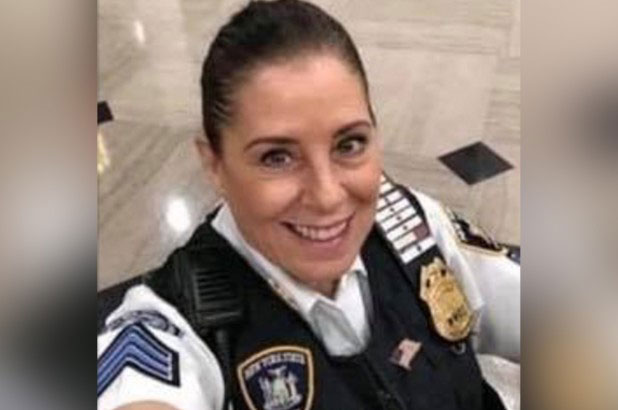
Brooklyn Court Officer Suspended After Posting Racist Photo of Obama

By Ida Siegal

A court officer in Brooklyn was suspended without pay for 30 days after she posted a photo of former President Barack Obama hanging from a noose on Facebook.
A coworker of Sergeant Terri Pinto Napolitano says she should be fired for the offensive and racist post. The image Napolitano posted only not only showed Obama being lynched and the caption “we will not yield … your day is coming traitor,” but it also showed Hillary Clinton about to be hanged with the caption “it’s not over till the fat lady swings.”
The post quickly spread, disgusting Napolitano co-workers who called her vile and racist.
A court officer who has worked with Napolitano and asked not to be identified told NBC New York that the Sergeant was a known racist and would “harass minority defendants inside her courtroom when she was bored by yelling loudly at them for talking, disrupting court proceedings, while speaking to Caucasian defendants in a completely different demeanor.”
“She’s a disgrace to the many of us who respect the public and the integrity of our job and respect the criminal justice system and process,” the officer said.
Chief Judge of the Courts Janet DiFiore wrote a scathing letter referencing Napolitano and called the post “abhorrent.”
“This conduct is abhorrent, by anyone, at any time, and under any circumstances. But at this critical moment in our history – when our nation is reeling from the death of George Floyd and its aftermath – it is a sickening and unpardonable offense against every colleague in our court system as well as the vast and diverse public that we serve,” DiFiore said.
The court officer’s union is also not supporting Napolitano, saying on Facebook that her post was racist.
Napolitano’s Facebook page has since been deleted, attempts to reach her for comment have been unsuccessful.
The court’s Inspector General says investigators are reviewing the post and considering further disciplinary action.
Copyright NBC New York

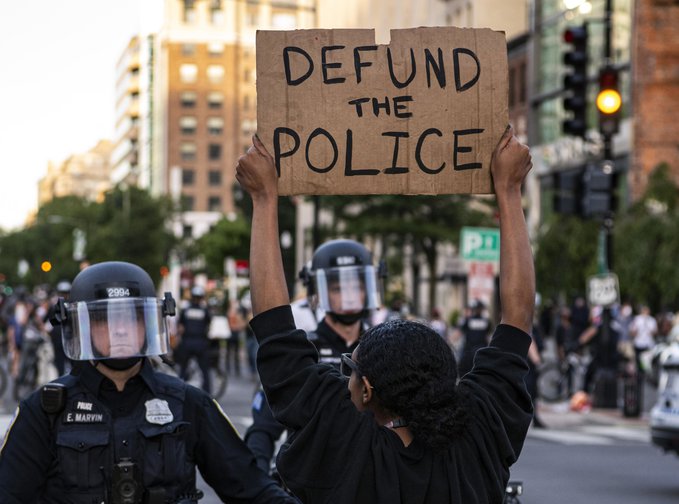
Words We Thought We’d Never Hear, “Defund The Police”

Across the land and across the world multitudes are expressing outrage over the killing of George Floyd and Breonna Taylor, the latest among countless victims to be killed at the hands of U.S. police. They are shouting an ultimatum that unchecked racism yields despicable injustice that can no longer be ignored, placated, justified or excused. The marches continue daily in many locations, and as they do, pressure is mounting on legislators to effect real and systemic change.
Among the voices demanding to be heard are those advocating for police reform. But many demonstrators, communities members, and some legislators, no longer accept training and retraining as the solution. They say that training means little to biased cops determined to engage Black and brown civilians with disrespect. Neither does it move aggressive members of the force who appear to relish brutal encounters and repeat them with impunity if there was no prior penalty.
Body-cams mean little if they are turned off at pivotal moments or if the footage is “lost.” Diversity hires matter little if the new hires are shunned, harassed or coerced into silence, and policies to defeat racial profiling are toothless if that culture is accepted while the complaints of community members fall on deaf ears.
NY Times columnist Charles Blow and actor David Oyelewo took part in Oprah Winfrey’s “Where Do We Go From Here?” a simultaneous discussion on OWN and multiple other TV networks that aired on 6/9 and 6/10. Like others who write about race and justice, Blow says the entire structure is meant to protect an age-old objective of submission and low-cost labor.
“… This is about power. It has always been about power,” said Blow. “It’s just that the police are the lowest cog in this machine. That’s the one that touches you. They were born out of a need to protect property and control bodies. And the crime that was being committed in the beginning — is the slave was running away.”
Oyelewo shared the emotional effect of Floyd’s killing on him.
“I didn’t realize how deep the wounds were,” he said. “I had spent so much of the last two weeks crying. And one of the moments where that began, was when I went to speak to my son, and I didn’t have the words. Because George Floyd wasn’t resisting arrest. So it’s not like saying to my son, ‘Put your hands on the dash, don’t be confrontational.’ Those conversations are already emasculating. To basically say, ‘Forget about justice in an interaction with the police. Come home alive.’

No More Business As Usual
Irate New Yorkers don’t believe that true reformation is in the cards without a citizen/legislator takeover of the police force. Civilian Complaint Review Boards haven’t worked and the judicial system fails to convict — and seldom even prosecute — cops charged with murdering civilians or damaging or stealing their property. Activists are calling for the defunding of departments nationwide. In Minneapolis, where George Floyd was murdered, its City Council voted last week to disband the police department entirely. They plan on reconfiguring it for the benefit of the people whose taxes pay the salaries of their police force. The veto-proof bill has yet to be signed into law by Mayor Jacob Frey, but he and the Minnesota Department of Human Rights have filed a joint Temporary Restraining Order against the Department, forcing immediate reforms while a date for a human rights investigation into the department is being set.
Here at home, Public Advocate Jumaane Williams blasted Mayor Bill de Blasio last week.
“Mr. Mayor, you have an opportunity here,” he said. “$Six billion? You’re saying we can’t hire no teachers, no counselors. The only thing, however, that we can add more to, is hiring a class of police. We are here to change the framework of how this city can move forward; you are setting us up for failure.”
The mayor initially pushed back against the proposition to cut the NYPD budget by $1 billion. But pressure built as demonstrators were handled roughly by police while irate viewers watched at home. The mayor announced a change of heart on his daily address across TV networks.
“Our young people don’t need to be policed, they need to be reached,“ he said. “We will be reallocating funds from the NYPD to youth initiatives and social services. The details will be worked out in the budget process in the weeks ahead.”
Some City lawmakers would like to see him restore funds to the Summer Youth Employment Program, to education, mental health services and housing. They believe such an investment will help reduce violence and crime, resulting in money well spent.
Although the defunding discussion is characterized by speculation, it’s about allocating resources elsewhere, particularly in scenarios where police presence seems to escalate, rather than resolve matters — such as when mental health professionals would do a better job, and cops don’t relish responding to those calls anyway. Students often report being harassed by police at school, a place where security personnel might do fine.
New York State Assembly candidate Stefani Zinerman underscores the need for responsible reform that includes community input.
“I believe in a community policing model that includes partnerships with the NYPD,” said Zinerman. “I’m concerned that the programs we fought for to bring about change, that they would defund those programs first and what we would be left with is a total racist and militarized police force that would be, again, wreaking havoc in our communities.”
In Camden, NJ, where the police force was disbanded and reconfigured in 2017, Police Chief Joseph Wysocki has learned to share power with the community. He was on television Wednesday morning telling a local reporter he had called Yolanda Deaver, organizer of a protest march held there last week, to ask about the plans for the demonstration, if they expected any trouble, and if he could march with them. She accepted and things went smoothly.
Austin, Texas already has a measure of the defund/reallocate strategy in place, having saved funds using phone operators to handle responses to emergency calls and send the needed city personnel, who are not usually police. San Francisco and other cities are adopting or considering it. Mayor Eric Garcetti aims to divert $100-$150 million from the Los Angeles Police Department to fund programs designed to help communities of color.
So it appears George Floyd lit a spark for a wholesale revamping of our criminal justice system, involving not only hiring, firing and administration, but also, in some cases, the closing of prisons and the reexamination of penalties and enforcement. Citizens have long charged the system with brutality, corruption, racial profiling and other abuses of power. Some are now open to the idea of police chiefs being hired by, and held accountable to, the community, to civilian review boards with the power to remove bad cops, and to have potential police officers take psychological exams.
Some police forces have been required to make significant changes already, and have done so with dramatic results. Other locales have always employed cops, commissioners, wardens, corrections officers and parole officers who do their jobs within the guidelines of the law, but find their impact diminished by a Blue Wall of Silence or a system of patronage.
Unfortunately, the vast majority of jurisdictions remain frozen in amber, specimens of powerful, entrenched unions and compromised elected officials.
“We must be clear when we talk about defunding the NYPD,” said Wilfredo Florentino, East New York Community Advocate. “We are calling for a reallocation of $1 billion of the NYPDs budget, a sizable chunk of a city’s overall budget, and to reallocate funds to Black communities, where the most violent policing occurs. By defunding the NYPD, we are standing up to systemic racism, and the intentional and deep-rooted Anti-Black terrorism by the NYPD.”

In Brooklyn, Signs of the Times

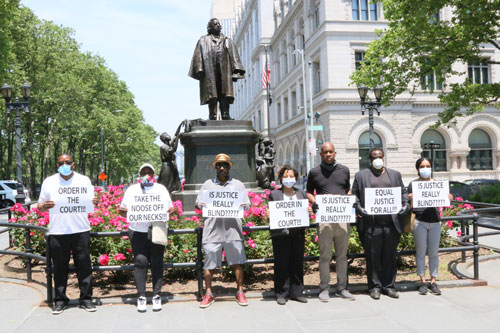
Members of the Brooklyn Anti-Violence Coalition organization of activist-leaders gathered in front of The Henry Ward Beecher Monument, at the request of Our Time Press, yesterday. The intention was to underscore the changing perception – and shifting currents — of leadership in America as well as to document a peaceful protest and press conference called by the group.
The press conference was to condemn the recent heinous, despicable act of a court officer who posted on Facebook lynching images of President Barack Obama and former Secretary of State Hilary Clinton.
Speakers, including BAVC founder Taharka Robinson and President Bruce Green, noted how the pandemic of racism wends through the American systems as strong today as in 19th century America when orator/abolitionist Beecher extolled his views on then-liberal causes of the day.
The session attended by broadcast and print press took place a few feet from the Supreme Court of Kings County, now demeaned by the act of a civil servant. The protestors said she should be fired, not put on leave at taxpayers’ expense. (BG)

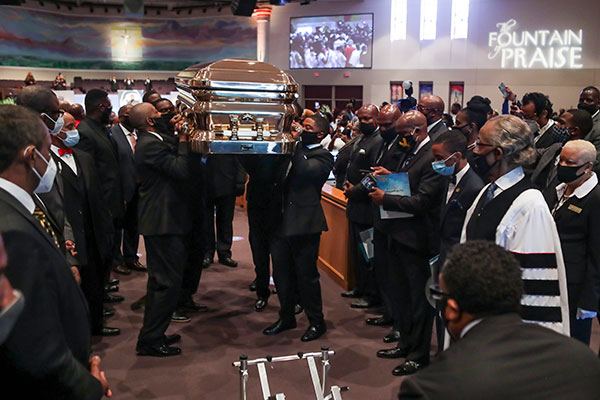
“My Daddy Changed the World”

-Gianna Floyd, age 6

Brooklyn, Manhattan, Bronx, Queens
District Attorneys Denounce Chokeholds
“We support legislation that would criminalize … excessive force”

STATEMENT
As we have seen recently with the death of George Floyd in Minneapolis, and six years ago right here in New York City with the death of Eric Garner, the use of chokeholds and other holds or restraining techniques that can cut off the supply of oxygen to a person’s brain have an unacceptably high risk of death. The NYPD has long recognized the danger of chokeholds, and banned its use nearly three decades ago.
 
We stand in support of proposed city and state legislation that would criminalize the use of chokeholds and similar restraints by law enforcement officers while making an arrest. We must take action against the use of excessive force by the police.
 
Police officers risk their lives every day performing a dangerous job, and we are grateful for their service. We offer our support and respect for those who continue to uphold their sworn duty to serve and protect, doing so with NYPD’s core values of courtesy, professionalism and respect of the community.
 
We also acknowledge the need for increased accountability. We support the efforts of the Council today to pass legislation to amend the administrative code to respect the right to record police activities, to require visible shield numbers and rank designations, and to establish procedures for an early intervention system with record-keeping and reporting requirements that will allow the police department to identify officers who may be in need of enhanced training or monitoring. 
 
We thank members of the City Council for pushing for the passage of these bills, and for their continuing commitment to keeping all New Yorkers safe.
 
Brooklyn District Attorney Eric Gonzalez
Manhattan District Attorney Cyrus Vance
Bronx District Attorney Darcel Clark
Queens District Attorney Melinda Katz
 

Eric Garner
(September 15, 1970 – July 17, 2014)

A Staten Island, NY native, Mr. Garner, 6’3”, described by friends and family as a “neighborhood peacemaker,” was a father of six, grandfather of three, and a former horticulturalist for the NYC Department of Parks and Recreation.
In 2014, the New York City medical examiner’s office determined Mr. Garner’s death was a homicide caused by neck compressions from an apparent chokehold.

George Perry Floyd
(October 14, 1973- May 25, 2020)

Born in Fayetteville, NC, Mr. Perry was raised in the Third Ward of Houston, Texas. He moved to Minneapolis, Minn in 2014. A star high school basketball player, Floyd, a former truck driver, worked in security and protection. He was the father of two daughters and one son and described as a “gentle giant”
by his brother.

Floyd, 6’6, died in the custody of Minneapolis police officers.
Note: Mr. Garner and Mr. Floyd’s deaths were videotaped by observers/witnesses at the respective scenes.