Home Blog Page 350

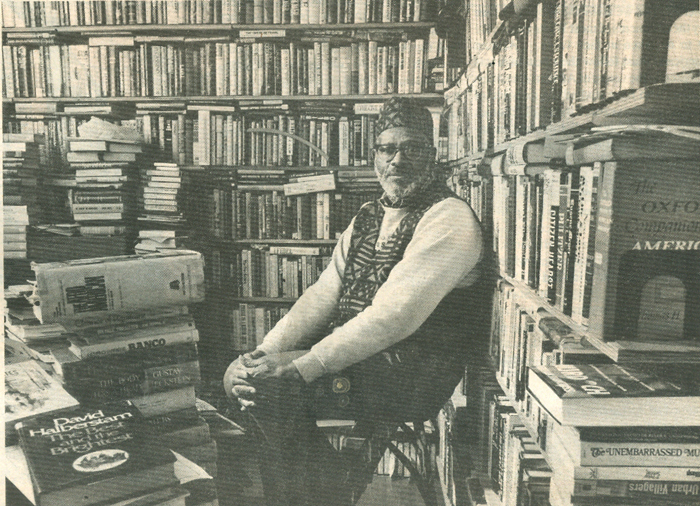
Professor William H. Mackey

Reprint from February & April 1997

Over the years we’ve had the opportunity to meet and interview historians, artists and thought leaders. One friendship we formed and particularly cherish, was with Professor William H. Mackey, who held class every Thursday evening in the basement at 850 St. Marks Ave.
Below are excerpts from extended interviews at www.ourtimepress.com


“The education system has a long history of dehumanizing people,” Mackey says. “The truth is not being put out there. It’s a continuing struggle trying to steer away from misdirection and miseducation. It’s so easy to delude ourselves into thinking that what we are being told is what really is. Positive insanity is the only rational outlet. I believe we can do it ourselves and learn everything we need to know right in the village. It’s not a new way of thinking. But I would never tell you what to think. I will advise you not to compartmentalize anything. Everything ties in. Knowledge is all around, if you use all your senses, you’ll find it.”

On Power, Comfort Zones, Demons.
Now when you talk about children not developing or progressing because they come from troubled or so-called dysfunctional homes — our children? — that’s a whole ‘nother thing. I ask, “Is that actually true?”
 I am in the counter-class. I’m an idol-smasher. My empirical experience — and I don’t pass it off as some kind of laying down of the final word — has convinced me that the problem in society is not so much in terms of family, but in terms of the people in the society that make the decisions. That power thing!
 Some people might say that’s an easy cop-out. But I’m prepared to explain this. History shows us whenever a society is in trouble it has this tendency to blame the least powerful unit in the society. Let me give you an example: in the society we live in, the concept of power is based on race–and I’m using this objectively. This is not a passionate thing. This is observation. It has always been based on race, particularly in terms of how power is distributed or not distributed.
 No ruling class likes to have its comfort zone disturbed. Whenever it is messed with, there is a tendency to blame someone, the designated demons, the bogeyman. That term is not used so much as I am aware of, these days, but when I was growing up in the South, it was standard procedure to hear a white mother say to their children, “If you don’t behave, I’m going to get the bogeyman after you!”, while pointing to a Black person.


 What is being done here? You’re deliberately creating a concept of the demon. And things that threaten them are always considered anything or anyone of darker hue. How does it tie in? Very simple. When you look for a demon to blame, you are looking to escape responsibility. That’s why the term scapegoat exists in this society. In earlier societies, if something negative happened and the group or clan could not explain it, they took an animal and beat it and hoped to God this would please the gods! What you are doing is protecting your comfort zone. Once you can convince yourself that these things are happening to me because of some outside force, and these are the folks who are doing these things and causing these things to happen to our family, it may not change things from happening but it absolves you of any responsibility and guilt. Now, more and more, as a society becomes more sophisticated, there is a need for more denials.


 The demon could be Blacks, Muslims, Native Americans… anybody who is different. And the less concrete information you know about others, outsiders, the more you demonize them. You don’t even think about it. You wake up in the morning. If it’s raining, you say, “Oh yeah, it is so and so’s fault. It’s a bad day; they did this.”
 All this has to do with disturbing the comfort zones of those folks for whom the system theoretically works. Now let’s go back and look at the concept of family in this society. My grandmother, Harriet Sibley Weston, didn’t know what the hell a behaviorist was. When I didn’t behave, I got my butt handed to me. But do we know all victims or perpetrators? As society becomes more technologically oriented, as more and more of these new inventions and new creations come online, they’re supposed to make life easier for you, but they really don’t. Who’s at fault? Is it me? Is it you? Do we really want to deal with this? One of the things that’s very difficult for people in a so-called techno-society to deal with is that they have been programmed to think that things are going to get better, but it isn’t. This is a culture that constantly thinks in terms of progress, meaning progress on whatever level you’re on. It means that whatever happens this week, you’re supposed to be on a higher-level next week, always be moving upwards. No retrogression. Just progress. And what’s it all based on?  Statistics.
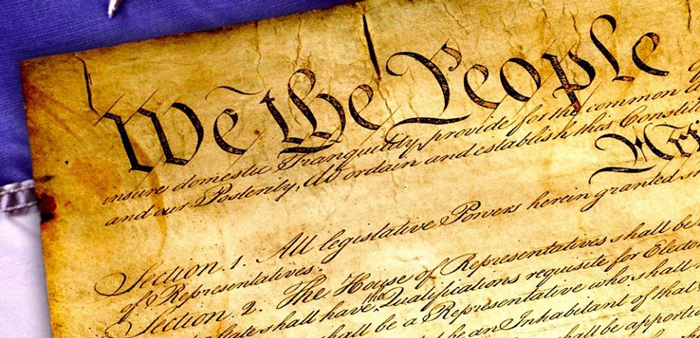
The Fifteenth Amendment

The Fifteenth Amendment to the US Constitution, ratified on February 3, 1870, says that the right to vote cannot be denied or abridged on the basis of race, color, or prior condition of servitude. The Fifteenth Amendment is often grouped with the Thirteenth Amendment, ending slavery (1865), and Fourteenth Amendment, securing citizenship (1868), as one of the “Reconstruction amendments,” which were passed by the radical Republican-dominated Congress following the Civil War.

In effect, the Fifteenth Amendment secured the right to vote for African American men. As many as one million African American men registered to vote throughout the South, where in many districts African Americans constituted the majority or near-majority of the population. This expansion of political power also resulted in a dramatic increase in political representation as African American men were elected to local, state, and federal offices throughout the North and South.


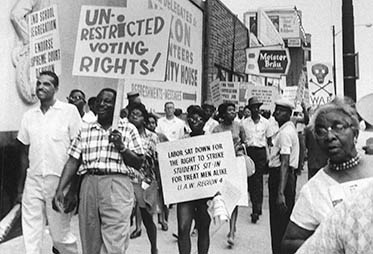
Many of the gains provided by the Fifteenth Amendment proved to be only temporary, however, because many white Americans strongly opposed black political power. Following the end of Reconstruction, many southern states quickly enacted laws that limited the voting power of black citizens in order to restore white supremacy. In some places, African Americans faced additional taxes or the threat of losing their jobs, homes, or even their lives if they tried to vote. By the 1890s, most black communities in the South were effectively disenfranchised by these state and local policies, despite the Fifteenth Amendment. During the 1960s, securing equal voting rights became one of the central issues of the civil rights movement, culminating in the Voting Rights Act of 1965. From the Digital Public Library, https://dp.la

An article titled “Free the Ballot,” about voting rights during the civil rights movement, from Memphis World newspaper, February 13, 1960.

Free The Ballot
America is not fully free so long as the ballot is fettered in any part of the United States of America. The right of the Negro citizen to vote is embedded in the Fifteenth Amendment of the federal constitution. In a number of states the right-to-vote amendment has been frustrated, negated and butchered.

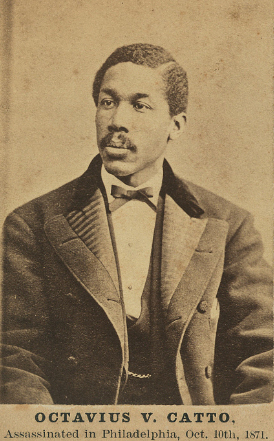
A portrait of Octavius Catto, an African American activist, educator, and political organizer, ca.1871.
In addition to his work as a political organizer and educator, Catto worked with Frederick Douglass as a recruiter for black regiments during the Civil War. Catto was a supporter of the Republican Party and an advocate for the Fifteenth Amendment. Although Pennsylvania was a free state prior to the Civil War, African American men’s right to vote had been rescinded by the state legislature in 1838. For the city’s first election following the Fifteenth Amendment, Catto led a campaign encouraging Philadelphia’s African American community to vote. On election day, Octavius Catto was shot and killed by Frank Kelly, a Democratic Party agent.


In the South there is only token Negro voting on an average basis. In a number of Southern counties with more Negro citizens than white citizens there are no Negro voters. This is a tragic commentary on American democracy. Excuse given for such racial denial of voting is the preservation of “white supremacy” and to prevent “Negro bloc voting”. The bogey of “Negro rule” and the preservation of “white rule” are other scares.


Still much is said of “States’ Rights” and “local rule.” Yet local rule should be based upon the rule of the local people. States’ rights envision a respect for personal and individual rights. Southern politicians tend to distort the theory of states’ rights and to misapply the idea of local rule.’


The Fifteenth Amendment bestows upon the Negro citizen a right which constitutionally cannot be removed by state action or states’ rights doctrines. Yet that very thing is being done in the South and the Congress has been indifferent and laggard about using its authority and power to protect, guard and actuate the Negro citizen’s right to vote in the South.


A number of bills have been introduced in the Congress seeking to implement the Fifteenth Amendment. The Republican Administration and the Democratic Majority Leadership together with individual lawmakers have submitted bills designed to make voting rights practical opportunities for the Negro group. Introduction of bills, press releases about them and the criss-cross of quibbling partisan criticism, do not always produce legislation.


Therefore if the President of the United States actually means that he is for meaningful voting by the Negro group in the South he is going to have to begin to fight with all of his power for such legislation. He probably will need to carry the fight to the people in a special nationwide civil rights speech. We would like to see President Eisenhower carry the fight for practical voting opportunities to the people and exert bold and uncompromising leadership for the right to vote.


In the meantime, those who want Negro voting opportunities established and materialized in the South should build a fire under Congress. A hard fight is a hand and the Southern lawmakers in Congress are tough, skilled and experienced counter fighters, let Congress have no peace of mind, no easy conscience and no happy time at the polls until adequate civil rights legislation is passed in the current session.

Exodusters : African American Migration to the Great Plains

When Reconstruction ended in 1877, southern whites used violence, economic exploitation, discriminatory laws called Black Codes, and political disenfranchisement to subjugate African Americans and undo their gains during Reconstruction. Kansas and other destinations on the Great Plains represented a chance to start a new life. Kansas had fought to be a free state and, with the Homestead Act of 1862, the region offered lots of land at low cost. As a result, between the late 1870s and early 1880s, more than 20,000 African Americans left the South for Kansas, the Oklahoma Territory, and elsewhere on the Great Plains in a migration known as the “Great Exodus.”


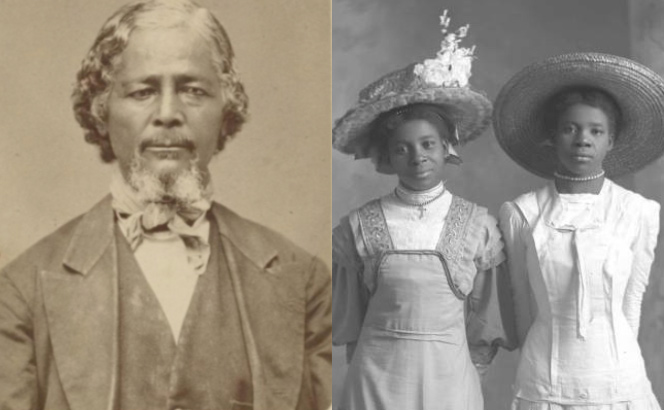
These African American migrants, or Exodusters, came primarily from Mississippi, Louisiana, Texas, and Tennessee. Some participated in organized recruitment efforts to establish black colonies in Kansas. Others just picked up and left, often traveling by steamboat to St. Louis, where they received help to get the rest of the way. One prominent promoter of the Exodus was Benjamin “Pap” Singleton, who organized several colonies in Kansas and recruited African Americans from Tennessee to move there. The peak of the Exodus occurred in the spring of 1879 when 6,000 migrants arrived in Kansas in only a few months.


For many Exodusters, the “promised land” of Kansas proved more punishing than they had hoped; the land was difficult to cultivate, and building homes and businesses with few resources proved challenging. The Exodus slowed in the 1880s and, by 1900, the population of many of the rural Exoduster towns and settlements began to decline.


The Exodus demonstrated that formerly enslaved people were claiming their freedom of movement—the power to decide where they would travel and live that slavery had denied them. In doing so, they sought better lives for themselves and rejected the violent white supremacist regime that was taking hold in the post-Reconstruction South. The predominantly black communities the Exodusters created provided important models of black self-government and community building in the West at the end of the nineteenth century.

Politics is Not a Spectator Sport

Make no mistake about it, we are in a war for the future of the country. 2022 will be remembered either as the year democracy is triumphant or that Republican voter suppression wins, and we begin the transformation into an authoritarian state, only waiting for Donald Trump to be installed in 2024 and begin his purges and consolidation of power as all dictators do. They must be stopped.
We in Brooklyn aren’t on the front lines, but we can send arms to those who are. And in this war, it’s money that is the ammunition and it’s advertising and the field operations that are the weapons that need to be loaded.
Unlike previous battles for the vote, we don’t have to face dogs, firehoses, cattle prods or Billy clubs. We can’t be there to knock on doors and hand out flyers. What we can do, is go to the websites of those in the trenches and send them some ammo.
Below are excerpts from appeals from candidates running in races that will determine control of the Senate, which is critical, particularly since Republicans are favored to take the House.

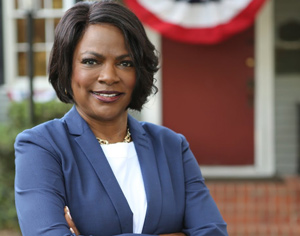
From Rep. Val Demming,
Senate Candidate in Florida

When I’m in the middle of make-or-break moments like this for my Senate race, my mind often goes back to Jacksonville – back to the tiny house I grew up in with six brothers and sisters. Things weren’t always easy. Mom was a maid, Dad was a janitor, and although we didn’t have a lot of money, we had each other.
In fact, it was Mom who used to say to me: “Never grow tired of doing good, Val — never tire.” Those words inspired me to get into public service, and ever since then, growing tired of doing what’s right was never an option.
These words have been deep in my soul as I have served the public, from my time in the Orlando Police Department to Congress. They’re the words I spoke to myself as I impeached Donald Trump. And they’re the words I think about now, as I see how we desperately need more than a 50-50 Senate to build back better for the American people.
Never tire, I think, as I recognize Florida is Democrats’ best opportunity to expand our Senate majority. Never tire, I think, as polls show me statistically tied with my opponent, and I come out of yet another finance meeting with the realization I’m far behind where I need to be before a big deadline like this. 
My unlikely story of opportunity is proof of what’s possible – and I promise I will never tire as I work to make sure the greatness of America is accessible and affordable for all Americans. A 50-50 Senate isn’t working for you or our country, and it’s up to us to expand our majority and secure a future for voting rights, reproductive freedom and all our shared values.
This may be one of the first emails you’re getting from me, or it very well may be the hundredth. 
It’s not lost on me that amazing supporters like you hear from me a lot over emails like – perhaps even more than you hear from some friends and family.
But in a battleground race like this, with Senate control on the line, I’d rather over-communicate than miss an opportunity to strengthen the grassroots team that will flip this seat blue. 
Because the reality is this, David: You’ve contributed $105.00 to this campaign – and that grassroots support has meant everything to me. You’re one of hundreds of thousands of donors who are building a campaign that can compete with Marco Rubio and flip Florida’s Senate seat blue come Election Day. You’re helping make a meaningful difference for Floridians and the country. I cannot thank you enough.
The opportunity is right in front of us. CNN is calling Florida’s Senate seat one of the most likely to flip blue. Experts at The Cook Political Report increased my chances of winning. But with Mitch McConnell sitting on a massive war chest to protect Marco Rubio, I simply cannot win without your help. 
So once again, ahead of my next $25,000 fundraising goal at midnight tonight, I’ve got to ask for your support: Rush a monthly contribution of $20 or more now – or whatever you can spare to help me defeat Marco Rubio – to win in Florida and expand our Democratic Senate majority.
https://valdemings.com

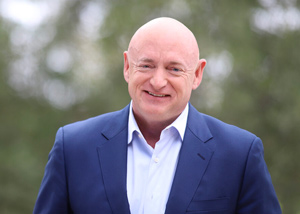
From Mark Kelly,
Candidate for Senate in Arizona

In just a moment, I’m going to ask you to contribute to my re-election campaign before midnight tonight. Please give me a chance to explain why this request — especially today — is so important.
Here’s the truth:
We’re less than one year out from Election Day. And our January deadline is nearly here.
But this goal is important for a few more reasons.
First, a National Republican Super PAC is running ads to defeat me in this race, and we need the resources to withstand the attack.
Now, the reason we’re facing so many attacks is because CNN ranks this seat as one of the most likely to flip in 2022. And our official race ranking just changed from Lean Democratic to Pure Toss Up.
But our secret weapon against the corporate special interests is you. Because if we have the resources we need, we’re going to win.
It would be the honor of a lifetime to serve Arizona for a full term, but I can’t do that alone.
To read about the candidate and Donate: https://markkelly.com
 

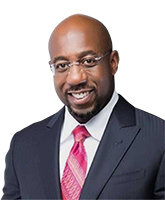
Senator Ralph Warnock,
Candidate for reelection in Georgia

I won’t sugarcoat it, friend. We have a big problem: We fell short of our first end-of-month goal of the election year, and now we’re behind in a race that experts say will decide Senate control.
Nate Silver’s FiveThirtyEight reported that Republicans are favored to retake the majority for Mitch McConnell this year, and it’s clear why.
They only have to flip one seat – and they’ve made me their top target for defeat.
Donald Trump himself has already held a massive MAGA rally in Georgia to prop up my potential GOP opponent, Herschel Walker (R) – and Trump allies started pumping $100,000 per day into Walker’s campaign to defeat me. 
These attacks will only keep coming, friend – and now, with this new fundraising gap, we’re falling short of what it will take to fight back. That’s why I’m urgently asking: Will you rush a contribution of $5 or more right now to help us close this budget shortfall immediately, keep Georgia blue, and defend our Senate majority?
While I’ve spent my first year in office providing pandemic relief to struggling families, fighting for voting rights, and delivering on our progressive priorities, extremist Republicans are doing everything they can to block our people-first agenda and smear my record.
Republicans know that if Democrats keep Georgia blue, the GOP will have no chance of retaking the Senate majority. That’s why Mitch McConnell is lining up the full force of the GOP establishment to flood this race with MILLIONS to turn Georgia red – and this surge in spending could be having a devastating effect: Recent polling shows this Senate race is neck and neck. 
So, we simply can’t accept this missed fundraising goal – or any missed goals going forward. Every dollar has the power to decide this race, so I’m counting on you to give as much as you can spare right now.
Every minute we waste by not hitting our goal is another minute we give the GOP to mobilize against us. Please, friend, I have to ask: Will you give $5 or more right now – as much as you can spare by midnight tonight – so we can win in Georgia and defend our Democratic Senate majority?
Thank you so much.
https://warnockforgeorgia.com/

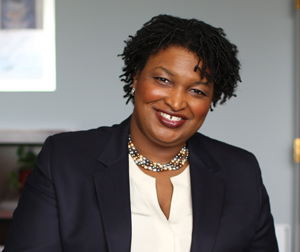
From Stacey Abrams,
Candidate for Governor of Georgia

We saw the power of unity, teamwork, and inclusivity when Senator Warnock and Senator Ossoff won the historic runoff elections last year – as Georgia voters delivered a Democratic majority that many experts assumed was impossible. They carried their synergy from the campaign trail into the U.S. Senate to get to work together for Georgians.
To continue Georgia’s progress, we must send Senator Warnock back to Washington and elect a governor who will be a partner in fighting for Georgians of all backgrounds in every zip code.

Will you join us by splitting a $25 contribution between Senator Warnock and me right now to help us both win in November?
Reverend Warnock’s re-election is personal to me – not because we are on the ballot together this year but because we have fought side by side on behalf of marginalized communities for many years. I know his commitment to expanding access to affordable health care, protecting voting rights, and fighting poverty because we have been partners in these fights.
When I launched a statewide voter registration effort to empower people of color in Georgia, Raphael Warnock was at my side, and he even took the reins when I stepped down to launch my 2018 campaign.
When I was serving as House Minority Leader, he joined me and others across the state to sign up Georgians for coverage under the Affordable Care Act.
In the Senate, he has delivered relief for struggling families and small businesses, lifted the voices of Georgians into a national conversation about voting rights, and brought home investments in infrastructure, technology, job creation, and more. He’s pushing to renew the child tax credit, which he helped pass and has cut childhood poverty by 50%, and he is fighting to expand Medicaid coverage for more than 500,000 Georgians.
Senators Warnock and Ossoff are producing real results – all without the help of the current governor. Imagine for a moment what we could achieve as Georgians if, in addition to our senators, we also had a governor who believes in making progress for our families.
The candidates from the Republican side are dividing not only their party but also the people of Georgia. Their fight is with each other – our fight is for you.
On the ballot this year, Raphael Warnock and I are one team for One Georgia. We’re honored to have you with us.
https://staceyabrams.com