

Op-Ed By: Hetal Tangal, MD, Associate Medical Director for Ambulatory Care, One Brooklyn Health
Vaccination records should be part of the back-to-school checklist, just like school supplies, sports forms, and physicals. Children spend many hours in close contact with classmates and teachers, so staying up to date on recommended vaccines helps protect them from diseases that can spread quickly in school settings.
It is also important because school requirements and recommended vaccines can change as children get older. New York State endorses the 2026 American Academy of Pediatrics (AAP) childhood and adolescentimmunization schedule,for the 2026–27 school year and requires students to meet specific vaccination requirements for school attendance.
Checking your child’s record before school starts gives families time to identify missing doses, clarify documentation, and schedule catch-up vaccinations rather than discovering a problem after the school year begins.
Parents should ask their pediatrician to review the child’s entire immunization history against the age-appropriate schedule, rather than focusing on just one or two vaccines. The key point for parents is simple: do not try to reconstruct the schedule from memory. Have your pediatrician review the actual record.
The Preteen Visit is an Important Vaccination Checkpoint
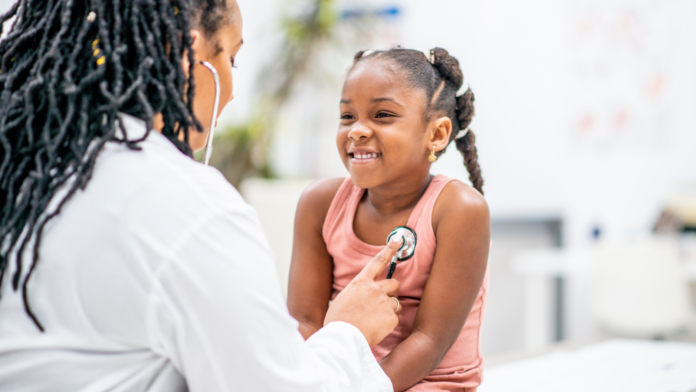
The 11–12-year-old well visit is an especially important vaccination milestone. Around this age, children routinely reach the stage when they should receive vaccines such as Tdap, HPV, and meningococcal, with additional doses at later ages when recommended.
HPV vaccination is particularly valuable when given during the recommended adolescent window, before exposure to HPV. Meningococcal vaccination is also important because adolescents are at increased risk for meningococcal disease, which can be serious and progress rapidly. New York includes meningococcal vaccination among its school immunization requirements for students in the relevant grades.
This is one reason the 11–12-year well visit should be viewed as more than a routine physical. It is an important preventive-health milestone.
Catching Up and Addressing Vaccine Concerns
If your child has missed a vaccine, don’t panic and don’t assume it’s too late. Parents should make an appointment with their pediatrician and bring whatever vaccination records they have.
In most situations, children who fall behind can follow a catch-up schedule. A missed dose generally does not mean the entire vaccine series has to be started over. A pediatrician can determine which vaccines are due based on the child’s age, health history, and previous vaccination history.
Parents often have questions on vaccine safety, the number of vaccines children receive, whether multiple vaccines can be given during the same visit, and whether it is better to delay or spread vaccines out. These are reasonable questions, and parents should feel comfortable discussing them with their child’s pediatrician.
One common misconception is that delaying vaccines is automatically safer. Delaying can actually leave a child unprotected during a period when they may be susceptible to disease, and it may require additional visits. New York’s Department of Health notes that receiving multiple vaccines during the same visit is considered safe and can reduce the number of office visits.
My advice is to have an open conversation with a trusted pediatrician and look at the evidence together rather than relying on social media posts or anecdotes.
Vaccination is both personal protection and community protection.
A vaccinated child is less likely to become infected with a vaccine-preventable illness, and vaccination can also reduce opportunities for disease to spread to others. That matters in a school community because classmates, teacher, staff and members of their families may include infants, people with certain medical conditions, or others who are particularly vulnerable to infections.
Schools bring large numbers of people together every day. Keeping vaccination rates, high helps create a safer environment for students, teachers, school staff, families and the broader community. New York State specifically describes school immunization requirements as a way to protect students, teachers, and their families.
Make Preventive Care Part of Back-to-School Planning
The beginning of the school year is a great time for a comprehensive well-child visit. A school or sports physical shouldn’t be viewed simply as paperwork. It is an opportunity to identify health issues early and make sure children are ready to participate safely in school and activities.
Families should also consider seasonal vaccines such as the flu vaccine, as part of their annual preventive-health planning. Flu can spread readily in schools and may cause children to miss school, sports and other activities. The annual vaccine is an important way to reduce the risk of influenza and its complications. Rather than waiting until flu activity is widespread, families should ask their pediatrician when the seasonal vaccine is available and appropriate for their child.
Know Where to Turn for Care
Bring the record to the pediatrician even if you’re unsure what it means.
Parents don’t need to become experts in immunization schedules. A pediatric practice can review the child’s history and determine what is due.
If records are incomplete, the pediatrician’s office can help determine what documentation is available and what additional vaccination may be appropriate. New York also maintains the New York State Immunization Information System (NYSIIS) which schools can use to verify student immunization status.
The best advice is: don’t wait until the first day of school. If you’re uncertain, make the call now.
One Brooklyn Health offers a broad range of pediatric services, including ambulatory care, developmental and behavioral pediatrics, pediatric subspecialties, emergency care, and preventive care. Our pediatric practices support children throughout each stage of growth and development, with a focus on their overall health and well-being.
For families preparing for school, One Brooklyn Health’s primary care practices offer children’s immunizations, developmental screenings, annual wellness exams, and school and sports physicals.
OBH has pediatric and family-care locations throughout Eastern and Central Brooklyn, including BFCC Linden, home to our Pediatric Specialty Offices, as well as Brookdale Family Care Centers at Eastern Parkway, New Lots, Pennsylvania Avenue, Bristol Street and Bishop Walker. Caring for your child is our priority. Learn more about our pediatric services here.