

By Kazembe Batts
IG: @ Kazbatts
Recently, two major international events, including the 62nd Munich Security Conference (MSC) in Germany and the 39th African Union Summit (AUS) in Ethiopia, took place. Both multi-day gatherings were well attended by national leaders and influencers from around the world. Only the MSC received major coverage in the American media. United States Secretary of State Marco Rubio, former Secretary Hillary Clinton, U.S. Representative Ocasio-Cortez, California Governor Gavin Newsom, and other Americans participated and articulated policy positions in Germany. At the MSC, European priorities were highlighted, and Africa was only discussed in side meetings. Rubio boasted, “We gather here today as members of a historic alliance, an alliance that saved and changed the world.”
For our mental and spiritual health, let’s focus on Africa and the African Union. The AU, formed in 2002, has 55 member states that are often on opposing sides of conflicts. Its chairman, Mahmoud Ali Youssouf, a Djiboutian diplomat, is reduced to expressing “deep concern” over the continent’s endless crises – from wars in Sudan and the Democratic Republic of Congo to insurgencies across the Sahel – but with limited authority to act.
Unfortunately, “At a time when the AU is needed the most, it is arguably at its weakest since it was inaugurated,” said the International Crisis Group (ICG) in a recent report. Today, the AU still relies on 64 percent of its annual budget on the United States and European Union, which are cutting back support, leaving it underfunded and under-equipped. It has missed successive deadlines to make itself self-funding in 2020 and 2025. Leaders of the individual member states have routinely blocked attempts to grant the AU enforcement powers that would constrain their authority within their borders.
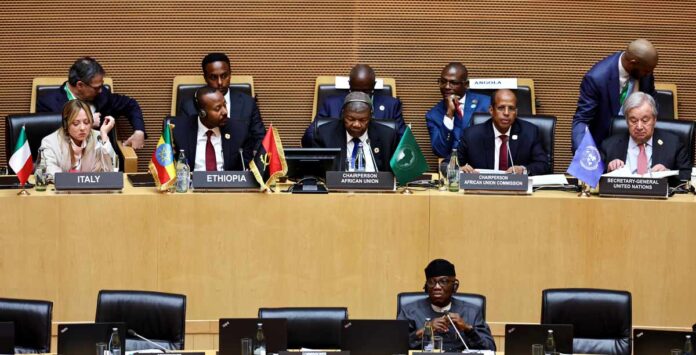
The 39th summit gathering in Addis Abba drew representatives from across the globe, including United Nations Secretary-General António Guterres, who underscored the importance of AU-UN cooperation on peace and sustainable development. On the U.S. side, Senior Bureau Official Nick Checker and Deputy Chief of US Mission to the African Union Walter Parrs represented the United States. No prominent African American leaders attended.
As we celebrate Black History Month, remembering recent history can be insightful. The lack of high-profile American government participation at the AU summit is in line with the Trump administration’s description of Africa as “shit hole” places, hatefully disparaging Somalians and accusing Black people (Haitians) of “eating the pets…eating cats and dogs”. While the United States, with 45 million people of direct African ancestry among its citizens, ignores and disrespects Africa by constantly shifting trade, tariff, visa, and sovereignty policies, other nations in the world are enthusiastically engaging with Africa.
During the summit, China’s paramount leader, Xi Jinping, announced that starting on May 1st, China will impose no tariffs on imports from 53 African countries in a strategy to further increase trade between Beijing and the continent. China-Africa trade reached $222 billion in early 2025 and could increase once the tariffs are scrapped.
Beijing, in fact, already had a zero-tariff policy for 33 African countries, but now expands this previous policy to the entire continent, except for the small, landlocked nation, Eswatini. Total bilateral trade between the US and Africa is $75 billion. Italian Prime Minister Giorgia Meloni arrived in Addis Ababa on Friday for the second Italy-Africa Summit, the first held on African soil, reaffirming Rome’s strategic pivot toward investment-led cooperation with the continent under its Mattei Plan.
With nearly 100 projects across 14 African nations, the initiative targets critical sectors including energy, infrastructure, agriculture, and digital development—all aimed at creating economic opportunities to stem irregular migration. The following are three agreements coming out of the AU summit.
Sustainable Water and Sanitation Commitment:
Member states adopted strengthened commitments to improve water security and sanitation systems, aligning implementation with Agenda 2063 priorities. Leaders emphasized integrated management of water, climate resilience, and infrastructure development. The agreement promotes national-level accountability mechanisms and coordinated continental frameworks to expand safe water access, recognizing its central role in public health, agricultural productivity, and long-term economic development.
Peace, Security, and Constitutional Governance: the summit reaffirmed the African Union’s zero-tolerance policy toward unconstitutional changes of government and renewed its commitment to conflict prevention and resolution initiatives. Leaders endorsed enhanced coordination of African-led peace operations and reinforced mechanisms to stabilize conflict-affected regions. The agreement underscores the importance of governance, the rule of law, and institutional legitimacy as essential pillars for sustainable peace and development.
Global Governance Reform and Representation:
Heads of state reiterated Africa’s common position on reforming the United Nations Security Council to ensure equitable representation, including permanent membership for African states. The summit called for structural adjustments within global institutions to better reflect contemporary geopolitical realities. This position emphasizes fairness, inclusivity, and recognition of Africa’s demographic, economic, and strategic importance in international decision-making processes.
The summit also adopted a resolution that describes slavery, deportation, and colonialism as genocide and crimes against the people of Africa and designated November 30 as the “African Day of Tribute to African Martyrs and Victims of the Transatlantic Slave Trade, Colonization, and Apartheid.” Summits and resolutions are great but do African people, including those in the USA, have the power to implement. To improve the peace and quality of life of the masses of people. We must build that power. As the late, great Rev. Jesse Jackson is famous for saying “Now is the Time!”