

By Jeffery Kazembe Batts IG: @kazbatts
Can we all Africans get along? Pan-Africanism is slowly moving from theory into policy. Visa reform, continental trade agreements, improved air travel, and regional business networks show the way to a more united African future. For decades, Pan-Africanism has been discussed in symbolic or emotional terms.
Now some leaders and countries are building what Kwame Nkrumah dreamed of, a united Africa politically and economically connected after colonialism. Work needs to be done because a tourist from Europe can often move around the continent more easily than Africans.
Africans whether entrepreneurs, students, artist, or visiting family may still face expensive visas, border delays, and suspicion simply trying to move around the continent. That contradiction sits at the center of one of the biggest political debates about Africa’s future.
Open borders and easy travel or closed borders and growing xenophobia. Resolving the clash between these two visions will greatly impact on the continent’s future.
On one side is the growing movement toward visa-free African travel, supported in recent years by countries like Ghana, Rwanda, Benin, Togo, Seychelles, The Gambia, and more recently Kenya. These governments have argued that Africans should be able to move across Africa more freely for business, tourism, education, and cultural exchange.
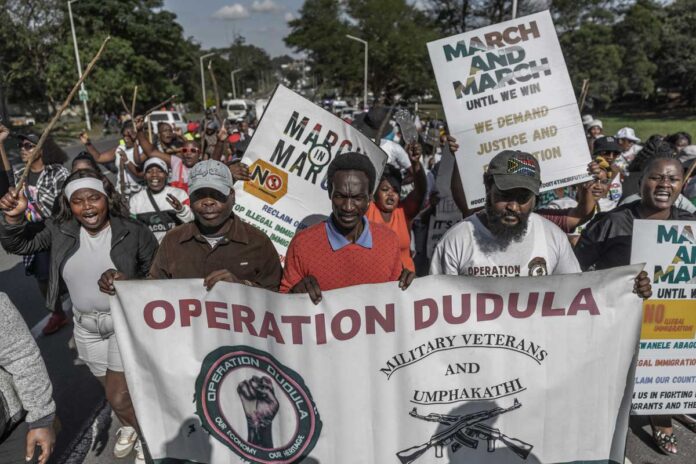
In contrast there is a more fearful politics represented in South Africa by the anti-immigrant movement known as Operation Dudula, which means “push back.”
The movement reflects growing anger toward African migrants from countries such as Zimbabwe, Nigeria, Ghana, Mozambique, and Congo. Supporters say migrants take jobs and place pressure on public services. Critics argue the movement encourages xenophobia and weakens African unity.
Operation Dudula is extra painful for pan-Africanists because of the history of ending apartheid. South Africa represented continental solidarity. Across the continent, countries made major sacrifices to support the anti-apartheid struggle: Nigeria provided funding, Tanzania trained activists, and Zambia faced military pressure for backing South African liberation movements.
Today unfortunately, post-apartheid South Africa is struggling with massive unemployment, inherited inequality, corruption, and failing public services. In poor communities, migrants have increasingly become targets of frustration.
This matters because South Africa is not just any African country. It remains one of the continent’s largest economies and most influential cultural powers.
Political attitudes in South Africa often shape wider African debates. What does Pan-Africanism really mean if Africans still fear one another across borders?
Operation Dudula did not appear out of nowhere. Many working-class South Africans genuinely feel abandoned economically. In overcrowded townships, people compete for jobs, housing, and informal business opportunities. In that environment, blaming foreigners becomes politically easy. Seeing Ghanaians fleeing violence in South Africa felt to many people like a pin stuck into the balloon of African solidarity. Can we all Africans get along?
Yes, we can. Most South African Black people and the governing political parties do not support Dudula. At the same time, other countries have moved in the opposite direction. Rwanda has promoted itself as a center for African business and travel. Ghana has steadily expanded access for African visitors.
Benin became especially important because it openly connected its visa policies to the idea of reconnecting Africa with the global Black diaspora. Seychelles and The Gambia have also adopted more open policies. Kenya’s recent position is especially important. Under President William Ruto, Kenya moved toward visa-free access for most African travelers.
The policy reflected both idealism and practical economics. Kenya understands that easier movement can increase trade, tourism, conferences, investment, and regional influence. Although currently at odds with South Africa, Ghana, historically and contemporarily, has been one of Africa’s strongest supporters of Pan-Africanism and African openness.
The country has promoted itself as a welcoming home for Africans and the African diaspora, especially descendants of enslaved Africans in the United States and the Caribbean.
Many believe that Pan-African unity on a continental level is not possible without the Democratic Republic of the Congo being stable. The DRC has long represented both Africa’s tragedy and its potential. Rich in minerals and strategically located, Congo has suffered from war, foreign exploitation, and political instability for over a century. Congo’s future depends heavily on regional integration. Its economy and geography make isolation almost impossible.
Currently there is a scramble for control of the land, with the Trump administration attempting to dictate the terms, to extract crucial minerals. At the center of the African continent, the DRC, in a world free from neo-colonialism could be the heart of a pan-African economic integration movement.
In many ways, ordinary Africans are already practicing Pan-Africanism even before governments fully catch up. Technology and access to information have empowered those with access. Musicians collaborate across borders. Traders move goods informally between countries every day. Students study abroad within Africa.
Young Africans follow each other’s music, fashion, sports, and politics online. Cultural connections between Africans are growing faster than many governments expected.
One especially interesting part of this debate involves Africans living in the West, especially in the United States. Historically, Pan-Africanism depended heavily on Black intellectuals and activists in the diaspora. Figures like Marcus Garvey, W.E.B. Du Bois, George Padmore, and Malcolm X believed Africans and people of African descent worldwide shared common political interests.
Today many African visa policies still focus mainly on holders of African passports, not necessarily Black people abroad with ancestral ties to Africa, like Africans in the USA, Caribbean or South America. But Ghana’s recent “Year of Return” invited descendants of enslaved Africans to reconnect with the continent. Benin has pursued similar policies.
Rwanda has also encouraged stronger ties with the diaspora. Still, a Black American may sometimes face more immigration barriers entering African countries than a European traveler does.
The debate over African mobility and Pan-Africanism is about will Africa become a connected political and economic community, or remain divided into suspicious nation-states created during colonial rule? South Africa’s Dudula movement suggests one future: fear, protectionism, and closed borders.
The visa-free movement suggests another: cooperation, mobility, and integration. Neither side is completely naïve. Open borders alone will not solve Africa’s economic problems. But closed borders will almost certainly deepen division. Real Pan-Africanism will not be built mainly at conferences.
It will grow through ordinary human movement — students studying abroad, traders crossing borders, artists touring, families reconnecting, and businesses operating across Africa.
The recent evacuation of Ghanaians from South Africa is tragic but may become an important warning sign for the continent. It exposed how fragile African unity can still be beneath the speeches and slogans. Can pan-African unity and understanding exist when xenophobia runs rampant, literally, in the streets of South Africa.
It is likely that a payback retaliatory mindset will emerge in the home country if exclusionary movements, like Operation Dudula are not curtailed?
Many African leaders praise the European Union’s open travel system while Africans themselves still face major restrictions moving across Africa. Changing this will not be easy. There will be fear, resistance, political backlashes and setbacks.
Which way forward: Will Africa define itself through fear of fellow Africans, or through the understanding that its future may depend on Africans finally being able to move, work, build, and dream together? Can we all Africans get along?