

By Jeffery Kazembe Batts
IG: @kazbatts
Whether the rubber that fueled early industrialization or the uranium that shaped the nuclear age, and now cobalt, the Congo has been indispensable to modern life. Yet the Congolese people remain locked out of the prosperity and a decent quality of life that those resources should make possible. This is not an accident of history. Since the turn of the century, demand for smartphones, electric vehicles, and renewable energy storage has surged. Cobalt has become one of the world’s most strategic resources.
The central African nation holds some of the world’s richest deposits of cobalt, copper, coltan and lithium and accounted for 76 percent of global cobalt output in 2024, according to the US Geological Survey. A building block for a powerful Africa – Congo should be at the heart of African development. Non-Congolese forces, whether corporate on national want the cobalt and other resources. Recent trump administration facilitated maneuvers underscore how high the stakes have become.
Last December Presidents Félix Tshisekedi of Congo and Paul Kagame of Rwanda traveled to the Washington DC to sign a minerals partnership agreement intended to secure cobalt and other critical minerals for global supply chains. The deal was brokered with U.S. involvement, reflecting Washington’s growing interest in stabilizing the mineral rich east. Yet the violence continues, and the United Nations recently warned that the conflict is expanding, with drone warfare now threatening civilians and complicating humanitarian access.
Peace remains distant, and security forces shape who extracts the minerals from the earth. The optics of the meeting foreshadowed problems as the two heads of state could barely look at each other. The agreement immediately sparked public concern inside the DRC and in February, the Congolese government was forced to deny accusations that it was “selling off” national mineral wealth under the deal. “The DRC has not sold off anything at all.
The DRC has not sold anything at all,” minister Louis Watum said on the sidelines of the African Mining Indaba conference in Cape Town. Although many Congolese citizens know history and have seen foreigners enriching themselves while leaving their communities dirt poor.
Possibly compromising its sovereignty, “the DRC has submitted a list of strategic projects to Washington that will be reviewed in coming weeks by a joint steering committee”, Vice Premier Daniel Mukoko Samba said at Davos in January. Building up its security / military options, since the Kagame / Tshisekedi summit the Congo has announced the creation of a $100 million paramilitary mining security unit, backed by funding from the United States and the United Arab Emirates.
The stated goal is to protect mining sites from illegal exploitation and armed interference. a region where armed groups, foreign backed militias, and criminal networks operate in the shadows of cobalt and coltan mines. But the move raises critical questions.
Who will this force ultimately protect, Congolese communities or foreign commercial interests? Will militarization bring order, or will it deepen tensions with artisanal miners who depend on cobalt extraction for survival? And how will this new force interact with existing security actors in a region already crowded with militias, private contractors, and foreign troops? Is an American initiated military response needed.
The new unit will be deployed gradually, with an initial 2,500 to 3,000 personnel expected to be operational by December following six months of training in military collaboration, the IGM said in a statement. The paramilitary force is projected to have more than 20,000 personnel across all of Congo’s 22 mining provinces by the end of 2028.
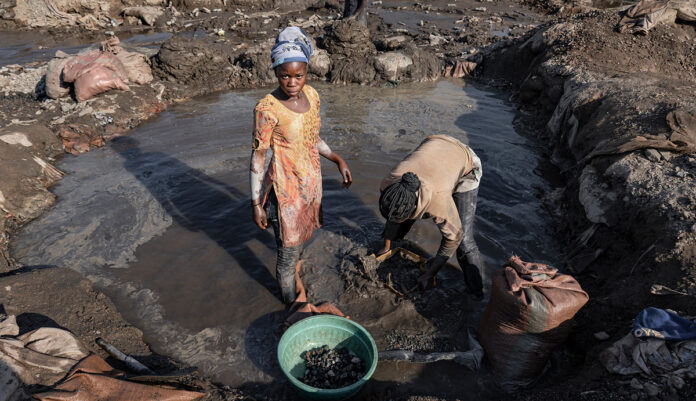
Development and quality of life challenges are profound in the region. Creating the wealth but not benefiting from it, more than a million Congolese work in artisanal mines, often in dangerous conditions without safety equipment or legal protections. Entire communities are displaced when miners come calling. Living with environmental degradation, from contaminated rivers to stripped farmland, undermines long term development and public health. Raw cobalt is exported, refined abroad, and sold back to the world as high value products. The Congolese nation and people capture only a fraction of the wealth generated from their own land. Despite billions in mineral exports, the DRC is seeing little development.
How to build a sovereign, powerful Congo and Africa without the USA overtly and covertly undermining African interests and being a major problem? For Congo recent agreements with the United States and Rwanda, and the creation of the new mining security unit, will shape the prospects of the cobalt sector in the near future. Congo’s new strategic relationship with the Trump administration could help bring order to a chaotic industry, or history shows it could entrench the current militarized model of extraction that leaves local communities marginalized.
The path forward must be guided by a simple principle: the minerals that power the world should also power the development of the people who live atop them. The Congo has paid the price of global progress for centuries. For African people the 21st century must be different. It must be the century in which African nations, not foreign corporations or external powers, determine the destiny of their own resources. Only then will the wealth of the Congo finally build Congo.