

Book Review by Dr. Brenda M. Greene
The Queen of Sugar Hill:
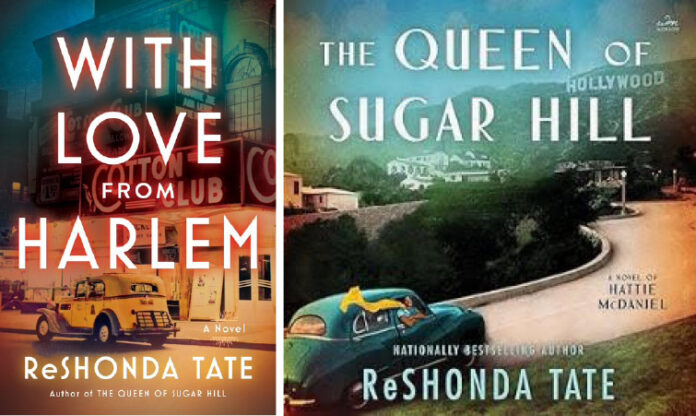
A Novel of Hattie McDaniel
ReShonda Tate. William Morrow,
420 pages, 2024.
With Love from Harlem: A Novel of Hazel Scott
ReShonda Tate. William Morrow, 402 pages, 2026
For every woman who has ever felt unseen, whose brilliance was overlooked, whose voice was silenced, whose story was never told,
This is for you. -ReShonda Tate, With Love from Harlem
The Queen of Sugar Hill and With Love from Harlem are historical novels based on the lives of two Black women who made history in film, theater, and music. National best-selling author and award-winning journalist ReShonda Tate tells the story of Hattie McDaniel in The Queen of Sugar Hill (William Morrow, 2024) and the story of Hazel Scott in With Love from Harlem (William Morrow, 2026). Tate’s epigraph at the beginning of With Love from Harlem applies to the protagonists in both novels.
These stories represent Black women who persevere despite the racism and gendered attacks they face in public spaces throughout this country. Hattie McDaniel made history as the first African American to win an Academy Award for Best Supporting Actress in a Supporting Role in the 1939 American controversial epic Gone with the Wind.
Tate’s forthcoming novel, With Love from Harlem, is based on the life of Hazel Scott, the Trinidadian American jazz prodigy, classical pianist, and singer who was the first Black woman to perform at Carnegie Hall and who was known for her activism and refusal to play to segregated audiences.
Tate does an excellent job of crafting two engaging novels that imagine the interior lives of Hattie McDaniel and Hazel Scott as they negotiate the trials, challenges, and rewards of being the first Black woman in their respective fields.
Her ability to envision conversations with the friends of McDaniel and Scott on their love interests, marriages, professional lives, and the blatant and subtle racism and discrimination both women face is commendable. Readers will meet the circle of actors, musicians, and writers who have interacted with McDaniels and Scott.
McDaniels and Scott were strong advocates for their stances on when and where they would perform and faced criticism as a result of these stances: Hattie McDaniel for playing the role of “Mammy’ in films and Hazel Scott for her activism and refusal to play stereotyped roles of Black women.
Tate’s portrayal of the impact that McDaniels made in the film and entertainment industry is a notable highlight of the novel. Although McDaniels had won an Oscar, she was still relegated to playing the role of Mammy in subsequent films and was subjected to disparaging remarks and negative press from many Blacks as a result of this.
Tate devotes considerable time to describing the backlash that McDaniels faced from the NAACP and from Black soldiers stationed within the United States and Europe during WWII. As an actor, McDaniels advocated for Blacks to participate in WWII, but there is little evidence that she addressed the racial discrimination they faced upon their return to the United States after their military service.
It is evident that she was conflicted about this. In her view, she was making a difference in the film industry because she was given opportunities to perform for White and Black audiences.
She was known as saying “I would rather earn $700 a week playing a maid in a film than $7.00 a week playing a maid in real life.” Her goal was to perfect her craft and to make a difference for future generations. Her dedication to this was a form of activism.
The title of the novel, The Queen of Sugar Hill illustrates another form of McDaniel’s activism. There was a “Sugar Hill” community in Los Angeles that was known as an historic affluent neighborhood where Black civil rights activists, actors, and musicians resided during the early 1940s.
Prior to the 1940s Black people were barred from living there because of restrictive covenants that forbid Whites from selling or leasing their property to Blacks. McDaniels became involved in leading the movement to overturn this racially discriminatory covenant and was one of the first Black women to purchase a home in Sugar Hill, Los Angeles.
Tate’s research into the life of Hazel Scott in With Love from Harlem begins when she performs at New York’s Café Society and meets her future husband, the Reverend Adam Clayton Powell Jr. Scott. A major highlight of With Love from Harlem is when Scott volunteers to testify before Senator McCarthy’s House Un American Activities Committee (HUAC) after facing accusations of being of being a Communist and unpatriotic.
Tate’s description of the details regarding the personal lives of Scott and McDaniels may be disconcerting to some; however, it is clear that in the case of both McDaniels and Scott, Tate is committed to providing a full description of what both women endured in order to fulfill their personal goals.
While The Queen of Sugar Hill and With Love from Harlem are historical novels respectively and not “authentic” biographies of Hattie McDaniels and Hazel Scott, they offer an excellent starting point for acknowledging the hurdles each woman faced, their journey towards changing history, and the impact that each made in different but related ways.
Tate’s novels inspire an appreciation for these two women whose passion for music, film, and theater have and will continue to influence future generations Black women in film, music, and theater.
Dr. Brenda M. Greene is Professor Emeritus and Founder and Executive Director Emeritus of the Center for Black Literature at Medgar Evers College, CUNY. For more information, visit https://www.drbrendamgreene.com