

By Kazembe Batts
IG: @kazbatts
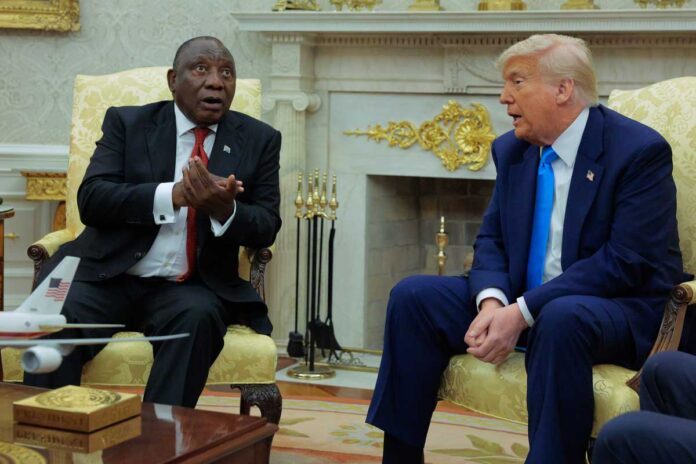
Relations between the United States, South Africa, and Israel are complicated. The current Trump administration has overtly frozen and downgraded relations with Africa’s most industrialized nation, South Africa. During a May 21 meeting in the White House, President Donald Trump attempted to embarrass South African President Cyril Ramaphosa by raising unsubstantiated claims of “white genocide” and showing what critics described as a misleading video of a funeral car caravan.
Trump also criticized South African legislator Julius Malema for using the historic liberation slogan “kill the Boer.” At the same time, Israeli Prime Minister Benjamin Netanyahu has visited the White House at least six times since Trump returned to the presidency. Under Trump, the United States has moved in lockstep with Israel in its confrontation with Iran—an action Netanyahu has urged the United States to take for decades.
Meanwhile, diplomatic relations between South Africa and Israel have deteriorated sharply. South Africa successfully brought a case against Israel at the International Court of Justice (ICJ), accusing it of genocide against Palestinians. The ICJ ruled that the allegations were “plausible,” a decision that deepened the diplomatic rift between the two countries.
Since Nelson Mandela walked out of prison in 1990, most American presidents—George H.W. Bush, Bill Clinton, George W. Bush, Barack Obama, and Joe Biden—have acknowledged the historic struggle against apartheid and maintained generally supportive relations with the ANC-led government in South Africa. Trump, however, has taken a markedly different approach.
The MAGA dominated administration demanded that the South African ambassador to the United States Ebrahim Rasool leave his post because he spoke up for African sovereignty and then appointed L. Brent Bozell III as the U.S. ambassador to South Africa.
Bozell quickly echoed Trump’s controversial views about conditions in South Africa and was later rebuked by South African Foreign Minister Ronald Lamola, who stated: “Broad-based Black Economic Empowerment is not racism, as regrettably insinuated by the ambassador.” Trump has also cut bilateral aid to South Africa, affecting health and nutrition initiatives.
At the same time, his administration has prioritized immigration pathways for white South Africans, even chartering planes to bring some migrants to Virginia. South Africa’s foreign policy has also contributed to tensions with Washington.
Since the end of apartheid, South Africa has aligned itself with the Global South and maintained diplomatic and economic relations with countries such as Russia, Iran, and China. Washington often views these ties as contrary to Western strategic interests, while South Africa insists that they reflect its sovereign right to pursue an independent foreign policy.
Economically, South Africa benefits from the African Growth and Opportunity Act (AGOA), particularly in the automobile sector. Although Trump reluctantly extended AGOA last year, his administration has hinted that it could be revoked to pressure South African political leaders. In contrast, Israel remains firmly embedded in the United States’ strategic framework.
For decades it has been the largest recipient of American foreign aid. Pro-Israel organizations such as the American Israel Public Affairs Committee (AIPAC) and the Anti-Defamation League (ADL) have successfully lobbied to maintain this assistance and to reinforce Israel’s influence in U.S. politics and global affairs. As a result, the contrast is striking.
The United States under Trump is openly aggravated with South Africa and increasingly out of sync with its leadership. Israel, on the other hand, continues to enjoy extraordinary support—often described by critics as being treated almost like a 51st state by successive American administrations.
The question then becomes: what is the status of South Africa–Israel relations? The answer is that the relationship is severely strained. Since South Africa filed its ICJ case in 2023 and the court ruled that the allegations of genocide against Palestinians were plausible, bilateral ties have deteriorated sharply. Israel denies the allegations. Adding to the intrigue, three planeloads of Palestinians recently arrived in South Africa without prior public notice. Observers have questioned whether individuals from the Occupied West Bank or Gaza could have traveled without Israeli approval.
Many South African leaders and activists have drawn parallels between the treatment of Palestinians and the treatment of Black South Africans under apartheid. Israel strongly rejects this comparison. Diplomatic tensions escalated further when Israeli chargé d’affaires Ariel Seidman was declared persona non grata by South Africa and asked to leave the country for allegedly abusing diplomatic privileges. Israel retaliated by expelling South Africa’s ambassador to Palestine, Shaun Edward Byneveldt.
Within the United States, these developments raise complicated questions—particularly for Black America. Historically, African Americans played a crucial role in the global anti-apartheid movement. When Nelson Mandela visited the United States after his release from prison, he thanked the community at Boys and Girls High School and at City College on 125th Street in Harlem before beginning his national tour.
Recently, after his tense White House meeting with Trump, President Ramaphosa traveled to Chicago to pay tribute at the funeral of Rev. Jesse Jackson. At the podium he reminded attendees that Jackson not only ran for president but had also traveled to South Africa shortly after Black Consciousness leader Steve Biko was murdered by apartheid police.
For decades, Black America has stood firmly with South Africa and its people. Today, however, the geopolitical landscape is more complicated. Several influential U.S. political leaders—Hakeem Jeffries in the House of Representatives, Chuck Schumer in the Senate, and Yvette Clarke in the Congressional Black Caucus—represent Brooklyn constituencies.
When South Africa and Israel pursue conflicting geopolitical agendas, what positions will Black American leadership take? Will they continue to support South Africa and push back against Trump administration policies? Difficult choices lie ahead—choices that will shape the future of Africa’s most industrialized nation and determine how Black America continues its long tradition of engagement with South Africa.