
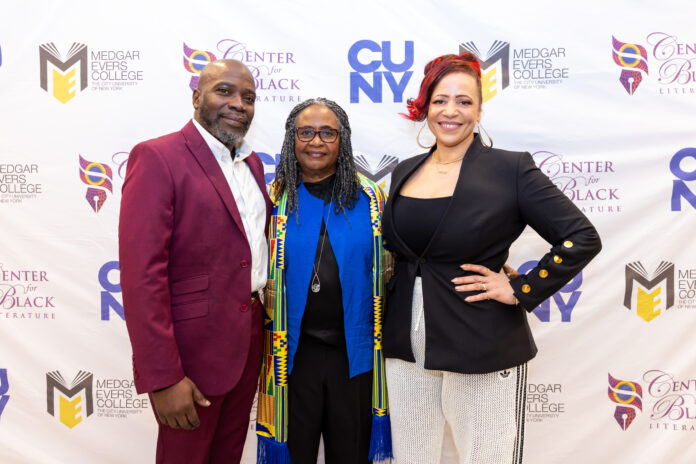

Dr. Brenda M. Greene
Prof. Donna Hill
The Center for Black Literature hosted the 18th National Black Writers Conference, a community gathering with the dual purpose of expanding Black literature while opening a dialogue around the layers of environmental justice and its impact on Black and Brown people throughout the African Diaspora.
Opening night began with our keynote speakers, Pulitzer Prize winner Nikole Hannah- Jones (1619 Project) and award-winning journalist Michael Harriot (Black AF History: The Un-whitewashed Story of America). Roundtable panels challenged the audience to conceive of a different world where we, of African descent, re-embrace, reclaim the land, our bodies, our economics, our spirits, and most importantly, identify the paths that we must traverse to reimagine our future.
The Conference was not only a convergence of ideas but an intergenerational assemblage that began with cultivating the next generation of thought leaders, our young readers and writers from our Re-Envisioning our Lives Through Literature program, (ROLL). The Scholarly Panels called on the academic community to tackle topics such as: Environmental Racism, Ecological Displacement, Digital Surveillance, the Black Arts Movement, and Reggae Music Against Ecological Ruin. For the first time, the Conference hosted a panel of Medgar Evers College students who answered the question, How Does Popular Culture Influence Social Thought, Interaction and Activism. On the other side of the generational spectrum, we honored our Elders during th Dr. Edith Rock Workshop for Elder Writers, where these amazing griots shared their writing and memories that made us laugh, remember. and sometimes shed a tear.
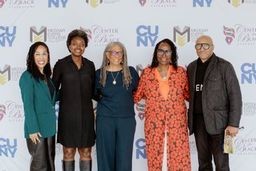
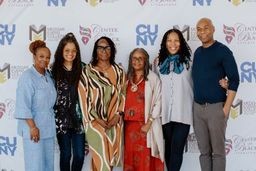
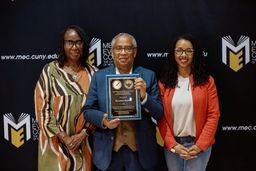
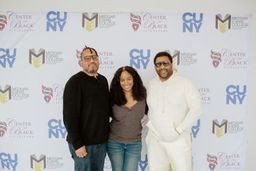
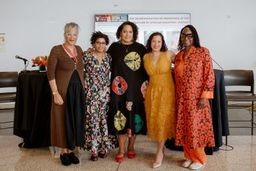
Poets have always had a special place in our hearts, and the Poetry Café that featured a cross-section of local poets did not disappoint.
The centerpiece of the Conference was the six roundtable-conversations that were led by moderators: Dr. Uche Blackstock, Ijeoma Oluo, Sabrina Schmidt Gordon, Trymaine Lee, and Abby West. Panelists Nana Ekua-Brew Hammond and Desiree Cooper gave us insight into paths to resilience. Regina Mahone, Renee Bracey Sherman, and Jennifer L. Morgan excavated the impact of legislation and racism on the female body. Andre Brock and Attika J. Torrence broke down how technology and the media influence literature.
Cebo Campbell, Chelsea Frazier, and Natalie Braszile gave us food for thought on the growing movement of returning to the earth for sustenance. And Dr. Ayo Sekai, Clarence A. Haynes, and Dolen Perkins-Valdez identified the ways that Black writers and readers have developed multiple avenues for publishing and ensuring that their stories and voices will not be silenced.
The conference’s closing program and Awards paid homage to Camille Dungy, Dr. Imani Perry, and Kassahun Checole, literary figures whose work exemplifies the mission and vision of the Center for Black Literature and gives voice to the community at large.
Reflections on the 18th National
Black Writers Conference
Dr. Brenda M. Greene, Founder and Executive Director Emerita, Center for Black Literature
“Our Keynote speakers, Nikole Hannah-Jones and Michael Harriot are powerful journalists, historians, and storytellers whose work has impacted the way we teach the history of America. Their groundbreaking scholarship provides a counternarrative to our history, what our Nobel Laureate Toni Morrison would call a Black gaze from which to view the story of America.
It is particularly significant that we listen to this discussion at this time in our history, the semi-centennial of the “founding” of this nation, a celebration that will take place in July 2026 while our President in an attempt to mythologize our history, installs a statue of Christopher Columbus on White House grounds and reinstalls statues of Confederate soldiers.”
Nikole Hannah- Jones,
Keynote Speaker
“Environmental justice means allowing people to have the ability to be repaired for the years of damage that’s been caused. We know that Black folks, indigenous people, and poor people who are non-black and indigenous have “worn” an unfair proportion of environmental toxins, the destruction of land and greenery and are least likely to live around parks and green space.”
Michael Harriot, Keynote Speaker
“When you look at the mythology and the marketing scheme that America’s myth is based on, it contradicts the things that America actually did. It does not acknowledge the harm and the reality of how you’ve treated some people and how you’ve prioritized the humanity of white people over everyone else.”
Attika J. Torrence,
Conference Speaker & Writer
“I think the conference is amazing. Nikole Hannah-Jones said that any change that would be made must be made by another generation, a younger generation. So it’s incumbent upon us to get the youth here. And I know that’s a challenge because getting youth to sit down and enjoy things that adults/elders enjoy is a challenge. We need to arm our youth with the tools that they need to go into this world. I’m happy that it’s here at Medgar Evers College. The symbolism doesn’t miss me, you know. Anytime we can, especially in today’s age, create some form of utopian convocation of Blackness, I’m down.
Aminata Gunata, Conference Attendee
I’m very grateful to be able to be here today because Nicole Hannah-Jones, especially, is someone that I look up to. As someone who has studied Black History and Journalism and because of the time that we’re living in, hearing these kinds of thought leaders and intellectuals gave me solace, some comfort, and a sense of hope.
Deborah Barton,
Conference Attendee
I heard a lot of things that resonated, especially the teaching of our children, which is so important. We don’t tell our children the real history. So I’m getting The 1619 Project because I want to share that with my class.
Dr. Brenda M. Greene is Professor Emerita and Founder and Executive Director Emerita of the Center for Black Literature at Medgar Evers College, CUNY.
Prof. Donna Hill is Associate Professor and Executive Director of the Center for Black Literature Executive Director of the Center for Black Literature at Medgar Evers College.