

By Enoch Naklen
Multimedia Journalist
Standing at the intersection of Williamsburg, Bushwick, and Bed-Stuy, the Bishop Gallery sits in the geographic ‘Broadway Triangle’. It is a place where a single block offers the sight of Jewish families picking up their children from local yeshivot, situated across the street from Spanish signages, and just around the corner from graffiti-littered apartment complexes at the forefront of one of the oldest Black communities in America.
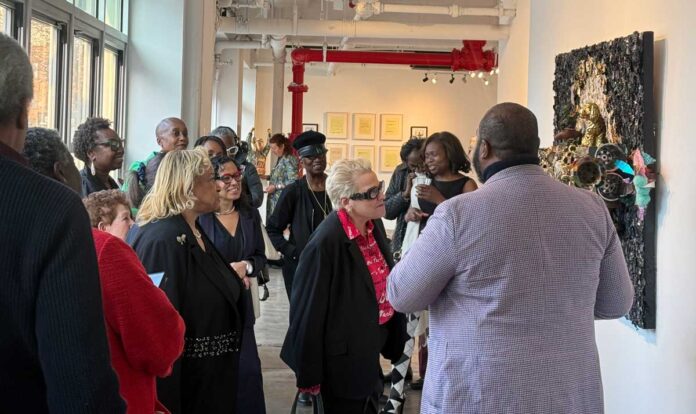
On a recent evening, this intersection served as the backdrop for an “ultra-VVIP” private screening, where a diverse audience of longtime New York residents and community luminaries gathered for a first glimpse of the revitalized exhibition, “Our Friend, Jean.”
Guests moved through the expansive, light-filled space balancing wine and finger snacks while overlooking more than 20 artworks, including drawings, writings, apparel, mixed media collages, and ephemera. These pieces represent the earliest works of Jean-Michel Basquiat, on loan from a circle of collectors who knew him intimately as friends, collaborators, and lovers.
The guided tour was led by co-founder Stevenson Dunn Jr., with fellow co-founder Erwin John also in attendance, both men having spent nearly two decades building a sanctuary for high art within the heart of their own neighborhood.
The evening also served as a moment of communal recognition. Among the attendees was a group of Black women judges invited to the gallery in honor of Women’s History Month. The delegation was led by Judge Robin Sheares, who coordinated the visit for her colleagues and their guests. Stevenson noted that the timing was intentional. While the event was open to all judges, the decision to host this specific group during March highlighted a shared commitment to leadership and legacy.
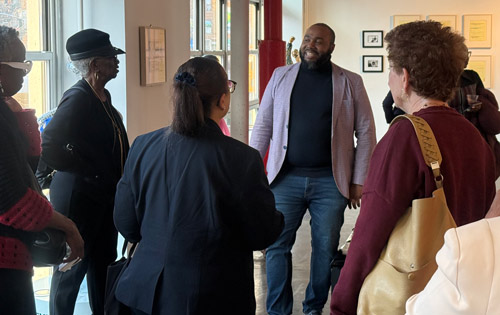
“The significance is bringing world-class artists to our community,” Stevenson told Our Time Press during the tour. He spoke on the paradox of the “export” of culture, a narrative that still persists today. Despite coming from a more privileged background, Basquiat opted to adopt a life that reflected the raw reality of the artists around him, a decision that led to the birth of cultural staples like SAMO.
Created alongside Al Diaz, who served as one of the key collectors that helped make this exhibition possible, Basquiat inscribed the streets of Manhattan with enigmatic social commentary that eventually moved from the concrete of the sidewalk to the canvas of the elite.
“Distance and proximity are not the same thing,” Stevenson explained. “You can feel really close physically, but so distinct from a place. One of the real things about accessibility is having your own spaces to go into.”
The tour was anchored by the presence of Alexis Adler, a key collector and co-curator whose history with Basquiat predates the hundred-million-dollar auction records. Speaking to the crowd during the walk-through, she shared a defining memory of the first time she and Jean met outside a bar.
After Jean stepped in to help an erratic man carrying a broken glass bottle, a precedent of care was set that led to her documenting his life through her lens. Her presence underscored the exhibition’s title; these are not merely artifacts, but the preserved memories of a friend.
The “Our Friend, Jean” exhibition originally debuted at the Bishop Gallery in 2019 before embarking on a historic six-city tour of Historically Black Colleges and Universities (HBCUs), including Howard, Hampton, and Clark Atlanta.
This journey was an intentional effort to address the fact that while many HBCUs have only recently begun formal collections, their students and history are often cited in major museums only as a “courtesy” mention. By bringing the physical work to these campuses, the gallery ensured that the art remained a living resource for research and study within the institutions that mirror the communities Basquiat frequented.
Embedded in this mission is a deep understanding of the systemic elitism of the art world. “The arts can be kind of snobby. They’re talking in this fancy tone,” Erwin John told Our Time Press. He observed that art collection is often viewed as a prestigious pastime reserved for a select few, creating a barrier for underrepresented groups.
As art made within these neighborhoods accrues interest and capital, it rarely stays where it was birthed, fueling a cycle where the creators are separated from their own contributions. Erwin’s mission is a form of strategic infiltration. “Instead of criticizing it, let’s just do it ourselves,” he said, reflecting on his time at Howard University where he first caught the “entrepreneurial bug.” By positioning the gallery here, the founders are challenging the capitalistic feel of the industry to give back to the community that serves as its greatest inspiration.
As guests moved through the room, they found that the front half of the gallery—the space you first interact with upon entering—is dedicated to the group exhibition, “Reminder: The Children Are Our Future.” This expansive show, which has been live since late last year, features a powerful roster of artists from six different continents.
The space was intentionally designed to be a vessel for all sides of the imagination; while some works occupy the walls in traditional 2D formats, others exist as mixed media and sculptures that require a physical presence to be fully understood.
The pairing makes sense within the broader Bishop ethos, using the universal innocence of childhood to bridge the gaps in a hyper-polarized world. For Stevenson and Erwin, the gallery remains a “mutual lifeline,” a place where the art finally belongs to the people who inspired it.
The Bishop Gallery is located at 630 Flushing Avenue in Brooklyn. The gallery is open by appointment Monday through Friday and is open to the public on Saturdays from 12 to 6pm.