Home Blog Page 856

Bridge Street AWME Church Celebrates 250 Years

In one glorious day, a church bridges its past to its present, to its future …

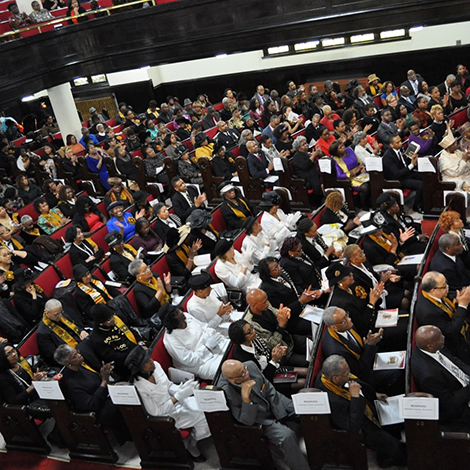
When people talk about having their roots in Brooklyn, few have roots deeper than the 250-year-old congregation of Bridge Street AWME Church.  As expected, great moments were experienced at this historic church that, as The Rev. David B. Cousin and guest speaker Rev. Dr. Cornell William Brooks said, “continues to make history”.

The entire day was a sweeping, dramatic evocation of the program’s theme centering on honoring Bridge Street’s two convergent histories: from the AWME ancestral founding entity and its evolvement as Bridge Street African Methodist Episcopal Church.

It was a rousing service of great words, great music and great people coming together to fellowship and celebrate the foundations for great works already in progress.  The church honored the keepers of Bridge Street’s missions and heritage and heard congratulatory words from the leaders in the courtrooms of the city and state, and all levels of government who are charged with fighting for Bridge Street, its neighbors and neighborhood.

Exhilarating performances by Bridge Street musicians and liturgical dancers in white roused the congregation.  A harmonic universal choir robed in black, featuring singers from the church unified with the voices of friends from other church families, hailed the church triumphant.

The Rev. Dr. Cornell William Brooks, National President & CEO, NAACP, and The Rev. David B. Cousin, Sr., pastor, Bridge Street

As the nation’s Black History Month closes, Our Time Press appreciates the action of the pastors, trustees and congregation in inviting such a speaker as The Rev. Dr. Brooks to deliver an impactful sermon that, in itself, was history-making on the level of the great messages and delivery of The Rev. Martin Luther King, Jr.   A transcrip

tion of his entire speech will appear in the March 10 issue of Our Time Press, in celebration of the birthday of Harriet Tubman, who also spoke to Bridge Street congregations before the dawn of the 20th century.

On this page, we offer these brief highlights of this one church so that the community remembers and takes lessons from the perseverance and the determination of those who have made this anniversary celebration possible.


The Awardees …


Rev Charles Griffin- Founders Award

Rev. Charles Griffin received The Founders Award, a new honor, for exemplifying the spirit of the early founders of our church, and who have helped to further the spiritual work and legacy of the church. It is given to a leader age 30 or older. He has served on the ministerial staff for more than 20 years.

Gregory E. Jones, Jr. received the Young Adult Award for his consistent, committed service to organizations of

Greg E Jones, Sr accepting award for Greg E Jones, Jr – Young Adult Award

Bridge Street, and has active involvement in the community.  Jones, who recently became a firefighter, mentors young men of character at Community School 21.

Spencer Jackson – Youth Award

Spencer Jackson received The Youth Award for demonstrating commitment to the ideals of Bridge Street Church, school and community. Nominees are actively involved in the organized youth activities of the church; participate in school and community activities and service projects; are in good academic standing.

Anne Brunson, longtime Bridge Streeter, was awarded the Church and Community Award recognizing her leadership in setting the example of good Christian values.  She also provides spiritual, cultural, social, educational or business programs which address the needs of the “whole person” in the church and community.  They must also give back to the community by providing

Anne Brunson receiving The Church and Community Award

employment and business opportunities, as well as quality services which enhance the community. Ms. Brunson is former President and 2nd Vice President of the New York Con.

The Steele-Powell-Morris-Beasley Family received the Faithful Family Award recognizing families with two

The Steele-Powell-Morris-Beasley Family, Faithful Family Award

or more generations of membership, service and leadership, sustaining the spiritual legacy and work of Bridge Street Church and Community. The oldest generation joined Bridge Street in 1945.  Over the years, various members of the family have been part of the Church School, the Usher Board, Girl Scouts, the Security Ministry, the Junior Steward Board, the Women’s Day Committee, the Arthur L. Funn Lay Organization and the Board of Trustees Conference WMS., among other notable achievements.


HISTORICAL HIGHLIGHTS

OF THE AFRICAN WESLEYAN METHODIST EPISCOPAL CHURCH
BROOKLYN, NEWYORK

1766   The African Wesleyan Methodist Episcopal Church was organized.

1794     The congregation purchased land from wealthy landowner Joshua Sands, and built a small church,
which was named The Sands Street Wesleyan Methodist Episcopal Church. The
congregation consisted of Caucasians, free Negroes, and ex-slaves. The Sands Street congregation
grew rapidly and needed a larger place to worship.

1810     A new church was completed. The church was named First Methodist Episcopal Church of
Brooklyn and had a mixed congregation of fifteen hundred members. Between 1810 and 1817, the
Black church membership increased rapidly causing relations between Blacks and Whites to
deteriorate. Whites wanted Blacks to pay $10 a quarter to worship in the galleries. They withdrew
from the First Methodist Episcopal Church of Brooklyn and temporarily worshipped in each other’s
homes.

1817     On May 14, 1817, they formed a society to raise funds to buy land to build a church, agreeing to pay
50 cents a month into a treasury for a building fund. In the fall of1817, a grand rally was held and the
amount of$130was collected towards the building fund.

1818     On January 12, 1818, after being legally notified, the “male” members of the society met for the
purpose of choosing trustees, whose duties were to take care of the temporal affairs of the church or
religious instruction. A delegation was appointed to go to the Philadelphia to see Bishop
Richard Allen of the AME Church about sending a preacher for the new church and to ordain several of the delegates as local preachers. On January 19, 1818, Peter and Benjamin
Croger went before Magistrate John Garrison in Kings County Court of Common Pleas and filed a
Certificate of Election. On February 7, 1818, the Certificate of Election was approved by the
Court of Common Pleas, and the first African Wesleyan Methodist Episcopal Church was
incorporated in the Village of Brooklyn, State of New York.

1819     OnJuly21, 1819, the church corporation purchased land located on the east side of High Street near
Jay Street, and built the first African Wesleyan Methodist Episcopal Church in Brooklyn.

1824     On February 17, 1824, Peter Croger was elected the first delegate to the General Conference of the
AME Church held in Baltimore, Md.

1827     The men of the AWME Church set up an educational system for colored youngsters. On
September 25, 1827, the cornerstone of The African Free School (known as Colored School # 1)
was laid under the direction of Henry C. Thompson, an AWME Church Trustee.

1854       The AWME Church bought from the trustees of The First Congregational Church the property at
309 Bridge Street for $12,000. On the first Sunday in August 1854, the Rev. James Morris Williams,
the 21″ pastor of The AWME Church, marched his congregation from High Street to their new
church home at 309 Bridge Street. Hereinafter, this church was known as The Mrican Wesleyan
Methodist Episcopal Church. From 1854 to 1938, the congregation worshipped at 309 Bridge Street
and the church was also known as Bridge StreetAWME Church.

1862 On December 31, 1862, a historic three-day celebration of freedom took place in Brooklyn.

Hundreds of Brooklyn citizens, black and white, flooded the Bridge Street African Wesleyan
Methodist Episcopal Church to attend the church’s traditional “watch night” service on New Year’s
Eve. Parishioners came in great numbers because President Abraham Lincoln h promised to sign
the Emancipation Proclamation on New Year’s Day. This was the first day of an historic three-day
celebration of freedom at the church.

1863      On January 1, 1863, President Abraham Lincoln signed the Emancipation Proclamation and freed
four million African American men, women, and children. The African Wesleyan Methodist
Episcopal Church (Bridge Street AWME Church) remained open all day as word spread and people
arrived to express their joy, as well as their concern about the ongoing Civil War – in meetings,
speeches, prayers and songs. On January 2, 1863, the church presented a formal program of speakers,
including African-American historian, William Wells Brown and abolitionist Theodore Tilton. In
February 1863, the nation’s leading civil rights activist Frederick Douglas spoke at Bridge Street
AWME Church, delivering a stirring speech on the need for black soldiers in the Union ranks. A few
weeks later, Douglas used the Bridge Street address to launch his historic “Men of Color, To Arms”
campaign, which recruited 200,000 African-American soldiers to the Union cause.

1865      In October 1865, Harriet Tubman, the nation’s most famous conductor on the Underground
Railroad, visited the church. According to The Brooklyn Daily Eagle, she was welcomed by an
immense congregation-half of it whites-and hailed for her heroism as a Union scout and nurse.
At the time, the church organist was Susan Smith McKinney, 18, who was born and raised in
Weeksville. She was an activist in missionary work and the suffragist movement, and became the first
African-American woman to earn a medical degree in New York State. The AWME Church played a
prominent role in the anti-slavery movement as an abolitionist meeting place and a “station” on the
Underground Railroad, hiding freedom seekers in the church basement. Other Brooklyn churches
did the same, including Plymouth Congregational, Siloam Presbyterian and Concord Baptist.

1938      On Sunday, December 4, 1938, the Rev. Mansfield E. Jackson, the fifty-second pastor of the African
Wesleyan Methodist Episcopal Church, marched his congregation from 309 Bridge Street to their
new church home at 277 Stuyvesant Avenue, which was purchased from the Grace Presbyterian
Church. From its pulpit at Sands Street, High Street, Bridge Street and Stuyvesant Avenue, some of
the greatest preachers and orators of the last two centuries have championed social justice causes for
an egalitarian society.

In 1818, a delegation was appointed to go to the Philadelphia to see Bishop Richard Allen of the AME Church
about sending a preacher for the new church and to ordain several of the delegates as local preachers.’ Since
that time, three former pastors were elevated to the episcopacy of the AME Church.


Interfaith Medical Center Honors Black History Here & Now      


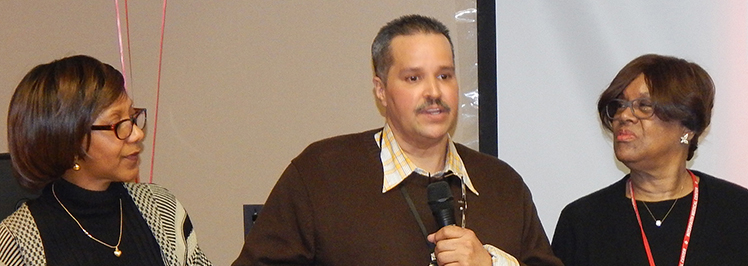
Interfaith CEO/President LaRay Brown, Canon Diane Porter, Community Outreach Officer Sharonnie Perry

Easter came early this year at the Black History Program presented by clients and staff of Interfaith Medical Center’s Department of Psychiatry, Ambulatory and Primary Care Programs and Community Affairs, which included a standing-room-only audience with stories of Resurrection, courage, faith and resilience.

The program, seamlessly run by Mistresses of Ceremony Sharonnie Perry and Gabrielle Mathias, began with longtime Interfaith religious leader Reverend Canon Frederick Opare-Addo giving an invocation of healing before Norman Davis led with the Black National Anthem and Dr. Evaristo Akerele introduced the new CEO of Interfaith Medical Center Ms. LaRay Brown.

One aspect of her introduction Ms. Brown felt needed correction was as the first African-American woman to head a major hospital. CEO Brown said she is the first at a private hospital, but there have been others as heads of public hospitals and that “I have to recognize my sisters because I stand on their shoulders”.

Ms. Brown shared that being “the first” African-American woman in a particular position of leadership in 2016 was something she was “not proud of” and that there were issues of social inequality and social justice that still existed all around us and that “we have a responsibility to keep on keeping on”.

This was followed by examples of those who “keep on keeping on”, beginning with the clients of the IPRT mental health program with a collection of creative writing by Antoinette, Charmin, Quintin, Marie, Ian, Joy and the multitalented Karen.

In an example of life giving meaning to art, Darren, Linda and Jennie gave a rendition of “Stand by Me” that was a soulful sound resonating with particular meaning for an audience of those who have seen hard times and who, at times, have needed something to hold them while they pulled themselves back up.

Allois Douse, CDOS – Jose “Joey” Roman – Barbara Smith

Awardee Jose “Joey” Roman spoke to this saying he came into Interfaith as a client diseased by alcohol: “It destroyed in six years what it took forty years to create”, but now is clean and employed at the center.   According to Joey, and I think he would know, there is a road to sobriety that must be traveled because “it’s a journey not an event”.

Award recipient Richard Symister spoke of the work ethic he learned from his father and accepted in honor of his parents and grandparents and the values they instilled in him.   The standards they set gave him the strength to create MovEvolution, a sports physical therapy, body work and performance enhancement studio located in the middle of the former Bogolon District at 87 Fort Greene Place.

“I am not bipolar, I have bipolar disorder,” announced award recipient Leslie Sterling as she spoke of her “invisible illness” and how it can be helped with exercise, diet and finding release for the unavoidable stresses in life.  A believer in the efficacy of creative arts therapy, Sterling says “people can heal through the arts”, and that what is centrally important is to “find what feeds your soul”.  One of the things that feeds Ms. Sterling’s soul is the free ShapeUp NYC fitness program she works with at Interfaith every Wednesday at 3pm.  (FYI ShapeUp NYC is a citywide program with no registration offering fitness classes such as aerobics, yoga, Pilates, Zumba and more.)

Divinah “Dee” Bailey, CEO The Watchful Eye

Upon accepting her award, Divinah “Dee” Bailey, founder of The Watchful Eye anti-HIV/AIDS organization, called over Mistress of Ceremony and Director of Governmental and Community Relations Sharonnie Perry to acknowledge Ms. Perry’s years of “work and commitment” in the community and tells of their coming together during the early years of the AIDS epidemic when Interfaith was the first hospital to have an entire floor devoted to AIDS patients.

Ms. Bailey also told a story of how only a few months ago, while driving a large vehicle in downtown Brooklyn, she suddenly felt the deep, seeming life-ending, childbirth-like pain of kidney stones.  Though headed toward Methodist, she turned around and headed to the “real hospital right in our community”, Interfaith.  The “unapologetically Black” Ms. Bailey said that in our community “we have great people and a great hospital”.

  • Awardee Canon Diane Porter is a former member of the Board of Trustee’s for Interfaith Medical Center and founder and CEO for the IM Foundation, focusing on health care issues. A lifelong Episcopalian and a trailblazer in the church in her own right, Canon Porter spoke of her family history from the time her mother refused membership in the Women’s Auxiliary at St. Catherine’s Hospital in Indiana because women were not allowed on the board and her father’s work at Phillis Wheatley Hospital in Kansas City, Missouri.


Jerome Pogue

Award recipient Jerome Pogue flatly stated, “Interfaith saved my life” as he spoke of starting drugs at 16 and still carrying two bullets from a time when he had given up on life and was “angry at God”.  “It was an ugly thing,” the life he knew before “*MICA taught me to love myself” and he’s now 8 years clean.  In his work with young people, he says a lot of young people don’t have work ethics.   Pogue says he has painfully come to realize that the very basics such as personal responsibility for showing up on time are things that “they really don’t know” and that have to be instilled because “children are the future”.

Who we are and what we become is held in two pounds of brain matter and the care and feeding of it determines whether it ever is able to discover and exploit its gifts.    Subject to smoke, alcohol, drugs, stress hormones and a toxic environment of bad air or water and afterbirth, there is likely a continuation of that womb experience compounded by societal pressures and the “little grey cells” make the wrong connections, don’t know why and as Mr. Pogue says, that’s when things get ugly.  The good news from the morning was that with guidance, the human spirit can find its way.  That’s what we saw at Interfaith and it was a pleasure to watch.   By David Mark Greaves

Original music by Ms. Antoinette Taitt was performed at the lunch provided by Health First.

*(Mentally-Ill Chemical Abuser [MICA] Continuing Day Treatment Program 718.613.4355)

Chemical Dependence Outpatient Services (CDOS) 718.613.4450


Where the Atlantic Yards CBA Stands

By Akosua K. Albritton

Pacific Park’s–née Atlantic Yards–construction is moving full steam.  At the February 24, 2016 community update meeting in the Shirley Chisolm State Office Building, Senior Vice President of External Affairs for Forest City Ratner Ashley Cotton described the progress in building 550 Vanderbilt Avenue, 535 Carlton Avenue, 38 Sixth Avenue, 664 Pacific Street, 461 Dean Street, and the extension of the Long Island Rail Road yard.  Ms. Cotton gave the height and number of affordable housing units for each building–some 1,700 units.


There is dedicated space on the first four lower floors at 664 Pacific Street for a 616-seat middle school. 38 Sixth Avenue is being outfitted with a health center.  This work occurs due to the skill of prime contractors, subcontractors, and their constructions crews.  What do the quarterly reports from the Independent Compliance Officer reveal about the contract awards to minority business enterprises and women business enterprises in pre-construction services and total construction expenditures?  What percentage of all construction workers are minorities and what is the percentage of women hired as construction workers? It took foresight for the crafters of the Atlantic Yards Community Benefits Agreement (CBA) to consider these keys to a win-win situation for the developer and community.


Devotion NYC leader Michael West met with Ms. Cotton, February 18, 2016 to ask these questions.  “Ms. Cotton cited some numbers—1,700 construction workers, 50% are minorities, 10% are women, 20% are Brooklyn residents—but there was no document to support her words.  We asked that she send the document to us by February 29.  Rather than the report, she emailed a letter to him, February 29, 2016 containing the same numbers she had stated in the meeting.”  Mr. West had been associated with BUILD. By 2008, he left the organization “due to other responsibilities and had a job.”


Without the report neither the CBA Executive Committee nor the public can study the many statistics to know the project’s progress in realizing the CBA.  CBA Coalition Chair Delia Hunley-Adossa was contacted by telephone March 1, 2016 in order to obtain the M/WBE and construction workers statistics; however, the voice mail for Brooklyn Endeavor Experience from where Ms. Hunley-Adossa operates was not activated and contacting her via info@beegreennow.org which is listed on the website resulted in the return message: “Remote SMTP server has rejected the address…it does not exist”


What of the Independent Compliance Officer (ICO)?  Who is this person and where are the quarterly reports? According to Michael West and Norman Oder, Atlantic Yards/Pacific Park Report steadfast blogger, no one is in that position.  “Enforcement of the CBA is pretty much dependent on the Independent Compliance Monitor.  [This person] is supposed to report to the community; however, no one has ever been assigned to the position,” explained Mr. West.


According to the CBA agreement:

The ICO shall be responsible for oversight of the Project Developer’s, Arena Developer’s and Coalition members’ obligations under this Agreement, investigation of any complaints brought against the Developers or a Coalition member regarding implementation of this Agreement and review of the Developers reports required under Article X (the “Developer Reports”).  After review of the Developer Reports, the ICM shall provide a report to the Executive Committee and the DBOAC, as defined below, on the status of the implementation of all initiatives.


Mr. West advances Devotion NYC to serve in this capacity. Rather than one person receive an annual salary of up to $100,000, for $149,000 the organization Devotion NYC would perform the same duties.  Another organization he suggests is a multiservice organization called HigherSelf Lifestyle.


The crucial item to examine is the change in the project’s name from Atlantic Yards/FCR to Pacific Park.  Pacific Park is being constructed by Greenland Forest City.  This is a joint venture between Greenland, USA, the developer of record which is a Chinese real estate developer and Forest City Ratner which is responsible for property management.  Greenland, USA controls 70% of the project.  Scott Solish is Greenland’s Director of Design and Development.  Solish left NYC Economic Development Corp. to assume this post.  NYS chapter President of the National Association of Minority Contractors Joseph Coello opines, “Greenland ought to be part of discussions and [learn whether] they are prepared to follow the mandate of the CBA.”


This joint venture initiated changes for the project by the Empire State Development Corp.  “The General Project Plan was modified June 2014 to accelerate construction and the creation of the Atlantic Yards Community Development Corporation (AYCDC) which gives input on development, housing, and community impact.”  One of the 14 board members is Bertha Lewis, Black Institute Executive Director

Impact of Foreclosure Upon Communities of Color

Foreclosed home

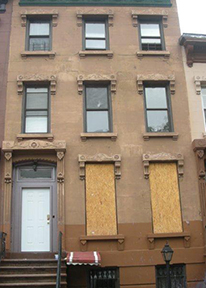
On Friday, February 19, 2016 the New York State Foreclosure Defense Bar (NYSFDB) co-sponsored a Legislative Luncheon at Brooklyn Law School, led by Congresswoman Yvette Clarke (9th Congressional District). The topic of discussion, the “impact of foreclosure upon communities of color”, was buoyed by a recent report issued on January 27, 2016 by Special Inspector General Christy Goldsmith Romero of the Troubled Asset Relief Program (TARP)[1]. The report details the impact that the low rate of Home Affordable Modification Program (HAMP) approvals has had on the foreclosure crisis, specifically the impact on Brooklyn communities over the past five years. It found that from 2009 to 2015, nearly half of the TARP funding allocated to support HAMP remains unspent, funding which is set to expire in 2016. In addition to this, in April 2015 approximately three out of four homeowners had their HAMP applications denied, which totals to over four million people nationwide.

As a member of NYSFDB, David Bryan, Director of the Consumer and Economic Advocacy (CEA) Program, attended the luncheon and participated in a panel discussion. Starting with a chant of “Black Homes Matter!”, which the room joined in on, Bryan launched into a narrative of a recent case involving a lender discriminating against clients in the provisions written into their mortgages. Historically, communities of color have been disproportionately impacted by unfavorable mortgage agreements and predatory subprime lending practices, which have led to higher rates of foreclosure, patterns that persist to the present day. The CEA Program team represents clients and helps fight against such discrimination, an increasingly important need given that the vast majority of homeowners facing foreclosure do not have a lawyer. Bryan concluded the discussion by reinforcing that in order to deter financial institutions from taking advantage of homeowners there must be a clear threat of criminal prosecution in place for those that violate the law.

The general consensus from the members of the Legislative Luncheon was very clear: the foreclosure crisis of the Great Recession is not over. Over the next three to five years, close to $10 billion in community and family wealth could be transferred out of Brooklyn as lenders continue to foreclose on homes and seize property. This leads to the threat of displacement for tens of thousands of Brooklynites, which will drastically change the landscape of neighborhoods that have been predominantly minority and working class for many years. With the number of judges handling residential mortgage foreclosure cases in Brooklyn recently reduced from 25 to 2, and the funding designed to support HAMP set to expire in 2016, a joint effort among local lawmakers and civil legal service organizations is imperative to ensure that Brooklyn homeowners are given a fighting chance to remain in their homes.  (Brooklyn A’s News)


Judiciary Changes Choke Foreclosure System, Hurts Homeowners

By Dan Wise

Foreclosed home

New York City Public Advocate Letitia James cast a harsh spotlight on Justice Lawrence S. Knipel, the administrative judge in charge of civil cases in Brooklyn Supreme Court, at a meeting convened Friday under the leadership of Brooklyn Congresswoman Yvette Clarke to examine the impact of foreclosures upon communities of color.

During the course of the meeting at Brooklyn Law School, James rose on several occasions to express dismay over the way foreclosure cases are being handled in Brooklyn and angrily vowed to seek a meeting with him.

About 70 public officials, homeowners’ lawyers and their clients attended the session. The session was presented in conjunction with the New York State Foreclosure Defense Bar.

The message from about a dozen lawyers and their clients, who were designated as presenters, was clear: the foreclosure crisis of the Great Recession is not over. To the contrary, the crisis is greater than ever because government-related entities, such as Fannie Mae, have been selling off huge amounts of troubled mortgages at bargain prices to investors, who, in Brooklyn, are pressing hard for foreclosures so they can take advantage of rising prices as gentrification in some of its poorer neighborhoods speeds ahead.

David J. Bryan, director of economic advocacy at Brooklyn Legal Service Corp. A, said that Fannie Mae and other like entities “will accept the loss of a substantial portion of the homeowners debt when the loans are sold to a hedge fund but not to help homeowners save their homes.”

“Hedge funds win and Jane Public loses,” Bryan explained, because, for example Fannie Mae has rulemaking authority to forgive principal on loans it owns but chose not to exercise it, even though the Treasury Department has required private holders of mortgage debt to consider forgiveness.

In that vein, a report released by TARP’s Special Inspector General Christy Goldsmith Romero on January 27, found that $11 billion of the TARP funds set aside to fund the HAMP program in 2009 remains unspent. That is nearly 50 percent of the $22 billion originally earmarked to support HAMP. (See TARP Report on p.93.)  Unless reauthorized, HAMP will expire at the end of 2016.

TARP refers to the Troubled Asset Relief Program in which Congress approved a $700 billion bailout in 2008 for the nation’s collapsing financial system. Congress eventually pared the bailout to $475 million, of which $22 million was set aside to fund a program designed to provide mortgage relief to homeowners who had become delinquent in their payments. The HAMP (Home Affordable Mortgage Program) was designed to provide a process by which banks and homeowners, in appropriate instances, would negotiate downward modifications of the amount homeowners are required to pay on their mortgages.

The U.S. Treasury Department subsequently issued detailed guidelines to determine who is eligible to receive a modification and, if so, in what form and what amount.

Inspector General Romero also found that only 22 percent of more than 5 million requests for HAMP loan modifications had been approved as of November 2015. (TARP Report p.97)

A study prepared by the New York State Foreclosure Defense Bar buttresses the notion that minority communities in Brooklyn have been disproportionately impacted by the gentrification process. The foreclosure bar twinned data from the Federal Reserve Board of New York examining the number of foreclosures in 2013 by zip code with 2010 census data on the racial makeup of 171 zip codes within the state.

The results of that analysis, which was part of a Powerpoint presentation at the session, shows that four of the 10 zip codes with the highest number of foreclosures in 2013 were in Brooklyn. The percentage of Hispanic and black people living in those neighborhoods ranged from 85 percent in the vicinity of Cypress Hills and East New York to 96 percent in East Flatbush, Brownsville and nearby neighborhoods.

Good NY Laws–Judicial Enforcement Spotty

The new pressure to extract the gold now present in the distressed assets held by the likes of HUD, HFA, Fannie Mae and Freddy Mac comes against a backdrop of bank indifference and intransigence which has frustrated the operation of the HAMP program, said Jay Inwald, who oversees the foreclosure prevention practice of Legal Services NYC, which has aided 10,500  limited-income New York City homeowners since the HAMP program started in 2009.

Inwald noted that New York has very strong laws designed to help homeowners “avoid losing their homes”. Specifically, the state adopted a law in 2009 which dovetailed with the HAMP program to require holders of delinquent mortgages to negotiate “in good faith” before proceeding in court to foreclose upon homes. In 2014, the appeals court covering Brooklyn and Queens ruled that the bank adherence to the HAMP guidelines should be the measure of “good faith”.

Nonetheless, Inwald explained, banks frustrated the process by often (and repeatedly) losing the extensive paperwork homeowners were required to submit to qualify for a downward mortgage modification and refusing to process applications in the manner specified in HAMP guidelines.

More saliently, Inwald said, the courts have signaled a lukewarm approach to enforcing the requirement that banks negotiate in “good faith” with homeowners. In a follow-up interview, he explained that the legislation adopting the “good faith” requirement specifically instructed the Office of Court Administration (OCA) to adopt rules to ensure that court referees conducting the settlement conferences have the power to ensure that the parties refrain from “willful dilatory practices”.

Yet, the rules issued by OCA to implement the new settlement process were silent on what powers referees and judges have to enforce the “good faith” requirement. As a result, he added, the courts have been loath to enforce specific requirements enumerated in the new law (Civil Practice Rules and Procedures Section 3408) such as a requirement that banks appear at settlement conferences with full authority to “dispose” of a case. Instead, he said, banks routinely use attorneys who are only hired for the day and lack basic information about the case.

Residential Foreclosure Judges Cut from 25 to 2

Against this backdrop, Inwald said, Knipel in January overhauled the assignment of residential mortgage foreclosure cases to reduce the number of judges handling them from about 25 to two. Under this plan, more than 6,000 pending residential foreclosure cases were reassigned to Brooklyn Justice Noach Dear, a former City Councilman who represented a predominantly Orthodox Jewish section of Brooklyn. The remaining 2,000 “old” residential cases were transferred to Justice Peter Sweeney. Previously, the residential cases had been randomly assigned among 25 judges, all of whom handled many different types of civil cases.

At Friday’s meeting, Inwald said it is “difficult to imagine” how a single judge could handle 6,000 cases without “causing an even more substantial backlog or reverting to a rubber-stamp process”.

Inwald’s description of the problems posed by shifting 6,000 residential cases to a single judge is what brought Public Advocate James to her feet. She angrily demanded in reference to Knipel, “Who is this Supreme Court Judge?” and vowed to seek a meeting with him.

That was one of several occasions in which James rose to express her dismay with the way foreclosure cases are being handled in Brooklyn and elsewhere in New York City. One of those instances was in response to the account of Carl Tripp, a manager of a U.S. Postal Office in Brooklyn. Tripp related how he had been offered a mortgage modification by Chase Bank, and had paid his mortgage at the lower rate for six months, more than twice the time period specified in the HAMP guidelines. Nonetheless, Tripp said Chase refused to make the loan modification permanent.

Reflecting upon Tripp’s treatment and the similar experience of another homeowner James said, “No one should be treated like that”.

Several of the homeowner lawyers at the meeting recounted that only a day earlier, at their request, Knipel had met with them to discuss concerns about the assignment of so many residential cases to Justice Dear. They reported that at the meeting Knipel had been unresponsive to the issues they raised.

Lucien Chalfin, OCA’s Director of Public Information, declined to defend the new assignment system in Brooklyn or state whether Knipel would meet with James. Instead, he wrote in an e-mail, “We don’t comment on assignments and certainly not on pending matters before the court”.

One wonders whether OCA will give Public Advocate James the same response when she requests a meeting with Knipel.

Nor will James be alone in seeking to resurrect and reform HAMP. The meeting was attended by state Assembly members Annette Robinson, Eric Dilan and Latrice Walker, and Jumaane Williams and Inez Barron, both members of the City Council. All five, as well as Congresswoman Clarke, agreed to press officials at their level of government to put HAMP back on track.  Dan Wise reports on WiseLawNY, a blog about the courts and law in NYC. https://wiselawny.wordpress.com