Home Blog Page 837

A Discussion of Police & Race

Excerpts from Democracy Now! July 8, 2016


Amy Goodman

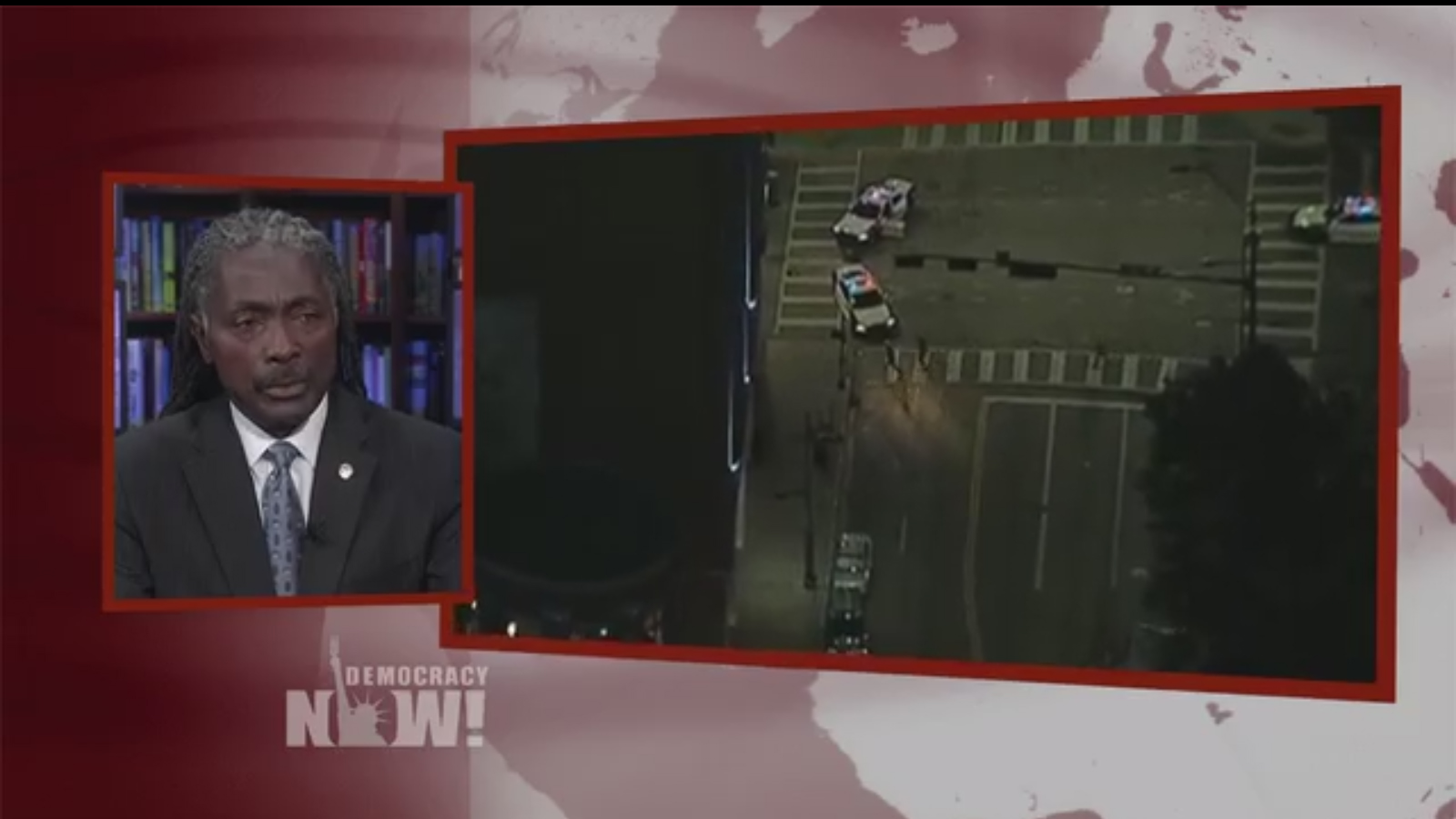
We begin today’s show with two guests. Graham Weatherspoon is with us. He’s a retired detective with the New York City Police Department. He’s also a board member of the Amadou Diallo Foundation. And Marc Lamont Hill rejoins us–journalist, distinguished Professor of African-American Studies at Morehouse College in Atlanta. He’s just written a new book, it’s called Nobody: Casualties of America’s War on the Vulnerable from Ferguson to Flint and Beyond. Welcome you both to Democracy Now! Graham Weatherspoon, let’s begin with you. Your reaction to the horror that unfolded last night, carrying on for hours in Dallas, just as this peaceful anti-police brutality protest was wrapping up, snipers opening fire on Dallas police.

Graham Weatherspoon

GRAHAM WEATHERSPOON: Yes, the last three days have been numbing in this country, and we are at a very pivotal apex right now in terms of where this country is heading or where it will wind up very shortly. I’ve carried the caskets during my tenure. I have stood over people that I knew laying on the ground. My partner was shot in the face and I’ve had people try to kill me numerous times. But what we saw last night, and I didn’t know this until I woke up this morning around 6:00 — it took me back to a conversation I had with Ray Kelly a few years ago, and I asked him, I said, do you want urban warfare in the city of New York? Because people had come to me years ago after Amadou had been killed — and these were ex-military personnel — and they said they were tired of it. And they said, we’re going to start killing these cops. And I said, that’s not a good thing to discuss or even recommend. But it is a reality. There are people out here who — and we’ve seen it just in the political spectrum over the last few months with comments that people have made and just the fanning of the flames. We now know that whoever these individuals were, and I had said this to Ray Kelly, a bulletproof vest is not going to protect the police officer, not from someone who is using a high-powered weapon.

So, unfortunately, it has come to pass, not here in New York but in Dallas, and I pray it never happens here, but there are people out there who are not operating on all cylinders who have weapons. My son, who is in the military, told me some years ago that they were weeding men out of the military who were part of the white supremacist movement, and they were joining the military just to get the training. You know there are a lot of things going on in the back that you just — and the general public doesn’t have an idea of what is of — of what is happening.

So the FBI and JAG and other units of the government were trying to find out who those men were to pull them out of the military so they couldn’t get that type of training. But then you, you, you look at the situation last night. A peaceful demonstration erupts into total chaos. I did an interview yesterday on News One and I said, we cannot afford to move with the “eye for an eye” mentality. Innocent people wind up dead on both sides. We see this in Iraq right now with these insane bombings that are going on. We have seen it in Palestine between the Jews and the Palestinians. Nobody wins. There has to be a time where we come to the table to truly address the issue of race in this country. It is a cancer that has polluted not just this country, but it’s polluted the world. And until we choose to come and sit down and talk, number one, I believe that most Americans live in two states in this country. The state of denial and the state of fear.

Marc Lamont Hill

MARC LAMONT HILL: I think we absolutely have to engage this question of race, there’s no doubt about that. We also have to engage the question of power, because everyday citizens don’t have equal footing with the state in order to battle the state, in the same way that I would argue Palestinians and Israelis don’t have the same footing. Right? One is in a position of power, one is an occupying force, one is not. The same with law enforcement in our communities. One is an occupying force and one is not. So, we have to look at that as well. And so, what — and I also want to be careful that we don’t link what happened last night to the Black Lives Matter movement, or the anti-state violence movement — resistance movement, because — and, and I know you’re not doing that, but that, that has been the instant, kind of, easy media narrative, and it becomes a sort of straw man. And that’s very dangerous.

AMY GOODMAN: I found, in watching the coverage of the horror that took place last night, people saying, oh, you know, look at what happens, they’re protesting police and then they’re killed. But, was it really protesting the police or is it a peace movement? It is for peace. There is no contradiction in being opposed the the killing of police officers and the killing of young black men who are stopped for their taillight being out.

MARC LAMONT HILL: Absolutely. I would argue any good revolutionary movement or radical movement or progressive movement is driven by humanistic principles. I have worked with, I have studied, I have organized with, I have marched with, and I have covered, as a journalist, the Black Lives Matter movement and anti-state-violence activists all around the country for the last two years. And not once has the question of shooting police come up. In fact, when we go to these rallies and we see people beginning to cause problems, we try to weed them out. When I was in Ferguson, the biggest thing — problem we had was that some of the, sort of, extremists would come in, and particularly anarchists, and would try to kind of colonize the movement and turn it into something that it’s not. The Black Lives Matter folks said on Twitter today, this is a movement driven by a sense of dignity, a sense of peace, a sense of purpose. We want to end violence against the state. We don’t want to reverse relations of oppression. We don’t want to turn into killers. We want to stop the practice of killing. We don’t think the state has the moral authority to kill us, and we don’t want to go around killing cops.

So, even if there is an outlier who happens to be an activist, and I don’t know that to be the case, but even if there were and outlier who, who was somehow considered self, self identified as an activist and they shot a police officer, that’s not a reflection on the movement, that’s not a reflection on our principles anymore than the, the Klan members are a reflection of the Tea Party. There are certainly Klan members in the Tea Party, but that’s not the organizing principle of the movement and certainly that’s not the case for Black Lives Matter or any of these other kind of anti-violence movements.


AMY GOODMAN: This issue of guns. President Obama said from Warsaw, we also know when people are armed with powerful weapons, unfortunately, it makes attacks like these more deadly and more tragic. Now, you’re a former cop on the street, a former detective. What about this, the high-powered weapons they had?

GRAHAM WEATHERSPOON: There is no need for people to have high-powered weapons. They’re not hunting. Those are assault weapons. They’re used for combat situations. They are not to protect your home, necessarily. You have a handgun, I’m not against people having a handgun legally, but we have to understand in this country, money motivates a lot of things. And unfortunately, money is the God of this country. So as money is generated, politicians respond one way or the other. We have no need for assault rifles. We’re not hunting bear, we’re not hunting elk or anything else. Those days are long gone in this country. It was 250 years ago. That is not the time we’re living in now. There is no need for people to have 7.62 NATO rounds, 223 ammo. That’s high-velocity ammo. You are not simply protecting yourself. You are out there with a high-capacity magazine. You’re out there taking people. You’re a killer. You’re a killer. Yes, you know, people like to go and shoot and target-practice. That is great. But there’s a limit to everything. My pastor says anything to the extreme becomes error. So, it’s best to stay, if we can, near the middle. But these, these weapons? AK-47’s and such? There’s no need for them.

For the entire Democracy Now! broadcast, click here.
 

The Public Expresses Dismay at Police Killings

By Akosua K. Albritton

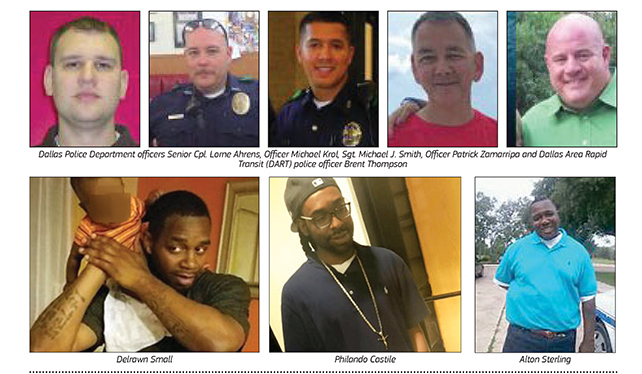
The major news outlets broadcast “Four black men are killed in one week by the police”. These men are:

  • Delrawn Small, age 37, from Brooklyn, NY, DOD: July 4, 2016. He had his five-month-old child in the car with him.
  • Alton Sterling, age 37, from Baton Rouge, LA, DOD: July 5, 2016.
  • Philando Castile, age 32, from St. Anthony, MN, DOD: July 6, 2016. He was outside of his car with his fiancée Diamond Reynolds reporting the incident on her cell phone seated in the car, and their very young daughter Dae’Anna encouraging and steadying her mother.
  • The fourth man in this count is Micah Johnson, age 25, killed in Dallas, TX on July 8, 2016. Johnson was the incensed man who became a sniper and killed five police officers.  To shorten the duration of the standoff, the local police department used US military weaponry to incapacitate him.


The fact is more than the above listed men were killed by the police during the week of July 4th.  These other men were African-American, too and also Caucasian and Hispanic/Latino.  Apparently, the frequency of killing suspects by US police forces is such a concern to the American and international public that web sites exist for the purpose of keeping track of the activity.  English major daily The Guardian established The Counted: Police Killings in the U.S. website in 2015.  Killed By Police is the database that includes web links to news articles and photos of the killed people.  Another website is Innocent Down.  The website is so named because the U.S. justice system is based on the premise “innocent until proven guilty”.  Killing suspects circumvents the process.


This reporter went to the streets to obtain the public’s response to the question: “Do you have a reaction to the four black men who were killed in one week?” The Flatbush Avenue Street Fair and the Soul Summit at Fort Greene Park were the venues to meet the following New Yorkers:

Lisa McKenzie, Canarsie section of Brooklyn; McKenzie, a woman of African descent, was distributing literature at the street fair when I asked for her comments and reaction (she declined having her picture taken): “I think that everything done is a real tragedy.  More can be done to train the police.  They need training in human relations and compassion training.  They need to know that not every black man and woman is going to harm them…They are seeing color before “person”.


If a police officer is scared of black people, he ought to tell their supervisor if you think your life is in danger.  And in Castile’s case, he was in his car and stated he had a gun.


This is causing a lot of tension and people are getting scared of cops…  These four men that were killed in 48 hours were supposed to go home.  1% of cops are bad and all the cops need to be retrained.  I saw a video on Facebook with a female police officer reacting to this [situation].  She was startled by what she saw.  She said other things could have been done other than shoot.


It will turn into a bad situation where the cops are against the civilians and the civilians are against the cops.  The man in Dallas who retaliated violently…This was his response to all the killing of black people.”


Keith Wiliams

Keith Williams, East New York section of Brooklyn: “Man is the only misfit in his environment.  All other animals kill for food; man kills for vindictiveness.  It’s unfortunate that we’ve come to accept killing without asking the questions.


Is it human culture or corporate/class or group of people responsible?  We need to get back to education…  It is Krisna Murti who said, “Education must be for the significance of life. Education when combined we’ve virtue if an asset of incalculable value.” These are things I embrace.  I don’t look at the news much.  Is news to inform about a catastrophe and to plan how to deal with it or to just gaze at the catastrophe?


Ganesh Sarma and Austin Hannah.

Austin Hannah, Prospect-Lefferts Gardens section of Brooklyn: “I think it is terrible.  I think it is racially motivated.  The police should be held responsible.  Good cops need to do a better job of weeding out the bad cops.  It reflects poorly on all police.”  Hannah’s associate Ganesh Samar of Richmond VA. interjected: “The worst part is the local police: they conduct the investigation afterwards.”


Darrell Adams, Canarsie section of Brooklyn: “It is troubling.  You fill empty in your stomach—feel nervous…  Another day, you feel helpless.  You don’t know what day it will happen to you.  History is repeating itself…  It gets

Darrell Adams

scary.  It is like you never know.  The first video, the two cops are holding the man down.  The second video, the Minnesota one. His child was in the back seat.  He had about 63 traffic violations…  It was like an execution.  [My] family in Georgia texts me frequently, asking me to be careful.


Joseph (last name not given), a man of African descent from the Flatbush section of Brooklyn:  Joseph declined being photographed because “I’m trying to get a city job”.

If you’re scared to be a police officer, don’t take the job.  What is needed is better training in the academy to deal with communities of color–for black and white officers.  Some police officers-including blacks–turn into something else while on the police force.  They become “blue people”.  If you know there’s a bad cop, say something.  You should be able to turn in a bad cop without saying your name nor face retribution from your commanding officer.”


A Jewish Perspective on Race in America & the Continued Police Killings of Black Men

By Kings County Politics News Service

Yossi Stern

In the wake of yet more police killings of black men, this time in Louisiana and Minnesota, some have been trying to pin blame on the Jewish State of Israel as the cause of this deathly police misconduct.


This included pro-Palestinian organizations that chanted in protests from Ferguson to Palestine, and most recently the New York University’s chapter of Students for Justice (SJP) in Palestine shared a post on its Facebook page claiming that “the same forces behind the genocide of black people in America are behind the genocide of Palestinians”.


The logic behind the SJP Facebook post was that the Jewish State is responsible for all actions taken by police in the United States because some police officers spend a few days training in Israel.


In response, OTP spoke with Yossi Stern, the retired longtime head of the Crown Heights Patrol and community activist that has long been working on the relationships between blacks and Jews.


“It is not unusual for some to be trying to blame the Jews and Israel for the police killings of blacks or what happened in Texas as they’ve been trying to blame the Jews for everything for the past 5,000 years,” said Stern. “Even trying to get Jewish viewpoints on the situation on first perception is divisive as if their collective views are any different from blacks or whites or Spanish. What is happening is a human issue.”


Stern said clearly the majority of police (for the most part) do a good job, but there is a long-standing undertone that they look at black men as suspects and they are guilty until proven innocent.


“This prejudgment is what causes these type of killings to happen. It’s been going on for years, but now because of social media it’s more visible and these incidents get even stronger emotional responses,” Stern said. “So, collectively, black people and minorities don’t trust the police because of their view of them when they approach a scene.”


Stern said a good example of this is the recent case where police stopped a black youth for riding his bicycle on a sidewalk, which is technically illegal and this gave police the right to stop him under probable cause. The first cop aggressively attacked the youth and when the second cop arrived, instead of saying something to the first cop, put the kid in a choke hold, he said.


“These type of incidents are not uncommon and have to change through a huge culture of understanding and education,” Stern said. “On the flip side, because police respond to calls in poor and minority neighborhoods where crime is higher, often their first response is to attack and then listen. This echoes (number one) of prejudgment and (two) the police want to defend themselves in case there’s a gun.”


“So the police overreact and then the community gets overdefensive. So much negative prejudgment on both sides is cocktail for disaster.”


Stern said while peaceful marches can help address the situation, blocking highways, chanting to kill the police and other such forms of civil disobedience is not the answer.


“What happens then is the police and the establishment harden their side and the civilians with legitimate issues harden their side and there’s destruction on both sides,” said Stern. “Without providing a clear path to solutions everyone gets hurt.”


Stern recommended that number one, the police hierarchy must provide better training to the officers, who often don’t come from the neighborhood where they police, on how to serve and protect the neighborhoods they cover. Secondly, community policing has to be brought back where cops walk the beat and get to know the community – places where people are friendly and good citizens and places that are trouble spots, he said.


“Thirdly, inner-city communities must set up monthly proactive town halls in schools, senior centers and community centers to aggressively get the community educated on laws and how the police work. Lastly, the level of distrust can only be broken and rebuilt if each side sees their faults that they carry. Refusing to acknowledge problems on both sides makes it hard to address them,” said Stern.


“The black community across the country can and should round up a thousand black attorneys to address the unfairness in America because it’s clear that blacks are being beaten by the greater system,” he said.


Stern said these aggressive approaches to meeting with both the Jews and blacks since the Crown Heights riots have helped quell misunderstandings and breaks down the barriers of bigotry.

Bad Times and Hard Work to Be Done


By David Mark Greaves

Okay, we know we’re better than this as a nation and we have to hold firm to that thought as we work our way through these increasingly difficult times.

Sniper Micah Johnson was a man who snapped.   He was known to be unstable, and what led him to commit the horrifying and irrational killing of 5 police officers and wounding of 6 more because they were white was that festering instability combined with the police killings of Philando Castile and Alton Sterling and the toxicity of racism that is embedded in America.  All of these deaths have broken the nation’s heart and caused many to wonder where we are headed, particularly now with that Fascist wanna-be Donald Trump trying to manhandle his way into the driver’s seat.

There are so many reasons for the situation we’re in that there is no point in finding some group to blame because there is enough to go around.

The police have a very tough job and they are not the enemy here and neither is the Black Lives Matter movement or those who respond with All Lives Matter.  All lives do matter, but it is Black lives that were bought and sold as products for hundreds of years.  It was Black lives that were lynched by the thousands, some at celebratory events attended by Christian families, none of whom thought Black lives matter at all.   Their descendants are still among us, and because the enemy, that mentality that allows  slavery and lynching, where black people are not seen as fully human, has not been vanquished. and although it is in the core of America, it is not a part of the American curriculum, but should be included as part of the Common Core because the study of that history helps explain where we are today.

When Mr. Castile informed the officer that he had a firearm, was that information taken, even unconsciously, as a reasonable cause to shoot him?   This would not seem possible if not another Black man with a gun in his waistband was killed while on the ground with no provocation.  Without the video, “a gun was recovered” makes any statement by the officers true.  How many times has a weapon on the scene been a “green light” in a race killing?   That is an impossible thought until last week.

But it isn’t just lethal force that is the problem.  A just-released study, “Surprising New Evidence Shows Bias in Police Use of Force but Not in Shootings”, found no discrepancy in the use of lethal force toward Blacks or whites, but it found that less than lethal force, the physical handling of teens,   is where much of the distrust on the street comes from.  And it suggests that swift and sure punishment not be limited to the use of lethal force, and that police training and intense work on community relations, can bring police and communities closer together.

And on the streets there needs to be a decrease in police encountering situations.  Young people have to have their lives crowded with positive activities and opportunities.  They should be too busy to be standing around with idle hands.   It should be becoming very clear in this presidential election year that there has to be new thinking and what was not possible six months ago is what has to be done today.  Public schools with excellent well-paid teachers, year-round extended hours, study hall, music, athletics, all of it poured in as an answer to the national emergency that is the educational disaster taking place in the Black community.  In this most political season, politicians must be made to understand that the condition of the education system is not only a threat to the community, but to their staying in office.

In New York City, blame for the economic conditions that create police encounters and encourages “lifestyles of the poor and hopeless”, extends to the expenditures of the city budget, where only .3% went to certified Black businesses in the last fiscal year.  And the MWBE program, with its roots in the theft of labor from Africans and the theft of land from indigenous people and the slaughter of both, is where Asians and white women receive over 85% of the spending.   This is the kind of thing that has to change.

After the mourning, there is a lot of work to be done.  Register and vote!  Election deadlines are on page 15.


WHAT’S GOING ON


By Victoria Horsford


RIP:   ROSCOE BROWN


Roscoe Brown

New Yorker extraordinaire Dr. Roscoe Brown, 94, died on July 2.  A Greatest Generation exemplar, Roscoe Brown was one of the Tuskegee Airmen, who were the first African-American military pilots in US history.  A squadron commander, Brown flew 68 combat missions and shot down two German jets during WWII.   He was the recipient of the Distinguished Flying Cross Medal.  Brown earned a Ph.D. in Education after the war. He would become a household name in higher education, health and business initiatives. He was an NYU Professor before taking the reigns as President of Bronx Community College, a CUNY campus, for 17 years.  He was co-founder of the Sports Foundation and of One Hundred Black Men and was engaged in multiple health initiatives.


Dr. Brown did not have time for retirement.  He worked at the CUNY Graduate Center as Professor/Director of the Center for Urban Education Policy. He continued to host “African-American Legends”, a CUNY-TV Public Affairs show which airs weekly.  There was one unfinished business matter, Dr. Brown’s memoir, a  10-year work in progress.


NEW YORK CITY


Adriano Espaillat

Last week’s NY Congressional Primary was the end of an era!  NYS Senator Adriano Espaillat, who was born in the Dominican Republic, won the coveted Democratic race for  Charles Rangel’s 13th Congressional District seat.   He will no doubt win the general election, and he will become the first D.R.-born person to sit in the US Congress.

His victory accelerates the erosion of the Black Harlem political machine.  Representative Rangel endorsed NYS Assemblyman Keith Wright, an African-American, who lost by a narrow margin.  Political power in East, Central and West Harlem, the Bronx and Northern Manhattan, shifts from Blacks, who dominated that district since the 40s, to  Latinos, which according to the census records, represent 52% of the population. Low Black voter turnout and 9 Dem contestants attributed to Keith Wright’s loss.  In the general election, Espaillat will be challenged by Tony Evans, an African-American Republican, and Daniel Rivera of the Green Party.


What’s going on at NYCHA, the NYC Housing Authority, the nation’s largest inventor of public housing?   According to the Wall Street Journal story, “NYC To Sell Public Housing Stake. Developers  Pledge $100 in Renovations”, NYCHA is selling a 50% stake in 900 apartments in the  Bronx, Brooklyn and Manhattan  to private developers like L&M Development and BFC Partners. According to a NY Daily News story, NYCHA will pick private developers to manage and upgrade 21 apartment buildings.  The Bloomberg administration considered similar NYCHA/developers initiatives.


Maya Wiley

Maya Wiley, Chief  Counsel to Mayor Bill de Blasio, leaves this month to Chair the NYC Police Department’s Civilian Complaint Review Board, the watchdog group which investigates police on civilian misconduct.    The Police Benevolent Association is not happy about the  Wiley appointment.  Attorney Wiley will also start her career as a Professor at the New School University.


NEWSMAKERS


Israeli Prime Minister Benjamin Netanyahu begins his 4-nation African tour in Uganda, where his brother got killed during the Entebbe crisis. His Africa itinerary also includes Kenya, Rwanda and Ethiopia.


RIP:    Patrick Manning, 69, died on July 2 after a long battle with leukemia. A parliamentarian for 44 years, Manning served three terms as Trinidad

Patrick Manning

& Tobago Prime Minister from 1991-1995 and from 2001 to 2010.    A protégé of Eric Williams, renown  scholar, architect of TT independence and its first Prime Minister,  Manning entered Trinidad-Tobago politics in 1971 as a member of the Peoples National Movement Party,


THE SUMMER READER


The 18th Annual HARLEM BOOK FAIR(HBF)  returns to the Schomburg Center for Black Culture, located at 515 Malcolm X Boulevard, Harlem USA,  and along the 135 Street strip from Lenox to Eighth Avenues. The nation’s largest African-American Book Festival, the HBF is also the flagship Black Literary event in the Americas and will offer  exhibition booths, panel discussions, book sales and workshops.


Annette Gordon Reed

Newly published nonfiction book, “MOST BLESSED OF THE PATRIARCHS: Thomas Jefferson and the Empire of the Imagination,” by Annette Gordon-Reed and  Peter S. Onuf,

which centers on Jefferson’s life at his Monticello Plantation in Virginia.   Most blessed of the patriarchs is a Jefferson description.  A father, husband, slave owner who sired many slave offspring, he was a student of the Enlightenment. The co-authors say, “We wanted  to understand what  TJ thought that he was doing in the world…. what is going on inside his head”.


“WHITE TRASH:  The 400-Year Untold History of Class In America” by historian  Nancy Isenberg explodes many other myths about the  early European settlers who arrived in the 17th Century  in what is today’s USA.  According to a NY Times review, “The great majority of early  colonists were classified as   ‘surplus population and expendable rubbish’.”  They were rogues, vagrants and an assortment of convicts.


HOMEGOING is the debut novel by Ghana-born millennial Yaa Gyas, who was raised in Alabama.  It is a sweeping saga spanning a few centuries which begins with  two  half-sisters, unbeknownst to each other, in 18th century Ghana. One marries well to an Englishman, the other is sold into slavery and the plot twists through the Civil War, the Great Migration to 20th  Century Harlem.


Flo Anthony’s new novel, “ ONE LAST DEADLY PLAY”,  is a sequel to her mystery “Deadly Stuff Players, which centers on  a Black columnist and her crime-solving partner, an NFL Hall of Famer,  as they roam through the infectiously glamorous  world of elites and celebrities in NYC, the Hamptons  and beyond.   A seasoned entertainment journalist who is syndicated on radio and in print media, Flo Anthony also publishes BLACKNOIR Magazine.


Magazine:  Read the Town & Country magazine article OAK BLUFFS ON MY MIND.  “For more than a century, the African-American elite have flocked to the Martha’s Vineyard community.” Here, a few share their stories. Dr. Henry Louis  “Skip” Gates and Vernon Jordan are two of the MV storytellers.


                                                            CULTURE CLUB


The Harlem Opera Theater will present a FREE concert in tribute to the victims and families of the Orlando massacre at the Convent Avenue Baptist Church,  located at 420 West 145 Street, on Sunday, July 17 at 2 pm. Vocalists and musicians will perform.


The SHUFFLE ALONG Broadway musical door closes and another opens. The MOTOWN: THE MUSICAL returns to Broadway at the Nederlander Theatre,  opening on July 12 for 18 weeks.  Actor Chester Gregory plays Berry Gordy.


For two years, Hollywood fails to recognize Black excellence with its Oscar nominations, but it has $140 million to invest in a new feature film iteration of white supremacy with the release of THE LEGEND OF TARZAN, which opened on July 1. Wonder if Tarzan gets an Oscar 2016 nomination nod.


A Harlem-based entrepreneur, Victoria Horsford can be reached at vhorsford@aol.com.