Home Blog Page 792

View From Here: We Must Beat Back the Hate

With the rise of President-Elect Donald Trump and the pride in the openness of hate that he inspires, the attacking of women with hajibs, hanging a noose on a tree in Ft. Greene Park this past October along with writing of anti-Semitic graffiti nearby, we thought it a good to remind the readers of the not so distant past in this country.

The people you see in these photos are not out of some distant past. They are the grandparents and in some cases even the parents, of the baby boomer generation and of a certain kind of Trump supporter.   The joyful crowds, sometimes numbering in the thousands at these lynchings, are the grandmas and grandpas who gave guidance to the generations we’re dealing with now. This is the stock they came from. And now they’re joyous at Trump rallies, proud of what they are. They are dangerous in this mode and not just to blacks, ask the Jews, ask Indigenous People around the world. They are the chaff of Trump’s supporters, and they must be separated from the wheat, those regular people who just don’t want to be further drained and left behind. They wanted to see change and it remains to be seen if it’s the change they wanted. If it is not, then there is the opportunity to unite with them around common issues of inequality being voiceless at the national level.

But first will come the suffering. And there is no use in kidding ourselves and hoping for the best. This is a really bad time we’re in, with insecurity in housing, food, healthcare, personal freedom and the future of the planet now as parts of our lives. We are facing the prospects of a further criminalized and enslaving justice system, more voter suppression, and can look forward to the creation of an enemy, foreign or domestic to justify authoritarian rule.

We are reprinting only three of the nine pages of the lynching list from our February 2, 2012 issue. The entire list, searchable by text, is here.   This reprint is sooner than expected, but things are moving too fast to wait for Black History Month, 2017.

Local Activists Cause TD Bank to be Closed on Martin Luther King, Jr. Day “From Maine to Florida”

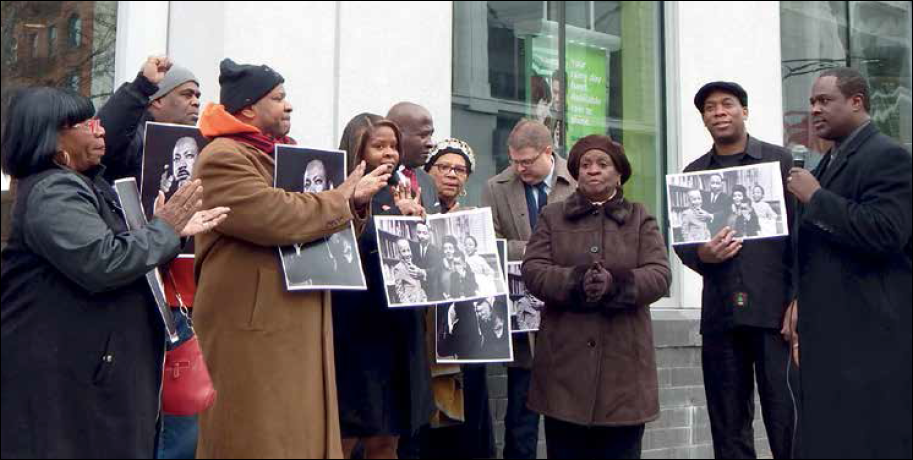
TD Bank accepts demands and closes branches on Martin Luther King holiday. Celebrating the victory are:
Dolly Finney, James Robinson Geoffrey Davis, Tai Johnson, James R. Ray, III, Canon Diane M. Porter, Attorney
Michael T Mullen, Assemblywoman Annette M. Robinson, Bruce Green, President Bed-Stuy Anti-Violence Coalition,
Rev. W. Taharka Robinson.
Stained glass ceiling broken. Dr.
Sharon Codner-Walker presents Rev.
Holman, newly-named first woman
minister of Bethany Baptist Church.
(photo: Mark Stewart)

After pressure from Rev. Taharka Robinson and the Bedford-Stuyveant Anti-Violence Coalition, TD Bank has changed its holiday policy and will be closed on MLK’s Birthday. “Almost a year ago, we demonstrated here to tell TD Bank they had to honor Dr. King. And now they will be closing their doors at 1,400 locations from Maine to Florida on Dr. King’s national holiday.”

Assemblywoman Annette Robinson, chair of the Assembly Banking Committee, said that the hard work needed to make this happen was reminiscent of another time.   “The Montgomery Bus Boycott in the Fifties celebrated people who had a mind to do something and today we celebrate people who had a mind to do something and to make a difference. Dr. King said if you don’t say something, nothing will happen. That means that we die a little every day because we fail to stand up with courage.”

The assemblywoman said the holiday is not for a day of shopping, but rather, “A day of service for all of us in our communities to celebrate Dr. King in spirit and in truth for the work he did for us. And he deserves to be celebrated by us being in service on that day”.

Bruce Green, president of the Brooklyn Anti-Violence Coalition, called it a “significant” victory when a “giant” with 1,400 locations was brought to change. “This ain’t no lightweight work,” said Green, noting that the coalition founded by Taharka 10 years ago, is still in the struggle in ways large and small for the voiceless in the community.

Ms. Tai Johnson, PA James’ Intergovernmental Affairs Coordinator, read a message of support from the Public Advocate who referenced the time we’re in writing, “Now more than ever, it is so critically important that we take time to reflect on his work and carry out his message. And Dr. King would never allow us to go back down a path of normalizing hate. Thank Rev. Robinson, a true leader, for all his work. He called on TD Bank to recognize Dr. King and stop the funding of gun violence that is ripping our communities apart”.   Geoffrey Davis, citing Rev. Robinson’s work on the Chanel Petro-Nixon case as well as the TD Bank initiative said, “You’re a 21st century hero, that’s what you are”.

On the Path to Improved Financial Health – Step 4: Insurance Management (Part 4 of a 5-Part Series)

Previously, I have talked about knowing where you are currently financially, planning and budgeting as well as managing your credit. Step 4 on your journey to improved financial health is insurance management. There are so many types of insurance that can impact your finances that there are too many to address in one article. Some examples are health, long-term care, dental, vision, auto, life, disability, homeowners’ and renters’ insurance. In today’s installment, I want to focus on only a few health, life and homeowners’ insurance.

Many individuals are offered health insurance coverage through their employer and may face limited options regarding the companies that could provide their insurance. Regardless of whether you are getting insurance on your own or through your employer a few decisions need to be made. First, you need to determine your family’s health insurance needs; i.e., what benefits do you definitely need for your family and what do you not necessarily need? For instance, if you have a family member that has chronic health conditions, you want a plan that will be able to cover the cost of the medications that will be needed. Another concern is whether you have a doctor in the plan that you feel comfortable with or if not, are you willing to pay more for a doctor that may be outside of the network of doctors?

Normally, health insurance plans have deductibles that must be met before payments will be made. Are you willing to pay more in an annual premium to have a lower deductible or are you willing to have a higher deductible in exchange for a lower premium? Every plan has some type of annual deductible. Additionally, when you visit a doctor there are co-payments required in most instances. Does it make sense to avoid co-payments by selecting only providers that do not require co-payments or do you want to be able to choose from a wider selection of potential medical providers? These are all questions you need to answer to not only improve your physical health but also your financial well-being.

Another common insurance consideration is whether you need to purchase life insurance. Not everyone needs life insurance. If you are single and have nobody that relies on you for support, then life insurance is not necessary. You can set aside funds for your burial or cremation. If you do have people that rely on your income, then life insurance protection is definitely something for you to consider. Shop around so that you are not paying more than you should.

The last type of insurance I want to address is homeowners’ insurance. For most people, their home is their most valuable physical asset. Despite this fact, many people are not fully aware of what is covered and what is not covered by their policy. I recommend that you become familiar with what is covered and what is not. It is not something we really want to think about but if you ever experience a covered loss or even worse a loss you thought was covered, you will appreciate knowing how much of a financial impact you may be exposed to. Do you know what type of coverage you have on your property? By this, I mean does your policy cover the full replacement value of your home or is there some other way the amount you could be paid in case of the loss of your home is determined? Are you aware of how much of your personal property loss is covered by your policy? If you have questions, contact the insurer to find out what the policy is saying and how the change impacts you. Don’t forget to consider changes/additions to your home that the insurer may not be aware of that could impact your benefit. Next week is the finale to this series.


Wayne J. Vaughan, author of Keeping Your Church Alive: Advice for Pastors, Leaders and Active Members.

Why Are NYC Public Schools Still Separate and Unequal?

By Akosua K. Albritton

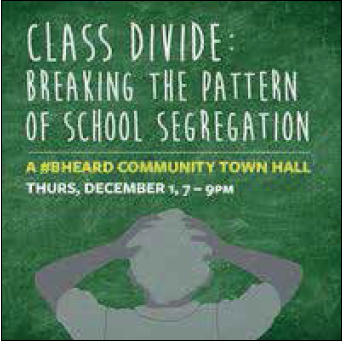
#BHeard is BRIC Arts Media House’s monthly town hall where selected social agents are assembled to weigh in on a salient issue surrounded by real Brooklyn residents. On December 1, 2016 Brian Vines moderated Class Divide: Breaking the Pattern of School Segregation.

The social agents for this town hall were Josh Wallack, NYC Department of Education’s Deputy Chancellor; Yasmeen Khan, WNYC Education Reporter; Nikole Hannah-Jones, New York Times Staff Writer; Clarence Taylor, CUNY Civil Rights Historian; Lurie Daniel-Favors, General Counsel for Medgar Evers College Center for Law and Social Justice; Lazar Treschan, Community Service Society Youth Policy Director; and NYC Councilman (39) Brad Lander.

Brian Vines opened the discussion by explaining New York City has wrestled with the racial and economic segregation that exists within K-12 public schools, with some exceptions in the high schools. The NYC Department of Education is years behind in creating a plan to put New York’s racially diverse school-age children together in the same classrooms. What was not brought out was that back in the 70s school busing occurred where pupils of color left their neighborhoods to be taught in Euro-American neighborhoods. This reporter had one charter school management administrator recount his experience of daily fights after school with neighborhood youths who opposed Central Brooklyn teens being taught in their South Brooklyn high school.

Vines asked each panel member to choose between the words “desegregation”, “integration” and “diversity” for what needed to be achieved or was it something else that was at stake.

Nikole Hannah-Jones responded, “The Black kids are the most segregated of New York City’s ethnic and racial groups”. Lazar Treschan noted “72% of the public school population is Black and Latino…the word for me is desegregation in a way that is fair”. Clarence Taylor explained that “New York City has been struggling with the racial composition of classrooms since the 1950s”. Taylor leaned toward the word “integration”– “integration where no one felt superior or inferior to anyone.”

Lurie Daniel-Favors did not select a word, rather she asked, “How to get Black and Brown youth to operate in white spaces?” Daniel-Favors opined, “Race continues to be the determining factor in economic status”. Daniel-Favors seemed more concerned with access to a high quality and useful education over students of color seated in the same rooms with Caucasians. In her words, “[It needs to be a] translation into an education that allows us to transcend our present socioeconomic conditions”. She pointed to “many of her Harvard-educated friends who have no idea how to improve the economics in the Black community”. Later into the panel proceedings, Daniel-Favors contended “New York City lacked a transformative education” and called for “a culturally responsive education”.

Integration is occurring in many neighborhoods but not in the way some policymakers have considered. There is the movement of Caucasian families into Black communities, which impacts public schools’ funding. For example, PS 705 in Crown Heights is in transition from being a predominantly Black and lower-income student body to a Caucasian and higher-income student body. PS 705’s Principal Sandra Beauvoir-Soto explains in a documentary that the school is in transition where, “We are just meeting the eligibility requirements for Title I funding”.

Deputy Chancellor Josh Wallack was finally pulled into the discussion when Brian Vines asked about the progress the Department of Education has made in forming a plan to redress school segregation. Wallack said in a rapid-fire manner, “Policy was in development to improve schools to achieve diversity and school quality, Pre-K for all; AP classes and Algebra taught in all high schools; ensuring public high schools are getting kids ready for college and career”. When pressed by Vines for more specifics Wallack explained, “We’re putting together a plan that explains why diversity is needed and propose new systems. We’re still engaged in discussion and have a long way to go before getting policy concretized and then initiated”.

WNYC’s Yasmeen Khan’s time as the Education Reporter had her recognize that “Parents focus on school quality over diversity. Parents are buying into neighborhoods that are zoned to the elite public schools”. Later in the conversation Khan stressed, “Desegregation or integration could be achieved when policymakers and the public study the school district lines”.

K-8 students’ school choices are relegated to those within a given school district zone. However, high schools are part of a citywide system. Khan champions having middle schools operate within a borough-wide system. It appears Khan sees a transition from the nest (K-5 grade school district zones) to the tree limb (6-8 grade borough-wide options), to a full flight off the tree limb (9-12 grade citywide options).

CM Lander, chair for the Committee on Rules, presented his usual cheery demeanor upon arrival to the panel. Lander pointed to “Park Slope College and the Brooklyn New School as models of multiculturalism”. He stated, “Three years ago, there was no dialogue about segregation and the work required to desegregate the schools. We are farther along due to organizing”. The organizing he referred to was what Lander called “the means to counter tribalism which requires a whole lot of steps at once”.

For Hannah-Jones, the pressing issue was race and racism. “Race and racism need to be dealt with. It doesn’t matter whether you have citywide or district school options. Race is the deciding factor.” Hannah-Jones pointed to the racial and economic oppression that exists for New York’s Black and Brown residents. She went as far as to say, “There’s a need to blow up the system and build it up from the ground in order to offer equitable education”. There were audible sounds of approval by the audience.

What’s Going On: AMERICA, AMERICA

By Victoria Horsford

THE NATION: As the world turns, that piece of real estate identified as the USA seems to be on an accelerated descent into Dante’s Inferno. Heads reel from unfolding American news stories and those about race and the criminal justice system. On 12/5, a mistrial was declared when a SC jury (11 whites and 1 Black) failed to arrive at a unanimous decision re: white policeman Michael Slager, who shot and killed Walter Scott, a Black motorist, in the back last year. The murder was videotaped. On December 1st, a road-raging white man, Ronald Gasser, killed Joe McKnight, a former NFL player, in Louisiana.   Why is Gasser free and uncharged on 12/5? In SC, white supremacist Dylann Roof, who killed nine Black people in a Charleston church last year, and who faces 33 federal charges, wants to represent himself in the death penalty trial, which begins Wednesday. He reversed his request and wants those lawyers back– “at least for the guilt phase part of the trial”–and he will represent himself for the sentencing phase of the trial. These cases should spill into the Trump Presidency era! Already, political pundits predict that Trump’s Department of Justice, sans Eric Holder and Loretta Lynch, could kill police reform.

President-elect Donald Trump has been sorta/kinda busy with outreach to Black America in assembling his cabinet. He called Rev. Al Sharpton last week, probably a courtesy call. He met with billionaire Bob Johnson, BET Networks founder who has businesses in real estate and entertainment. Johnson would not disclose if a cabinet spot had been offered. The really good ones, like Defense and Treasury, have already been assigned.

Dr. Ben Carson

It is official. Dr. Ben Carson, MD, is Trump’s nominee for HUD, Housing and Urban Development, a post normally reserved for African-Americans by both Democratic and Republican administrations. Why is Carson destined for HUD instead of the Health and Human Services bureaucracy? Carson has little-to-no experience in housing nor urban development.   He justifies the HUD nomination saying, “I feel that I can make a significant contribution, particularly to making our inner cities great for everyone”. He continued: “I grew up in the inner city and have dealt with a lot of patients from that area.”

THE DEMOCRATS: The Democratic Party and the Democratic National Committee requires immediate and dramatic overhaul. The 2010 elections indicated that new leadership was inevitable. It was followed by the elections of 2012, 2014 and the 2016 debacle. The next DNC chair needs to be a Congress outsider, someone who can devote full-time to 2018 and 2020 victories.

NYC: Next year is the NYC mayoral election year. Politicos and business people, from both sides of the aisle, covetously eyes the second-hardest job in America. One bit of good news for Mayor de Blasio is that his good friend, Patrick Gaspard, will be back in town soon.   A member   of de Blasio’s “agents of the city” inner circle, Gaspard is US Ambassador to South Africa and a former political adviser to President Obama.   Gaspard has accepted a newly created position with the Open Society Foundation, founded by billionaire philanthropist George Soros.

HARLEM: Hold the date, December 16th, 6-9 pm for Assemblywoman-elect Inez Dickens and the MLK Democratic Club’s Annual Holiday Kwanzaa Party at the Kennedy Center on West 135th Street. Party attendees should bring a wrapped book, toy or new article of apparel for distribution to community children.

BROOKLYN: Assembly member Rodneyse Bichotte, District Leader Josue Pierre and the Shirley Chisholm Democratic Club will co-host their 6th Annual Toy Drive and Holiday Party on December 17th at 7 pm at 204 Parkside Avenue. An unwrapped toy is the price of admission. Toys can be delivered to the District Office at 1414 Cortelyou Road until December 19th, Monday to Friday, 9 am to 5 pm. For more info, call 718. 940. 0428.

DECEMBER IN NY

The Apollo Theater presents the Classical Theatre of Harlem’s “The First Noel, A Musical”, from December 10-18 at the Apollo. “The First Noel” is a memory musical that flashes back to Harlem in 1985 when Noel comes back to NY to sell her family’s home but bittersweet memories keep getting in her way. It is a story of love and belonging. The Lelund Durond Thompson and Jason Michael Webb score is a joyous celebration of gospel, pop, jazz and deftly reimagined holiday standards. “The First Noel” returns to the Apollo after SRO performances during the 2015 holiday season. Brian D. Coats, Tina Fabrique and Ashley Ware Jenkins are members of the megatalented ensemble cast.

The US-Ghana Chamber of Commerce, in collaboration with NY Carib News, will host a book-launch party for DEMOCRACY or DEMON-CRAZY? A nonfiction work by Rev. Dr. Quainoo, which “examines democracy as a widely embraced government system and questions its validity”. The book party will be held on December 17, 6-8 pm at the Marriott –Residence Inn Times Square, located at 1033 Avenue of the Americas, Manhattan.

AFRICA 2 AFRICA and the Catalyst Network Foundation will co-host a long-overdue mixer and panel discussion, DISTANT RELATIVES-RESTORING BLACK RELATIONS, a look at Black immigrants and African-Americans with a “focus on low levels of inclusion among generational Black families and Black immigrant families”, on December 13 at 7 pm at the Katra Lounge, located at 217 Bowery, Manhattan. Panelists are Diane Weathers, former Essence executive; Professor James Small; Attorney/envoy Robert Van Lierop; and Fasil Amdetsion, international legal and foreign policy adviser.  Bert Gervais will be panel moderator. [RSVP distant relatives, eventbrite.com]

Kechie’s Project will host its 3rd Annual Girls and Guys Night Out Fundraiser on Monday, December 19 from 6:30-9:30 pm at the Permanent Mission of Nigeria to the U.N., which is located at 828 Second Avenue in Manhattan. Admission is $75. Kechie’s Project is a nonprofit organization that helps educate and empower girls in the USA and Nigeria.


A Harlem-based entrepreneur, Victoria Horsford can be reached at Victoria.horsford@gmail.com.