Home Blog Page 752

The Fight for Fair Funding for Schools in NYS Continues

Guest Opinion

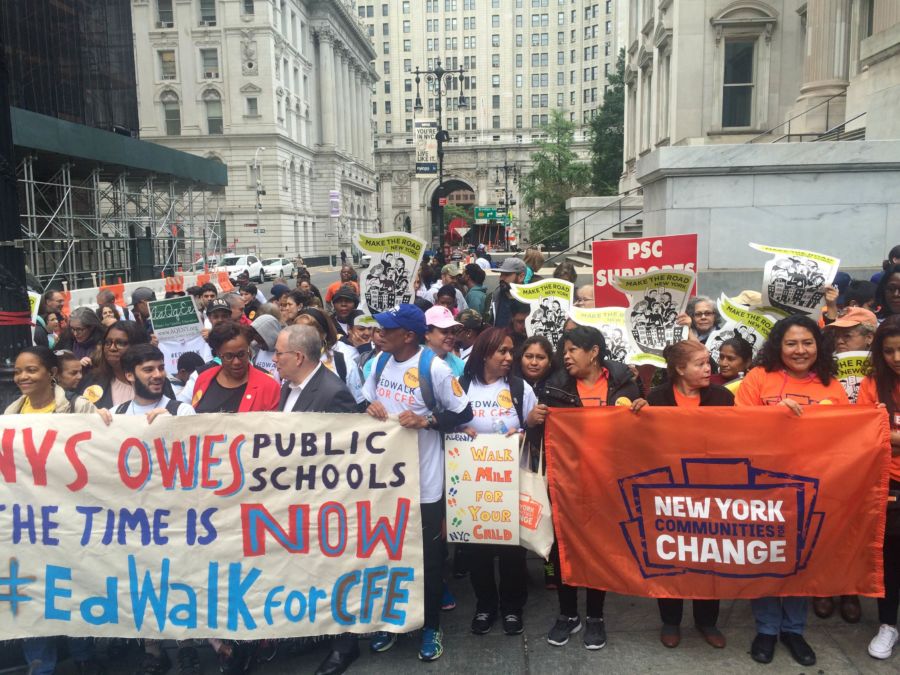
On June 27, 2017, the New York State Court of Appeals issued a ruling in the New Yorkers for Students’ Educational Rights (NYSER) school funding lawsuit. The NYSER case was brought by parents and many statewide and NYC-based education groups who are suing the state due to its continued failure to provide students with a “sound basic education” as required under the New York State Constitution. The New York State Court of Appeals ruling allows the case to go to trial and present evidence regarding specific alleged constitutional violations in New York City and Syracuse. Below, education activist Earline Mensah, a Parent Ambassador, Adelaide Sanford Institute’s (ASI) Parent Leadership Institute, offers her views on school funding.

by Earline Mensah


This ruling is an emphatic call to action for those who value equity in education to rally for fiscal parity in all public schools, where so often a zip code designates a child’s ability to attain a “sound basic education”. We can no longer afford to sit idly back and let a few do the work that we as concerned parents, grandparents, aunts, uncles and most importantly, advocates for educational equity must take ownership of.

The legal battles for educational parity have been fought in courts throughout the country on behalf of our most precious asset, our children, and it is unfortunate that so many are unaware of these epic undertakings. The New Yorkers for Students’ Educational Rights (NYSER) school funding lawsuit stems from a group of parents from New York City, who in 1993, under the leadership of former Councilman Robert Jackson and Attorney Michael A. Rebell, launched the Campaign for Fiscal Equity (CFE), which sued New York State for failing to provide students with the quality education that is their right under the New York State Constitution. This constitutional challenge lasted for 13 years with CFE partnering with other organizations across New York State. In 2006, the New York State Court of Appeals ruled that the state had failed to provide students with the classroom resources necessary to receive a “sound basic education”, a right guaranteed by the New York State Constitution.

In 2007, in response to the CFE lawsuit, the Foundation Aid formula was instituted by the state with a commitment to adding $5.5 billion in basic classroom operating aid over 4 years to all state school districts. The state allocated $2.3 billion to schools in Foundation Aid as the phase-in began, resulting in a much-needed expansion of programs and services at many schools.

During the fiscal crisis in 2009-2012, the state froze funding for the Foundation Aid formula, which has never been fully actualized, the formula calculates the total amount of Foundation Aid the state is obligated to provide for each school district. The Board of Regents currently has calculated $4.3 billion owed statewide. New York City District is owed $1.9 billion.

NYSER vs. State of New York is a lawsuit filed in February 2014 against the State of New York, the governor and other officials on behalf of the state’s public school students. It charges that the state is violating students’ educational rights by neglecting its constitutional obligation to ensure that every school has sufficient funding to provide all students with a “meaningful educational opportunity”. The case is being brought on behalf of a group of plaintiffs that includes 26 individual parents and students from all parts of the state and New Yorkers for Students’ Educational Rights (NYSER), a statewide coalition of stakeholder groups that formed to bring the lawsuit.

NYSER legal counselors are Michael A. Rebell, an internationally known education law scholar, expert on school finance and school funding litigation, and attorneys from Morgan Lewis working on the case are: Douglas T. Schwarz (Partner), Brendan T. Chestnut (Associate), John A. Vassallo III (Associate) and Suzanne A. Farer (Associate). Both Mr. Rebell and the Morgan Lewis firm are representing NYSER and the NYSER plaintiffs on a pro-bono basis.

Once again, this decision can’t go unheeded. We as proponents of equity in education must rally in support of our children to ensure that they are not denied their educational rights under the New York State Constitution to a “meaningful education”, one that includes:

  • sufficient numbers of qualified teachers, principals and other personnel;
  • suitable and up-to-date curricula, including an expanded platform of programs to help students who are at risk of academic failure;
  • adequate resources for students with disabilities and English-language learners; • appropriate class sizes;
  • sufficient and up-to-date books, supplies, libraries, educational technology and laboratories;
  • a safe and orderly environment;
  • adequate and accessible school buildings.

A “meaningful education” must be adequately funded, which is why we as advocates for equity in education should applaud this decision of the New York State Court of Appeals to hear the case of NYSER vs. State of New York. It is regrettable that only two school districts (New York City and Syracuse) have been granted an appeal in the pursuit of fiscal equity as we inherently know that fiscal disparity in education is a statewide and/or country concern.

Perhaps we as a state will follow the lead as recommended by The National Commission on Equity and Excellence in Education which recommends that the states:

(1) Identify and publicly report the teaching staff, programs and services needed to provide a meaningful educational opportunity to all students of every race and income level, including English-language learners and students with disabilities;

(2) Develop systems to ensure that districts and schools effectively and efficiently use all education funding to enable students to achieve state content and performance standards and to meet state constitutional requirements;

(3) Periodically review, develop performance evidence and update their finance systems to respond to changes in academic standards, students’ demographics, program research, costs and other factors relevant to maintaining meaningful educational opportunities;

(4) Create fair funding formulas that ensure that funding is equitable and publicly reported for all public schools in the state and district;

(5) Establish regular state-level data and information systems to provide guidance and feedback to ensure that all students in every school are in fact being provided the opportunity for a “sound basic education”.

Earline Mensah is a recurring writer for Our Time Press.

 

View From Here: Meanness flows from the top like a mighty stream

by David Mark Greaves

There is meanness being applauded at the Departments of Justice and Department of Health and Human Services, and a climate destructor at the Environmental Protection Agency.   The Voter Integrity Commission is beginning its voter suppression agenda with requests for voter information from all of the states. Most of them refused, but the direction of the commission is clear. The intent is to win the next election by any means necessary.   It is the white supremacists last grasps for power.

President Trump has successfully destroyed the dream of the nation continuing triumphantly on an ever-enlightening path. He has a callous disregard for constituents never before seen in American politics. Regarding the health concerns of millions, Trump petulantly says “Let Obamabacare fail”, because the Republicans can’t pass any health legislation, oblivious to the physical and emotional pain his words imply.

Then there are the Russians and there are plenty of them. They are all over this administration and Trump family like flies on what flies like best. They are so close, and yet information about any meetings between them are uniformly forgotten about in security filings that then have to be updated, (three times in the case of Jared Kushner). The hallmark of Trump and members of his administration, is the constant lying that makes everything they say suspect. For example, their reaction to concern about Trump’s perplexing and unprecedented break of protocol when he Ignored allies at a dinner of heads of state and spent an hour speaking privately with Vladimir Putin, with only the Russian translator present.

When the meeting came to light, Trump strongly rejected the intimations that there was anything “sinister” about the private conversation. White House spokesperson called talk that suggested anything other than innocence, “False malicious and absurd.” Unfortunately, based on their track record, they’re really telling us that in fact it was nefarious and that’s just the way they roll.   Men like Donald Trump and Vladimir Putin are amused by the consternation of others. They are not constrained by norms or ethics, they acknowledge only force.   When Joseph Stalin said he would invade Poland, an aide exclaimed, “The Pope would never stand for it!” Stalin replied, “How many troops does the Pope have?”

With Republicans controlling both chambers of congress, we can’t hope for much help coming from that quarter. The most likely cavalry will be coming in the report from the office of special prosecutor Robert Meuller. When that happens, as the great heavyweight boxer Joe Louis once said about an opponent’s tactic to keep moving around the ring, “He can run but he can’t hide.”


The Melo Saga

0

By Eddie Castro

It has sure been quite the roller coaster ride for the New York Knicks this past season. With another 50-plus loss campaign, the failed experiment of hiring Phil Jackson, more drama has surfaced with the Knicks, none like the drama that surrounds star player Carmelo Anthony. As I acknowledged in previous articles, Anthony has been talked about in many trade rumors during and after this season. Then-Vice President of Basketball Operations, Jackson was very public on moving the former 10-time All-Star. This created drama between Anthony and Jackson. Jackson was, of course, fired last month by the team and Anthony continues to be swirled around trade rumors.

Anthony has been one of the most dominant scorers the NBA has seen since his arrival to the league in 2003. However, Anthony’s Achilles’ heel has been known that he may not have the ability to make players around him better. Anthony is owed approximately $54 million with two years left on his contract. It is safe to say that the relationship between he (Anthony) and the Knicks has been fractured after multiple attempts by Jackson to get him to waive his “no-trade” clause, which is in Anthony’s contract. The franchise is clearly not going to buy out the rest of his contract or part ways with him unless they can get some sort of compensation in return. According to many reports via trade, Anthony would be willing to waive his no-trade clause to join the Cleveland Cavaliers or the Houston Rockets, with the Rockets reportedly being his desired destination.

The Knicks are certainly in rebuilding mode. Something the 32-year-old Anthony may not have a desire to be a part of. Last week, the team announced the hiring of former Kings General Manager Scott Perry as their new GM, with Steve Mills being promoted to the Vice President role. During Perry’s introductory conference, Mills was asked about a possible buyout of Anthony’s contract, in which he responded with a simple “No”. The team will not rule out trading Anthony, however, there’s even the possibility that Anthony could remain with the team. Mills also added that the Knicks future “may be without Carmelo”. For now, the team has not done much to rebuild other than sign former Hawk and now 2-time Knick Tim Hardaway, Jr. to a questionable 4-year, $71 million dollar contract. This saga might very well continue to linger through the summer. Will Carmelo Anthony be in a Knick uniform this year? Stay tuned!


Jeff Sessions wants to let police take more people’s stuff even if they aren’t convicted of a crime

Trump’s Attorney General is pushing civil asset forfeiture to a new level

By German Lopez

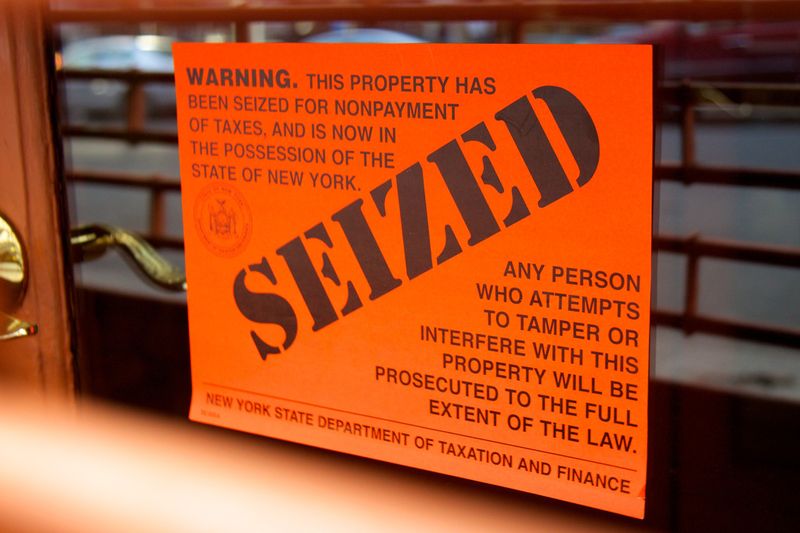
In America, it is legal in most states for police to take and keep your stuff without ever convicting you for a crime. Now, Attorney General Jeff Sessions apparently wants to let police do this even more often.

Most states and federal law already allows what’s called “civil asset forfeiture”. This lets police seize someone’s property without proving the person was guilty of a crime; they just need probable cause to believe the assets were used or obtained in some kind of criminal activity, typically drug trafficking.

Police can then absorb the value of the property — be it cash, cars, guns or something else — as profit, either through state programs or under a federal program known as “equitable sharing”, which lets local and state police get up to 80 percent of the value of what they seize as money for their departments. For police departments, this can end up a fairly profitable venture.

Speaking to the National District Attorneys Association Conference in Minneapolis on Monday, Sessions said he’s issuing a new directive that will, among other things, aim to increase civil asset forfeiture.

“[W]e hope to issue this week a new directive on asset forfeiture — especially for drug traffickers,” Sessions said. “With care and professionalism, we plan to develop policies to increase forfeitures. No criminal should be allowed to keep the proceeds of their crime. Adoptive forfeitures are appropriate as is sharing with our partners.”

Police already seize a lot of assets from people. A recent report from the Inspector General at the Justice Department, for example, found that the Drug Enforcement Administration alone seized more than $3.2 billion in assets from 2007 to 2016.

But Sessions wants more. The announcement comes in sharp contrast to the moves of several states — led by Republicans and Democrats — and President Barack Obama’s Administration, which attempted to limit the use of civil forfeiture following reports of its frequent abuse by police departments.

Civil asset forfeiture is very frequently abused.

Critics have long argued that civil forfeiture allows law enforcement to essentially police for profit since many of the proceeds from seizures can go back to police departments. And while people can get their property back through court challenges, these cases can often be very expensive and take months or years.

Michael Sallah, Robert O’Harrow and Steven Rich uncovered several instances for the Washington Post in which people were pulled over while driving with cash and had their money taken despite little to no proof of a crime. The suspects in these cases were only able to get their property back after lengthy, costly court battles in which they showed they weren’t guilty of anything.

I also previously covered the story of college student Charles Clarke, who was at the airport when police took his life savings of $11,000. Police said they smelled marijuana on Clarke’s bags, but they never proved the money was linked to a crime, and Clarke provided documents that showed at least some of the money came from past jobs and government benefits. The case led to a lengthy court battle before the government finally returned his money — with interest.

Stories like Clarke’s have driven some states to enact reforms. For example, in New Mexico and North Carolina, a court must convict the suspect of a crime before the same judge or jury can consider whether seized property can be absorbed by the state. In Minnesota and Montana, meanwhile, a suspect must be convicted of a crime in court before the seized property can be absorbed by the state through separate litigation in civil court. And in California, the state requires a conviction for forfeiture — but only for financial seizures worth up to $40,000; a boat, airplane or vehicle; and any real estate.

States’ limitations don’t entirely stop police from seizing someone’s property; cops can still do that with probable cause alone and hold the property as evidence for trial.

But the government won’t be able to absorb the property and its proceeds without convicting the suspect of a crime. This limits police seizures in two ways: It forces cops to show the suspect was actually involved in a crime after the property is seized, and it can deter future unfounded seizures for profit since police know they’ll need to prove a crime.

Still, the federal government and most states continue to allow civil forfeiture. The federal law, in particular, creates a big loophole, even in states that limit local and state police’s forfeiture practices. If local and state cops work through the federal program they can still conduct forfeitures and their police departments can keep as much as 80 percent of the proceeds, regardless of what state law says. Only a few states restrict local and state police from working with the federal government on forfeiture cases.

The result: In much of the country, police can legally take your property even if you never committed a crime.

“It’s ridiculous. I think it needs to change,” Clarke told me in 2015. “I don’t think the cops should be allowed to take somebody’s money if they haven’t committed any crime. We’re treating innocent people like criminals.”

Thinkers’ Notebook by Marlon Rice

Lift Every Voice

The idea that only white voices, or only foreign voices, or only other voices are the ones that are shaping the narrative of this New Brooklyn is a farce.

I told Tai Allen that I’d meet him at Khem’s Jerk Spot, but it doesn’t open until 2pm on Sundays and our meeting was for noon. Still, we convened in front of Khem’s, a new restaurant located on Lewis Avenue in the heart of Bed-Stuy, to figure out where we are going to grab a bite to eat. Peaches, which borders Khem’s to the north, was in full brunch bloom, patrons of various ethnicities huddled in groups patiently awaiting the 30-45-minute wait time for a table. Two blocks up, Beso’s had its French windows pushed open, offering customers sitting at the front the feel of outdoor dining. A few doors up from Beso’s, Therapy Wine Bar had a bustling scene as well. We chose Emeline’s at the corner of Macon and Lewis, an establishment named after a woman who was born in the 1800’s in Weeksville, which was America’s second-largest settlement of free Blacks before the Civil War, located in what is now known as Crown Heights. This restaurant is owned by her grandchildren.

Lewis Avenue has blossomed into a well-developed thoroughfare of restaurants and boutiques, a great number of them, including those mentioned above, are owned and operated by Blacks (Peaches is owned by B&C Restaurant Group, which is comprised of two partners, one of which is Black). However, the neighborhood has indeed changed from decades ago when brownstones were abandoned and businesses were scarce. I know this as a fact, because when I was a kid my grandfather owned a numbers spot in a storefront that sat on the same block that Beso’s and Therapy Wine Bar are on. I used to sit at the counter eating jolly ranchers while the community would come in to play their bo-litas. The numbers spots and the bodegas, both decidedly old Brooklyn motifs, have been pushed out to make way for restaurants and organic markets. But it isn’t just outsiders coming in and developing the community.

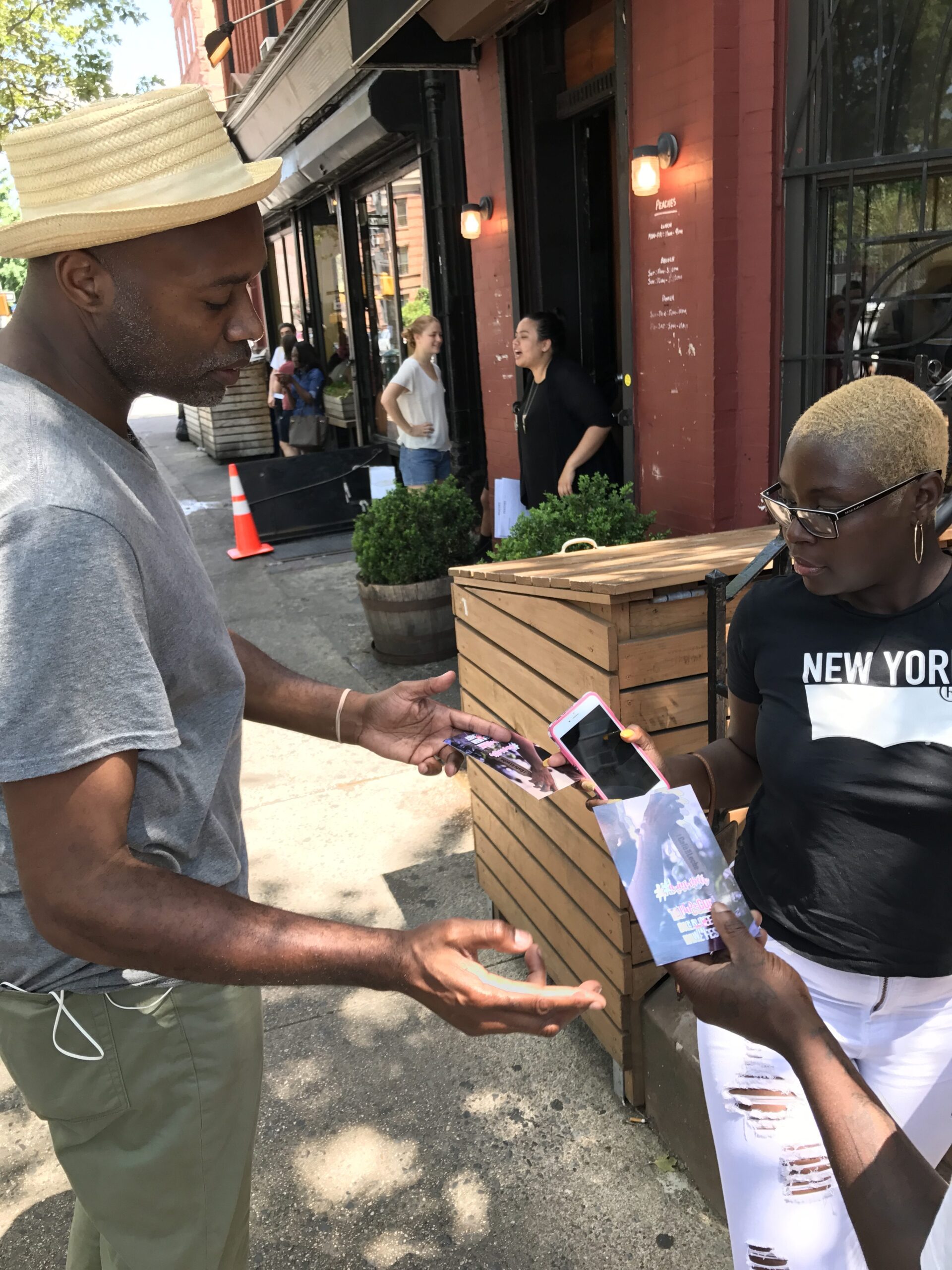
Tai Allen is one of the producers of Tap and Cork, an annual beer and wine festival in its fifth year of operation. It is Bed-Stuy’s first major beer and wine festival born inside of The Lab, a former event space on Fulton and Tompkins in 2013. Tai and his team moved the event to Restoration Plaza in 2014, and it’s been there ever since. Over 2,500 people assemble every August to sample craft beer and wine from dozens of vendors, most of them from the community. Tai figures that the demographic for Tap and Cork is currently 70/30 women to men, and 60/40 Black to white, numbers that speak to a changing neighborhood. Tai is old Brooklyn, a poet, singer and author, a consummate artist always working to mesh community and culture in ways that reveal the beauty in both. So, for Tap and Cork, he approaches restaurants, lounges, wine shops and beer gardens in the community to present them with the opportunity to be a vendor. His marketing team and even the DJ’s he uses are all from the community. The event grows every year – more vendors, more patrons, more visibility. And as it grows, it becomes part of the overall development of the community, this transformation into New Brooklyn, an idealized place where young people all across the world want to move.

As demand increases, supply decreases and prices rise. When prices rise, those without the economic resources to stay afloat become displaced. Anyone who’s taken an economics class understands this concept. But when it plays out in neighborhoods these concepts leave a sour feeling in the stomachs of those who’ve watched it play out, and blame becomes an easier way to explain things.

While I scoff down my home fries, Tai explains how he sees the development of culture and community play out in Bed Stuy. “What we are doing is a direct reflection of the people who were already here. People who were here already want things like Tap and Cork in their community. Then it works, and it attracts someone else from somewhere else, and when they come in then it ultimately pushes out those who wanted it in the first place.” I swallowed my brunch and asked the $64,000 question. What can we do to help the displacement? His response speaks to a strategy of inclusion. “With everything that I do, I make sure that businesses in my community are able to eat from it. We can’t help everybody, but we can empower the businesses.”

The fourth principle of the Nguzo Saba is Ujamaa, or Cooperative Economics. The principle touches on building and maintaining our own stores, shops and businesses, and profiting from them together. The one thing that will keep our communities from drowning in the seas of hyperconsumerism is the continued commitment to supporting small businesses, as well as a continued commitment from developers and event organizers like Tai Allen to offer up opportunities for revenue and visibility to these same businesses so that as new neighbors settle in, their social landscape includes patronage of the very shops and businesses that represent those who have already succeeded in developing Central Brooklyn. Let’s face it, businesses like corner stores, delis, pizza shops, laundromats and diners are the backbone of developing any neighborhood. They provide a service, they provide jobs to the neighborhood residents and if the owners are from that community then the money stays in the community. The biggest danger to losing the identity of Brooklyn isn’t the new neighbors. Most of them will admit freely that it was the identity of Brooklyn that drew them in. The biggest danger to losing the identity of Brooklyn is hyperconsumerism, allowing big businesses to usurp economic opportunities from small businesses. So, eat at Emeline’s. Attend Tap and Cork on August 12th at Restoration Plaza. Support the community by supporting the businesses therein. Make sure that your voice is helping to shape the narrative of New Brooklyn.