Home Blog Page 750

OpEd: WHY DO THEY KEEP KNOCKING ON OUR DOORS?

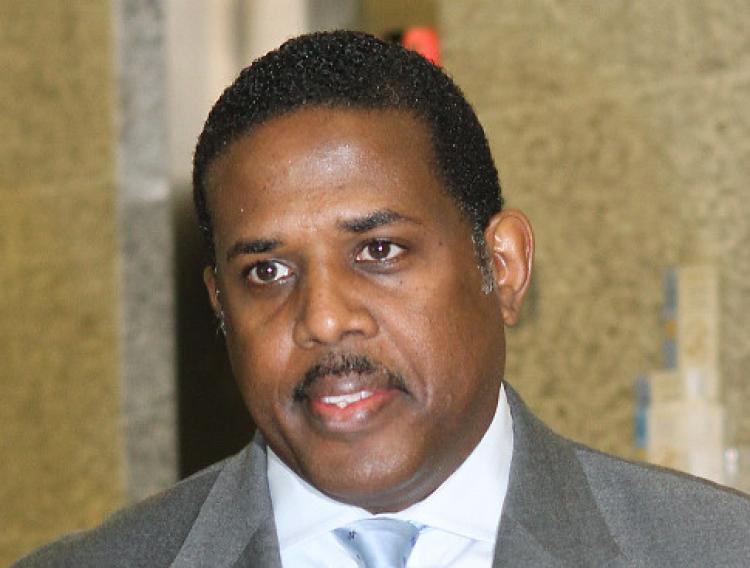
By State Senator Kevin Parker and Richard Berkley, Esq.

They come to our neighborhoods in a van, or other times in cars. They spread out across the blocks and, one by one, they knock on doors. Or they call. And call. And call. They knock on our door and call when we are eating or sleeping, or trying to spend time with our family. They are called retail Energy Service Companies (ESCOs), and they make their money by getting people — and in some instances tricking consumers — to switch their energy service provider.

The ESCO salespitch varies, but it usually contains a promise to save you money on your energy bills. Sometimes they say they are from the “energy company,” or even pretend to be from your local utility, which is not true. Sometimes they say a new law requires you to get electric or gas service from them, which is also not true. Sometimes they say a recent law has given you competition and choice, and if you will just show them your bills, they will tell you how to save money. You show them your bills, only to find out later that they switched your account to their company—without asking.

The knocking on your door, the calls from anonymous phone numbers, the untruths told to get your business, and the broken promises to save you money, are the characteristics of ESCOs. Additionally, based on an analysis of thousands of complaints obtained from the state regulator, the Public Service Commission (PSC), by the Public Utility Law Project of New York (PULP), it appears that ESCOs also focus these high-pressure and often deceptive sales tactics in zip codes containing large numbers of low and fixed-income households, the disabled, seniors and customers with English fluency challenges.

According to the PSC’s most recent numbers, hundreds of thousands of low-income households across upstate and downstate New York are under siege and being overcharged by these ESCOs. In New York City, PULP found that in 2015-2016 more than 90% of ESCO customers paid more for service than if they had not been hoodwinked into leaving– or transferred against their will — (i.e., “slammed”) from their usual utility service. PULP also found that between 2012 and 2014, 64% of the complaints in New York City cited overcharging, 32% concerned “slamming,” and an additional 31% contained allegations of fraud.

In February 2016, the PSC and Governor Cuomo took strong steps to reform the ESCO market by requiring them to actually save retail and small commercial consumers money on their bills—and to put that promise in writing or be barred from serving those customers. Instead of keeping their industry’s promises, however, the ESCOs sued to block the PSC’s reforms, claiming that their industry would suffer irreparable harm by actually having to deliver on their claims, and that the possible harm to their industry outweighed the real harm being inflicted by ESCOs.

On June 30 of this year, after eighteen months of ESCOs fighting in court rather than cease charging excessive prices, Justice Zwack of State Supreme Court delivered a strong decision protecting consumers, and stated: “that the ESCO market is in need of immediate reform to protect low-income consumers …” We believe the ESCOs will appeal this decision, and that they will claim they offer competition and choice. Somehow, in the avaricious world of the ESCOs, choice is more valuable than affordability. Further, they seem to believe that loyalty points and gift cards are added value for consumers sufficient to justify overcharging them. The reality, as pointed out by the PSC is that the ESCO market cannot function competitively. As such, their low-income customers are more likely to have their electric and/or gas service terminated because of unaffordable energy costs like theirs. And once a household’s credit is ruined by such terminations, it is harder in the future to pursue any of the many things that require spotless credit.

Until the PSC and Governor finish the job of comprehensively regulating ESCOs and protecting consumers, as a State Legislator, and as a consumer advocate, we advocate that low- and fixed-income New Yorkers avoid taking energy service from ESCOs. It is time for the ESCOs’ deceptive tactics and anonymous harassment calls in low-and fixed-income neighborhoods in New York City and across our state to stop.

If you have been switched against your knowledge or agreement, call the PSC’s hotline (800-342-3377) and ask them to help you switch back to your utility.

 

Sen. Cory Booker just introduced a bill that could legalize marijuana nationwide

One advocate described it as “the single most far-reaching marijuana bill that’s ever been filed in either chamber of Congress”.

Updated by German Lopez

A new bill in the Senate would not just end the federal prohibition of marijuana, but encourage states to legalize pot as well.

The bill, proposed by Sen. Cory Booker (D-NJ) on Tuesday, would remove marijuana from the federal scheduling system, which is the basis for its federal criminalization. That isn’t new in the Senate; Sen. Bernie Sanders (I-VT), for one, also put forward a bill that would deschedule marijuana back in 2015.

Where Booker’s bill goes further is it actively encourages states to legalize cannabis. Specifically, the bill leverages federal funds to incentivize legalization in states that have enforced laws against marijuana in a way that disproportionately impacts low-income people and people of color — a category that includes virtually every state. (A 2015 report from the Sentencing Project, for one, estimated that Black Americans are 3.7 times as likely to be arrested for marijuana possession as their white counterparts, but only 1.3 times as likely to use pot.)

The measure addresses the two layers of prohibition. Under current federal law, pot remains illegal even in states that have legalized — creating big barriers to states that have legalized, including restrictions on business tax deductions and access to banking. But whether marijuana is legal, decriminalized or illegal at the state or local level is decided through state or local law — meaning that a city or state could conceivably keep marijuana illegal even if the federal government removes all of its own restrictions.

“This is the single most far-reaching marijuana bill that’s ever been filed in either chamber of Congress,” Tom Angell, head of the pro-legalization Marijuana Majority, said in a statement. “More than just getting the federal government out of the way so that states can legalize without DEA harassment, this new proposal goes even further by actually punishing states that have bad marijuana laws.”

The legislation would also be retroactive, so it would automatically expunge federal marijuana use and possession crimes from people’s records and let those currently serving time in prison for marijuana use or possession petition for resentencing. And it’d create “a community reinvestment fund” that Booker’s office said would go toward job training, reentry services and community centers, among other programs.

The bill faces no chances of getting through Congress. But it shows the remarkable turnaround that legalization has taken over the past few years. At the beginning of 2012 no state had legalized marijuana. Just five years later, eight states — including California, the most populous — have legalized pot.

And now a well-known Democratic politician is proposing and even hoping to encourage legalization.

Booker has long criticized the war on drugs and supported medical marijuana legalization but his office said this is the most sweeping proposal he’s ever put forward on changing the nation’s drug laws. (When I asked Booker if he supports legalization in 2015, his answer was, well, unclear. Now we have a very clear answer.)

But Booker will face stiff opposition in Congress, where most members remain publicly opposed to legalization, and the Trump Administration, which has vowed to crack down on states that have legalized marijuana within their borders.

Although legalization doesn’t have much political traction in Washington, it’s backed by a majority of Americans. Gallup’s surveys found support for legalization rose to 60 percent in 2016, up from 58 percent in 2015 and 25 percent in 1995. The last big issue to see that kind of rise in public support was same-sex marriage.

35th CD Race: Hotly Contested…But will battle bring out the voters?

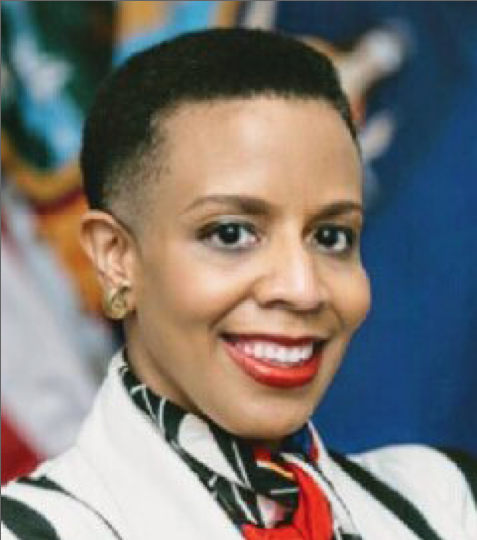
Incumbent Laurie Cumbo
Candidate Ede Fox


The Democratic Primary 35th Council District race is the hottest in Brooklyn. Incumbent Laurie Cumbo is facing off against multiple candidates for a seat at the table where the city budget is allocated, zoning rules are changed and lives are affected in our neighborhoods and in our homes. And yet according to the recently released Board of Elections Annual Report for 2016, the voter turnout for Brooklyn for the primaries was an almost-surreal 9% of eligible active voters.   That level of voter turnout makes any race volatile, but especially here, where Cumbo bested Ede Fox in the 2013 Primary by only 1,825 votes. Because it only takes a small movement to have a huge impact, this race is being fought door-to-door and has become personal, with accusations of lying and deceitfulness becoming part of the rhetoric.

They say, “All politics is local”, and after the Block Association and the Community Board, the City Council is about as local as you can get, but there is no need to bring national tactics and young people to distribute “Fake News” handouts on Brooklyn streets. Akosua Albritton’s story, page3, of misused youth, is a warning to beware locally and Victoria Horsford, page 4, warns us of our national challenge.

Cumbo Endorsed by Public Advocate James, Council Speaker Mark-Viverito and Borough President Adams


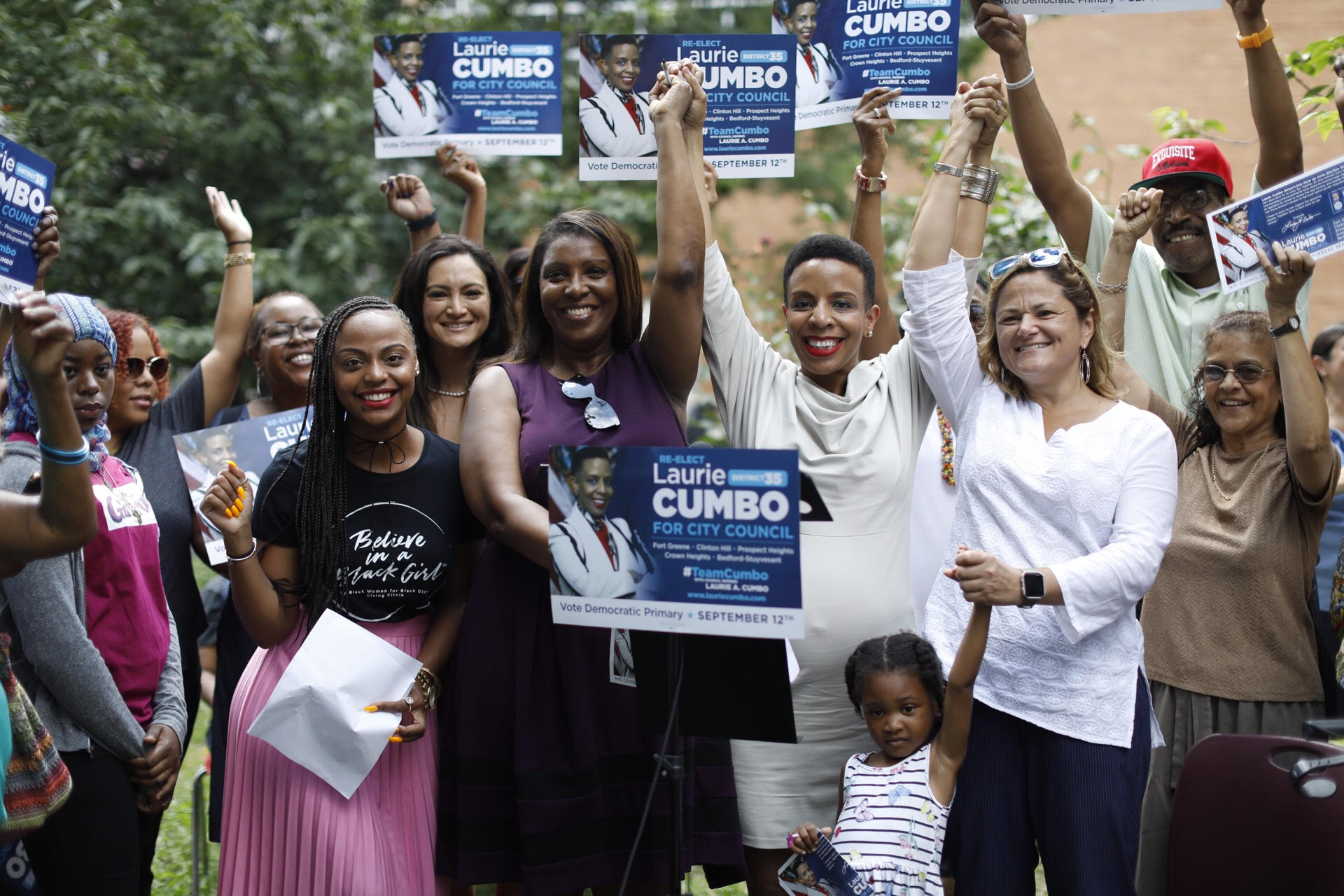
 At the Ingersoll Community Center’s Garden of Eden earlier this month, Laurie Cumbo was endorsed by her predecessor in the 35th District and current New York City Public Advocate “Tish” James, Speaker of the New York City Council Melissa Mark-Viverito and Council member Vanessa Gibson, the presidents of four tenant associations in the district and women leaders from all across the city.

This week, Borough President Eric Adams added his endorsement saying, “I am proud to announce my endorsement of Council member Laurie Cumbo’s reelection. Laurie and I are working together to reduce gun violence, stop the Bedford-Union Armory development project and improve our parks and schools”. “No one is fighting harder for her community than Laurie, and I look forward to working with her for another four years.”

“It has been an honor to work with Brooklyn Borough President Eric Adams over the last three years on issues that matter most to the 35th District. We’ve fought side-by-side for victories on issues ranging from low-income housing and public safety to capital improvements in our schools and domestic violence prevention,” said Council member Laurie Cumbo. “Most recently, we worked together to deliver a major victory for the community to create over 600 units of rent-regulated affordable housing at the Brooklyn Jewish Hospital housing complex, which prevented the displacement of hundreds of Brooklynites. Eric is a tower in our community and I look forward to building on our accomplishments together over the next four years.”

Primary day is September 12, 2017.


Brooklyn District Attorney Eric Gonzalez Receives the Rev. A. R. Bernard and Social Justice Leader Bertha Lewis Endorsements

On Sunday, Brooklyn District Attorney Eric Gonzalez received the endorsement of the Rev. A.R. Bernard, pastor of the Christian Cultural Center and social justice leader Bertha Lewis, founder of the Black Institute and founding co-chair of the influential Working Families Party.

“I am supporting Eric for District Attorney because he knows that we can keep our communities safe, all while protecting civil rights and promoting social justice,” said Rev. Bernard. “We need someone with his record of experience and commitment of reform to continue to move Brooklyn forward.”

Said Lewis, an early supporter for Ken Thompson in 2013, “Eric is Brooklyn through and through. He has devoted his life to keeping Brooklyn safe while reforming the criminal justice system and ensuring equal justice for every Brooklynite. He deserves the next four years to continue this important work”.

Eric Gonzalez, a lifelong resident of Brooklyn, was raised by a single mother for most of his youth, living first in Williamsburg. During the 1980’s, his family moved to East New York during the height of the city’s crack epidemic. Gonzalez is a graduate of John Dewey High School in Coney Island, Cornell University and the University of Michigan Law School where he was president of the Latino Law Student Association. He is married to his wife Dagmar and they have three sons.

Gonzalez also holds the political and labor endorsements of the following:

Unions

Service Employees International Union (SEIU) 1199, Mason Tenders, United Federation of Teachers (UFT), Service Employees International Union (SEIU) 32BJ, Transit Workers Union (TWU); Retail, Wholesale and Department Store Union (RWDSU); United Court Officers Association (UCOA), Council of Supervisors and Administrators (CSA); NYC District Council of Carpenters, Sheet Metal Workers Local 28, Metallic Lathers and Reinforcing Iron Workers, DC9 of the International Union of Painters and Allied Trades

Elected Officials

Public Advocate Letitia James, Comptroller Scott Stringer; Assembly members Pamela Harris, William Colton, Robert Carroll, Rodneyse Bichotte, Tremaine Wright and Latrice Walker; Council members Brad Lander and Mark Treyger

Democratic Clubs

Central Brooklyn Independent Democrats, Lambda Independent Democrats, Jim Owles Liberal Democratic Club, Muslim Democratic Club of New York, Vanguard Independent Democratic Association, Stars and Stripes Democratic Club, Progressive Democrats Political Association, Bay Dems, United Progressive Democratic Club, Shore Front Democratic Club, Thomas Jefferson Democratic Club, 41st AD Democrats Club, 57th AD Democratic Organization.

Organizations

Working Families Party, New York Immigrant Action Fund (the 501c4 arm of the NY Immigration Coalition)


(Photo credits: Kevin Pratt for Eric Gonzalez for District Attorney)