Home Blog Page 743

East New York Native finds entrepreneurial success upstate

People

In the Capital Region

Cory Nelson’s Food Court in Troy, New York is something Brooklyn does not have and should.

But Nelson tells us when he returned to his Sast, New York home after graduating at Howard University, the neighborhood had changed and there was no room for him, not his entrepreneurial dream.

But Cory’s dream of opening an establishment with a dual purpose–to provide diners with a choice of good foods, and the people who create the food a site to incubate – is fully alive and well in New York State’s capital region, some 300 miles from his native BK.

Nelson’s highly successful “Troy Kitchen: A Gourmet Food Court” is an inviting high-scale boutique of cultural food choices with permanent food vendors, a wine, beer and coffee bar in the center of Troy, New York downtown, currently enjoying a revival.

Nelson’s emporium is ideally situated between two colleges — Russell Sage College and RPI Institute – plus area courts and professional business offices. It’s a short walking distance from the area courts, professional business offices and the Hudson River.

Nelson, 28, studied computer science and chemistry at Howard. He first opened the businesses with some other ambitious Brooklyn-based colleagues.   Now a resident of Troy, he’s on his own and doing just fine from what we observed last Saturday.


It’s up in the air as to whether he will duplicate the same success in his hometown. After all, it’s getting more and more expensive to open a business here. But one thing’s for sure, Cory Nelson knows which side his bread is buttered when it comes to who or what to create for his success.

Nelson told Troy-based former Brooklyn resident Suzanne Spellen, a Brownstoner writer, “Whenever I have an issue, I think of East New York. Surviving and thriving there – that’s real toughness”.

He also commented in an interview with Ms. Spellen about his childhood: “I ran track five days a week. We went to the Intrepid and places like that, but there was no context made. Kids need a connection, it has to be more organic and relate to them somehow, or it just doesn’t mean much.”

“If I could do anything again in East New York, I would have realized that I wasn’t constrained by borders. The Financial District, any part of the city that you’re interested in – it’s only a subway ride away. But we are stopped by these artificial borders. We think those places are not for us – a mental blockade.”

“I never went to the Museum of Modern Art until I was an adult. It was there the whole time. I wish I could have explored all of New York City when I was younger and been more exposed much earlier and aware of what’s out there. Small things – small opportunities that could have opened up the doors to the world earlier.”

But at 28, Nelson, with two years of entrepreneurship success, is opening doors for businesses that will eventually branch out from his spot to a whole new world of their own. He also has established himself as a dynamic young role model for thousands of dreamers in Brooklyn and beyond.

For more information on Cory Nelson and the Troy Kitchen, visit

A.G. Schneiderman Files Lawsuit to Protect Dreamers and Preserve DACA

A.G. Schneiderman Files Lawsuit to Protect Dreamers and Preserve DACA

Today, New York Attorney General Eric T. Schneiderman led a coalition of 16 Attorneys General in filing suit to protect Deferred Action for Childhood Arrivals (DACA) grantees. The lawsuit, which was filed this afternoon in the U.S. District Court for the Eastern District of New York, details how the Trump administration has violated the Equal Protection clause of the Constitution by discriminating against DREAMers of Mexican origin, who make up 78 percent of DACA recipients; violated Due Process rights; and harmed States’ residents, institutions, and economies.

“Immigration is the lifeblood of New York State. The Trump administration’s decision to end DACA is cruel, inhumane, and devastating to the 42,000 New Yorkers who have been able to come out of the shadows and live a full life as a result of the program,” said Attorney General Schneiderman. “These DREAMers play by the rules. They work hard and pay taxes. America is the only home they have ever known – and they deserve to stay here and keep contributing to our state and our nation.

“That’s why we’re taking the Trump administration to court to protect DREAMers and the New York employers who rely on them. It’s clear that President Trump’s DACA repeal would cause huge economic harm to New York – and that it’s driven by President Trump’s personal anti-Mexican bias. Attorneys General have not hesitated to act to protect those we serve, and I’m committed to continuing to use every tool to protect New Yorkers,” Attorney General Schneiderman concluded.

The lawsuit was led by New York Attorney General Schneiderman, Massachusetts Attorney General Maura Healey, and Washington Attorney General Bob Ferguson, and filed by a total of 16 Attorneys General: New York, Massachusetts, Washington, Connecticut, Delaware, the District of Columbia, Hawaii, Illinois, Iowa, New Mexico, North Carolina, Oregon, Pennsylvania, Rhode Island, Vermont, and Virginia.

View From Here: The Kings County Civil Court Judge Primaries Look Like a Battle 

One of the facts that’s brought to light in “Black Brooklyn: The Politics of Ethnicity, Class and Gender” by John Flateau is the recurring instants of increased white voter turnout when there was a white candidate opposing a nonwhite person and the overall power of ethnic identity in voting.  This suggests there should be considerable concern on the part of the Democratic Party in this year’s judicial Democratic primary where there are ten candidates running for five judgeships and the five highest vote-getters win.  Five of those running are backed by the Democratic Party and five or not.

How will first-time Kings County white voters make their choices?  How will longtime white residents, uncomfortable with the increasingly diverse judiciary, vote?

Voting for city, state and federal offices are very different from voting for civil court judges that the voter and the voter’s community will be standing in front of.  All of the candidates insist they will administer justice fairly, but the tribal instinct still asks, “Will this person be fair to me and my community?”

A reading of Flateau’s “Black Brooklyn” suggests looking at identification with the community, which may be different than the party, and it is that which motivates the voter. In terms of gender, we can expect the women in the race to do well.  And because the contest for District Attorney features Eric Gonzalez, we can expect the Hispanic candidates to do well also.

The problem for the county Democratic machine is the presence of Thomas Kennedy, John O’Hara and Patrick Haynes, whose names signal white heritage to the 17.8% of the county that voted for Donald Trump, as well as the white supremacist-lite community who decry the privilege while they lap it up.

And insurgent Isiris Isella Isaac may also be helped by the possible increased Hispanic turnout, now only enhanced by the pardoning of Arizona Sheriff Joe Arpaio, while Sandra Roper is emphasizing her Caribbean heritage.

On the plus side for the party, candidate Patria Frias-Colon may also benefit from an increased Hispanic vote, but they’ll have to go down a bit to find her–she’s on the 14th ballot line.

Judge Carolyn Wade is unopposed and safe, and incumbent Judge Robin Sheares from Bedford-Stuyvesant is number one on the line for the judges.

No one should feel that their candidate is safe or doesn’t have a chance.  This is a vote for the people who one day may determine the direction of your life or of someone you know.  Because if we don’t come out to vote, some other community will come and snatch the office away from us.

Civil Court Judge Candidates

Frederick C. Arriaga

Arriaga received his B.S. from the University of Florida and his JD from the Brooklyn Law School (1992). Arriaga began his career in 1992 as a senior attorney for South Brooklyn Legal Services. He then worked in 1996 and 1997 as a senior attorney for the Legal Aid Society’s Brooklyn Office for the Aging before returning to South Brooklyn Legal Services in 1997. He served there as a senior attorney until 2004 when he became counsel to the Brooklyn Borough President.

Patria Frias-Colon

Frias-Colon currently serves as the Brooklyn Borough Chief for the New York City Law Department’s Family Court Division where she supervises and oversees the juvenile delinquency practice.  Prior to that, she served the NYC Department of Education as Agency Counsel in 1998 and later promoted to Assistant Deputy Counsel to the Chancellor.  Previously, Patria served as Assistant District Attorney in Kings County and an Adjunct Professor with St. John’s University School of Education.

Patrick Haynes

Patrick Haynes is a former Brooklyn prosecutor now in private practice at the Law Office of Patrick Haynes.

Isiris Isella Isaac

Principal law clerk to Brooklyn Supreme Court Justice Shawndya Simpson; NOTE: Approved by the New York City Bar.

Thomas Kennedy

Thomas Kennedy, an associate at Glancy Prongay & Murray, represents plaintiffs in white-collar fraud cases.

John O’Hara

John O’Hara, a Brooklyn attorney who made headlines when he became the first person to be convicted of illegal voting since the 19th century by then-District Attorney Charles Hynes.  It was an unlawful conviction and overturned 20 years later by the Conviction Review Unit and finalized by Acting DA Eric Gonzalez.  O’Hara told the Daily Eagle that being a convicted felon for 20 years has given him an unusual “perspective”; it’s “an experience that you bring to the bench”.

Connie Melendez

Melendez is the Principal Law Clerk for Justice Marsha L. Steinhardt at New York State Supreme Court, Kings County. In this capacity, she researches, analyzes and resolves issues of law, procedure and evidence arising from medical malpractice, negligence and foreclosure actions.  Melendez graduated from Rutgers University magna cum laude with a Bachelor of Arts in Psychology, received a Juris Doctor from Brooklyn Law School in 1986.

David C. Pepper

Pepper is the Principal Law Clerk to Civil Court Judge Martin M. Solomon where he participates in all aspects of trials, hearings and proceedings. He is fully responsible for conducting and scheduling discovery conferences for an inventory of over four hundred commercial cases and conducted and participated in settlement conferences in commercial, civil and landlord-tenant matters.

He is a graduate of the State University of New York at Binghamton and also holds a J.D. from Brooklyn Law School.

Sandra Roper

Born in Panama, Sandra Roper’s father was Costa Rican and her mother, Panamanian. She immigrated with her grandparents, UAW member Lionel Scott, and 1199 member Cecilia Scott, and lived in Crown Heights, Brooklyn on Pacific Street. Roper has won many academic and public service awards. She attended  Sheepshead Bay High School, Long Island College University and received her Juris Doctor from Brooklyn Law School and a Masters of Law from New York University (NYU). Roper was a member of 1199 member for 37 years and was a candidate for Brooklyn District Attorney in 2001

Hon. Robin K. Sheares

After graduating from Brooklyn Technical High School, Sheares continued her education at Ithaca College in Ithaca, New York where she received her Bachelor of Arts in Political Science. Years later, she earned a Juris Doctor degree from St. John’s University of Law, and in 1986, she passed the New York State Bar Exam.

Upon receiving her law degree, Sheares found work as a court attorney, assisting judges on legal matters regarding landlord-tenant laws. During this time, she also worked on Dunaway hearings, which are hearings conducted to determine whether the evidence used in a case was obtained from an illegal arrest.

Sheares continued to work as a court attorney for nearly twenty years before deciding to start running for Civil Court Judge. After two unsuccessful campaigns, she was elected in 2007, becoming the Honorable Judge Robin K. Sheares.


Van Sertima: They Came Before Columbus

“Fake news,” if let to stand unchallenged long enough, becomes fake history and gets to be taught in school and taken as fact. Such is the case with the canard that Christopher Columbus “discovered” the North American continent. He was the second European after Viking explorer Lief Erickson, but he came later than voyagers from the African Continent.

Dr. Ivan Van Sertima, author of They Came Before Columbus: The African Presence in Ancient America, has written about two periods of African influences in the early Americas. First came those who influenced the Olmec civilization, and the second period was probably the result of Mandingo voyages in the 1300’s. In these excerpts from an interview with the OTP publishers in October in 1997 at his home in Highland, NJ, he elaborated on his findings of evidence. DG


Ivan Van Sertima: What startled me most and I think I have said that before, was to find that Columbus was the chief witness.

He actually wrote in his Journal of the Second Voyage that when he was in Haiti, the Native Americans came to them and told them that Black-skinned people had come from the south and southeast trading in gold-tipped metal spears. Columbus may not have believed but he actually sent two of these spears back to Spain and they were inspected microscopically in Spain and found to be identical, not just similar, identical, in their ratio of gold, silver and copper alloys to spears being forged in Guinea.  They were composed of thirty-two parts – 18 of gold, 6 of silver and 8 of copper.

And all the words for the spears had identical sounds that Africans were using on the other side of the Atlantic.  Now how can you argue with that?  And as I probed further into the matter, I discovered that it was not just Christopher Columbus but a dozen Europeans who claimed they saw, or heard from other Europeans who saw, these Africans.  My critics claim this is just an Afrocentric theory.  Then Columbus and his son and all the explorers who came, who saw, who conquered, were all Afrocentrics, if one follows the logic of this silly argument.

Ferdinand Columbus, one of the four sons of Columbus, said, “My father told me he saw Negroes north of Honduras”. Then there is Vasco Nunez de Balboa coming down the slopes of Quarequa, which is near Darien, which we now call Panama. We have it down to the day -September 25, 1513. He sees two tall Black men among the Native Americans. This is not the era of the African Slave Trade.

The Spanish were utterly startled (so startled that four of them comment on it) and they asked the natives from whence did these Black men come. They did not know. All that they knew was that they lived in a large settlement nearby and they were waging war with them and had captured these two. These Africans are described in detail. Exceedingly Black, a foot and a half taller than the average Native American, of military bearing.

Peter Martyr, the first historian of the European contact period, said that these Blacks must have been shipwrecked long ago from Africa (he called it Ethiopia, which was then a general word for Africa from the word aethiops, meaning burnt skin). You also have other commentators like Lopez de Gomara, who wrote that, “These Blacks Balboa saw were identical with the Blacks we have seen in Guinea”. Rodrigo de Colmenares reported that one of the captains of Balboa saw Blacks “east of the Gulf of San Miguel”.

Then Alphonse de Quatrefagos, author of “The Human Species”, presents us with a map drawn by a French sea captain, Kerhallet, showing independent Black settlements in the area later called Brazil.  Also at the tip of Florida and on the island of St. Vincent.  This can account for the Charruas of Brazil, the Jamassi of Florida and the Black Caribs of St. Vincent.  They were all pre-Columbian Black settlements. Captain Kerhallet presents a map of these settlements and that is the area, that very area, that is the endpoint or terminus of currents flowing in across the Atlantic from Africa.  The Africans appeared exactly where the ocean current from Africa takes you.

Few people are aware that there are natural sea-roads, I call them “marine conveyor belts”. That is what they really are. Once you are caught in these currents and you do not have an engine (and no one had engines at that point in time), you have to come to America. The better your ship and knowleOTPe of the ocean, the more likely you will come on purpose. The worse your ship and seamanship, the more likely you’ll come by mistake. It is clear when you look at this map.

OTP:  That’s a very powerful map. That map of the currents.   As soon as you see it, you say, “Yes, that’s right.”

IVS: There is also evidence in the form of a map which as early as 1448, roughly half a century before Columbus, shows both the outline of Brazil as well as the relatively exact distance of Brazil from the West African coast.  So there you have it – eyewitness accounts, metallurgical evidence, linguistic evidence, botanical evidence, cartographic evidence (the map), oceanographic evidence (the currents that sweep you from Africa to America), skeletal, oral, documented, and above all, iconographic evidence; that is, paintings and sculptures of these people which show clearly, except to those who refuse to see, all the features we associate with the African. There is also, as I mentioned, the epigraphic evidence, the script I found on the rock at St. John’s in the U.S. Virgin Islands.

OTP: What about the boats they came in?  Tarzan movies give millions of people the impression that African navigational development stopped at the canoe.

IVS: Both ancient and medieval African boats have been tested on the Atlantic sea routes to America and crossed the ocean successfully. Thor Heyerdahl, with the help of Buduma boatmen on Lake Chad, rebuilt a pre-Christian African craft – a papyrus reed boat- and crossed the Atlantic successfully. Hannes Lindemann discovered that Africans had enormous dugouts as large as Viking ships.  Lindemann tested one of these and made it to America in 52 days, 12 days less than Amerigo Vespucci, even though Vespucci left from an equally favorable starting point on the African-Atlantic coast.

Dr. Alain Bombard rode a life raft, L’Heretique, from Casablanca in North Africa via the Canaries to Barbados in 1952 without stocking up with adequate supplies of food and water, with only a cloth net for small sea fauna, a fishing line with hook for little tunny and two spears. He also carried a container for collecting water when rain fell. He survived in perfect health.

OTP: Apart from the medieval journeys, you have presented a great deal of evidence for journeys long before Christ.

IVS: Yes, yes. That is the most important section of my new book – the section on the Olmec. The Olmec is the first major civilization in America.

OTP: Your critics claim that you said African Egyptians founded the Olmec civilization.

IVS: That is a naked and nasty lie, I have never said so.  The Native Americans created their own civilization. I pointed to contact with Old World peoples – in this case, the Egypto-Nubian.  I demonstrated a number of remarkable coincidences between their ritual complexes and even a few of their technological developments.  I spoke of an influence.  All contacts between two peoples lead to influences.  But I never claimed they brought civilization to Americans.  That is a very Eurocentric type of claim.  I pointed to specific elements in Nile Valley civilization (both Egyptian and Nubian) which are found as early as the era of Ramses III (circa 1200 B.C.) and persist as late as circa 700 B.C., era of the Nubian Renaissance.

OTP: What of the Olmec stone heads?

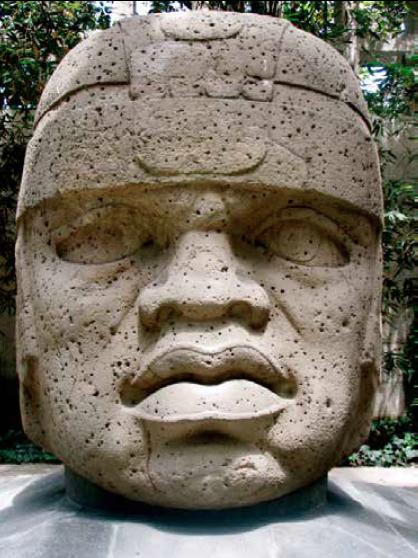
IVS: About a dozen of these have been found. Now I want to make it clear at the outset of this discussion that not all of these are foreign types.  I lived among Native Americans for the first 12 years of my life, I know them better than my own nuclear family, half of whom I never saw again after my babyhood, not until the teen years of my life.  De Montellano, chief of my critics, claims that all the stone heads are “spitting images of the Native American”.  I do not like to attack my critics personally.  Arguments should be met with arguments, but I have to say in this case, this man is either blind or an idiot.

Apart from the unique combination of nose, cheek, jaw, lips, there is one unhelmeted head with a tuft of Africoid hair and another one with seven braids.  They are very realistically portrayed in spite of their size.  As the head of the first American expedition, Dr. Matthew Stirling said of the first stone head he examined: “Despite its great size, the workmanship is delicate and sure, the proportions perfect.  Unique in character among aboriginal American sculptures, it is remarkable for its realistic treatment. The features are bold and amazingly Negroid.” He got into big trouble with his colleagues for that.  He is now saying that the models for these great stone sculptures were “mythic beings”.

OTP: Unbelievable.  Who in the archeological establishment supported you?

IVS: The only one who is old enough and free of the constraints of his earlier position to tell it like it is, to speak the truth without fear or favor, Dr. Clarence Weiant.  He actually headed the first expedition of the Smithsonian into the Olmec world.  The New York Times, it seemed, trusted no one here to talk about this matter.  But then came the most surprising thing of all. Dr. Clarence Weiant wrote the Times in my defense.  “As someone who has been immersed in Mexican archeology for some 40 years, and who participated in the excavation of the first of the giant heads, I must confess that I, for one, am thoroughly convinced of the soundness of Van Sertima’s conclusions.”

OTP: To think that after all these years and all the work you’ve done, these people are still trying to sabotage you. You defended yourself eloquently before the Smithsonian, you appeared before a congressional committee and got them to delete the word “discovery”, decisively debunking the Columbus myth. You sat on the Nobel Committee of the Swedish Academy for five years to advise on the selection of Nobel laureates in Literature.  You were even invited to join UNESCO. You are the compiler of the first Swahili Dictionary of Legal Terms.  You have edited 12 anthologies on African civilizations. Your poems appear in English, French and German anthologies. Yet there is a raging debate over everything you have written. They are still trying to put you down.

IVS: Well, fighting for a new vision of man, a new vision of history, is worth it, painful though it may be. The warrior’s courage does not protect him from the wound of bullets.  But I have found over time David, that the negatives have been my greatest help.  That is the one lesson I have learned over the years.  The negative is very important.  Oftentimes, it is more important than the positive.  Sometimes if something is highly successful and meets no great opposition, it can make you facile. If it meets with great negatives, it can be even better in the end.  Unless it is destroyed, it is far better that it meets with negatives.  The negative makes you go back to find and check out everything. You find a whole lot of new things. If before you came in with a revolver, the next time you come in with a cannon.


Centennial Celebration of Esther Cooper Jackson – A Living Legend

“Art is only important to the extent that it aids in the liberation of our people.”

Elizabeth Catlett 

“There is no force equal to a woman determined to rise.”

  1. E. B. DuBois

“You may write me down in history With your bitter, twisted lies,

You may trod me in the very dirt But still, like dust, I’ll rise.”

    Maya Angelou

Yes, I want to know what will your legacy be? This is a question that I would like to put to each and every one of you?”

    Margaret Burroughs

Your legacy is powerful and inspirational.

  • Founding Editor of the leading cultural, political and intellectual journal Freedomways magazine.
  • A tireless defender of civil rights, human rights, social justice and international rights.
  • An advocate for those who were “prophets in their own country”.
  • A documentarian for our historians, sociologists, educators, novelists, artists, musicians and poets.

Your work has created a legacy for our youth activists and underscored the embodiment of what it means to live the purposeful life.

Resistance has been in and defined your spirit.

You have demonstrated that struggle is a part of life and that we can all engage in what activist and hip-hop artist Talib Kweli calls, “A Beautiful Struggle”.

Happy 100th Birthday 

Dr. Brenda M. Greene & Dean Richard Jones

On Saturday, August 26, I had the privilege of attending the 100th Birthday Celebration of Esther Cooper Jackson, a longtime and tireless advocate for civil rights, human rights and social justice.   Esther Cooper Jackson, born August 21, 1917, celebrated her 100th Birthday with family, friends and colleagues at the W.E.B. DuBois Research Institute located at The Hutchins Center for African & African-American Research at Harvard University, an appropriate place to host the celebration. W.E.B. DuBois, a friend and colleague of Esther Cooper Jackson and her husband James E. Jackson, Jr., was the inspiration for and one of the founders of Freedomways, A Quarterly Review of the Freedom Movement. Esther Cooper Jackson was managing editor of Freedomways for 25 years, following the journal’s first general editor, Shirley Graham DuBois.

During the celebration, Ms. Jackson shared how Dr. W.E.B. DuBois was “. . . a humanist and mentor who instilled in me the commitment to social justice and equality”. She underscored how Dr. W.E.B. DuBois and Shirley Graham DuBois continued to have an influence on the life of her and her husband and how they corresponded after Dr. DuBois and Shirley Graham DuBois relocated to Ghana at the invitation of the late Kwame Nkrumah.

The Honorable Julian T. Houston, retired Associate Justice of the Massachusetts Superior Court, Executive Committee member of the Justice George Lewis Ruffin Society, and nephew of Esther Cooper Jackson, in reflecting on her life, recounted how W.E.B. DuBois and Shirley Graham DuBois provided support for Esther and her daughters, Harriet and Katherine, when her husband, James Jackson, went underground during the McCarthy era for five years after being targeted by the government for his activities related to the Communist Party.

I had the privilege of meeting Esther Cooper Jackson in 2014 when the Center for Black Literature at Medgar Evers College honored her as part of its National Black Writers Symposium on Audre Lorde. The center presented Ms. Jackson with an award for her lifelong dedication to literature and freedom. When I called Esther to confirm the time that I should pick her up from her home for the program, she held me on the phone while she wrote the information down in her appointment book. I knew that I was about to meet an incredible woman, a sharp and wise chronicler who regaled me on the drive to Medgar Evers College and later in her interview on my radio show, Writers on Writing, with stories of her work with the Southern Negro Youth Congress (SNYC) and with the writers and activists with whom she had worked and/or who had written for Freedomways: people such as Alice Walker, John Oliver Killens, Dorothy Burham, Audre Lorde, Nikki Giovanni, Ossie Davis, Ruby Dee, James Baldwin, Romare Bearden, Jacob Lawrence and many others. She informed that she regretted that she could not attend as many intellectual, cultural and political programs as she desired and I specifically remember talking about how traveling to a program at the Schomburg Center for Research in Black Culture which featured David Levering Lewis, a close friend and colleague.

It was indeed an unforgettable moment when I later received a phone call from Esther’s daughter, Harriet Scarupa, who informed me that Esther Cooper Jackson wanted to donate her collection of African-American literature to the Center for Black Literature at Medgar Evers College. The Esther Cooper Jackson Personal Book Collection on African-American Culture is now housed in the Charles Evans Innis Memorial Library at Medgar Evers College. I presented Ms. Jackson with a poster and photos from the exhibit at her 100th Birthday Celebration.

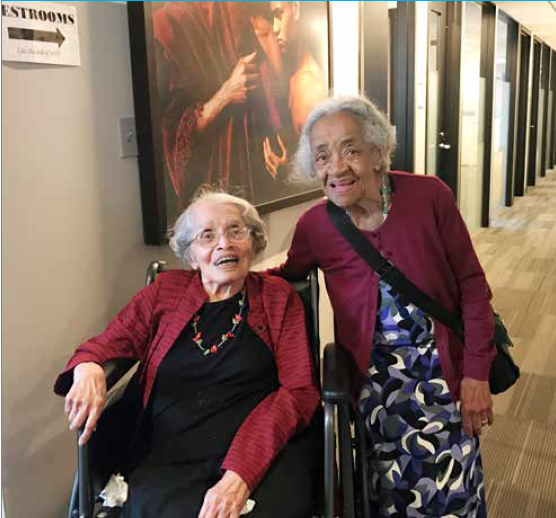
In attendance at the Birthday Celebration were Ms. Jackson’s longtime friend and activist Dorothy Burham (102 years old), who made notable contributions to public education, civil rights, women’s rights and the promotion of racial and economic equality; Margaret Burham, University Distinguished Professor of Law at Northeastern University in the fields of civil and human rights, comparative constitutional rights and international criminal law, and  founder of the School of Law’s Civil Rights and Restorative Justice Project; Dr. David Levering Lewis, historian, Julius Silver University Professor of History at New York University and Pulitzer prize-winning author of the biography of W.E.B. DuBois; Dr. Mary Louise Patterson, pediatrician and editor with Evelyn Louise Crawford of Letters from Langston: From the Harlem Renaissance to the Red Scare and Beyond; James Steele, Special Assistant to Congressman Meeks and his wife Brenda Steele; Bernice Green, co-founder of Our Time Press; and Claudia Loftis. Ms. Jackson’s daughters, Harriet Jackson Scarupa, a retired journalist; Katherine A. Jackson, a retired psychologist; her grandson, Dr. Mark Scarupa, a physician; and in-laws and nephews were also among those in attendance.

New York City Public Advocate Letitia James sent a letter and proclamation in honor of Esther Cooper Jackson and those who could not attend sent remarks. Among them were Timothy Johnson, Director of the Tamiment Library at NYU which houses books on Marxism from the personal collection of Esther Cooper Jackson and Dr. Henry Louis Gates; Alphonse Fletcher, University Professor and Director of the Hutchins Center for African and African-American Research at Harvard University.


By Dr. Brenda M. Greene, Executive Director of the Center for Black Literature

Professor of English and Department Chair

Medgar Evers College of the City University of New York