With the publication of the Paradise Papers, leaks of financial documents researched by the International Consortium of Investigative Journalists (ICIJ), we see how little consideration major corporations such as Nike and Apple have for the American people. They profess to be philanthropic and good corporate citizens, but instead, they’re stealing from all of us by evading taxes involving hundreds of billions of dollars.
Nike touts giving $10 million in community grants, while stashing $12.2 billion in offshore accounts. The ICIJ says those profits “have been taxed at less than 2 percent by foreign tax authorities—and not at all in the United States”. Here the country has provided, and continues to provide and maintain, the infrastructure and population necessary for their companies to be born, exist and prosper and I’m sure they are thankful for that. But not so much that they are willing to pay into the system to maintain the physical infrastructure and have the health, welfare and education of the population attended to. Their actions demonstrate that business school has taught the managers that their first responsibility is to increase the wealth of the stockholders and of course themselves, by paying as little as possible for goods, labor and taxes as all are a drag on the profit God.
On top of the rampant tax evasions by companies and ultra-wealthy individuals, the Republicans have proposed an amoral tax plan that will make people like Donald Trump and the billionaires in his cabinet even richer by cutting back on tax money that would go to students, the elderly, the poor, the middle class, children, the environment and anything that smacks of humanity or human kindness. And their attempt to eliminate the estate tax, which applies only to the very wealthiest, is perfectly described by a commentator who wrote, “Somewhere in America there’s a child with a $30 million trust fund who needs our help”.
That this is increasing economic imbalance is occurring at the same time as the use of opioid and other mental-state-altering drugs is skyrocketing is interesting in light of a 2002 study published in the Journal of Epidemiology and Community Health. There, the researchers found that “the suicide rate in Australia increased significantly when a conservative government (similar to Republicans here in the U.S.) was in power”. And speaking about the increase in suicides among whites during the economic downturn in 2008, Robert D. Putnam, a professor of public policy at Harvard, said there is an “emerging pattern of evidence of the links between poverty, hopelessness and health” The connection between the intense concentration of wealth, the opioid epidemic and the epidemic of white male suicide at some point will become too obvious to ignore and all the Trump chest thumping will not be able to hide the profanity of his promise.
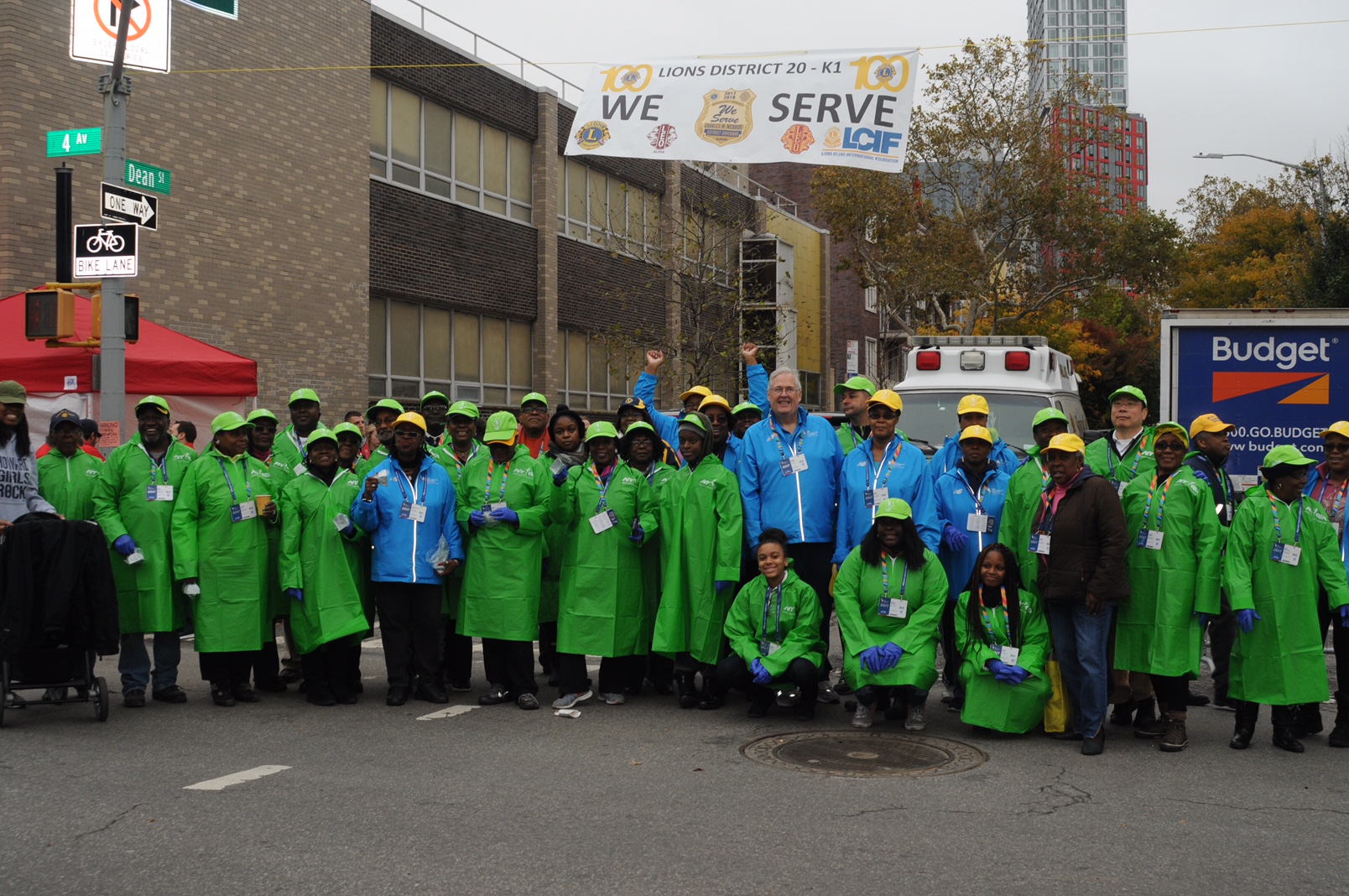
In celebration of LCI’s 100 years as a service organization, the districts have been urged to establish Centennial Projects in four key areas of need – Vision, Youth, Environment and Hunger Relief.
Lions Club International is the world’s largest service club organization with more than 1.4 million members in approximately 46,000 clubs in more than 200 countries and geographical areas around the world. For more information, visit: e-district.org/sites/20k1/contact.php.
For over 20 years, Bernice Green traveled around the US and Europe as the first Black publicist at CBS Entertainment and News promoting stories of fiction and fact. During her tenure as the network’s senior publicist from the 1970s through the 1990s, Green was a go-to for crisis communications and handling challenging stars. She was assigned to direct publicity on over 125 shows from Sixty Minutes, 911,Tony Awards and the Grammy Awards to Murphy Brown with Candice Bergen, Alex Haley’s Queen with Halle Berry and Monte Carlo with Joan Collins. Advising and managing the images of these world famous, outspoken women was second nature to her. Bernice was the eldest daughter of renowned Bed Stuy community activist Jane Witherspoon Green and was raised in the shadow of her dynamic mother and family friend Shirley Chisholm.
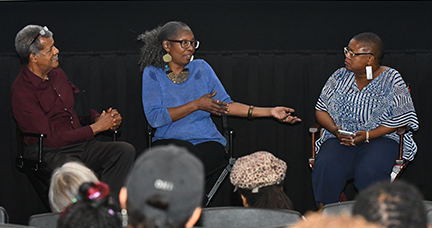
David Greaves, Bernice Green and moderator Moikgantsi Kgama at the Reel Sisters Film Festival at the Magic Johnson Theater in Harlem.
At the closing day of the 20th Anniversary Reel Sisters of the Diaspora Film Festival & Lecture Series, Green’s documentary homage to her mother And Call Her Blessed: A Portrait of Janie was showcased at the Magic Johnson Theatre in Harlem. Moikgantsi Kgama, founder of ImageNation Cinema Foundation moderated a conversation with Green and her husband David Greaves, the producers of the film and publishers of Our Time Press. The short documentary profiles Jane Lee Weatherspoon Green (1925-2013), a Bedford Stuyvesant grassroots activist, whose passionate voice was a major force in shaping anti-poverty programs and community self-empowerment for four decades in Brooklyn. The film captures the grit, wit and fire of the late mother of 16, who grew up in Jim Crow Georgia, but became part of the Great Migration and raised her family in Brooklyn.
Outspoken about the needs of Bed Stuy, she became the creator and founder of the long-time Eleanor Roosevelt Education Outreach program; former Board member of Brooklyn Congress of Racial Equality (CORE), Bedford Stuyvesant Youth-in-Action (YIA) and Brooklyn’s Community Board 3. The film showcases a woman who not only met with Jackie Onassis and Robert Kennedy, but who was a community powerbroker and advisor to Brooklyn’s political leadership from Congress and City Hall to Borough Presidents and District Attorneys.
“After decades of traveling the country to capture human interest stories for CBS, it seemed a natural to document Janie. I approached her as a community personality, not as my mother,” explained Green. “During the editing of the film, I became aware of my responsibility to the world and to her progeny to create a document about a woman whose value to the community and Brooklyn was beyond measure.”
Playwright J. E. Franklin “How much richer our lives would have been if we’d had an opportunity to record their stories, as we can today.”
To award-winning playwright Je Franklin, who penned the classic play Black Girl, And Call Her Blessed: A Portrait of Janie is part of the historic legacy of Black women speaking out for social change and retelling the story for the next generation. But, Franklin stresses, in the 21st Century, there’s an urgency for visually recording these histories.
“The women role models were our grandmothers, the Obeah women and our teachers. Because white terrorism was a daily reality, any form of activism had to be covert. Our records of their lives are stored in diaries or in stories pulled from our memories. How much richer our lives would have been if we’d had an opportunity to record their stories, as we can today.” said Franklin. “Today’s young activists have been pleading with elder activists for generations to talk to them and give testimony. It’s past time for them to get their cameras and interview more “Miss Janies.”They have to get the testimony as if all our life depended on it. Because it does!”
Moderator Moikgantsi Kgama and Reel Sisters Founder Carolyn Butts, at left, with Bernice Green, far right, daughter Joanna Williams, granddaughter Chelsea and husband David Greaves.
Already, Green’s daughter Joanna Williams and 9 year-old granddaughter Chelsea are collaborating on a documentary film about her legacy. Last year, Chelsye wrote and directed an award-winning student film. Green’s mother was blessed to see her daughter using communications skills to be at the forefront of social change. As former Director of PR at UniWorld Group, Green headed Microsoft’s first multicultural campaign for Bill Gates and the massive multi-year NYC African Burial Ground Campaign for the Schomburg, which included personally escorting Sidney Poitier on a tour of the historic opening.
Legacy is so integral to Green’s career mission that she launched the communications consulting firm Legacy Communications. And Call Her Blessed: A Portrait of Janie is part of that legacy. The film has earned accolades, including an American Women in Radio & Television Award. “My goal was to create a living document of a woman that people, including myself, would say ‘Wish I could have met her,’” said Green. “The great Ruby Dee viewed “Janie” and thru a note, to both me and Dave, expressed an interest in “Janie” as a character. Imagine if Ruby Dee played Janie!”
David Robinson came to the offices of the International African Arts Festival this past Sunday, invited in partnership with the National Association of Kawaido Organizations (NAKO), and spoke about the creation of his Tanzanian coffee farm, the Sweet Unity Farms cooperative of four hundred small family farms he is part of, and expanding to trade with the “African-American tribe” of the Diaspora.
They produce 100% Tanzanian Gourmet Coffee. This is coffee you’re proud to drink. Below are some of his remarks.
DAVID ROBINSON:
We went to Africa in the ’70s, and again to relocate in the ’80s, trying to create some optional directions. Investigate different potentials for the development of our African-American tribe and our ability to impact the African race which our tribe is part of.
David Robinson speaking to a gathering at the offices of the International African Arts Festival about the coffee growers of the Sweet Unity Farms Co- Op in Tanzania. Photo: Bernice Green
Our years of enslavement and struggle here have put us in a strong position to be able to impact our race’s development; and yet based on those experiences we have come to be a much more domestic people in terms of the confines of America as opposed to being global. Right now, and for the last many, many years, colonialism in the 1800’s was just another form of globalization. But everybody, crossing the deserts and the badlands coming from South America, Central America, into North America, those were individuals. The Chinese were sponsoring corporations and individuals all around the world. American companies, European companies, are all throughout Africa. Everybody, whether it’s an individual, a small-scale company or a corporation–large multinational corporations are dealing on a global economy in order to survive.
I have believed for the last 30 years, and it’s been part of the reason that I’ve gone to Africa, that the African-American as a tribe cannot afford to hope to stay here and survive and develop. We will not impact our race and play a role that we can play as a group that has been exposed to Western dynamics in education and economics to help save and develop our race.
So, I’ve been blessed to be in Tanzania, made the transition from 1982 to 1984 – very grateful to have started a farm in 1990. Met my dear wife in 1990 as well. We have a little over 250 acres of land as our family’s farm, by 1996 we started a cooperative which grew into several hundred small-scale family-owned farms and neighbors. I think I mentioned the figure of over 1000 acres under cultivation in coffee as a cooperative. There are 400,000 small-scale families growing coffee in Tanzania. Annually, the nation produces 100,000,000 pounds of coffee. Kenya, Ethiopia and Cameroon produce but that’s just Tanzania’s figure.
So, we are on a wealthy continent with a crop called coffee which originated from that continent. We have taken it to the level of not just farming a commodity and selling that commodity, either at the village level or the national level as a raw product. We ship our coffee to the United States in a 40,000-lb. container and then we roast coffee in New Jersey and sell it under the name of our farm, Sweet Unity Farms Coffee. I’ve been with Segun (Segun Shabaka) before and we’ve sold the coffee here. I just got in a week ago and did not organize coffee to be sold for this meeting but there’s ways on the web that you can find it and that’s a discussion.
But we’ve taken the wealth; the raw product of coffee is not much more than 10% of the cost of the coffee in the supermarket. So, when you’re selling at the village level, you are really not engaging in the profitable component.
With just the labor component, we get enough money for the grist and the fatback and the greens, to go back and farm; but not to develop our schools, our families, our housing, our medical facilities, and that will be the order of the day. And over the 40 years that we’ve been in analyzing and working in the struggle and when we hear people say, “War is the nature of humanity”, we say that may be true but there are different kinds of war. Certainly, economic conflict, competition, taking advantage of opportunities, developing your raw products into finished products. Being sophisticated enough to negotiate in the global economy. That isn’t violent warfare and it seems like fair game and we aren’t playing it.
We’ve reasons for it but that’s not going to guarantee our survival and we were here in Harlem in the ’70s under the name of United Harlem Growth. We were buying brownstones back then for $500 apiece and you know to this day I will not condemn any Jew, Greek, Asian who is in our community today because brother, from 1960 to 1980, we had 20 years of opportunity and we were unfortunately going in the wrong direction. We were leaving Harlem and going to Queens, we were going to Jersey. Those who had to put a few dollars into education were trying to get out.
So, we’ve gone to Africa to build our global resources. The land, the knowledge, how to grow the coffee and then come back and deal with the American market. So, I’m very proud and pleased that our cooperative involved in that and that is led by our family. You didn’t see – you saw some of the younger end of our family. We have 7 children here in America total and 3 left at home, but one of the children you saw is the last in this film. Young man just came over this year so we’re coming over here and getting education. We will see – those of us who go back, but one of our children who you didn’t see in that film now works for Gregory Coffee. Gregory is one of the chains here in America. She’s learning the coffee business on that end and then she comes in on her spare time. She’s also going to the university and then she also comes into the office of our coffee company and volunteers to help out on the paper work of our own coffee company. So, it’s definitely – I’m not supereducated by a long degree. As my sister said I went to Stanford University for one year and all that was protest. So, I didn’t go to class.
What we did in Harlem we did because we were people who needed housing. We were the – we had the heart but we could not pull together the brains, the educated of our tribe, the moneyed of our tribe to back it, we were raggedy, dirty and tough, and that separated us. I know people today who see I cleaned up my language and my beard is combed. But I know people, African-Americans, who wouldn’t relate to me in the 60’s and 70’s because of the cultural, verbal, dress, appearance and that this unity screwed all those brownstones. Those few of us got it but all the other housing… When I went to Africa we returned 15 brownstones to the city of New York because we could not find brothers and sisters to join in with our form of operation. Lost opportunity is happening every day, week, decade. It’s happening now in North America and globally.
We are fortunate to have what we have in the land that we have in Tanzania today, but my wife has been buying property around Dar es Salaam for the last 5-7 years. What she bought 5 years ago we couldn’t afford to buy today. So, even land costs in Africa are going up and opportunity lost. When I went to Africa, the first time I landed in Dar es Salaam I got to the hotel room and counted out my little $275 on the hotel bed and that was my start-up capital. Today, I encourage people to think $50,000 as your start-up. You don’t need that money the day you land but certainly in the first 12 months to set something up, you’re talking about that level of investment.
So, we’ve had 30 great years, we’ve tried to show that it can easily be done. Like I said, a brother without a college degree and a couple of hundred dollars in capital for his trip, be struggling and juggling and bringing in money always. Over the continent, you will be known as being a non-Swahili speaker. So, you’ll be known that you’re not from Tanzania and the next thing people say is where are you from Zambia? Uganda? South Africa? Once they find you’re from America, people call me Americani. You don’t get upset with these little titles. They call us a lot worse here. We have to know who we are, and we know where home is and that’s how we deal.
So, what we’ve come today to announce, discuss, plant the seed of an idea is we – our family has allocated 756 acres of land and we are in the process of designing a project where in 3 African-American individuals or families come and reside on housing that we will build on that land and manage a model and demonstration farm, growing a variety of agricultural crops. Then processing those crops at the village level into finished product. So instead of selling corn in the kernel, we will take the dried kernel, process it into flour and sell it by the 5 kilo, 10 kilo, 50-kilo bag both in Tanzania and outside. 40% of our vegetables, tomatoes rot after harvest because we can’t get them to market quick enough. We don’t process them. And now with jarring, which my grandmother did, she had a whole wall full of jarred vegetables, to sundrying, to the making of tomato sauce and spiced sauces, is what we will do with the vegetables.
We will be planting, harvesting, processing, marketing and selling the finished products. Not just of that 75 acres but all of our co-op families. Several hundred families who have extra corn or other crops. Once we find a crop that works then we can begin. Those people who plant a quarter-acre of tomatoes now, if there’s a market in the village they can easily go 4 times that to an acre, 8 times that to 2 acres, because we have created a processing mechanism to make it more profitable and to avoid spoilage.
We have begun to outline this initiative on paper. This is the first time I’m back in the United States to speak on it and I’m really here to sell coffee and see family but our relationship with Segun goes back deep and this is a great group of family to discuss with initially to get some feedback.
The Sweet Unity Farms coffee will be available at the IAAF office in Restoration Plaza in 1-2 weeks. Call 718-638-6700 for more information.
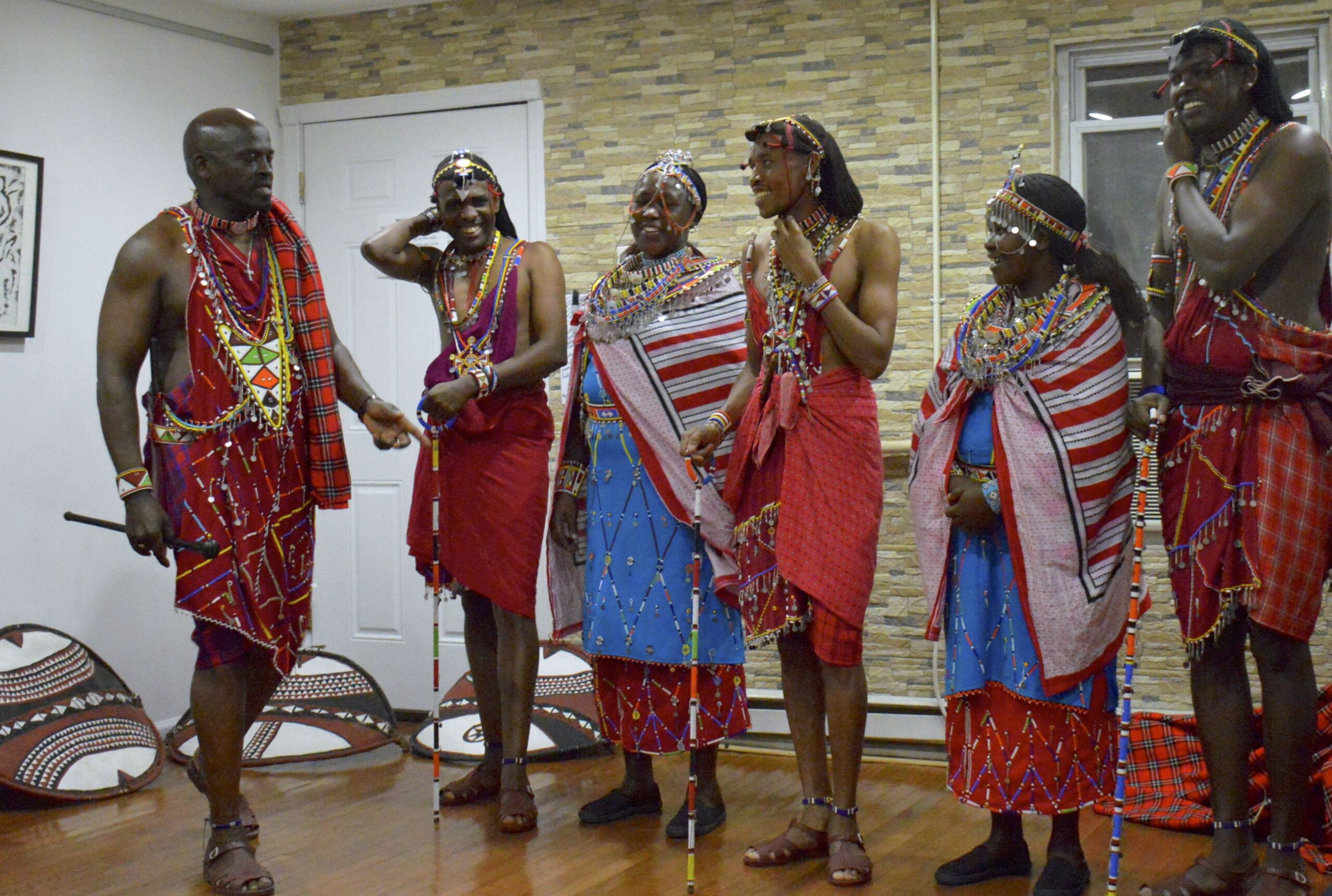
The culturally historical neighborhood of Bedford-Stuyvesant got a taste of southern Kenya as the world-renowned Friends of Sironka Dance Troupe graced Bailey’s Café last Friday. In conjunction with, and sponsored by the Bedford-Stuyvesant Museum of African Art, the troupe put on a performance that was as memorable as it was entertaining, and entertaining it was. Consisting of men and women of the Maasai heritage, the Sironka Dance Troupe were decked in traditional Kenyan garb adorned with elaborate Kenyan beadwork. As all troupe members were noticeably wearing red, I would later learn that red is a color commonly worn by the Maasai.
The founder and leader of the Sironka Dance Troupe, Nicholas Sironka, started out the program by providing the packed room with background information on both the troupe itself and the Kenyan tribe that they pride themselves in being a part of, Maasai. As described by Nicholas, the Maasai are a prideful people who have stuck to traditional Kenyan values in the face of increasing attempts to “urbanize” Kenya. High-minded viewpoints like respect for elders, and arguably most important of them all, respect for self, are espoused by the mighty Maasai. For the Maasai, having respect for elders entails that you dress honorably when in the presence of elders, Nicholas explained. In that sense, having respect for elders goes beyond the usual talking and acting respectfully. Saggy pants, a common “fashion” trend in the United States, would be frowned upon, particularly worn in the presence of elders, according to Maasai cultural norms. In an effort to not completely expose many deeply held American norms for the atrocious nature that they are, someone in the audience did manage to highlight that the sagging pants form of dress is also looked down upon here in the United States. The larger point of the matter is that much can be learned from the discipline and orderliness of the Maasai.
Photo: Ron Howard Art from Southern Kenya.
As the event progressed, cameras went up recording the wonder and sublimity that was the show put on by the Sironka Dance Troupe. Throughout the evening, guests continued to arrive to watch the troupe engagingly showcase traditional Maasai songs and dances. Every time I looked up, someone new had arrived. Among the songs and dances performed by the troupe, there was one in particular, a hymn and song, sung by Kenyan mothers to their young. I listened intently as this demonstration transpired while simultaneously recorded it on my videophone. I understood the value and rarity of such a live performance of song and dance from the continent which my ancestors originated. The whole while I had in mind my future offspring and the ability that capturing such a moment on film would provide me to share with my future child thereby directly connecting him or her to our motherland. The demonstration was equal part-surreal and inspiring.
Other presentations required the help of the Maasai men such as when the group performed the “jumping” dance. The aptly titled “jumping” dance is meant to demonstrate the physical prowess of Maasai men. During the dance, men, and in this case women, were literally jumping, two at a time in an effort to see who could jump the highest. The entire time, the audience was fully engaged as the Maasai would consistently seek out volunteers to dance and sing along even if those participating had little understanding as to exactly what it is they were saying. Everyone participating did, however, understand the universal language of kindness, love and community empowerment that was promoted by the dance troupe. In between each performance, Nicholas would give background on the tribe’s history and/or the significance of each ritual. Every word uttered by Nicholas was encouraging, reaffirming for everyone there the power and strength of all people.
Towards the end, a Maasai woman troupe member sung and hymned a tune that is commonly used to calm cows as they are being fed. Though such a concept may seem foreign to us Americans, for the Maasai this is normal as they are, by and large, cattle and goat herders. Before the performance began, Nicholas described how the orange milk holder used in the performance is found in the home of many Kenyans, including in his own, with the orange color specifically symbolizing hospitality. Over time, Nicholas explained, the orange gourd darkens and has a brownish orange hue as it is usually placed near the fireplace. This reinforces yet again the Maasai as a traditional group that has remained true to its cultural practices and norms.
The impact of the Sironka Dance Troupe was perhaps placed in perspective for me when at the very end, a local community member arrived and insisted that I take a picture of him with the Maasai. He was almost star-struck and even called his friend to brag that he was with, in his own words, “real” Maasai. The admirer, like Vira Lynn Jones, the Executive Director of the Bedford-Stuyvesant Museum of African Art, who was instrumental in securing visas for the group to travel to the United States, understands the significance and importance of the Maasai. His enthusiasm helped me to better appreciate Vira Lynn Jones’ prolonged battle in bringing the Sironka Dance Troupe to Bailey’s Café and to other prominent New York City venues. I understood more fully why Vira was so insistent on having the historic troupe perform amidst a hostile foreign policy climate espoused by the Trump Administration via their various travel bans. It’s not that Nicholas and the Sironka Dance Troupe were not effective in conveying the importance of their performance. Rather, seeing the admirer, who happens to also be my father, react in that manner only served to increase my understanding of the mighty Maasai people.