Yes, some people are insisting that Black Panther is really Black – in aesthetic, not just ethnicity. And yes, this is the first time so many Black people have been seen looking fabulous and doing fabulously well in a shiny world that stretches the limits of our imaginations. But that’s not the only reason so many are SO EXCITED about the movie. Let’s face it: we need heroes.
At a time when people are being raided of their hard-earned rights and their very dignity, we may have a need to see the majesty of Wakanda front and center, if only for a few hours. But can we get a little excited also about the real-life superheroes we are fortunate enough to have out here working on our behalf against sometimes incredible odds? Like these below, for example:
Colin Kaepernick
(AP Photo/Jeff Chiu)
Few people have embodied our rage and commanded our respect like Colin Kaepernick. This brother put himself all the way out there to take the lightning rod heat. Colin did what superheroes do – he took on the bad guys by himself. If others joined him – great! If not – cool. He was going to speak out against police brutality despite the cost—and the cost was considerable. Emblematic of courage and clear conviction, Colin has no use for a cape or a sonic spear; his Afro and cornrows are the heart on his sleeve.
Colin’s money stays up where his mouth is. Remember this?
“I will donate one million dollars plus all the proceeds of my jersey sales from the 2016 season to organizations working in oppressed communities, 100K a month for 10 months.” Done. His free Know Your Rights Camp for young people helps to keep kids alive by rehearsing them in the difficult dance that might be their next police encounter. They are also availed of information and resources on higher education and self-empowerment.
Maxine Waters
There was a time when it was not a compliment to be called Auntie – unless, of course, by your niece or nephew. But Congressperson Maxine Waters appears to find it as amusing as she does endearing. Who knew that all her work on – and behind – the scenes, would result in her becoming a household name synonymous with grit and greatness? People wait to hear what Auntie Maxine has to say about an issue, because they know it will be straight-edged.
Rep. Waters has gained a reputation, first among her constituents, then throughout the nation, for taking on the villains, be they at a hearing on Capitol Hill, across the table at a televised interview. Her bark is not worse than her bite – it is her bite. She will call anyone out and anything – if it’s not right.
Maxine is regularly out on the streets among her constituents, seeking truth through their lived experiences and finding ways to translate that into policy with teeth. Whether it was standing up for Geronimo Pratt and Rodney King, backing former Rep. John Conyers on reparations or voting against the war Iraq, to name just a few of her stances, Rep. Waters found the courage of her convictions.
The former chair of the Congressional Black Caucus, Maxine is the senior-woman in Congress. As the ranking member of the House financial Services Committee, she worked with former Rep. Barney Frank to seek a way to bring economic restrictions into play in countering the draconian surveilling of the citizenry by the NSA. She has always faced hard truths with resolve and a touch of humor and she is always welcome where people are need of a champion with a conscience.
Amandla Stenberg, an outspoken critic of cultural appropriation, was named Feminist of the Year by Ms. Foundation for Women at the ripe old age of 16. That same year, she was one of Time magazine’s “Most Influential Teens,” a list she’d be included on again in 2016.
A child model for Disney at age four and later an accomplished musician and songstress, Stenberg became widely known for her acting. Her first feature film was “Colombiana,” but being cast as Rue in the blockbuster film version of “The Hunger Games” (2012), set racist fans of the novel aflame, creating a media frenzy. When eyes were upon her she sometimes took the opportunity to speak out against injustice. But most often, she was too busy creating art to affect change. In 2015, she co-wrote, along with Samantha Jones, “Niobe: She Is Life,” a comic book featuring a Black teen warrior girl. “Niobe: She Is Death,” the second of a trilogy, was published in 2017.
In 2016, Stenberg’s School video project about cultural appropriation went viral when it asked, “What would happen if we loved Black people as much as we love Black culture?” Titled, “Don’t Cash Crop My Cornrows,” the video addressed white celebrities co-opting Black hairstyles, Hip Hop, etc., without respecting — or even grasping, at times — the underlying history and significance.
Stenberg works to help get more young women involved in STEM, is a youth ambassador with No Kid Hungry, and supports the Ubuntu Education Fund, of Port Elizabeth, South Africa. She directed the #BlackGirlMagic video series for Teen Vogue and in 2014 directed the short film, The Yellow Wallpaper. She plans to become a professional filmmaker who expands the breadth and reach of roles for Black women.
Tarana Burke’s journey on the path of advocacy did not begin when she coined the phrase “Me Too” in 2006. As a child born and raised in Queens, she was nurtured by her parents to know her history and to seek justice. She began working as a teen to improve conditions for other girls and her understanding of the importance of social justice work expanded when she spent summers working in the South. Proud of her work and filled with the urgency to serve and affect change, Burke would accept the mission instilled in her and would run with it.
Just Be Inc., which she founded (renamed Me Too in 2008), and Girls for Gender Equity, for which she serves as Senior Director, have shown girls their own bright faces and beautiful minds, passing along the courage to speak out and stand up for themselves and for one another.
Burke could likely never have imagined where her words would take her and other women. And men, too. She has been interviewed and celebrated, photographed and televised worldwide. More importantly, she has inspired a movement that is healing, empowering and creating seismic change. And it all started with pain, humility and a reckoning with herself. In an excerpt from her own words, Burke tells of a little girl named Heaven who confided in her about being the victim of repeated sexual abuse at home. Heaven’s words paralyzed Burke. The abuse she had suffered herself came rolling back and the pain prompted her to turn the child away, referring her to someone else. Burke failed that little girl, but she made the failure mean something. A lesson that bears repeating:
“I will never forget the look on her face.
I will never forget the look because I think about her all of the time. The shock of being rejected, the pain of opening a wound only to have it abruptly forced closed again – it was all on her face. And as much as I love children, as much as I cared about that child, I could not find the courage that she had found. I could not muster the energy to tell her that I understood, that I connected, that I could feel her pain. I couldn’t help her release her shame or impress upon her that nothing that happened to her was her fault. I could not find the strength to say out loud the words that were ringing in my head over and over again as she tried to tell me what she had endured… I watched her walk away from me as she tried to recapture her secrets and tuck them back into their hiding place. I watched her put her mask back on and go back into the world like she was all alone, and I couldn’t even bring myself to whisper… Me Too.”
When a school is the only one in its district to rise more than 20% in both the ELA and Math on the New York State exams, plus is outperforming the City and the District and is in good standing with the State, there should be commendations all around.
P.S. 25/The Eubie Blake School in North Bedford-Stuyvesant is a small school with a big success story, but there’s a proposal on the table to reward its achievement with closure at the end of the 2017-2018 school year. That’s if, at the end of this month, the Panel on Education Policy (PEP) votes to close it. The Community Education Council’s (CEC) decision to advise closure was based on its low population, despite its high performance.
The hearing panel included school principal Anita Coley; for the DOE, Phil Weinberg, Deputy Chancellor for Teaching and Learning; Acting District 16 Superintendent Rahesha Amon, and NeQuan C. McClean, President, Community Education Council, the organization that initially recommended the closure.
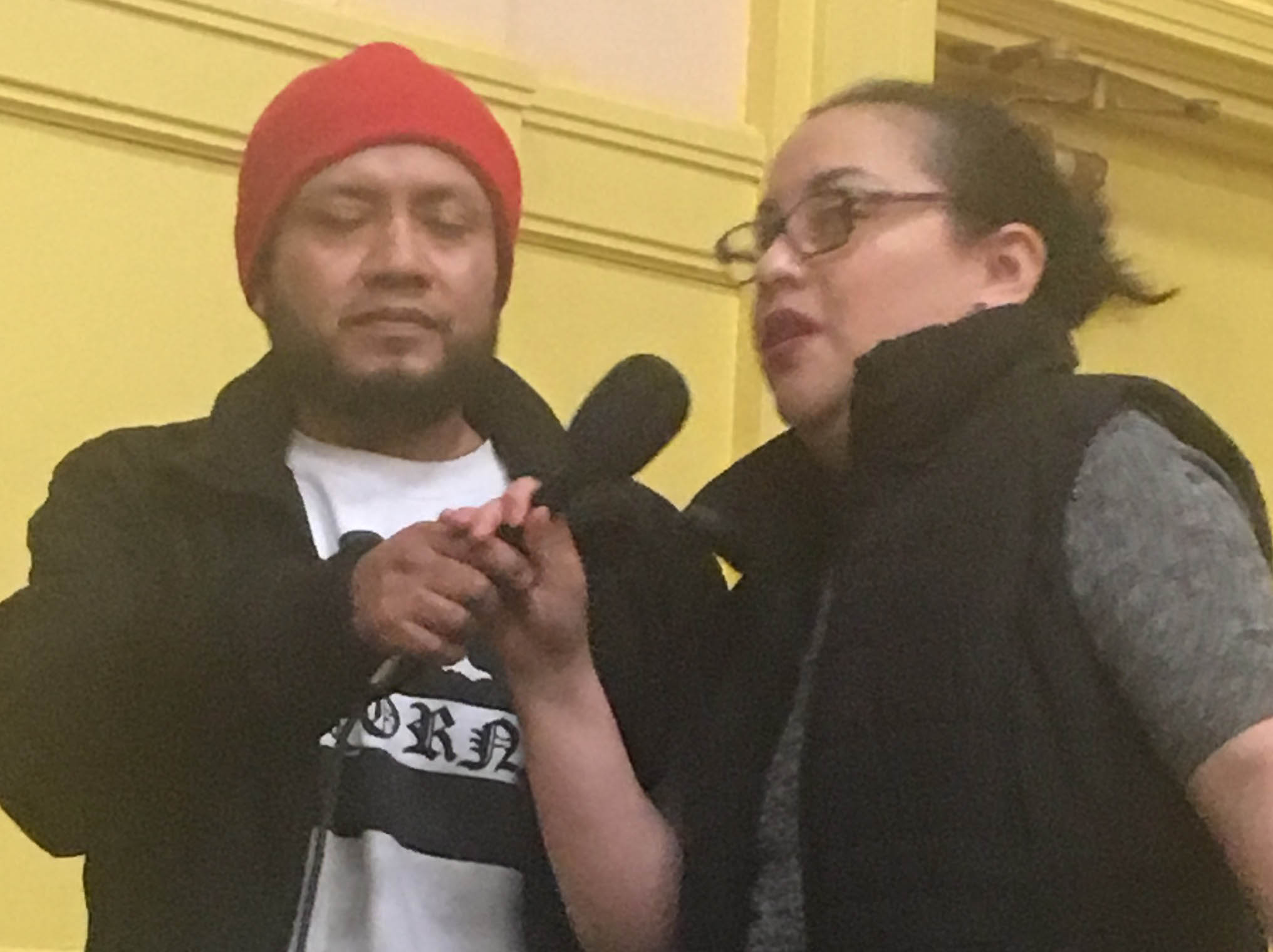
To get ready for the evening, the PTA, under the leadership of President Daisy Sanders waged a strategic campaign to bring attention to the school using the tried and true method of the parent’s phone bank. Letters were also sent to PEP, Councilman Robert Conergy, Congressman Hakeem Jeffries and other leaders. Community residents and neighbors were alerted. Even though the hearing fell on the same night as Community Board 3’s regular meeting, about 100 were in attendance that cold night.
The hearing opened with a parade of children respectfully chanting, “Save Our School! Save Our School!” The placards lifted high gave similar messages: Give Our Kids a Chance; New York State Recognized P.S. 25 as a reward School. Why Shut it down? After the introductions and statements on hearing rules, the floor was open to the speakers starting with community leader Deidre Williams, and including the children, parents, community residents, community advocates, education activists and others.
P.S. 25 Parent Raphael Sanders offered a solution to the complex CEC/DOE “small school/large space” dilemma. He said instead of closing the school, “Why not bring to P.S. 25 a small failing school and watch what happens!”
Another highlight was the appearance of former P.S. alumna Dr. Audrey Baker, a powerful Brooklyn education, community and civic leader, whose passionate comments received thunderous applause from the P.S. 25 family. “I am very disturbed that a school like this should be closed,” she said adding “this is something that has to be fixed.” Also, the comments of Aprille M. Russell, representing her mother, school alumna the late Evelyn A. Russell, for whom a school scholarship has been created.
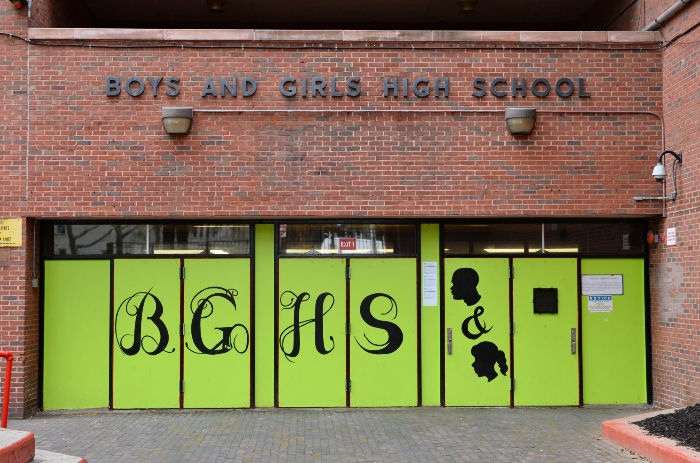
Boys and Girls High School was created in 1878 and courted controversy from its inception since it was considered inappropriate to provide free high school education to all students, including low-income students. The school was originally named Central Grammar School to avoid angering community members. Even in 1878, providing free high-quality education to low-income children invited scorn, so the school didn’t advertise that it was free in its name.
Without a reputation or track record, the lure of free education drew countless students, and in 1886, a second school was built. Boys were taught in one school and girls in the other. In 1975, the schools merged and moved to their current location on Fulton Street and Utica Avenue. Subsequent principals continued the original mission of Boys and Girls High School: creating college preparatory programs and other opportunities for students from all backgrounds.
While the name has changed, the tradition of providing high-quality education for passionate students has not. Shirley Chisholm, Lena Horne and Rita Hayworth are just some of the incredibly talented individuals who benefited from the world-class education at Boys and Girls High, and the legacy of top-tier education lives on.
Boys and Girls High School is one of the leaders in Brooklyn when it comes to STEAM education, or science, technology, engineering and applied mathematics. It is no secret that students will need technology skills to succeed in the modern global economy, and it is necessary that high schools provide this type of education. Boys and Girls High School is providing laptops, SmartBoards, iPads and desktops for students and creating career and technical education programs in computer technology and electrical engineering.
In addition, Boys and Girls High School offers several paths towards academic success. With over 18 Advance Placement classes, and an early college program with Long Island University, Boys and Girls High School has a high-quality college prep program in our backyard. Combined with their modern facilities and varsity sports teams, it is surprising that enrollment is low at Boys and Girls High School. Under the new principal, Ms. Grecian Harrison, Boys and Girls High School is entering a new era. With more investment in students and a focus on college readiness, the school will only improve, sending even more students in our city to colleges and universities throughout the country.
While parents are increasingly sending their children to charter and private schools, we cannot overlook the services that our borough’s oldest public high school has to offer. Boys and Girls High School has worked hard to become a modern campus, with many of the same opportunities as other expensive schools. We should be proud to have such a historic school in our community. It is my sincerest hope that parents will begin to take advantage of this educational opportunity and build upon the great legacy of Boys and Girls High School.
Did I ever tell you my Basquiat story? He painted the walls for a disco club in my building. When we left, his murals were still up. A corporate office was moving in, so they painted over them. -arm
I don’t remember the first time I ever met Jean-Michel Basquiat or IF I ever met him. Our relationship was more star-crossed than hand-pressing.
Our theatre company owned a building in Chelsea which had a large empty second floor which we used for rehearsals. We rented this space out at night for parties and events.
One event planner asked to rent it on a full-time basis given the proviso that they could decorate it.
Part of this decoration process was painting the walls. We gave them permission if they restored the place when they left.
Meanwhile, my friend owned a paint company and one of his accountants had a son who was an artist. Since I was in the arts, my friend asked if I could be helpful in finding him a gallery. Of course, I declined because the son was an unstable high school dropout punk art-type kid who would never amount to anything.
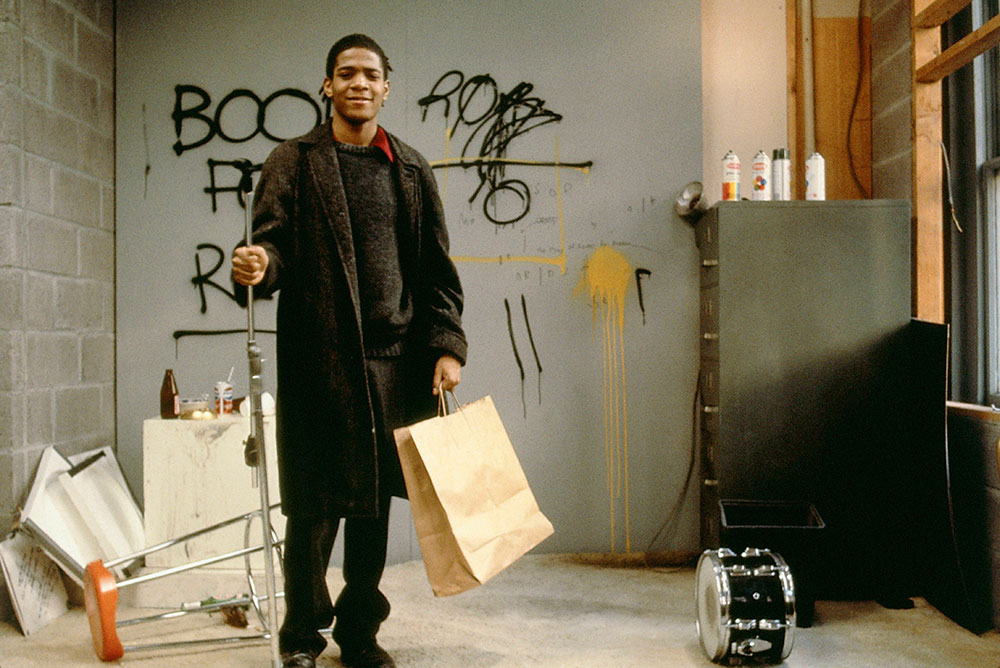
At the same time, my friend Andy Warhol had given his studio on North Moore St. to some kid who painted on walls for free. We all clucked our teeth and thought Andy was not only being played for a sucker, but worse yet, the kid paid him in worthless scribble-like paintings.
The next thing we know, this dopey-looking kid would come in at night and paint these scary-looking voodoo images all over our walls. They would light up under a certain light
This was at the very beginning of “graffiti” art. It wasn’t a matter of “tagging”, it was creating issue-oriented art in public spaces because you wanted to, not because you were commissioned or hoped to sell it.
Street Art became more and more “in vogue” as New Yorkers became more and more intrigued with the idea of “freethinking”. Social issues were being demystified in the visual arts.
Basquiat, Pere, reported that his son no longer had troubles finding a gallery; in fact, galleries were chasing him.
It was not until the father invited his boss and me to a party on North Moore St. that all three stars lined up. I realized what a big dummy I was. Jean-Michel, “the dopey kid”, was there and everyone in the art scene was fawning all over him. Ohhh! So this is the kid that Andy thought was so terrific.
Amongst the works was a portrait of his mother, Matilde, who it has been said encouraged her son’s creativity by taking him to museums, including the Brooklyn Museum, enrolling him there as a junior member when he was only six. The picture was conventionally painted with no graffiti and no words. It was so strong an image; an emotional image, that you could feel the intelligence and kindness of this woman oozing out of the canvas and into your heart.
The father, Gerard, was a businessman: he owned several apt. buildings in Brooklyn. I remember he told landlord stories, but I forget if they were for or against tenants.
There was talk about Jean-Michel not being friendly with his father because he dumped them for a white woman. Well, that could be true, but the two of them seemed to be getting along on this night.
With many people in the arts, they are not appreciated by their families. This was not true of Gerard. He knew his son’s worth and appreciated it.
The convergence came a tad late, however. The people who rented the space for an “after-hours” club went out of business and true to their word, painted over those scary voodoo images. We went back to renting the space for weddings and birthdays.
Ahhhh! What had I done?
Will his legacy encourage street artists? I’m not sure. After all, JMB was a street artist with classical training. He chose to be a street artist.
Because of Gerard’s careful attention to JMBs work after he died, the legacy of being a highly valued artist endures, and that is good. It is important that young people understand that in America art is valued by fiscal reality as well as artistic.
Basquiat’s intelligence was such that whatever he chose to do would have been successful.
-To Be Continued.
(Abigail Rosen McGrath’s BOTTLED is a recurring feature in Our Time Press. Bernice Elizabeth Green is the creator and editor of the First Thursday and First Thursday (Redux).