Home Blog Page 694

Top Environmental Scholars, Justice leaders at MEC: Communities of Color Have a Few Years To Turn Tide …

… on Matters of their Health, Welfare and Life & Death

 So, you think all this stuff about the environment has nothing to do with you; it’s just stuff?

Think again.

Peggy Shepard, co-founder and
executive director of WE ACT for
Environmental Justice, fought
successful battle for grassroots.

According to some of the nation’s leading environmental and social science scholars – speaking at Medgar Evers College’s SRO 23rd annual conference on environmental issues, last week – paying or not paying attention to the nation’s environmental issues and policies will determine if our children have a future.

The conference, themed “Environmental Disasters and the Urban Infrastructure,” was unique in that hundreds of young people – from middle school to college age – were in attendance and heard messages that not only warned of the dangers to come if they don’t understand how environmental policies are set; their power in making policy work for community sustainability and community survival; their responsibility in exercising their most essential power, voting; and what they can do right around them to get jobs, develop businesses and protect themselves.

Two of five key history-making activists in the global environmental justice movement – Peggy Shepherd, co-founder and executive director of WE ACT for Environmental Justice and keynoter Aaron Mair, former pioneering president of the Sierra Club,   – delivered striking, personal messages that appeared to hit home. They ranged from Shepherd’s warning: DO NOT purchase anything with the word fragrance, including household products and cosmetics, to Maier’s demand, “Get involved. You only have five years to get on track with conversations about and actions against environmental racism.

Photo: Tony Akeem
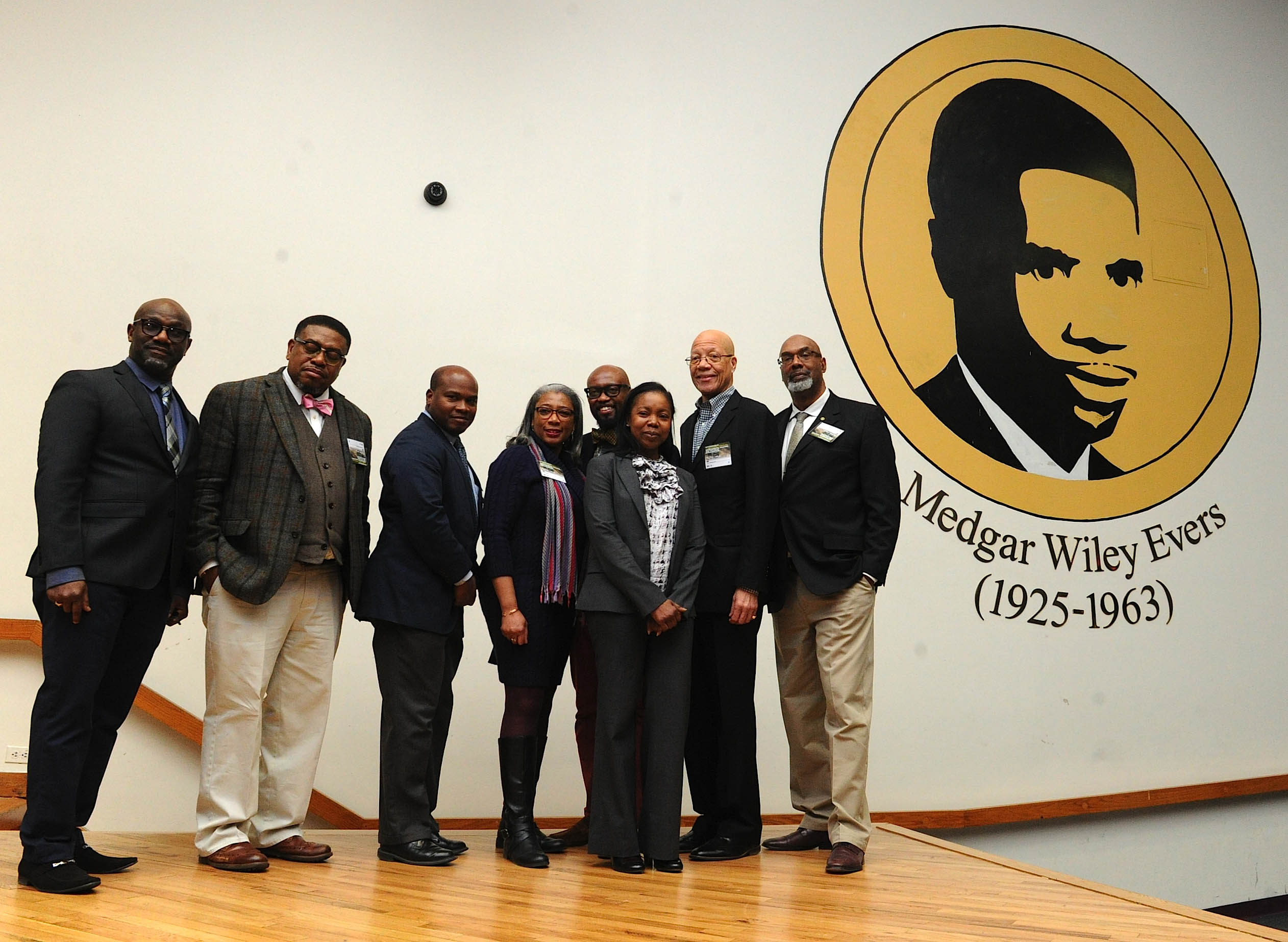
Panel on The Impact of the Trump Administration on American
Environmental Policies-National and Global: From left to right, MEC Public
Administration Professor Gregorio Mayers; Peggy Shepard, co-founder and
executive director of WE ACT for Environmental Justice; Dr. John Flateau,
PhD., Professor, MEC Public Administration and Political Science and
Director, MEC Census Information Center and Commissioner, NYC Board of
Elections; and Aaron Mair, epidemiological-spatial analyst, nationally known
environmentalist, and past president of the Sierra Club.

MEC professor Dr. John Flateau warned the audience to be ready for the multibillion dollar environment-related industry and the entrepreneurial and job opportunities that are coming with it. He also urged the audiences to respond to the 2020 census. An undercount will deliver fewer services for program funding, entrepreneurism and jobs. He also noted that the future digital voting technology may work against participatory democracy, where in communities of color, there is still a digital divide: some of us who are not tech-savvy or do not own smartphones or computers may not be able to vote.

The event was chaired by Dr. John A. Gibbs, Conference Chair Emeritus and Presented by MEC’s departments of chemistry and environmental science; Public Administration and environmental science program alumni.

Peggy Shepard has successfully combined grassroots, organizing, environmental advocacy and environmental health community-based participatory research to become national leader in advancing environmental policy. Shepherd advised go to the website: not sopretty.com.

Aaron Mair’s decade-long battle on behalf of communities in upstate New York led to a shutdown of polluting solid waste incineration in an inner-city community outside Albany, New York; a commitment by the State to close it and a $1.6 million settlement award to that community.

Mair was also a key figure in leading the fight and securing the Sierra Club’s participation in the Clean Up of the Hudson campaign. His actions resulted in a settlement between the EPA and General Electric to dredge toxic sediments from the Upper Hudson River.

Dr. John Flateau, PhD., Professor,
MEC Public Administration and
Political Science and Director,
MEC Census Information Center
and Commissioner, NYC Board of
Elections

Dr. Flateau, a professor of public administration and political science at MEC, and director of their Census Information Center is also Commissioner of the NYC Board of Elections. He is a strategist on federal, state and local campaigns; election reform and voting rights litigation designed to empower communities of color.

Some of this country’s most dynamic leaders in the environmental justice movement can be found at MEC. The panels covered two hard topics: in the morning, the Environmental monitoring and Sustainability: trends, challenges, and plans for a more sustainable future, and in the afternoon, the impact of the Trump Administration on American Environmental Policies – National and Global.

Panel moderators included: Dr. Alicia Reid, chair, Department of Chemistry and Environmental Science, MEC; Dr. Christopher Boxe, Deputy, Chair, Department of Chemistry and Environmental Science, MEC; Professor Rhonda Binda, Department of Public Administration.

The panelists included: Jim Young Shin, Lawrence Pratt, Elmer -Rico Mojica; Dickens Saint Hilaire and Oluwaseum Salako, Joel Strothers and Professor Gregorio Mayers, Byron Price, Ms. Shepherd, Mr. Maier and Flateau.

William Washington, General Manager, Con Edison Brooklyn and Queens Electric operations, who spoke on Preparing for Emergencies, introduced by Juliet Lewis, Manager of Public Affairs for Con Edison.

Welcome and Opening Remarks were delivered by respectively, Dr. Augustine Okereke, Provost, MEC and William Washington, General Manager, Con Edison, Brooklyn and Queens Electric Operations,

Professor Wallace Ford, Chair, Department of Public Affairs MEC, introduced the keynote speaker, panels and moderators.

Also hosting the conference were Dr. Dereck Skeete, CES, MEC; who moderated the questions and answer with Maier and Dr. Terence Blackman, Dean, School of Science, Health and Technology. To view the dynamic presentations and conference highlights, visit http://www.mec.cuny.edu. To understand why we may be cosmeticizing ourselves to death, Ms. Shepard advises our readers to visit the notsopretty.com website. The event took place March 10 in MEC’s Founders Auditorium and other areas on campus.



Free Agent 2018 N.Y. Jets

0
Minnesota Vikings quarterback Teddy Bridgewater gestures to a teammate form the sidelines in the fourth quarter at U.S. Bank Stadium on Sunday, August 28, 2016.(Pioneer Press: John Autey)

The New York Jets head into this week’s free agent frenzy with a lot of salary cap space money ($89 million to be exact) to potentially make a huge splash by signing key players. It has been well-documented simply because it always seems to be a necessity for the Jets when it comes to needing a quarterback. The best available quarterback in this free agent class is former Washington Redskins quarterback Kirk Cousins. Cousins has had some great years in D.C., including the last two in which he played under the team’s franchise tag. There are multiple teams, including the Jets, who are in need of a quarterback. The big question is, at what price would they be willing to pay to add a potential game-changing player? On Tuesday afternoon, that question was answered, but unfortunately, it was not the Jets who came away in the Cousins’ Sweepstakes. It was reported that Kirk Cousins has agreed to terms on a guaranteed 3-year/$84 million contract with the Minnesota Vikings. With Cousins off the market, what will the Jets do now? Here are some potential options for Gang Green.

After losing out on Cousins earlier on Tuesday, Jets General Manager Mike MacCagnan wasted no time in just sitting back and not counting with a quick move. The Jets were able to bring back veteran quarterback Josh McCown on a 1-year/$10 million contract to return to the Jets in which he had his best year in his 15 years as a pro. McCown can flourish in the new offensive system which will now be run by Jeremy Bates. McCown has lasted this long in the league because of his accuracy and smart play and his veteran presence in the locker room which can be beneficial should a younger quarterback were to be drafted by the Jets. Speaking of that, the Jets do have a few other options should McCown not work out for them in his second season with the team. You have quarterbacks like Teddy Bridgewater, A.J. McCarron and even this year’s Super Bowl-winning quarterback Nike Foles (if the Eagles should decide to trade him). The likelihood is that MacCagnan will indeed get his prized quarterback through the draft with the possibility of USC’s Sam Darnold (age 20), Wyoming’s Josh Allen (age 21), or Baker Mayfield (age 22) possibly landing in their laps. This will benefit the Jets nicely should they get their young franchise QB with McCown to help mentor them on life as an NFL quarterback.

It has not been all quiet for the Jets as free agency officially kicks off today. The team was able to agree to terms with former Los Angeles Rams cornerback Trumaine Johnson. Johnson, 28, was the best cornerback available in the free agent class. The Jets are also looking to bring back fellow cornerback Morris Claiborne, who started 15 games last season. If Claiborne returns to the Jets and paired up with Johnson, this will more than likely fortify their secondary which allowed 30 touchdown passes last season. Johnson has 18 interceptions and 42 pass breakups in six seasons (85 career games). With money to spend still, it will be interesting to see what moves Mike MacCagnan has up his sleeves to upgrade this Jets roster.

Sports Notes: (Baseball) We are just over three weeks until Opening Day!

BREAKING NEWS AS WE GO TO PRESS! Teddy Bridgewater will sign a 1-year deal to play for the Jets. Bridgewater did not play last year recovering from a serious injury dating back from the 2016-17 season. Photo credit :  John Autey/Pioneer Press

Wishing for Wakanda, Marooned in America: Movies and Matters of Reflection and Resistance

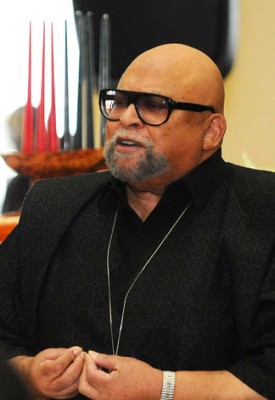
By:  Dr. Maulana Karenga

In the midst of the widespread euphoria about the “debatable real” and actually imagined qualities, achievements and benefits of the fantasy movie “The Black Panther,” it is good to remember that no matter how long we stay in the theater and no matter how many times we return to cheer, clap and dance in the dark, sooner or later the lights will come on and we will have to exit and confront the off-screen, cold-water reality of America. We must know in moments of clarity and calm consideration that even if we wish it to be otherwise, this is only a movie, a comic book story on-screen and we have every right and at least some reasons to enjoy it as we wish. But talking about it as if it is a pathway and push forward to liberation, resistance and racial pride runs recklessly into the face of reality and any concept of critical reasoning and pretends for a movie what only a movement of hard work and long struggle can achieve.

And it is such an unbounded and unreflective embrace that leads to the “need” and tendency to deny the movie’s flaws, overlook its stereotypes and explain away its misrepresentations of continental African and African-American culture and African peoples themselves; its discrediting and misrepresenting revolutionary struggle and resistance; and its cultivating the idea of the oppressor as an ally and enabler for African people.

Thus, so influenced we can overlook racist stereotypes of continental Africans in spite of their advanced technology: still carrying spears, even though sonic ones; trapped in “tribalism;” engaging in blood ritual battles to determine who will rule instead of using elections; and requiring the white CIA agent to save the Black woman and Black people from the Black man, asking the CIA agent to pilot their attack ship as if no Black person is technologically capable, assuring the agent that “we’re counting on you.” And this in spite of the CIA’s brutal and bloody history and current activities in Africa and around the world. We can also explain away the reductive translation of relations of continental Africans and African-Americans using a dehumanized would-be liberation fighter that ends up being little more than a gangster from the ghetto, indicted from the beginning by his name “Killmonger”–one who promotes and deals and participates in killing. And we explain away why a technologically superior country hides itself from whites who obviously know it exists and whom it can easily protect itself from or defeat, does not defend the continent and its people, and spends its hours on-screen fighting within itself.

The film’s appeal is understandable, not simply because of its favorably and mistakenly interpreted content, but also because of the favorable context in which it was produced and positioned. It comes at a time, as the audiences and onliners explain, when the attacks on African people, Black people, on the continent and in the diaspora, have taken a wild and openly racist turn. And the film becomes an alternative narrative for many to the rampant, racist, reductive translation and claims of who we are.

Moreover, many said it took them away from the more serious side of Black life, gave them a chance to relax and enjoy themselves watching a predominantly Black cast portray Black people highly advanced, in control of their lives and triumphant. And it was positioned in February, Black History Month, in which we traditionally celebrate and sing ourselves, reference and revisit our roots, identify and raise up heroes and heroines, extract lessons and models, and wonder out loud or silently “how we got over,” knowing deep down the struggle must–and does–continue.

But let’s face it, it was the marketing that created much of the marvel of the film. What film with Blacks as the subject has been so massively and skillfully advertised? Was “Selma” or “Malcolm X” or any other Black subject film made a must-see all over the world, with funds being collected and offered to send thousands of Black children to see it? And when have we seen almost every major media source approving and praising articles and commentaries on a Black subject coming attraction?

Surely, after all, the before-now talk about the predatory and profit-seeking character and conduct of a racist and capitalist society, we can’t possibly not know that this marvel of marketing of make-believe and this apparent established order consensus of approval and praise of the film means that it is clearly profitable for them and problematic for us. Clearly, capitalism is in it for the money, but also for the message, a message which maintains dominance, cultivates loyalty to the system in spite of its white supremacist and capitalist character, and lowers the oppressed’s conception of what they deserve, what they think possible and what they should accept.

Indeed, it is a central Kawaida contention that one of the greatest powers of any society, class or race is the capacity to define reality and make others accept it even when it’s to their disadvantage. It is the Hon. Marcus Garvey who teaches us that the propaganda of the oppressor is one of the key “organized methods used to control the world,” that “propaganda has done more to defeat the good intentions of races and nations than even open warfare.” It is, he says, a regularly used organized method employed “to convert others against their will,” against their best views and values.

And Min. Malcolm taught us to reject and resist the power and manipulation of the media, a weapon used constantly in the war to win the hearts and minds of our people and other oppressed and turn them against themselves and others. The people in power, he says, are skilled at the science of image-making and can “create a humanitarian image for a devil, or a devil image for a humanitarian.” And they “can make the victim of a crime look like the criminal and can make the criminal look like the victim.” Indeed, Malcolm concludes, “If you aren’t careful, the (media) will have you hating the people who are oppressed and loving the people who are doing the oppressing.”

Yes, it’s good to see Black people celebrating themselves, wearing African clothes, understanding themselves as African people, doing a version of the greeting/salute of the women of Us in the 60s and discussing issues of right and wrong in the way we do politics, distribute wealth, share resources and honor our obligations of solidarity to our brothers and sisters at home and abroad. But can we move beyond movie inspiration and episodic engagement with ourselves and continuously engage each other and issues more extensive than the ones the movie provokes some of us to discuss? And can we do this, not to defend a movie and our liking it, but in defense and advancement of our peoples’ lives and interests and the well-being of the world?

Our oppressors tell us we were abandoned or marooned in America by our people, but we are our people, the ones the enslaver enslaved. And taking seriously the other meaning of maroon, we are at our best, the maroons of our history, the maroons of America, the people who, in the midst of the Holocaust of enslavement, dared to reject the established order, free themselves, be themselves and build free communities. It is a lasting legacy and unfinished fight, and we owe it to ourselves to maintain its commitment to resistance and struggle, regardless of the movies we like or the lands in which we live.

Dr. Maulana Karenga, Professor and Chair of Africana Studies, California State University-Long Beach; Executive Director, African-American Cultural Center (Us); Creator of Kwanzaa and author of “Kwanzaa: A Celebration of Family, Community and Culture”; and “Essays on Struggle: Position and Analysis.” www.AfricanAmericanCulturalCenter-LA.org; www.OfficialKwanzaaWebsite.org; www.MaulanaKarenga.org.

… Of Kings and Heroes

Fern E. Gillespie

Chadwick Boseman, now soaring high in entertainment history with the milestone blockbuster Black Panther, began his acting career in New York’s Black theatre being mentored by legendary theatre producer Woodie King, Jr.at the New Federal Theatre.

“Woodie is one of the people that gave me some of my first opportunities in theatre—especially New York theatre. He’s dedicated himself to Black theatre, so I have a huge appreciation to him as one of my mentors,” Chadwick Boseman told Reelblack TV in 2017 while promoting Marshall.

King has been connected to Boseman’s career since the actor was a theater student at Howard University in the 1990s. At the New Federal Theatre, Boseman did plays and readings. Then in 2002, the New Federal Theatre presented Urban Transitions: Loose Blossoms by Ron Milner, about a Black family in crisis, directed by Woodie King. Boseman’s role as teen son E.J. was called an “insightful performance” by the Village Voice and earned him an AUDELCO Award. Boseman has continued with his connection with King.

“I knew and felt that he was just a brilliant artist,” King told Our Time Press last week. “He was astute. He came out of Howard University, so he picked up on things quickly. He was very knowledgeable and just easy to work with.”

Both Boseman and King have a fascination with Black historical heroes. Boseman made his mark in Hollywood creating memorable depictions of Black cultural heroes with biopics on Jackie Robinson (42), James Brown (Get On Up), Thurgood Marshall (Marshall) and now the comic book icon Black Panther.

“When I was growing up, we had to find these histories in books,” said King. “There were no images. “But now, theatre, film and television have some amazing Black superheroes, like Boseman, in starring roles in, and behind, the scenes.”

Black Minds Matter March and Rally

Harkening back to the effort to institute the Curriculum of Inclusion of the 1980s, New York lawmakers state Senator Jesse Hamilton and state Assembly member Diana Richardson advanced legislation requiring the NYS Board of Regents to incorporate New York State’s Black History in the New York City school curricula for kindergarten to 12th grade. The two lawmakers made their intentions public in May 2017 and continue to realize Black History in New York City public schools today. On January 3, 2018, Hamilton sponsored S5454A in the New York Senate and it was placed in the Education Committee. S5454A “relates to establishing the Commission on African-American History and Achievement.” Co-sponsors include Marisol Alcantara (D), 31st SD; Velmanette Montgomery (D), 25th SD; George Latimer (D),? Senate District; and Diane J. Savino (D, IP, WA), 23rd SD. The state Assembly version of the bill is A7192.

An hour-long documentary on Chamique Holdsclaw, the basketball star once called
“the female Michael Jordan,” will screen at the 2018 ReelAbilities Film Festival this
week and next. The film follows the phenom’s rise from her Queens hometown to
the WNBA, to Rookie of the Year and eventually an All-Star and a Gold Medalist with
her team at the Olympics. Meanwhile, her hidden struggle with mental illness led to
some dramatic lows and legal charges before she found her mission as a mental
health advocate. Showtimes and venues at REELABILITIES.ORG/NEWYORK.

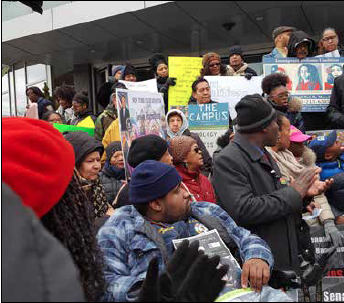
On Sunday, March 4, 2018, Senator Hamilton held the “Black Minds Matter March and Rally.” The rally was held on the steps of Medgar Evers College School of Science, Health and Technology at 1638 Bedford Avenue. It was a cold, breezy day; however, Brooklyn United Marching Band, a teen ensemble, led community leaders and residents along the march route, which was the circumference of Medgar Evers College Administrative Building at 1650 Bedford Avenue to return to the steps of 1638 Bedford Avenue to allow the 15 invited speakers to orate. District Leader Geoffrey Davis stated, “We want Black History in public schools.” Norelda Cotterel, PTA President of Medgar Evers College Preparatory High School, informed the body that “Medgar Evers College [College Preparatory High School] is under attack by the [New York City] Department of Education. Teachers are being sanctioned for adding Black History items in the different subjects. This high school is an Early High School, Early College School where the student body moves on to graduate from such Ivy League schools as MIT.”

The Black Institute Executive Director Bertha Lewis remarked, “In the 60s and 70s we were fighting for a Black curriculum, and in the 2010s we are still fighting for a Black curriculum. We are given the shortest month, which is the coldest month of the year, to celebrate. When are we going to get Black education?” Jamila Davis, author of She’s All Caught Up and who was sentenced to 12½ years in prison for a bank fraud scheme, remarked, “While I was sentenced to 12½ years behind bars, my accountants who prepared my tax filings, were given 2½ years. Davis told the crowd that during her imprisonment, she completed high school, earned her bachelor’s and master’s degrees. Davis’ presence at the rally was to wake up youth and adults to the allure of street life and fast money.

Nation of Islam Minister Paul Muhammad attended the march and rally in support of the state Senator. Muhammad said, “We have our own school, 50 years and counting.” This statement was made to encourage private citizens, civic organizations and houses of worship to commit to “collective work and responsibility” and building the institutions a community requires to survive and thrive. Altogether, 14 people were scheduled to talk. The last two speakers were state Senator Marisol Alcantara, a S5454A co-sponsor, and state Senator Jesse Hamilton. Senator Alcantara explained the legislation to the public. St. Senator Hamilton’s (IDC) comments were of a humanistic nature. Highlights of his speech include, “Gentrification can only happen if you’re undereducated. We have a struggle in front of us…keep fighting. We are taking a stand: Black Minds Matter.” The senator noted that the Working Families Party had an office on Bedford Avenue, in close proximity to the Medgar Evers College campus. Hamilton remarked, “Working Families Party says they are for us but they are not here today.” Hamilton said that his effort to include Black History in the curriculum of New York State’s most populous city has won him much hostility. The state senator has received telephone calls from people who curse and disparage him. These incidents give him the resolve to continue until the bill is voted into law and signed off by the governor. Hamilton’s essential statement is, “We have to have Black History in our public schools.”