Home Blog Page 673

Parents and Education Activists Prevailed; PS 25/Eubie Blake School Opened for Another Year

A major victory in court last month, led by journalist and education activist Leonie Haimson and her team, is keeping PS 25 open for another year. According to Haimson, on her blog, Judge Katherine Levine of the Kings County Supreme Court said the school should remain open next year and she will decide the complex legal merits of the case more carefully over the next few months.

She seemed impressed with our research on how all the other 33 schools DOE offered these kids were: (1) had a lower impact rating, (2) many of them were miles away, 19 in Staten Island, for example; (3) 25 were overcrowded; and (4) none had class sizes as low. And the DOE has not offered to provide busing for the students.

In short, she was impressed that in most every other school closing instance, the DOE promises better schools to the kids attending the closed school but they didn’t in this case because there are only 3 in the entire city and only one in Brooklyn and they are full.

She asked the attorneys: What’s the balance of harm? What’s the worst that happens if the TRO stays? Do the kids have the benefit of an excellent school for another year? The city attorney tried to argue this would hold up assignments for 3000 kids in all the closing schools, but the judge dismissed this and basically said that’s absurd. All the other assignments can go through. (Actually, there aren’t 3000 kids in closing schools, but about 2000 kids in all the closing schools & 661 in elementary schools and none of them will be affected, but the kids at PS 25, whose parents want them to remain.)

She was also interested in the zoning issue that the CEC hadn’t voted to approve this; said what public input was there? The DOE explained there were public meetings, etc. where parents expressed their concerns. The judge said you don’t have to listen to them, right? Is that the DOE’s position?

Let’s hope the city doesn’t appeal. We are also going to ask that they put a 3K and a pre-K in the school for the fall since there are waiting lists for D16 parents, especially for 3K. It’s probably too late for kindergarten though. Stay tuned! For an update, visit: www.classsizematters.org.

(“Best of” continues on Page 13, where the school’s top students are announced.)

The Best of Our Time

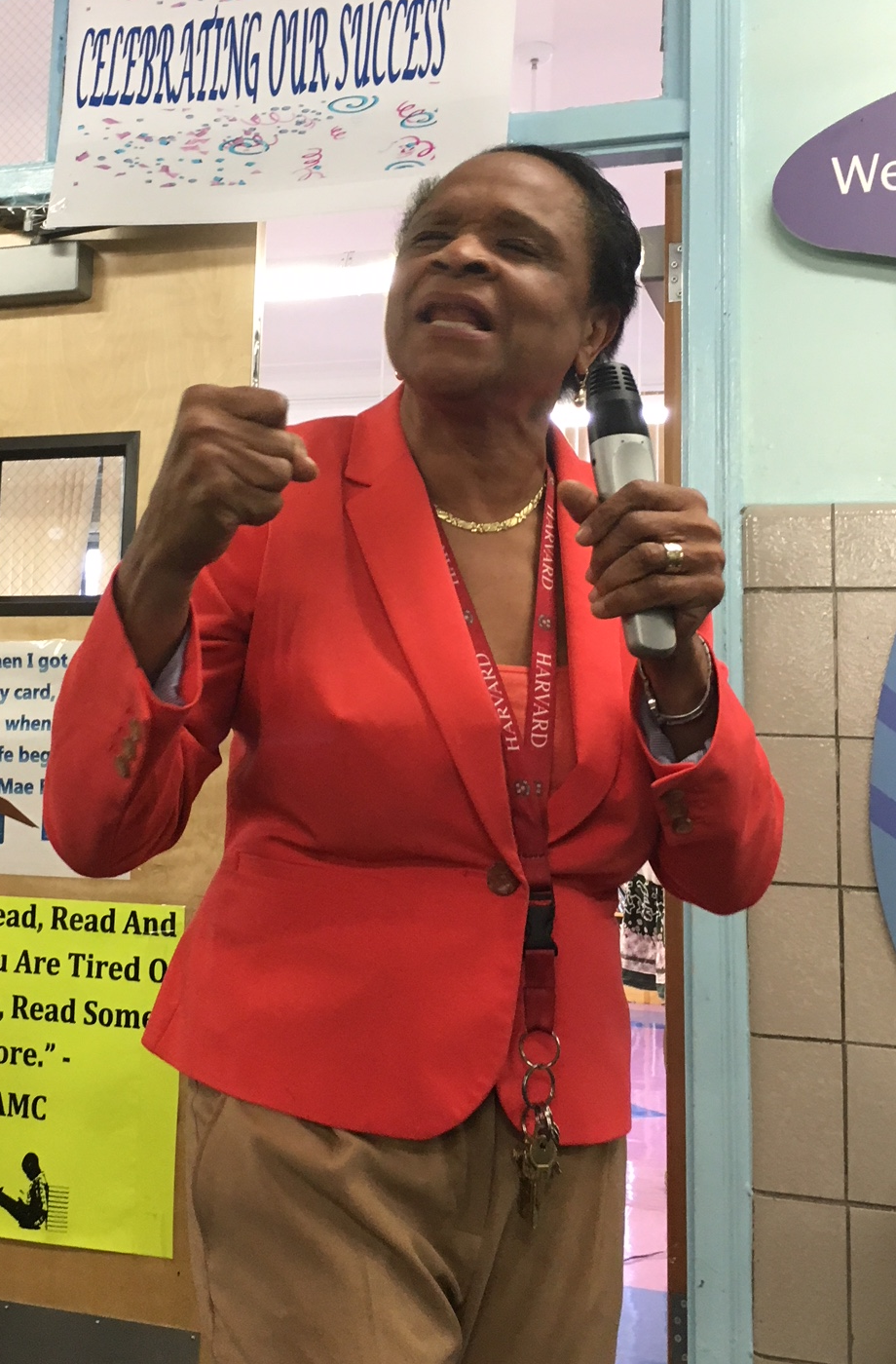
Community and education activists are a major reason P.S. 25/Eubie Blake School is staying open for another year.

But the school’s administrators and parents give credit to the students, who provided the impetus for advocates to go the distance.

Tuesday, June 12, P.S. 25 students worked the school’s garden in the morning, pulling weeds and planting a tree, and they were honored for their academic achievement with certificates and some trophies, in a special celebration with family and friends in attendance, that afternoon. The Garden moment will be covered next week in Our Time Press. Following are a list of the honorees, including the three winners of the Evelyn A. Russell Scholar Award.

Winners of the Art Awards: Ramaya King, Kyamalit Gray, Ashton Sherwood, Azzaria Kilpatrick, Kamiya Simmons, Amina Taylor, Kaleigh Louis, Angel Hayslett, Joshua Sanchez, Melvin Marshburn, Jayes Moises, Makeela Talbot, Kamiya Simmons, Adir Toscano, Jeremiah Etienne, Tanaya Graham, Nathanial Griffin and Tamaya Squires; Winners of the Science Awards: Brianna Simmons, Kyamalit Gray, Amina Taylor, Jayes Moises, Christina Williams, Jen Carlos Hernandez; Writing Awards: Saliyah Barnett, Azzaria Kilpatrick, Michael King, Alou Ndizeye, Jose Abarca, Juan Torres, Kyamalit Gray; Spelling Bee Award: Michael King, Kamiya Simmons, Da’Yah Fitch, Juan Parham; Oratory Contest: Jayes Moises, Azzaria Kilpatrick, Math awards went to the entire class of 3-301 (1st place), 5-119 92nd Place) and Pre-K-001 3rd place with 4-501 receiving Honorary Mention; Technology: Michael King, Juan Torres, Ramaya King, 5-501 Honorary Mention. Evelyn Russell Honors: Azzaria Kilpatrick was the first-place winner and Michael King and Salyah Barnett tied for second place. Gifts for this award included Visa cards from Ms. Aprille, Adam and Aisha, the children of the late alumna. (The winning essays will appear at www.ourtimeathome.com.)

Rediscovering Lost Values: Lessons Learned at Edmund Pettus Bridge

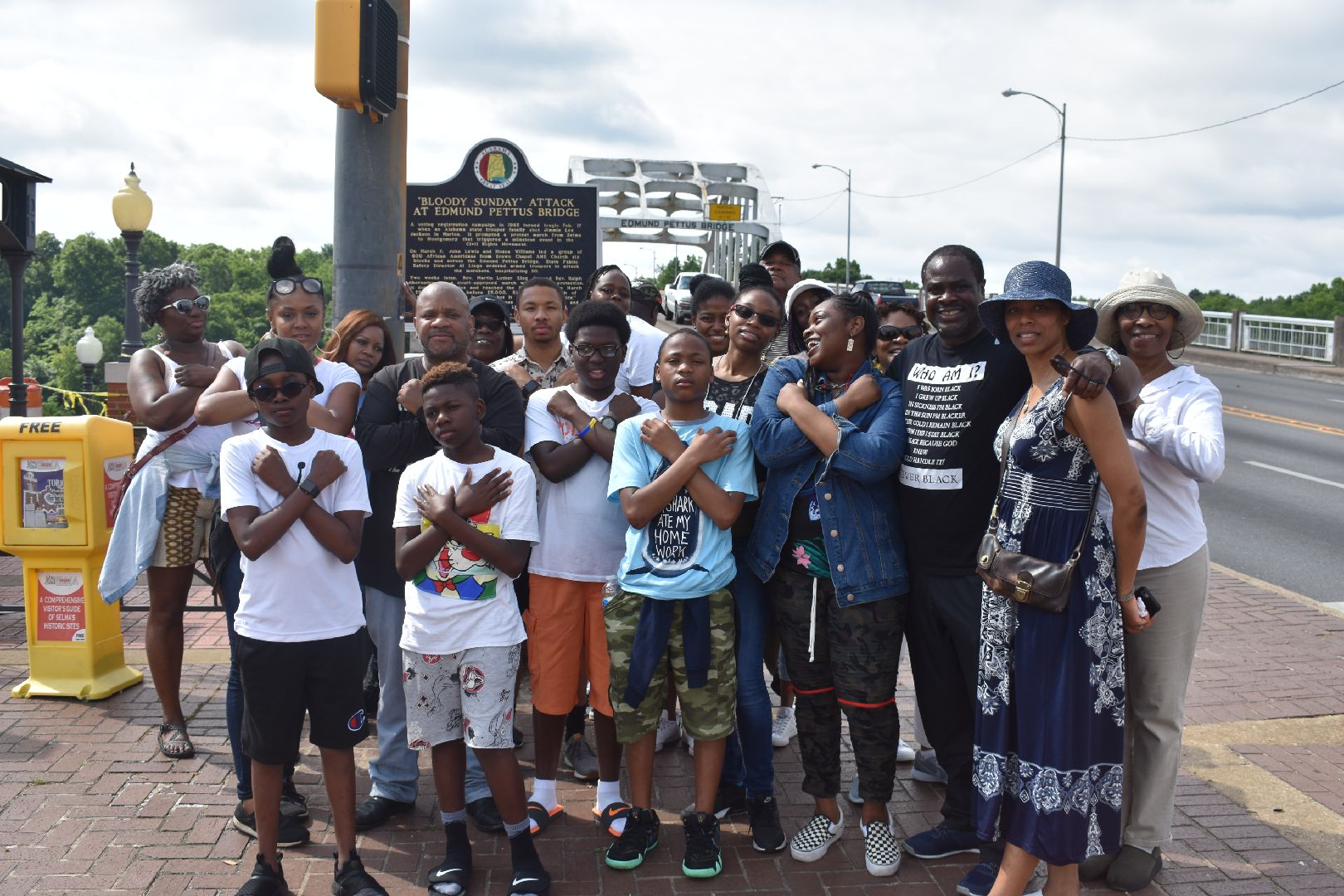
The Alabama sun beamed down on the Rediscovering Lost Values Tour while my father, Rev. W. Taharka Robinson, prepared our group to march across the Edmund Pettus Bridge by providing us with a history lesson.  This lesson illustrated the brutality and evil our ancestors knew they would face and encountered while marching across the bridge for the right to vote.

On March 7, 1965 in Selma, Alabama, now U.S. Congressman John Lewis, Andrew Young and Hosea Williams stood at the foot of the Edmund Pettus Bridge and prayed before the people began to peacefully march across to exercise their constitutional right to vote.  Alabama State Troopers stood at the other side of the bridge with clubs and tear gas. As the people marched, they were told to stop marching but they did not. Our ancestors were determined to obtain the right to vote and were willing to die for it, so they continued. As they marched, State Troopers brutally attacked, trampled and shot tear gas at them. This brutality was captured on television and outraged the world.  A few days later on March 9, 1965, Dr. Martin Luther King, Jr. organized a march across the Edmund Pettus Bridge. As he approached, he saw an Army of State Troopers, kneeled down to pray and turned around. The court was then petitioned for protection to protest & march across the bridge. On March 21, 1965, the National Guard protected the people as they marched across the Edmund Pettus Bridge to Montgomery, Alabama. Marchers walked 12 miles a day and slept in fields and reached the Alabama State Capitol on Thursday, March 25, 1965. By this time, they were 25,000-strong. Less than five months later, President Lyndon Johnson signed the Voting Rights Act of 1965.

As I walked across the Edmund Pettus Bridge, I felt very honored that my ancestors thought enough of themselves and future generations to fight for the right to vote.  They were determined and did not allow racism, intimidation, brutality or injustice to prevent them from moving forward and accomplishing their goal. They persevered! I am personally inspired by my ancestors and hope that all African-Americans honor them by voting.

Nia Robinson, 14, Medgar Evers Preparatory School

Who was Edmund Pettus?

After Reverend W. Taharka Robinson gave us a history lesson on the significance of the Edmund Pettus Bridge and the events that led to the 1965 Voting Rights Act, the Rediscovering Lost Values Tour walked across the bridge singing “We Shall Overcome.” Once the singing stopped, Kylen asked, “Who is Edmund Pettus?” Edmund Winston Pettus was born in Limestone County, Alabama in 1821. He was a lawyer, Confederate general, Grand Dragon of the Ku Klux Klan and a U.S. senator. Edmund Pettus supported the Confederacy and believed in white supremacy. The bridge was named after him 33 years later after he died.

Once I returned to the hotel in Montgomery, I quickly typed Edmund Pettus’ name into Google and was surprised to read who he was. My initial thoughts were how could a bridge be named after such a man. He endorsed slavery, terror, brutality and racism. As I researched more, I read several articles justifying his name on the bridge. Most of the articles stated that the Edmund Pettus name on the bridge is not glorifying or endorsing the man but it represents an event in history that changed the world.

A common issue today is renaming statues and monuments that represent racism and oppression. When I think of the Edmund Pettus Bridge, I think of “Bloody Sunday,” a time where my ancestors were attacked by police, shot with tear gas and were brutally beaten because they (peacefully) marched for justice, progression and change (voting rights).  Edmund Pettus was not a unifier, he believed in white supremacy and was a leader of the Ku Klux Klan. Should any bridge or structure be named after a man with a background like Edmund Pettus, a man who most likely would not have supported the march or the Voting Rights Act? In my opinion, NO!

Skye Matthews, 14, STAR Early College at Erasmus

Mother Wit Conference 2018 Brings Fathers and Mothers around the Table

With a spacious banquet hall and several carpeted nooks above it, John Wesley United Methodist Church at 260 Quincy Street in historic Bedford-Stuyvesant was the setting for a day of communication, inspiration and healing for women and men. Dubbed “The Mother Wit Conference 2018,” Healing on Fertile Ground, the event’s leadership team strove to present the various facets of fertility.

The phrase “mother wit” in the conference name refers to the deep common sense and know-how with which most people come to Earth. The workshops, panel discussions and the keynote address were accented by mother wit. The subtitle, “Healing on Fertile Ground,” speaks to the need for the essential elements of earth, fire, air and water to be in a pristine state within the human body and in the environment in order for people to thrive.

This conference came together from the contributions of visionary and producer Shawnee Benton-Gibson, LMSW/FDLC, whose talents include spiritual counseling, energy work and storytelling. Ms. Benton-Gibson explained: “Every year, I intuitively select a theme for the Mother Wit Conference and this year what came forth was ‘Healing on Fertile Ground.’ The vision, energy and vibration of this theme were alive and enlivened in every conceivable way on the day of the event. There were moments when the fertile ground of authentic sharing and storytelling produced the fruit of release, relief and restoration.”

Other key conference contributors include Dr. Torrian Easterling, who is the Assistant Commissioner of the Brooklyn District Public Health Office of the Center for Health Equity. Easterling served as co-producer and facilitator of the plenary session. Ashley “Ash” Marie Straw served as one of the conference coordinators and a performing artist within The Mother Wit Performance Ensemble and the Playback Theater performance. The Playback Theater uses improvisation to depict a moment in a person’s life. Shantel Gamble was the other conference coordinator. Ms. Gambles’ passions include holistic health advocacy and the use of alternative healing modalities.

Kinyofu Mteremeshi-Mlimwengu was the facilitator of the Red Tent Women’s Circle. Ms. Mteremeshi-Mlimwengu holds a Bachelor’s degree in Community and Human Services and a Master’s degree in Education. “Kinyofu Mlimwengu’s two focuses are reproductive self-care of women and the social, emotional, cognitive and behavioral development of their children.” Lasting approximately one half-hour, the Red Tent Circle sessions ran throughout the conference. The Red Tent is a luxurious, round enclosed space that is covered in several large, primarily red, colorful cloths. The Red Tent is symbolic of the womb. It is the space for women to discuss womb health, children, family and realizing dreams.

The Mother Wit Conference operated from 9:30 AM to 5:00 PM. Highlights included concurrent half-hour Red Tent sessions, the lushly imaginative The Womb Museum, curated by Shomany Gibson and Omari Maynard of ArtFul Living, where art covered the small space from the floor to the ceiling; keynote by Dr. Karen Althea Maybank who is the NYC Health and Mental Hygiene Deputy Commissioner and Founding Director of the Center for Health Equity, five concurrent workshops, panel discussions, The Mother Wit Performance Ensemble and the closing ritual. Kudos go to quilters Veronica Johnson, Pam Jones and Rita Strickland whose lavish quilts decorated the banquet hall.

There was much heart and disclosure at the event from presenters and conference attendees. During the panel discussions, Anastasia West and Paige Bellenbaum, in separate panels, revealed their postpartum periods involved an aversion to their infants. One married couple, Lucien and Tracey Humphreys, described their ordeal of living through the loss of their baby. All panelists agreed the common condolences for the loss of a child ring harshly in their ears.

Keynote speaker Dr. Maybank did the uncommon by having her public address cover her effort to have a child though unmarried and over 40. Maybank began by explaining her “career successes such as being Founding Director of the Center for Health Equity and launching the Office of Minority Health were not accomplishments that defined her life.” Rather, having a child within the bonds of marriage was more important to her. Maybank detailed the highs and lows of finding a man who agreed to fertilize her eggs “the old-fashioned way,” only for the man to back out of the arrangement a few days before the appointed date. Maybank, with controlled emotion, described how, at age 47, her physician dissuaded her from having some of her eggs freezed. At age 50, Dr. Maybank is reconciling herself with her current state of childlessness. Such is the state of industrial or high-tech society. This writer was apprised by a Nigerian national that in the rural areas, it is common for women to bear children in their 60s.
Sideline the NFL’s Manufactured Idea of Patriotism

By Assemblymember Walter T. Mosley

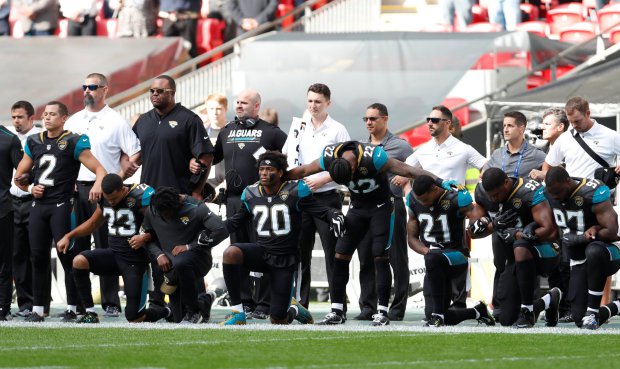
Last week, the National Football League issued a un-American policy that will prohibit players from protesting the National Anthem by kneeling on the field. This new policy is a manufactured and forced form of patriotism that specifically targets people of color, and it should not be tolerated.

In 1791, members of Congress guaranteed Americans freedom of speech under the First Amendment. With the publication of their new policy, the NFL violated their players right to a peaceful right to protest that is afforded to them under the First Amendment.

This violation undoubtedly targets players of color. Black athletes make up 70 percent of the NFL, while 94 percent of the League’s franchise owners and 74 percent of head coaches are white. The attempt to silence the majority of players for bringing attention to an important societal issue must not be taken lightly. Fans, viewers, and Americans can see that this sad attempt to “compromise” only serves as a distraction from a much-needed and broader conversation about racial injustice and police brutality.

As a son and grandson of former members of the NYPD and of our armed services, my respect for our first-responders and military is without question or debate. However, people of color across our country have time and time again been subject to violence and inequality. The injustices committed against people of color range from being followed around in a store, to being murdered at the hands of law enforcement. It is this brutality that motivated San Francisco 49ers quarterback Colin Kaepernick to take a knee. The truth is uncomfortable and ugly, but it is a reality we must face head-on in order to correct society’s wrongs.

Throughout last season, NFL players followed Kaepernick’s lead. Dozens of players from clubs across the country chose to exercise their right to peaceful protest, and many of us decided to throw our support behind them, acknowledging their fight and the reasons they offered by also taking a knee as the stars and stripes waved above. Not because we hate our country, but because we know our country can do better.

In the words of American novelist James Baldwin, “I love America more than any other country in the world and, exactly for that reason, I insist on the right to criticize her perpetually.”

Injustices against people of color continue every day, in every town, and in every city across our great nation. It doesn’t matter if you’re a professional athlete, a student, waitress, teacher, advocate or a civil servant. If you feel an injustice, you have a right to show the world you want to see a change. Take a knee against the NFL.