Home Blog Page 525

Influential Woman Olanike Alabi:

Making All the Right Connections 

District Leader Olanike Alabi, State Committee Member for the 57th Assembly District, has remolded her role into inspiring community empowerment through key relationship-building. 

Her online news calendar feeds important information on local movers and shakers to community media. Over 10 years, she’s sponsored numerous town hall meetings, and a toy drive for youngsters of North and Central Brooklyn in hospitals and at home.

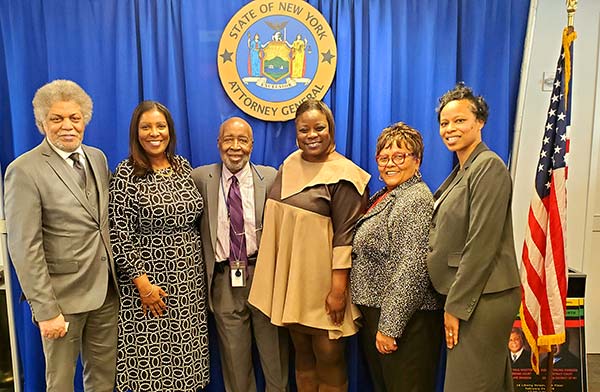
She’s seen in these photos with neighborhood power brokers: Associate Justice of the Appellate Division – 2nd Dept., Paul Wooten; New York State Attorney General Letitia James; Senior U.S. District Judge of the U.S. District Court for the Eastern District of New York Sterling Johnson; Sheila Davis, President of Church Women United in Brooklyn; and Bianca Robinson, Office of the NYS Attorney General.   (Photos: Courtesy of the Office of Olanike Alabi)

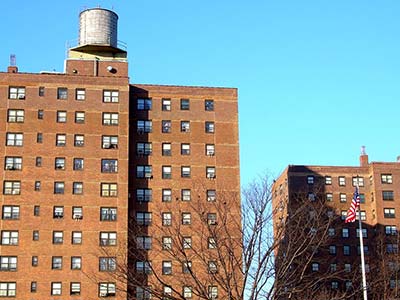
East New York in Crisis As City Officials Sell NYCHA Housing to Questionable Private Developers

Which May Lead to High-Speed Gentrification and Displacement of Residents

Op-Ed
By James Lewis, Jr.
EASTNEWYORKNEWS

It looks like gentrification in East New York might happen faster than we thought. It was recently reported in Crain’s and The Real Deal that New York City officials are handing management of NYCHA over to private developers for $1.5 billion. Two of the main private developers in the deal, L & M Developers and The Hudson Companies, will be taking over management of Linden Houses and Boulevard Houses in East New York.


New York City officials are well aware of the history of racism and bias in rental and maintenance practices by some private developers that act as landlords, and there is no reason to think the same biases are not going to occur with private developers managing NYCHA properties. Bias practices have led to citywide gentrification, while leaving people of color struggling to find affordable housing.


While local elected officials in East New York have talked about being against gentrification, selling NYCHA to private developers strongly supports gentrification. Private developers managing NYCHA developments leaves the door open to improper evictions, rejection of leases, displacement of residents and selective lease approvals.


According to an article on 6sqft.com, “The Housing Authority may also sell its unused air rights and/or accelerate a plan to allow developers to build market-rate apartments on underused land owned by the authority. According to Politico, the plan calls for a 70-30 split of market-rate to rent-regulated housing in private developments on public land.”


In the new residential buildings along the Elton St. corridor next to the Gateway Mall, which The Hudson Companies developed and The Related Companies manages, there have been sewer backups inside of the buildings since the buildings opened. The question has to be asked, how were these private developers selected with Hudson currently having problems with their new development in East New York?
“I have personally suffered from multiple raw sewer backups in my restaurant in the past three years with the most recent one occurring only two months ago, resulting in almost $300,000 in lost revenue and repairs,” stated Andrew Walcott, owner of Fusion East Restaurant, which is located in one of the buildings in East New York that was developed by The Hudson Companies and managed by The Related Companies.
Walcott added, “Representatives of Hudson and Related continue to blame the tenants and refuse to accept adequate responsibility for poor maintenance policies regarding the new buildings they own and manage on Elton Street in East New York. These issues have existed for years and are not exclusive to my business. What’s really sad is that I have been a member of Community Board 5 for 20 years and the Executive Members of Community Board 5 know in detail of the poor maintenance situation of the buildings on Elton Street. With that being the case, the Board should question how can Hudson be trusted to manage 6,000 aging public housing apartments, when they can’t properly manage 600 relatively new apartments on the Elton Street corridor of East New York.”


I have to thank EastNewYork.com for giving me a platform to bring this information to the residents of East New York while elected officials and Community Board 5 keep quiet on the issue. At the very least, community leaders should be informing the residents that NYCHA is being sold to private developers and how it will impact their housing, now and in the future. Keeping quiet is not the answer. Residents need to be informed.


I hear the excuses that there was nothing elected officials can do about it, the management of NYCHA has been bad for years, and so on. The fact is NYCHA residents will eventually see rent increases and displacement while East New York, in general, will see gentrification 2.0 at warp speed. Maybe if the residents were able to participate in the conversation, they could have assisted with coming up with an answer other than selling out to private developers.


Gentrification and displacement happened in Harlem, Bed-Stuy, Bushwick, Red Hook, and I can go on and on. East New York and Brownsville were last but now it’s at our doorstep.  Prepare yourself by getting your credit right and saving your money. Many will have to leave, but at least you now have the knowledge to know that gentrification is knocking at your door, NYCHA has been sold and your local leaders cannot, and have not, done anything about it. You must empower yourself.
Knowledge is power. Take this situation seriously and share with your family and friends. Be prepared for what is coming.


I will try to find out more information and I will surely share with my fellow East New York residents. We’re in this thing together. Let’s be smart.

Barron Speaks on Black Power: Part 3

David Greaves: Our Time Press
We get ads where they say, “80% of our AMI,” et cetera. You mean, the local council person can say to a developer in like, Fort Greene, Clinton Hill… “You want 80%, we understand that; but no, you can’t have it?”

Assemblymember Charles Barron: That’s it exactly. That’s why I’m so livid when you see me beating up Black elected officials. I know, ya’ll think I’m a radical and don’t like anybody. Not true. I supported some of these folks and was almost begging them to ‘please use your power.’ Here’s how it happens. You’ve heard of the ULURP Process. The Uniform Land Use Review Process. It starts off as a Community Board Advisory through a project, then it goes to the Borough Board Advisory, and then it goes to City Planning, and if they say yes, then it comes to the City Council. The final say-so on projects being built on city-owned land is the City Council.

OTP:The mayor can’t overrule?
Barron:No! No! That’s what I’m talking about – Black Power! We’re putting Black people in high places and they’re not using their power. The mayor can’t… You remember I told you he came to our office?

OTP:Yes.
Barron:And had to negotiate, and we said “No.” Are you kidding me?! He [the mayor] has no power over ULURP. None! David, this is why what Laurie is doing, what Cornegy is doing – is unconscionable and unacceptable. Many others, not just them. If they say no, the project is dead. Why do you think East New York is not gentrified?

I want you to come so you don’t think I’m just talking stuff. I want you to see it, we have four new parks renovated. Over 10,000 units of housing. We have three new $100 million-plus schools and a new library coming in, $36 million. We have a brand-new youth center, a $14 million two-story youth center that the community is going to own after 30 years! That’s Black Power!

OTP:I gotta get out there.
Barron:David, let’s do it. I am going to back everything I have said to you in this interview, I’m going to back it up with the material, real-life, you-can-feel-it projects!

OTP:Fair enough. But also, is it too late for Bed-Stuy?
Barron:We’ll see, a lot of the real estate is gone in Bed-Stuy and there’s not a lot of vacant land left. We still have vacant land left in East New York. I’ll give you another project – this is when you know there’s a difference between power and influence. When you have the ability to make decisions in your best interest, you have the power to do that, that’s power. When you have to demonstrate, scream, holler and persuade others in power to make it, that’s influence. So, I’ll give you an example of even influence: Remember when I interrupted the governor around his “State of the State?”
And I spoke out against him and you’d think that would get me punished. On the contrary! He called me up, and he said, “I want to build a park in your district.” I said, “Go ahead, but I’m not standing with you at a press conference. Then he has his people – at 888 Compton Avenue, which I’m going to take to you – it’s 22 acres of land that used to be the Brooklyn Development Center. They’re demolishing that. So, his agency, the State and Housing agency, they’re going to accept proposals. I told them, literally – you can ask them, and I’ll let you talk to the commissioner – I said, “Commissioner, we are not accepting you coming into our community and giving 22 acres of land to white developers! That’s not happening!”

I didn’t have no power to stop that, like I do on the City Council. By the state – they can just do it. But that’s not going to happen. We don’t argue for MWBEs (Minority and Women Business Enterprises) contracts. That’s down the line. You gotta get the prime contract. Gotta be the major contractor. You have to own the land! When you get MWBEs, that’s on a subcontracting level. You want them to be the general contractor, who owns the land!

So, I told them, “We’re not supporting anything that’s going to give this all to whites! Can you give us a minority contractor?” She said, “No problem.” They put out the request. She called me up, “You’re going to be pleased.” I said, “I’m not into ‘minorities.’ I’m into Black. Minorities could be women, could be anybody. I’m talking Black contractors.” I was so pleased! Of the 22 acres, we have a Black general contractor development company from Harlem. On a third of the land, they’re going to build 5,000 units of housing and they’re going to own the land and be the general contractor. And they can hire. And they’ll be VPs and all that other stuff. Another third is to a white developer. And the last third is to a not-for-profit that is diverse and has whites, Blacks and everybody. That’s what we are supposed to be doing in office!

If she would have been talking to somebody else, they would have been so happy that they’re building houses, they would have asked them for jobs. And they would have said, “Yes, we’re going to create jobs.” But if you get the general contractor, you can hire your own people! You don’t start off asking for jobs!

But that’s what these other politicians are doing. “I’m bringing in jobs, we’re bringing in businesses.” Yeah? But who owns it? I can give you two or three examples of how we got so much! Ebenezer Project, right across the street from the BRC, Inez negotiated that. We own! We have a Black woman, Erica Taylor, owning from her father, Tom Taylor. She now owns a third of that project! Because of us. That’s Black Power!
From Blocks to Bookshelves: One Man’s Passion for Curating Hip-Hop’s Legacy

What do Sylvia Robinson, A Tribe Called Quest, Biggie Smalls, The Roots and Wu-Tang Clan all have in common? If you said they are all significant contributors to the Hip-Hop culture, you’d only be half-right.
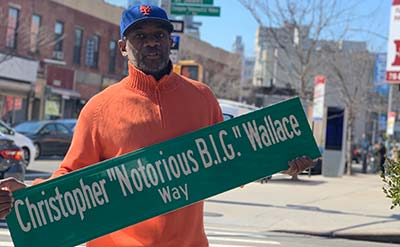
On this Saturday, March 7th, the Clinton Hill Branch of the Brooklyn Public Library will be holding the Friends of Clinton Hill Library Christopher Wallace Bookcase Dedication Celebration from 1pm-4pm. Along with art and musical performances, the website states that a bookcase highlighting materials on Hip-Hop, graffiti, Brooklyn and music history will be dedicated by the Friends to Honor Christopher Wallace, otherwise known as Biggie Smalls.

The person who is responsible for connecting the dots to make this happen has been working for the better part of the last decade to curate opportunities that solidify the legacy of some of Hip-Hop’s brightest stars.
Leroy McCarthy, 52, is a filmmaker and lifelong Brooklyn resident. He grew up in East Flatbush and attended Cheyney University before settling in Clinton Hill in 1998. He’s been in this community ever since. McCarthy is the man responsible for honoring Christopher Wallace with the co-naming of St. James Place and Fulton Street as “Christopher Wallace Way.” Since he started that campaign back in 2013, he has gotten five other blocks co-named after Hip-Hop stars, including Sylvia Robinson Way in New Jersey, Malik “Phife Dawg” Taylor Way in Queens, Wu-Tang Clan District in Staten Island and Avenue of The Roots in Philadelphia. Plans are in the works for future street-naming ceremonies, including among them, De La Soul in Amityville, and the Beastie Boys in the city. Although the movement has steam now, it hasn’t always been easy. In fact, the first time he tried to get Christopher Wallace Way, he was met with backlash and insults.
“August 2013 is when I first started the campaign to get the street named for Biggie at the corner of St. James and Fulton.” McCarthy said. “I got the petition signed, and I got support from the community. I brought all of that to the Community Board meeting, and at that meeting, one of the members said a lot of derogatory things about Biggie, but one of the things that stood out, was that she said he didn’t have the “physical characteristics’’ to be a role model. That set us back for a while, but in 2018, I got support from the City Council and then it was dedicated in 2019.”

Leroy’s passion for the culture is honest, and his ability to turn city blocks into works of Hip-Hop legacy is rooted in his unique skillset.
“In the 90’s, I moved out of New York and went to Atlanta. I was the college DJ rep for Bad Boy Promotions, so I have a background in music. But also, I work in film and television production as a location manager. So, I know where locations are, and plus, I’m from New York and I know Hip-Hop and where acts are from, so I just combined my knowledge about both things and used that to try and honor the culture in the best way I know how.

“But the thing that brought me to this and the energy behind this, is that I know that Hip-Hop is part of the American fabric now and should be respected in the same way as country music is and how rock and roll is. I didn’t think that Hip-Hop was getting that respect. So, I’ve tried to get this done and have been successful with getting these blocks named. My goal is to honor acts that have been revolutionary. Everyone that I have reached out to, to honor, has changed the game. This is where my calling is, combining my passions with my ability to work in communities.”

The dedication of a bookcase to Christopher Wallace, in the very neighborhood library that he was raised around and frequented as a child, is quite an awesome way to marry Hip-Hop and literacy. As Leroy puts it:
“For Saturday, I’ve organized with the Brooklyn Public Library to have a bookcase dedicated to Biggie. This is the library three blocks from where he lived, so this was his library growing up. The bookcase is going to be dedicated to Biggie and it’s going to have books dedicated to Hip-Hop, art, culture, fashion and photography. The Brooklyn Public Library has been very supportive of this. I’m not only doing this for Biggie, but I’m organizing for bookcases at libraries close to the other streets that I’ve been able to name. In this way, I’m trying to connect Hip-Hop outreach with literacy.
“I’ve gotten positive responses from Staten Island, Roosevelt (Long Island), Amityville for De La Soul, Long Beach (California) for Snoop, LA for Nipsey and even in Oakland for Tupac. So, this project will hopefully encourage kids to go into libraries and actually read about Hip-Hop, which will hopefully lead them to read about other things.”
The Clinton Hill Branch is located at 380 Washington Avenue in Clinton Hill. The dedication starts at 1pm, and will have live music, art installations and surprises for everyone. For more information, please go to the Brooklyn Public Library website.

Billie Holiday Theatre Announces Return of Fourth 50in50 with Letters to Our Sons, Saturday, March 14 – Sunday, March 15 

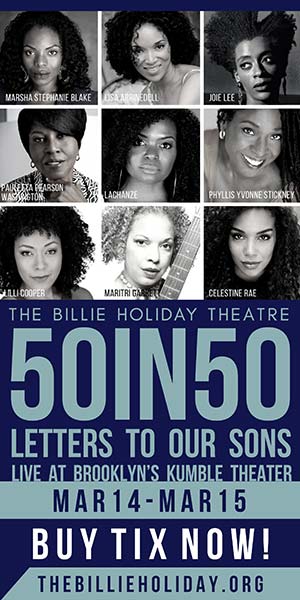
The Billie Holiday Theatre is proud to announce the cast for the fourth monologue showcase of its popular series – 50in50: Letters to Our Sons. In response to MacArthur “Genius” Dominique Morisseau’s curatorial statement, “50 original monologues” – selected from hundreds of submissions from women of African descent from across the globe – will be read by renowned actors to include: Lisa Arrindell (The Immortal Life of Henrietta Lacks, Saints & Sinners, Cat on a Hot Tin Roof), Marsha Stephanie Blake (Orange is the New Black, The Merchant of Venice), Lilli Cooper (Tootsie, Wicked), LaChanze (The Color Purple and Summer: The Donna Summer Musical), Joie Lee (She’s Gotta Have It, Do The Right Thing), Celestine Rae (Boardwalk Empire, Blacklist), Phyllis Yvonne Stickney (How Stella Got Her Groove Back, The Women of Brewster Place), and Pauletta Pearson Washington (She’s Gotta Have It, The Old Settler and Autumn at The Billie) with live music performed by Maritri Garrett. 

Performances will take place at the Kumble Theater at LIU, 1 University Place, Brooklyn on Saturday, March 14 at 3pm and 7pm, with a final event on Sunday, March 15 at 3pm.  
This year, Dominique Morisseau asks: “If sons are not just born of our loins, but also born of our collective energies, then what do we want to say to our sons? This legion of men who will grow up in a post #metoo, post #blacklivesmatter, post #timesup era? When we have been the defenders of men whose unmuted music continues to defile and degrade our sacred bodies? When we know these sons are also growing up in a world with our daughters, who do we want them to become? What wish, what lesson, what truth do we want them to know that could turn their course? Create a future of warriors, gentle giants, gracious, kind, loving, life-sustaining men. What do we want them to know about us and about themselves? And if we could create a map for their survival, what would be the route?”


“With 50in50, we wanted to create a space and platform for agency and empowerment so that women can share their stories from the nuanced and diverse places that we as Black women exist in every day,” said Dr. Indira Etwaroo, Executive Director, BHT. “This year’s theme really allows Black women to look at national and global issues through the lens of honest and open dialogue with Black men.”
In addition to the Brooklyn shows, The Billie will bring its monologue showcase to the dynamic WACO Theater Center in Los Angeles, California for its West Coast premiere on Saturday, March 7th at 3pm.