Home Blog Page 51

New York Football

0

By Eddie Castro
The wait is finally over. This past weekend, the 2025-26 NFL season for both the Jets and Giants kicked off. Both franchises are looking to improve from their lackluster seasons a year ago in which both teams finished third and last place in their respective divisions. Both teams also elected to move on from their starting quarterbacks from last year in hopes of providing a fresh start. Now if you are a true genuine and realistic fan of either the Jets or Giants, you know going into this season, the playoffs are possibly a long shot. The objective for the New York Football teams is will the change made by both teams help them solidify a new culture moving forward?


The Giants began their season against a dangerous Washington commanders team lead by their 2nd-year quarterback Jaden Daniels. Quarterback Russell Wilson made his Giants debut in hopes of lifting a Giants team to more signature moments than they did last year. For the third straight year, Big Blue had a poor showing in Washington and were held without a touchdown for the third consecutive season opener.

Despite multiple opportunities to score, the Giants were only able to put up two field goals in a 21-6 defeat. Now it’s easy for fans to go on a rant after one game and say that perhaps Wilson, who without a doubt will be a first ballot Hall of Famer when he decides to hang it up, no longer has that magic he did in his Seattle days. The fact of the matter is, with how the team’s offensive line played yesterday, Giants General Manager Joe Schoen could make a call to Tom Brady himself, and they would not have much success.

Wilson was pressured by Washington’s defense all afternoon long. An offense that featured several dropped passes by receivers, tight ends and running backs, it made the game even longer for the team’s offense that only managed to put up a total offense of 231 yards (168 passing and 63 rushing). The Giants defense didn’t make things better as they gave a total of 220 rushing yards on 32 attempts.


As for the New York Jets, the team welcomed a familiar face as Aaron Rodgers returned to MetLife Stadium in Pittsburgh Steelers black and gold. In what was a back-and-forth affair for most of the game, Rodgers was able to get the best against his former team, dishing out 4 touchdowns in a 34-32 victory. There is some positive takeaways for the Jets despite the loss. New Head Coach Aaron Glenn repeatedly said he wanted to get the running game to be a part of the team’s identity. The team had a total of 394 offensive yards with 182 coming with the run. The Jets also had a new quarterback making his team debut in Justin Fields. In his first game as a Jet Fields was impressive completing 16 of 22 passes for 218 yards and threw a touchdown. He Also rushed for 48 yards and scored two touchdowns. A costly turnover and a few miscues contributed to the Jets not able to secure the win.


It’s just one game in a long season. There is a lot of football left to be played to see just what the Giants and Jets identity is going to be this year. For the Giants, a big concern is being able to protect Russell Wilson. The offense line seems completely lost without their line anchor Andrew Thomas, is working his way back from off-season foot surgery from last year. For the Jets, the question is can they be that consistent on the offense line and clean up the costly turnovers? We shall see what Week 2 holds for both New York teams.

Sports Notes: (Baseball) The Yankees wrap up a three-game set against the Detroit Tigers tonight. The team will head to Boston for a huge weekend three game set against the Red Sox. The Mets wrap up a three-game set against the Philadelphia Phillies tonight. The team will head back to Queens and welcome the Texas Rangers for a three-game set beginning tomorrow.
Grassroots to Global

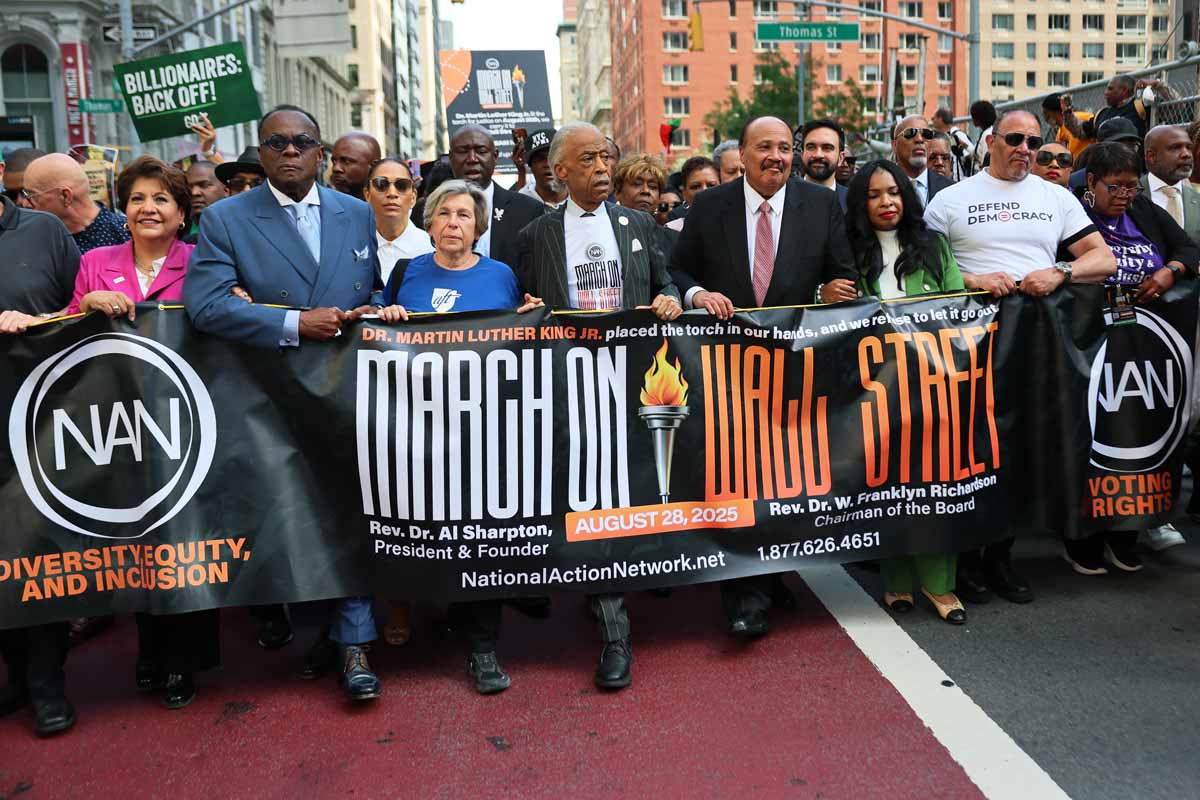
Thousands join The Rev. Al Sharpton, National Action Network and Civil Rights Leaders on Wall Street to Challenge Trump DEI Rollback Campaigns

By Stacy M. Brown
Black Press

USA Senior National Correspondent
Sixty-two years to the day after Dr. Martin Luther King Jr. delivered his “I Have a Dream” speech, thousands poured into Lower Manhattan on Thursday, linking arms and voices in what was billed as the largest demonstration of its kind since Donald Trump returned to the White House.


Led by Rev. Al Sharpton and the National Action Network, the March on Wall Street drew national civil rights leaders, clergy, activists, and elected officials, all demanding economic justice, equity, and fair opportunity at a time when diversity, equity, and inclusion programs have been dismantled by the Trump administration.

The march began at Foley Square, paused at the African Burial Ground National Monument, and wound its way down Broadway to Whitehall Street. Participants spanned generations and professions — labor unions, fraternities and sororities, educators, and teens — all united by the call to defend rights secured in the 1960s and to push back against what they see as the biggest transfer of wealth in U.S. history.

NEW YORK, NEW YORK – AUGUST 28: Rev. Al Sharpton speaks as New York mayoral candidate Zohran Mamdani listens during the March on Wall Street on August 28, 2025 in New York City. Rev. Al Sharpton and National Action Network (NAN) lead a protest march on Wall Street, which began at Foley Square, to urge corporate America to resist the Trump administration’s campaign to roll back diversity, equity and inclusion (DEI) initiatives. The march comes on the anniversary of the Civil Rights-era March on Washington in 1963. (Photo by Michael M. Santiago/Getty Images)


Newark Mayor Ras Baraka, who was arrested earlier this year while protesting ICE, challenged fellow municipal leaders to act. “We are here because our ancestors demand that we be here, because the times demand that we be here, because every mayor in every city in America should be rising up right now as Donald Trump tries to send the National Guard into our communities — we are here as they create the biggest transference of wealth this country has ever seen,” Baraka declared.

The presence of Martin Luther King III and Andrea Waters King underscored the continuity of the movement. “It’s extraordinarily significant, but in the back of mind, I am thinking about how sad this is, that 62 years after Dad delivered that dream for our nation and world that we are in the position we are in,” King said.

“And the goal is to find ways to move this nation forward around economic inequality.” King also posted on social media: “We were proud to join @NationalAction and my good friend, @TheRevAl, for the #MarchOnWallStreet. On the 62nd anniversary of the #MarchOnWashington and in the financial capital of the world, we marched for economic justice and fair opportunities for ALL.”


Dr. Benjamin F. Chavis Jr., president and CEO of the National Newspaper Publishers Association, stood with Rev. Dr. Boise Kimber, president of the National Baptist Convention USA Inc., marking the moment’s deep historical ties. “It marked 62 years after the historic 1963 March on Washington for Jobs and Freedom, and we continue to march, we continue to speak out, and we continue to demand freedom, justice, equality, and equity,” Chavis said. “Thus, we join the Rev. Al Sharpton and the National Action Network in the March on Wall Street.

The Rev. Boise Kimber and I stood together, shoulder to shoulder, at the March on Wall Street. I was pleased to represent the Black Press of America under the auspices of the NNPA. In the words of publisher-leader Frederick Douglass, ‘Freedom is a constant struggle.’”
Rev. Dr. Christopher Davis, General Secretary at the National Baptist Convention, USA, Inc., drove home the financial realities confronting communities of faith.

“I don’t care the size of your church,” Davis said. “Whether you have 10,000 members or 10 members, you can’t do ministry without money, so we have to be concerned about the economic plight of the people that fill our pews.” Among those addressing the crowd were Michael Eric Dyson, Benjamin Crump, Melanie Campbell, Maya Wiley, and others, each pointing to the urgency of resisting what they described as attacks on democracy, workers, and Black communities.

“It means we continue the movement 62 years later, marching on Wall Street, raising the issues of income inequity, DEI, and the takeover of cities with Black mayors. The dream is alive,” Sharpton told the crowd.

Brownsville Town Hall Tackles Health Disparities, Food Apartheid, and Community Concerns

0

By Nayaba Arinde
Editor-at-Larg
e
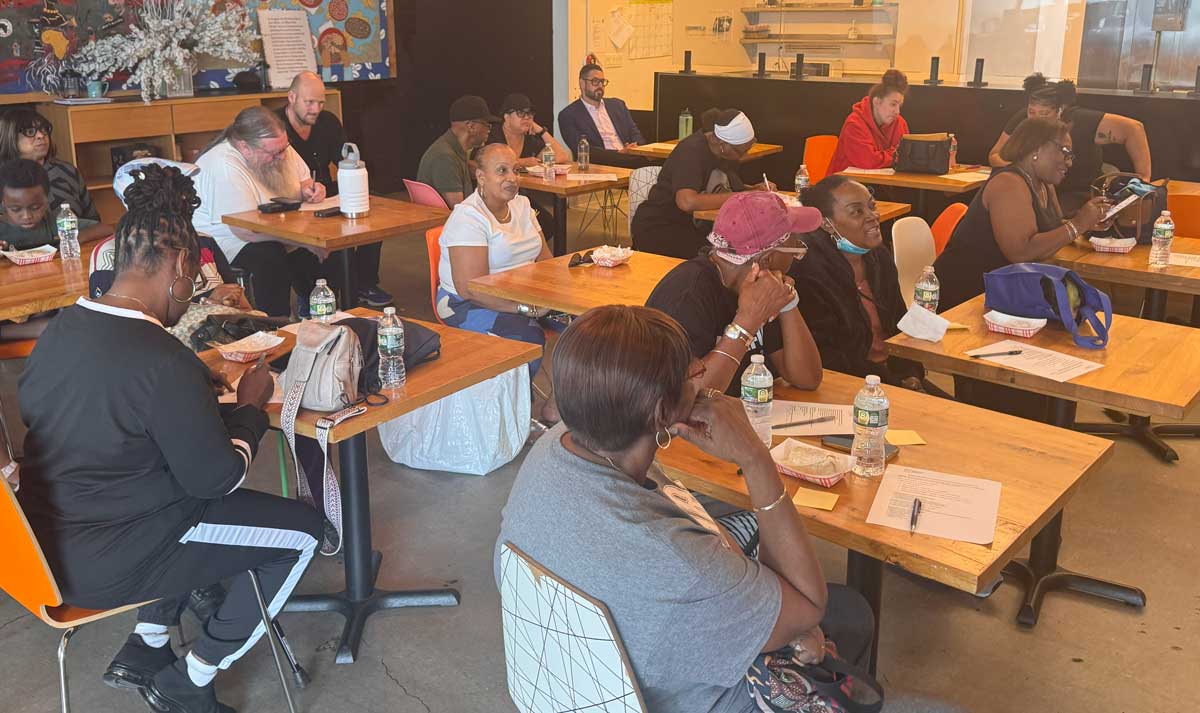
“My goal is to continue to create a safe space for our community members, and build that relationship with everyone, so they know that this is a hub for wellness,” Brooklyn health champion Jessica Joseph told Our Time Press. On a sunny Friday afternoon last week a room full of neighbors from elders to youth came out to a Brownsville Wellness Program Community town hall held at the Brownsville Community Culinary Center (BCCC) to talk about health-related issues affecting residents.


Joseph, manager of the BCCC Diabetic Wellness Program hosted the event.
As the attendees lunched on vegan and jerk chicken wraps they shared their health journey stories, heard from each other,and told moving and deeply personal stories.
Community activist Sadie Sanders told the paper, “I come to the workshops and town halls because I learn a lot about our health, and then because I’m an advocate when it comes to people dealing with health challenges like breast cancer and cancer in general, I come to share the information. This town hall is definitely needed. Jessica has been very, very good about bringing information to us, and I encourage her to keep doing what she’s doing.”


Jessica Joseph said, “I’m making space for you guys. I know what I think the community might need sometimes, but if I don’t hear directly from you, I go into strategy mode – like who do we need to partner with, and what more information do we need to bring into the space. I would be doing a disservice everyone, if I didn’t ask you ‘Hey, what is that you need?’”
A new mom, the Brownsville native assessed, “There’s a lot of work to be done. In light of all of the milestones, we still have a long way to go as it relates to just dispelling a lot of health issues, and identifying barriers in the community as well.”

Jessica Joseph, Health Advocate


Gabriel Zeltser, a registered dietitian, told Our Time Press that after he spoke before the group, and heard their responses, concerns raised by the community that afternoon included, “Mental health, men’s health, and support for people diagnosed with living with cancer, healthy eating, access to affordable healthy food.”


Some immediate solutions?
Saying that “understanding how people learn,” is key to imparting key information, Zeltser replied, “I think that they need to access the foundational knowledge so they can feel comfortable with making decisions for themselves on a daily basis. I think in this community in general there is the lack of awareness of agriculture nutrition, like how to take care of our bodies, like how our food is grown, like what we’re eating and how it benefits us. I think many adults would benefit from a refresher, and have got to gain financial knowledge, and then understand why they are making the decisions that they’re making.”


Elizabeth Hunt said she usually visits the center for their exercise program, and to teach folks about life insurance, and the “importance of it, which our people are not fully educated on, and also to create generation of wealth.”


So the meetings and town halls inform members of the community on a variety of essential topics, Hunt told Our Time Press, “It’s not only what we can do to help people, but what people are willing to let us help them with. Especially young women having babies too early, not taking care of themselves. Children are having children so early, and they’re not educated, or ready for that responsibility for themselves. We need to help educate them at town halls like this.”


Calling the town hall “very insightful,” Joseph said, “I feel like we heard an overview. I had an understanding of what the community needed, but hearing more about men’s mental health, men’s overall health, that’s important, and those are the things that can often be overlooked. We were just talking about how cancer can be overwhelming, and how taboo it is in our community, and marginalised – like breast cancer, and prostate cancer in men.


Sanders agreed, “When somebody gets breast cancer in our community, they try and hide it , ‘No, I don’t want nobody in the community, or even my family to know.’” She announced that her own daughter had battled breast cancer, and Joseph said that she has shared that her father is going through prostate cancer. “We found out last year, and it was like hush-hush. A lot of people don’t know how to interact or how to show up for you. How can we as a caregiver, as a daughter show up for this person in a way that they need us to show up?”


Impressed with the event was Hassan ‘Dr. Pooch’ Diop, Peer Health Educator, a holistic practitioner. He works with Meyer Cancer Center, Weill Cornell Medicine, and schools and community spaces. Noting that the community discussion focused on the concerns over the very unfortunately too common ailments, he told the paper that education and access to holistic care is vital.


“I write health-orientated children’s books–’Get Well Johnny Early Holistic Health-Literacy’ series. My goal is to educate the next generation of young minds and initiate them into the world of holistic health and preventative health. I have a holistic program that works, it deals with nutritional, environmental, social and emotional health. Our goal is to create holistic health-literacy, curriculum and entertainment around basic holistic health topics that children are excited about. In turn this will be a catalyst and motivator for adults to create new healthy habits for a healthy future.”


Diabetes and Food Deserts
Worth repeating Joseph once told Our Time Press, that food apartheid and diabetes are major issues in traditionally underserved communities. “Brownsville has the highest incidents of diabetes throughout all of New York City. There is a definite increase in onset diabetes in both Type 1 and Type 2.”


Causes she said include, “As we move into a more sedentary lifestyle…more consumption of processed food, and we’re taking more medication that has an adverse effect, and now you may have uncontrolled blood sugar as well. Lack of education around diabetes. I would say genetics, but, I feel that is very broad, but it does influence onset diabetes.”


There’s more…
In areas like Brownsville, she said, “We have a lot of food deserts. Food Apartheid means there is a structural reason why folks have inadequate access to good food.”
More affordable, healthy fresh food needs to be available in the Brownsville area, said Joseph, an expert in nutritional sciences.


“This BCCC community wellness space is open to everyone,” Joseph declared that the programs are open to anyone citywide. “So, come as you are. One of the facets of our programming now is we’re going to be launching the Social Care Network, and a partnership with Public Health Solutions. So, our medicaid members, in addition to all of our other community offerings and services, will also have access to social care navigation if they need additional resources, if they need individual nutrition counseling, medically-tailored meals, food access such as produce prescriptions.”

ASALH Historians: “Trump 2.0 Impact on Black Americans from SCOTUS to Job Loss of 300,000 Black Women”

0

Fern Gillespie
Our Time Press spoke to the leadership of the Association for the Study of African American Life and History, the founding organization of Black History Month for insights on “Trump 2.0 Impact on Black Americans.” Leading Black History historians Dr. Karsonya “Kaye” Wise Whitehead, the president of the ASALH and a professor of communication and African and African American Studies at Loyola University Maryland and Brooklyn resident Dr. Zebulon Miletsky, an associate professor of Africana Studies at Stony Brook and ASALH Chair of Communications discussed their concerns about this presidential administration in Part 2 of the Our Time Press conversation.


OTP: What are your thoughts about the Supreme Court greenlighting the Trump administration’s destruction of multiculturalism and diversity?
DR. WHITEHEAD:
I think that when you look at the steps and I go back to Project 2025, which if people use that as a handbook, it talks about how every step to get you to this point. Setting up and having a right wing leaning Supreme Court just didn’t happen overnight. These were steps that we’re taking from Trump 1.0. Actually, coming from stopping Barack Obama from being able to fill a Supreme Court seat.

By the time Trump 2.0 had the majority in the House, the Senate, in SCOTUS and the executive branch, we’re just starting to see what happens when you have the three branches all lined up and leaning heavily toward one party. And if they are all walking in lockstep. There is no resistance in SCOTUS. That majority is giving him the space he needs to enact the policies that he’s had been talking about that Project 2025 lays out.

OTP: What do you think about the impact of Justices Ketanji Brown Jackson, Elena Kagan and Sonia Sotomayor being the lone liberal voices in the Supreme Court?
DR WHITEHEAD:
One of the best things I think about is Justice Ketanji Brown Jackson is her voice. I call her, Elena Kagan and Sonia Sotomayor, The Supremes. The three sisters who are singing for justice right now. They’re doing something that Thurgood Marshall talked about. He talked about how the court changes.

That when you’re in the minority, your dissents are even more important because in the sense that you’re laying down the breadcrumbs essentially for future lawyers to follow. How do you unpack something that’s already in place? If you go back and actually read the dissents of Clarence Thomas, who remember, did not speak at all for years Clarence Thomas is certainly active now. It was in those dissents that him and Scalia, for example, laid down the breadcrumbs for future lawyers to follow to dismantle Rove vs. Wade.

That was a battle to get to the Dobbs decision. To lay down the breadcrumbs to whitewash the Voting Rights Act. What Justice Brown Jackson is doing right now is a fascinating study with her dissents. She actually joins the dissent with Sotomayor and Kagan and this she’ll write a separate dissent to take it one more step farther. She writes in this language where she’s even moving away from traditional lawyers speak.

It’s almost like she’s having a conversation with you in her dissent. It becomes a conversational tone. She’s laying out what needs to happen to be able to overturn what her colleagues have put in place. That’s why her voice is so important. We knew she was going to be in the minority, but she’s doing exactly what people hoped that she would do.

OTP: As an historian, when do you think that America will return to the pre-Trump era of diversity?
DR. WHITEHEAD:
I don’t think it will happen now. It won’t be Gen. Z. We’re now talking Gen. Alpha and Gen Beta. They will have a pathway to be able to overturn what’s being put in place right now. I’m a pessimist and sometimes optimist. I think we’re looking 50 to 75 years out at this point. The way policies are being overturned and new policies are being put in place. It’s not going to be an immediate effect in terms of turning over what Trump has put in place.

I just use Plessy vs Ferguson (separate but equal) in 1896 as an example. It took us until 1954 (Brown vs Board of Education), a whole different Supreme Court, different presidents, different house, different Senate to be able to overturn what was set in 1896. But it didn’t change in 1954. It took people going to the streets in 1963, 1965, 1967 to be able to actually implement the changes that were stated in 1954 with Brown. Some people think America moves very quickly. You have to have a wave of change with the law, policies, practices, procedures. What it didn’t change is what I call the 5th frontier and didn’t change in the hearts and minds of people.


DR. MILETSKY: The Republicans have become the party of hate. The party of anger. The party of backlash. This is much like the period after Reconstruction where you have a white backlash for years against Black folk, Black progress, ideas and laws. That’s what we’re in. We’re in a second White backlash. Our forebears got through it and so will we.

OTP:How do you advise Black Americans to get involved with the stress of dealing with this administration?
DR. MILETSKY:
I think churches are also getting involved and realizing this is a crisis of confidence and heart. This requires people who can spot a problem that’s growing. Have the presence of mind. They organize, make phone calls, write your legislators. Don’t give into this normalization of fear. Like executive orders or laws. In my church, we’ve started a social action ministry. We speak out. People of good conscious are the ones that are going stop this nonsense.

OTP: Over 300,000 Black women in professional positions in the federal government, corporations and colleges suddenly lost their jobs during the Trump administration. What is this impact?
DR. WHITEHEAD:
It was not lost on ASALH that 300,000 Black women lost jobs. That’s another step, because you are dismantling the Black middle class. It is happening right before us. I do know that black and brown people are really suffering right now, and I don’t think we’re suffering as much as we’re going to suffer. I think once school gets started in September, I think people are really going to see the impact of the decimation of the black middle class.

When you start talking about that number of Black women losing their jobs and what does that mean for the Black community, it’s going to be a devastating moment for us. And then we’re going to have to talk about how does the community come together to provide financial support, emotional support. We are going to have to do more things we’ve done in the past that allowed us to survive during very challenging racial and economic times.
The Association for the Study of African American Life and History will be holding our annual meeting and conference from September 24th to 28 in Atlanta focusing on “African Americans and Labor.” register, contact: www.asalh.org

Faith, Politics, and the Illusion of Post-Racial America

0

Everybody talks about how he’ll change race in America. Erase it or whatever. By this they mean he’ll change white people, which if it happened, would be amazing enough. But nobody mentions the better thing, Dave. How he could absolutely abolish, all at once, with one big stroke, end black politics forever. -From Great Expectations
by Vinson Cunningham

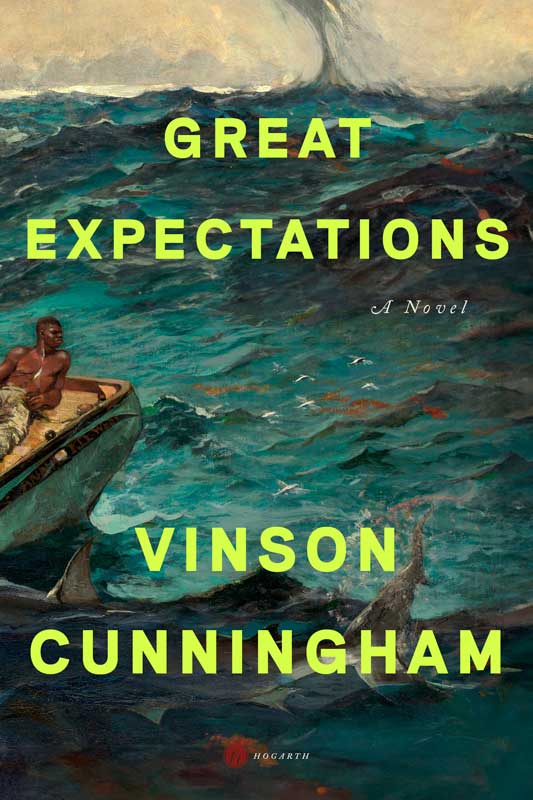
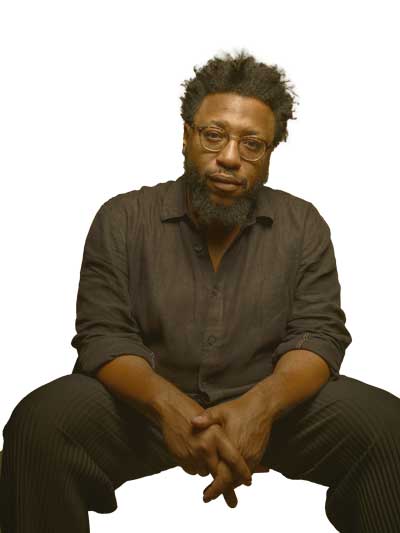
Vinson Cunningham’s debut novel Great Expectations (Hogarth Press, 2024) explores the personal journey of the protagonist David Hammond, a young Black man who is working on the campaign of a man referred to as “the Senator.” From the very beginning it is clear that “the Senator” is presidential elect Barack Obama. Vinson Cunningham is a former staffer on Barack Obama’s first presidential campaign. He is currently a staff writer for The New Yorker, co-host of the magazine’s weekly arts and culture podcast Critics at Large, and a Pulitzer Prize finalist for Criticism.

Vinson Cunningham


Great Expectations, a coming of age novel written in the first person, provides an insider’s description of campaign politics and an analysis of what it meant for a Black man to run for President of the United States. As the narrator, Dave or David as he is sometimes called in the novel, works on the presidential campaign of “the Senator” from Chicago for one year, he reflects on his memories of religion, schooling, parenting, and class and racial politics.
The novel’s title, Great Expectations forecasts Hammond’s symbolic journey as the only son of a teacher and musician who grows up in New York and Chicago.

Having grown up in the Pentecostal church, he interweaves his insights on studying the bible and religion with his experiences in working on the campaign. For example, the passage on his thoughts after observing the glow of the lights from a church reminds him of the setting of Moses and the burning bush. Hammond notes that the figure in the book presents a problem.


The scripture calls him the angel of the Lord and so the straightforward way to understand him is as a mere emissary, neither human nor divine. But I was taught to read the Old Testament in terms of the new and, therefore, to look for traces of Christ centuries before he appears. . . . Maybe the angel, so called another Christ, in this conception, reaches backward through time, stunning the transcriber of the law he’d later fulfill.


Is Hammond, in referencing this passage, thinking about the messaging of “the Senator” as a possible reincarnation of the Christ figure? The possibility of this insight is reinforced by Hammond’s description of a Black preacher he meets at a donor fundraiser.

The preacher whom Hammond had watched on television while growing up was very active in the Civil Rights Movement. However, he now preaches that he is glad to keep his sanctuary away from politics; thus, Hammond cannot understand why the preacher would come to a fundraiser for the Senator and asks him why he had come to the fundraiser? The preacher responds that “the Senator’s” election as president was the work of God.


A central theme in Great Expectations is the circuitous road to organizing and winning a campaign. Readers will come away from the novel with a clear picture of the elements that go into raising funds, coordinating a fundraiser, and campaign messaging. They will also witness that it’s almost impossible to escape some form of corruption and hypocrisy.


“The Senator’s” campaign is an awakening for David Hammond. He recounts: “The longer I worked on this campaign, the more I became aware of how much was hidden from me. How much I totally did not know.”


The projection of “the Senator” as someone who could change racial politics in this country and in doing so create a post-racial society is also a theme throughout the campaign. Beverly Whitlock, one of the major fundraisers for the campaign summarizes what a win for a Black president would mean.


Everybody talks about how he’ll change race in America. Erase it or whatever. By this they mean he’ll change white people, which if it happened, would be amazing enough. But nobody mentions the better thing, Dave. How he could absolutely abolish, all at once, with one big stroke, end black politics forever.


Reading this statement in the midst of what the nation is experiencing makes it very clear that a post-racial society is an illusion. President Barack Obama campaigned on a call urging the nation to embrace a new kind of politics and to have the audacity of hope. Eight years later, hope has been diminished for many citizens.


Great Expectations is a thought-provoking description of the expectations and evolution of a Black man’s understanding of politics and race in this society.


Dr. Brenda M. Greene is Professor Emeritus and Founder and Executive Director Emeritus of the Center for Black Literature at Medgar Evers College, CUNY. For more information, visit https://www.drbrendamgreene.com