Home Blog Page 484

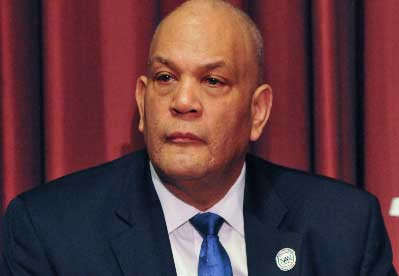
OUR TIME PRESS Q&A with …MICHAEL A. HARDY, ESQ.

Executive Vice President & General Counsel, and Co-Founder of The National Action Network

Our Time Press has followed the work of the National Action Network, founded by The Rev. Al Sharpton, for more than 20 years, and we have observed the contributions of NAN’s co-founder and legal counsellor Attorney Michael A. Hardy, Esq. for just as long. What specifically impresses us is NAN’s consistent community advocacy, strategic creativity and compassion for the people on the ground. The organization has raised emergency preparedness to an art form. We were impressed with its decision in response to COVID19: to convert satellite offices into community kitchens to deliver meals to those who needed them. We are energized by its commitment to get voters to the polls, and its tireless work around Voter Registration and encouraging the community to join in poll watching work and the 2020 national elections. Then, of course, there is the tireless work for our families, the Bells, the Carrs, the Hawkins, the Floyds, The Martin-Fultons and so many others. We requested a talk with Mr. Hardy, the day after Rev. Sharpton’s successful “Commitment March,” August 28, 2020, in Washington, DC. Mr. Hardy spoke to us the following morning.

Part One of Two

OUR TIME PRESS: Things are happening across the country and the National Action Network (NAN) seems to have been involved in several, if not most of them, as the go-to organization for support, guidance and stand-taking. Your thoughts on the missions, the reach and the people’s trust nationally in the National Action Network?
ATTORNEY MICHAEL A. HARDY: We are coming up on 30 years of National Action Network as an organization and I am proud to be part of it and to support what The Rev. Sharpton does and the services and opportunities he and the National Action Network provide to families and communities.
The work of The Rev. Al Sharpton and even myself preceded the National Action Network.
Many people have seen the recent HBO documentary “Yusuf Hawkins: Storm over Brooklyn” about the Bensonhurst tragedy in 1989. National Action Network was born out of that whole Bensonhurst incident and the attempted assassination of Rev. Sharpton after one of the marches.
People know NAN because we have built an organization, under the leadership of Rev. Sharpton. They know the work we have done. They know how to reach us. They know where to go when these situations happen. and they often do.
Rev. Sharpton has a nickname, Rev. 9-1-1.
It’s come to the point when it is understood when we can’t come. But when National Action Network goes to a community to help with a situation, it comes as an organization. When a police officer has a situation, the police union will come to provide the back up and help the family or to see situations arising and have the officer be prepared.
National Action Network provides that same work for many of the families that ask for support. We support them in all ways to give the organizational backing that they need in order to challenge the institution in various situations that they may be confronting.
If you think about what Rev. and NAN have done, looking at say, the Sean Bell family, the Gwen Carr family, Sabrina Fulton, we not only help these families, but we inspire them in a way that gives their lives new meaning and purpose. Someone like Gwen Carr was not only the mother of a victim, Eric Garner, but she herself has found new purpose in life to do things.
In some ways, Rev. Sharpton delivers miracles in the support and the justice he stands for. That’s me talking. Not him. It’s my observation over the years.

OTP: Last Friday’s “Commitment March.” What is community media being asked to commit to?
MH: Media must tell truthful stories. A diligent story. Ask the right questions. There are times when you may enter an interview, particularly major corporate mainstream media entities. You listen to the whole interview and you say there are more commonsense questions that could have been asked to give the reader an understanding on what’s happening here with a perpetrator or a victim. So they may tell a story that they want to tell as opposed to what is actually happening. Media entities that really seek to tell the unbiased story do the greatest service to the community they serve.

OTP. That reminds us of Rev. Sharpton’s statement on Friday: doors must be opened. We need a new conversation. What kind of conversation is that?
MH: When people want to commit, to helping and changing a situation, they must be willing to engage in it, and do something they may not be completely comfortable doing but is the right thing to do.
That’s how you really progress: have a partnership. It’s not the case that partners agree on all things. But, ultimately, they realize what the right thing to do is.
Look at what happened in the core part of the Civil Rights Movement from 1955 to 1968. The Congress that confirmed Thurgood Marshall as a Supreme Court Justice, and that passed the 1964 Civil Rights Act of 1964 and the Voting Rights Act of 1965, the Housing Act and on down the line, did not all want to do those things. But they knew that history put them in a situation where it was impossible for them to say, “No.”

OTP: In that history, not so far ago, in 1989, is the group killing of Yusuf Hawkins in Brooklyn and, in recent history, last February, the deadly shooting of Ahmaud Arbery by racists in Brunswick, Georgia That’s a 30-year span. What do you see has changed and what remains the same?
MH: The Arbery situation was a deviation.
After the Michael Griffith’s case at Howard Beach and Yusuf Hawkins in Bensonhurst and other cases that occurred in the South, you no longer saw that type of non-police racial violence against individuals. You may have seen discrimination happen, but that type of violence is a throwback to earlier days. The difference is: because of the movement that was built around those cases, the authorities had to act on them quickly. If there was a tape like in today’s environment, that would have made them different cases, and would have led to a full prosecution of the perpetrators.
Then again, the dynamics is a result of the work that has evolved from many organizations, and the underlying need to be responsive.

OTP: As you react to the various incidents happening now, do you wish there had been a camera present earlier in your career for a record of what was happening back then?
MH, Esq: Obviously, had there been a camera present for Amadou Diallo, Sean Bell and some of those earlier incidents, it might have made a tremendous difference.
However, even without the camera, you still fight the cases. There’s always enough evidence available to know that something happened that should not have happened. Would a camera have made a difference for any of the officers in those cases being convicted or not, no one knows. Certainly, a camera would have made it a different type of case.

Part II of Our Time Press Q&A with Attorney Michael Hardy continues, Thursday, September 10.
The View from Here: America’s Legacy of Racism

By David Mark Greaves

In this coming Saturday’s New York City lien sales of 4,700 properties, we see how America’s legacy of racism is baked into the system, showing itself at key moments in our lives, enveloping our lives and limiting our horizons from the moment of birth.
In a release calling for Mayor De Blasio to postpone the sales, New York Attorney General Letitia James says, “…according to the Coalition for Affordable Homes, the city is six times more likely to sell a lien on a property in a majority Black neighborhood and two times more likely to sell a lien on a property in a majority Hispanic neighborhood than in a majority white neighborhood.” It is part of racism’s death-by-a-thousand-cuts approach to race war. It is one of the pressures Black and Brown people are subjected to. Constantly.

Prime Targets
In addition to the systemic and even public attacks, we are the prime targets in the authoritarian takeover of the United States government. This is not crazy talk. According to Justice Department Special Counsel Robert Muller’s report on the 2016 election, it is our diverse readership of African Americans, who are progressives, conservatives and none of the above, that was singled out for special attention by the Russians and continue to be in the upcoming Presidential election.

Alternate Realities
Right now, there are millions of Russian bots moving through the internet, delivering messaging in support of a President who knows no boundaries, including fomenting something close to civil war. Working on his behalf, they hyper-target us sorted by demographics, zip codes, likes, dislikes, page views and web searches. Readers of Field and Stream and readers of House Beautiful, may live in the same household, but the messaging they receive will be shaped to their interests. They receive ads that self-delete and email giving messaging only for them. The messaging is reinforced on all their social media channels, as well as on Fox television and by the President. It is a total immersion in an alternate reality, where unstable personalities in this world of delusions will then act out solutions with real-world consequences.
This is what happened when the Trump-following 17-year-old with an AR 15-style weapon, killed two people in Kenosha, Wisconsin last week.

Inflamer in Chief
More violence, more fear: this is what Trump wants so that he can cry out, “This is what’s coming with Biden,” rather than the truth of, “This is just a taste of what you’ll get with four more years of me.”
The rhetoric that he, his family and his supporters use, actually describes what’s happening while Trump is president as Joe Biden’s America. They have no positive message, but what they do have is a gangsta president who will stop at nothing to retain power. He has installed an Attorney General who acts as his consiglieri, his Direct of National Intelligence just said he would no longer give in-person briefings to the Congress on election interference, the president dismisses anyone who speaks of Russian interference in the election, he has attacked mail-in voting and his Postmaster General has removed street mailboxes, taken highspeed mail sorters offline and cutback overtime preventing carriers from completing routes.
And finally, he said the only way he loses is if the election is rigged. And that’s the real reason Donald Trump won’t condemn the militia groups with their AR 15s and who are called terrorists by the FBI. He may need them November 4th to cause havoc and give him reason for stern measures that the Russians will be more than happy to help rile up.

Herd Immunity
Negative health disparities are more evidence of the legacy of racism that have been exposed by the coronavirus pandemic, with African American dying at three times the rate of whites. Now, one of the concepts being whispered in Trump’s ear about controlling Covid 19 is “herd immunity.” That is achieved when enough people, say 75-80% of the population, are infected, then the virus has no place to go. Of course, this would mean millions of people, disproportionally Black, Brown, old, poor, and in Trump’s mind, Democratic, would die. However, that would still leave too much collateral damage. And we can be sure that if it were the Republican upper classes who suffered most disproportionately from the virus, the idea of herd immunity would not even be uttered in polite company. More likely we’d hear, “Test everybody and test them again. Spare no expense, do whatever you have to do. This is serious.”

The Republican Agenda
Senate Republicans are complicit in all of this, with their outright voter suppression tactics and by blocking funds for election protection and funds for the postal service to handle the increased election load of mail-in ballots. By sticking with Trump, they have the Trump mob on their side, keeping them and their ilk in control for as long as possible, starting with the over 200 lifetime appointments already made to the federal judiciary. We cannot depend on Republicans to save our republic. They have a different agenda and ours has to be resistance by voting big time.

Bridgette Floyd: Will Future Generations Remember You for Your Complacency
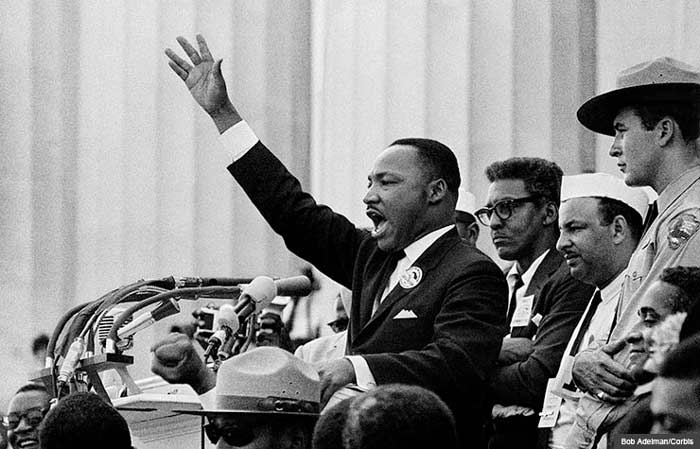
In this past Sunday’s march in Washington, we heard the calls for justice that were made in the 1963 march, except that now, we also were able to listen to the voices from the families of victims of direct racial violence.
Bridgette Floyd, sister of George Floyd, asked, “How will the history books remember you? What will be your legacy? Will your future generations remember you for your complacency? Your inaction? Or will they remember you for your empathy, your leadership, your passion for weeding out the evil and injustice in our world.
“Martin Luther King stood here 57 years ago, and he told the world his dream. But I don’t think y’all know, we’re here right now and have the power to make it happen. But we have to do it together. We have to do it together for our generations to come. For our children.
“My brother cannot be a voice today; we have to be that voice. We have to be the change and we have to be his legacy.”

New Phase for King’s Dream

Intergenerational Leaders Focus Conversations on Injustice in America, Voter Suppression, Voting Power … and Next Steps

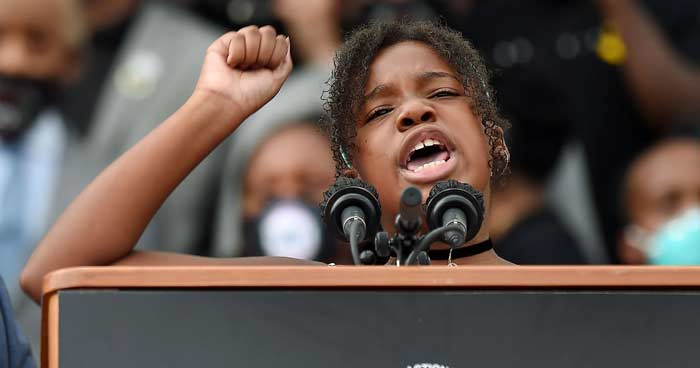
“The Commitment March: Get Your Knee Off Our Necks,” organized by The Rev. Al Sharpton (in photo, inset, left), Founder & President, the National Action Network, (NAN), and attended by thousands on Friday, August 28, 2020, commemorated the 57th anniversary of Dr. Martin Luther King Jr.’s “I Have A Dream” speech. Among the guest speakers were Rev. King’s granddaughter Yolanda Renee King, 12 (above).

Miss King’s Vision: “We Will be the Generation That Dismantles Racism.”

“We are going to be the generation that dismantles systemic racism once and for all, now and forever,” she said. “We are going to be the generation that calls a halt to police brutality and gun violence once and for all, now and forever. We are going to be the generation that reverses climate change and saves our planet once and for all, now and forever. And we are going to be the generation that ends poverty here in America, the wealthiest nation on Earth, once and for all, now and forever.”

She said that her grandfather “predicted this very moment” – when the struggle would move into a new phase. “The first phase was the Civil Rights (Movement), and the new phase is genuine equality,” she said.

“My generation has already taken to the streets peacefully, and with masks and socially distanced, to protest racism, and I want to ask the young people here to join me in pledging that we have only just begun to fight,” she said. “And that we will be the generation that moves from ‘me’ to ‘we’.”

“I didn’t know what would hit us in 2020 – a pandemic that shut our schools and put our young lives on hold, more killings of unarmed Black people by police, attacks on our right to vote, the worst economic crisis since the Great Depression that we learned about in school, and more extreme weather than ever before,” she said. But, she noted, “great challenges produce great leaders.”

And Miss King is ready to lead.

MEC FALL SEMESTER UNDERMINED: Part II

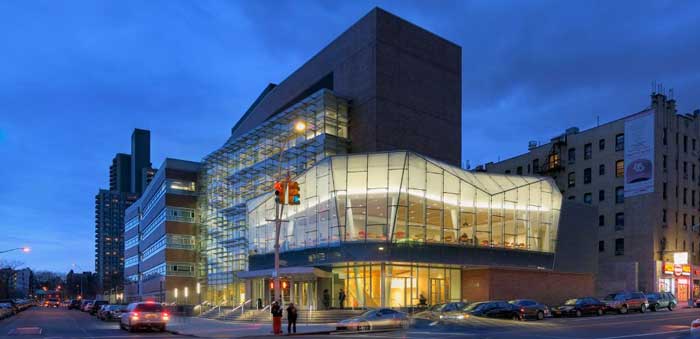
Faculty & Students Fight for NYC’s HBCU

By Maitefa Angaza

Correction:
From Part One of this article (MA)

Comments attributed to Terrence Blackman were not made by him and he was not a MEC founder. Also, Dr. Rudy Crew’s letter of resignation to the Medgar Evers College Community stated that he’d begin his new job in Georgia in July, 2020. So had the offer not been rescinded, he wouldn’t have been at MEC through June 2021 as reported.
In last week’s article, “The Ire this Time,” we reported on the disturbing state of affairs at Medgar Evers College, considered New York’s honorary HBCU. This week we provide more information, context and comments, including an alarming update as Fall classes are about to begin online.
Sakia Fletcher, outgoing student government president, graduated in June with a degree in Public Administration and Public Policies. Her last semester in office was a proving ground for the type of public servant she will be. She says that during the height of the pandemic, Rudy Crew was not around and students had to act fast to pick up his slack.
“We secured $50,000 from Student Technology and wrote a grant called the Medgar Evers College Relief Fund,” Fletcher said. By her accounting 200 students received $150 and 100 received $500, $1,000 or $1,500, the latter amount for students directly impacted by COVID-19 as a result of either they or a family member having contracted it.
And while CUNY provided laptops for students without them, Medgar Evers College needed to purchase bundles from internet service providers to give Wifi codes to students, as other CUNY schools did. Fletcher said that she and other students were expected to handle this themselves.
“The only info the college did give was the contact information for the different providers, and in many cases the providers’ free services did not reach the areas where students live.
“I live in the Bronx,” she said. “Most students commute; not everyone can afford to live in Brooklyn now, so many have moved out, but still go to Medgar.”
Fletcher says that for many MEC students to this day, it’s “a huge issue” that they do not have Internet service at home. She was one of them.
In addition, intimidation by the administration is said to be typical at Medgar Evers College, affecting not just students, but faculty, and even faculty representation. Dr. Zulema Blair, the current Vice-Chair of the College Council and Chair of the Department of Public Administration, is noted as one who has dared to speak out. Meanwhile, in a climate that some feel prioritizes retribution, advances that the College could make to solidify its legacy and attract and retain students, go unexplored. Fletcher cites one of her frustrations as an example.
“For a predominantly Black institution in Central Brooklyn named after a civil rights martyr to not have an African American Studies degree is shameful,” said Fletcher. “And for the only predominantly Black CUNY institution to still have classes in portable dormitories — it’s horrifying and humiliating!”
Barry Lituchy has worked at Medgar Evers College since 2007 as an adjunct assistant professor of History in the Department of Social and Behavioral Sciences. Asked about the general climate and student morale at MEC before the pandemic hit, he believes there was disappointment and fear for the mission.
“It seemed as though the college was being starved, and even undermined, from within. Medgar Evers College has this mission to be the HBCU for the New York City metro area, but the people at the top inside the institution don’t have any respect for that.“
An issue of concern addressed by Prof. Lituchi is what he calls, “a complete lack of respect for the faculty, particularly the adjunct faculty.”
CUNY’s 2017 contract requires three-year assignments for adjuncts who have taught the equivalent of two courses each for 10 consecutive semesters within a department. Prior to this, adjuncts had no job security from one semester to the next. While most colleges have complied, said Lituchy, MEC has tried to avoid it.
Three years ago he filed a grievance — on behalf of all the adjuncts, he says. He won. But now in 2020, adjuncts were again notified that they would not be retained. Lituchy filed his second grievance the same day. He feels the administration should actually be seeking to retain high-performing adjuncts, as they work at “much lower rates” than full-time or tenured professors, certainly lower than the high-salaried President Crew and Provost Okekere.
Dr. Armondo Howard, Chair of the Department of Physics and Computer Sciences at MEC, describes the current scenario as, “depressing.”
“We are being told that we cannot have some of our best adjuncts teach,” he said. “This is a tragedy for the university! I believe these adjuncts are the kind of people who will bring up enrollment and help keep the college going forward, which is exactly what we need.”
Dr. Shermane Austin, Deputy Chair of this department, is a tenured professor.
“A number of adjuncts, part-time faculty, are involved in a grievance process led by the PSC CUNY union over three-year appointments initially approved and then rescinded,” said Austin. “However, when affected adjuncts in the Physics and Computer Science Department were assigned courses for the upcoming fall semester, we were notified by the Dean of the School of Science, Health and Technology that they could not be hired until the grievance was resolved. These are two separate issues.
“Not only have adjunct faculty been unfairly penalized, but this is also an academic issue. In the age of Covid-19 and the disruptive impact of remote learning on our primarily minority student population, our best and seasoned adjuncts have been removed from teaching.”
A concerned faculty member who prefers to remain anonymous shared some of the causes of the alarm and frustration felt by many colleagues:
“Provost Okereke is running the college and we are now doing distance learning. Faculty are very concerned that there are exceedingly large classes, some from 42 to 50 students, and our college has a policy that no online instruction should have more than 30 students. Black and brown students are disproportionately affected by COVID-19. It’s really important to ensure that they have the optimum environment to get the attention they need.
“You also have asynchronous classes, which means students do not have designated times to go to classes. This was a policy imposed by the administration without consultation from faculty. And as a result, there is no specified time when students can meet with faculty members online. This is going to further impact the retention and performance of students.
“I am struggling with, how do I design my classes, where I can’t mandate that students meet with me? This goes against the mission of the College, which is to engage students to provide a nurturing and safe environment. This also violates the academic freedom of faculty members. When registration first started the classes had times and days. The provost had the registrar remove them. I don’t know how we’re going to do it. I really don’t.”
It would appear that the way forward for Medgar Evers College lies in the direction of CUNY demonstrating respect for and accountability to the students, faculty and staff. Real action informed by those most impacted by decision-making must be taken and the College’s full agency must be restored in honor of the heroism and sacrifice of its namesake.
Evelyn Maggio, a tenured professor of Business Law who’s been at the college for 23 years, says she’s not seen anything like the preferential treatment given the often-absent Rudy Crew.
“The Chancellor is letting Crew stay, supposedly for a year, because he’s a friend,” said Prof. Maggio. “The widow and the family of Medgar Evers wrote to the Chancellor, basically asking him to remove Crew. And now he is starting a search for a new president, but you know these searches — they can go on for six months, they can go on for six years!”

At the Heart of What Matters

New Book Tells Story of Organ Thieves in the Segregated South

It’s no secret that the nation has seen a disproportionate loss of life among Black Americans in our medical system. That was the case in May 1968, when Bruce Tucker, a Black factory worker, suffered a skull fracture and was rushed to the Medical College of Virginia (MCV). In less than 24 hours, the MCV surgeons had transplanted Tucker’s heart into the chest of a white businessman, prompting America’s first civil lawsuit for the wrongful death of its kind as explored in The Organ Thieves: The Shocking Story of the First Heart Transplant in the Segregated South (Gallery/Jeter Publishing), by Pulitzer Prize nominee and investigative journalist Chip Jones. 

For the first time, The Organ Thieves shows how racially biased attitudes fit a broader pattern of discriminatory behavior toward Black patients in the 1960s. Jones uncovers never-before-heard details and new investigative reporting including:

  1. The non-consensual surgical extraction of Bruce Tucker’s heart by surgeons at the Medical College of Virginia. After a junior medical examiner okayed the operation, Tucker’s beating heart was transplanted into the chest of an ailing white business-man without any prior consent by Mr. Tucker’s family. 
  2. Original archival legal and court documents, buttressed by eyewitness interviews with physicians, lawyers and journalists—many of whom will be available for an interview for the book—who provide a tense, minute-by-minute account of the last hours of Bruce Tucker.  
  3. Medical professional betrayals that mounted after the MCV doctors and administrators were shocked and dismayed to lose the heart transplant race to a previously obscure South African doctor, Christiaan Barnard, on December 3, 1967.  
  4. The first interview about the case in nearly half a century with L. Douglas Wilder, who was the Tucker family’s attorney in the case, and who would go on to become the first elected Black governor in the United States.  
  5. How Tucker’s brother William, a local store owner and cobbler, was frantically calling the hospital after getting a tip from an insider that surgeons were planning something strange for Bruce, who was unconscious at the time.  
  6. An in-depth exploration of the tradition of body-snatching that required surgical residents to work with professional grave robbers, aka “resurrectionists.” These practices lingered in the former capital of the Confederacy throughout Reconstruction and near the dawn of the 20th century. The book reveals the strange life of MCV’s live-in body snatcher, Chris Baker— a Black man who was revered by white medical students even as he faced threats of violence by local Black citizens. 
    7. A controversy surrounding MCV in 1994 when evidence of dumping bodies into old wells popped into public view during a construction project at what is now Virginia Commonwealth University’s medical center. After archeologists managed to exhume more than 50 human remains, the university ordered the site shut down—leaving an untold number of other remains beneath the front entrance of the building.