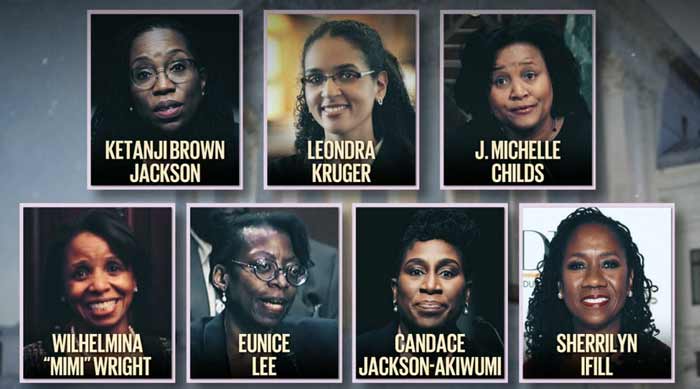
President Joe Biden made a campaign promise to nominate the first Black woman to serve on the Supreme Court, and he’ll now have his chance, given widespread reports that Justice Stephen Breyer will retire at the end of the current term. Supreme Court justices in the modern era tend to have similar resumes — eight out of nine served as federal appellate judges before their nominations to the nation’s highest court. Biden will likely consider nominees who don’t fit this mold, given that just five of the nearly 300 federal appellate judges were Black women when he took office, though he appointed five more in the past year. Here are some of the leading candidates:
Judge Ketanji Brown Jackson Biden nominated Jackson to the U.S. Court of Appeals for the District of Columbia last year, in a move that was seen as paving the way for her eventual accession to the Supreme Court. The D.C. Circuit of Appeals is considered the second-most powerful court in the country, given that it’s a venue where many important issues of constitutional and administrative law are decided. Jackson’s relative youth is also a factor in her favor. At age 51, if confirmed she would likely remain on the court for decades. Given the infrequent and random nature of Supreme Court vacancies, presidents in recent years have nominated younger justices in the hope that they will serve longer. Justice Amy Coney Barrett was just 48 when she was nominated by former President Donald Trump and confirmed in 2020 on a party-line vote in the Senate. Jackson also benefits from the president already having vetted her for the D.C. circuit role, while three Republican senators, Lindsey Graham of South Carolina, Susan Collins of Maine and Lisa Murkowski of Alaska voted with Democrats in favor of confirmation.
Justice Leondra Kruger Kruger has served as a justice on the California Supreme Court since 2014, when then-Gov. Jerry Brown made her the youngest nominee for the state’s highest court. Her youth is also an asset: at age 45, she would be the youngest person to be confirmed to the Supreme Court since Clarence Thomas joined the body in 1991 at age 43. Prior to her appointment to the California court, Kruger served as acting deputy solicitor general during former President Barack Obama’s administration, where she argued numerous cases before the Supreme Court. Kruger also served as a clerk for the late Justice John Paul Stevens in the early 2000s.
Judge J. Michelle Childs Childs serves as a judge on the U.S. District Court for the District of South Carolina, and is reportedly favored for the position by powerful Rep. James Clyburn, the third ranking Democrat in the House and whose endorsement of Biden before the South Carolina Democratic primary was seen as pivotal for his securing the party’s presidential nomination. Childs’ nomination would also bring a different type of diversity to the court, given that she received all her degrees from public universities, unlike the nine justices sitting on the court today, eight of whom received their law degrees from Harvard or Yale. Justice Amy Coney Barrett received hers from Notre Dame. Other names being floated for the role include Judge Junice Lee, who served for two decades as a appellate lawyer for indigent criminal defendants in New York before Biden nominated her to the U.S. Court of Appeals for the Second circuit and Judge Candace Jackson-Akiwumi, another former public defender who was nominated to the federal bench at the recommendation of Democratic Senate Judiciary Chairman Dick Durbin of Illinois.
Additional Possibilities Wilhelmena “Mimi” Wright Wright served as a law clerk for Judge Damon Keith. She worked at the law firm of Hogan & Hartson, LLP, in Washington, D.C. before joining the U.S. Attorney’s Office in Minnesota. Wright has earned numerous awards during her career, including the Myra Bradwell Award in 2006 from the Minnesota Women Lawyers, the Lena O. Smith Achievement Award from the Black Women Lawyers Network in 2004, the B. Warren Hart Award for Public Service from the Saint Paul Jaycees in 2001, and the Ten Outstanding Young Minnesotans Award in 2000. Wright was appointed to the Ramsey County District Court (Minnesota) in 2000 and to the Minnesota Court of Appeals in 2002 by Governor Jesse Ventura, on which she served from September 3, 2002 to September 26, 2012. Wright was appointed to the Minnesota Supreme Court on August 20, 2012 by Governor Mark Dayton, with her term beginning on September 27, 2012. She is the first African American woman to serve on the court. On April 15, 2015, President Barack Obama nominated Wright to serve as a United States District Judge of the United States District Court for the District of Minnesota, to the seat vacated by Judge Michael J. Davis, who took senior status effective August 1, 2015. Her nomination was reported by the Senate Judiciary Committee on September 17, 2015, by voice vote On January 19, 2016 the Senate voted 58-36 in favor of confirmation. She received her federal judicial commission on February 18, 2016.
Sherrilyn Ifill is a law professor and president and director-counsel of the NAACP Legal Defense Fund. She is the Legal Defense Fund’s seventh president since Thurgood Marshall founded the organization in 1940. Ifill is also a nationally recognized expert on voting rights and judicial selection. She is the author of On the Courthouse Lawn: Confronting the Legacy of Lynching in the 21st Century. In 2021, Time named her one of the 100 most influential people in the world on its annual Time 100 list.
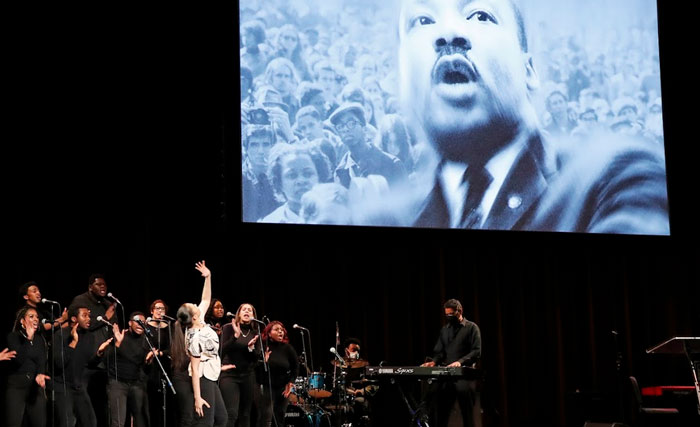
Brooklyn Academy of Music (BAM) hosted its annual Tribute to Dr. Martin Luther King, Jr. The 36th annual event took place Monday in the Howard Gilman Opera House and was livestreamed. The celebration included a keynote speech by critically-acclaimed author and cultural historian Dr. Imani Perry and remarks from: Governor Kathy Hochul, Mayor Eric Adams, Brooklyn Borough President Antonio Reynoso, Senator Charles Schumer, Senator Kirsten Gillibrand, Council Member Crystal Hudson, Congressman Hakeem Jeffries, Speaker Adrienne Adams, District Attorney Eric Gonzalez, and BAM Co-Interim President Coco Killingsworth were among those addressing the crowd. Below are excerpts from several of the remarks.
Senator Majority Leader Charles E. Schumer. Today we honor the legacy of the Reverend Dr. Martin Luther King, Jr., a man whose words and deeds accomplished nothing less than the elevation of the human race. It’s no coincidence that MLK Day is the only day on our calendar dedicated to a single American. We have Mother’s Day for the mothers, Father’s Day for the fathers, July 4th for the nation’s founders, Veteran’s Day for the veterans, but only one day for one man. And that’s just who Dr. King was, singular, exceptional, unique. …He lifted a giant mirror on his broad shoulders. And with his eloquence, his brilliance and with his faith, he forced America to look into that mirror. And America did not like what it saw, with all the racism, bigotry and discrimination. And that began our long trek to try and get full equality and end bigotry. We’re not there yet, but Dr. King’s mirror is still there showing America we must do better.
Senator Kristen Gillibrand (D-NY) Our work starts with everyone having a say at the ballot box. We have to pass voting rights laws. We have to protect fundamental civil rights and civil liberties. And if that means getting rid of the filibuster, then w should be getting rid of the filibuster. Our work starts with addressing the inequalities our healthcare system has shown. We know that Covid has shown it is harder for Black and Brown communities to access care, it has left them more susceptible to Covid and it has left them more susceptible to many diseases and underlying health conditions. One of those conditions is maternal mortality. We have seen in this city and this state, that women, Black women in particular, are up to three times more likely to die in childbirth or within a year of giving birth because of the color of their skin. This has to end. And I am working in Washington to change laws
It also starts with our public schools… …We have to see our schools as a pillar of our democracy and a cornerstone of our economy. Looking forward, I believe we should look at our schools as “critical infrastructure.” They should be so designated. And with that, resources should flow. Schools should be among the institutions first in line for PPE, for masks, so every child has a mask when they walk in the door. To make sure every child has access to the vaccines that they need on a timely basis. So teachers have access to vaccines, PPE, testing, so they know that when they go to teach, they are teaching in a safe place. That is how we should be imagining our schools. The safest place for our kids to be.
Photo by Althea Smith
Governor Kathy Hochul We come together year after year to talk about his life what he did as such a young person. He was just a teenager paractically when he got involved. 26-years-old when he led the Montgomery Bus Boycott. -…He planned the March on Washington as a 34-year-old young man. And he wrote some of hostory’s most powerful and poignant letters to the leaders around the world to fight for a cause he believed in to his core, is that every man woman and child is entitled to dignity and to equal rights sand they should never be denied. …He said every one of us should ask ourselves daily, “What are we doing for others?”
Photo by Althea Smith
Brooklyn Borough President Antonio Reynoso First I’d like to introduce everyone and welcome them to the center of the universe, that is Brooklyn, NY. The sun to the solar system that is New York City. Everything revolves around us. The light that shines among the other boroughs… I can’t tell you how grateful and how happy and proud I am to be able to stand here before you. A young, poor Brown by from the southside of Williamsburg to stand on this stage, honoring the legacy of Martin Luther King, Jr. really is something that I don’t tink in my wildest dreams that I ever could have accomplished. …Right now, I want to talk about Dr. King’s legacy, as his family has called for a day of action for voting rights sand is leading a march in Washington as we speak. As his son Martin Luther King, 3rd said “this is a day on, not a day off.” Here in the city of New York I am proud to say we recently passed the Our City, Our Vote legislation. Which I was proud to co-sponsor when I was a city councilmember. It’s the largest expansion of voting rights in over 50 years, allowing noncitizens to vote in our municipal elections.
Yet voting rights sand ballot access remain under threat throughout the country, putting the very future of our democracy at risk. Literally, since Reconstruction, there have been forces a work in state and local governments, trying to claw back any gains made in civil rights and enfranchisement and it is still happening today. Just last week in Texas, it became illegal for an elected official to promote voting by mail. Georgia’s 2021 election law changes were so restrictive that the justice department sued and now the Republican leaders are looking at new ways to keep Black and Brown people in disenfranchisement.
When Florida voters restored the vote to previously incarcerated people, the state’s Republican governor and legislature, intervened to require fees that echoed Jim Crow poll taxes. Even here in New York City, last Friday Republicans filed a lawsuit to stop the Our City, Our Vote legislation from being implemented. And we can’t let this happen. Martin Luther King Jr. said “when people get caught up with that which is right, and they are willing to sacrifice for it, there is no stopping point short of victory.” Let this remind us that we have to defend what we believe in by standing with all of our allies, all over the country to demand the passage of the national voting right legislation and to support local efforts on the ground to enfranchise voters of color. Here at home, as your Borough President, I will do everything I can to defend the historic Our City, Our Vote law and ensure that it is fully implemented throughout Brooklyn and the rest of New York City. I will support reforms to our Board of Elections and policies like Same Day Voter Registration, No Excuse Absentee Ballots, better working conditions for poll workers and more efficient voting procedures so that you don’t have to wait in line all day just to cast a ballot. Martin Luther King, Jr. called American democracy a dream unfulfilled. Let us Let’s work everyday to fulfill that dream, thank you.
Photo by Althea Smith
Crystal Hudson …These 17 deaths [ause by the Bronx fire] were unjust and untimely. We know that dismantling systemic racism and white supremacy is racial justice. And that battling police brutality and securing voting rights is racial justice. But fighting for fair and just housing is also racial justice. Insuring landlords keep the heat on in the winter where Black people live, is also racial justice. Accountability when building owners and management companies intentionally violate our laws and leave Black folks to die in their own homes is racial justice.
I pray for the families we lost in th Bronx. Justice will never come for them, their loved ones will not return but we can fight for accountability and we can fight to protect the most powerful mechanism of accountability, one’s right to vote. As we honor Dr. King, his family reminds us that today is not a celebration without meaningful action. Truly honoring Dr. King means advancing the basic tenets of democracy in our country and following the clarion call to secure ballot access for millions of Americans.
In 1965 after the Voting Rights Act languished in the House rules Committee after passing in the Senate, Dr. King wrote a letter titled “Let My People Vote,” in the New York Amsterdam News urging its passage as the first step in ensuring access to the ballot. He outlined a plan to register thousands of Black Americans across the South to vote, county by county from Virginia to Florida. In his letter he reminds readers “We cannot rest laurels have not yet been earned. We must toil on during the hot, sweltering summer months. We must get our long-deprived people registered in the South’s infamous Black Belt counties. Voting legislation does not put the names of Negroes on voting lists. We are not so naïve as to believe that persons who have traditionally opposed our right to vote, will not desist from intimidating us. There must be change. There will be a change.”
Today, eleven states have strict voter ID laws, a modern poll tax. Southern states closed twelve hundred polling places and millions are removed from their local vote roll each year, including the more than 200,000 Georgians, many of whom were Black, who were wrongly removed from the voter rolls ahead of the 2018 gubernatorial election, preventing the U.S. from having its first Black female governor, my Spellman sister, Stacey Abrams. The legacy of Jim Crow and the deep roots of White supremacy, have clearly ignored Dr. King’s call for change. Today I urge you to not rest. Because our laurels have not yet been earned. I urge you to get involved and remain involved. And I urge you to join the King family and continue to put pressure on the naysayers in Washington to pass the Freedom to Vote Act and the John Lewis Voting Rights Act. Our democracy depends on each of us actively participating and holding ourselves accountable to its success.
Photo by Althea Smith
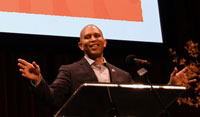
Congressmember Hakeem Jeffries Today is a day of reverence, a day of remembrance and a day of recommitment. It’s a day of reverence for us to honor publicly to celebrate to thank the Reverend Dr. Martin Luther King, Jr. for all that he did. He made America a much better place than the nation that he inherited. So we’re thankful for him and our civil rights heroes and footsoldiers. It’s a day of reverence for Dr. King. It’s also a day of remembrance, for us to remember the service, the sacrifice, and the struggle of Dr. King. On this journay toward justice, you can’t get from your point of departure to your point of destination without at some moment along the way encountering turbulence.
It wasn’t easy for Dr. King, it wasn’t easy for John Lewis, It wasn’t easy for Fannie Lou Hamer, it wasn’t easy for Rosa Parks. It wasn’t easy for A. Phillip Randolph and all the heroes and foot soldiers. They had to encounter turbulence. Bull Connor in Birmingham, that’s turbulence. Sheriff Jim Clarke in Selma, that’s turbulence. The racist Governor George Wallace, in Dixie, that’s turbulence. You can’t get from your point of departure to your point of destination on your journey towards justice, without encountering turbulence. So we remember and we respect that. Because when Dr. King would come into town on a desegregation campaign or to elevate the right to vote, he wasn’t greeted with wine and roses. He was greeted with Billy clubs, and fire hoses. They encountered turbulence each and every step of the way. But they had faith that things could be different and they put the work in and as a result of Dr. King’s leadership and partnership with so many civil right heroes and foot soldiers. Just think about what they were able to accomplish. The 1964 Civil Rights Act, 1965 Voting Rights Act, Medicare, Medicaid, HeadStart, the Elementary and Secondary School Education Act, the Higher Education Act. The Immigration and Nationality Act, the 1968 Fair Housing Act. In just five short years, they transformed America. And we’re thankful for that. They didn’t have the internet, they didn’t have cell phones, they didn’t have Facebook, they didn’t have Twitter or Instagram but they had faith. And they transformed America.
Lastly it’s a day of recommitment. Because while Jim Crow may be dead, he’s still got nieces and nephews that are alive and well. So we’re battling the ghost of the Confederacy right now who are trying to turn back the clock. Y’all know about that, back in Washington DC. Wickedness in high places . But that’s okay because we are going to channel the spirit of Dr. King to continue to make progress in America. We’ve got turbulence down in Washington but we’re going to fight through it just like Dr. King and others did. And as we fight through it. No matter what it takes we are going to pass the John Robert Lewis Voting Rights Act. We are going to pass the Freedom to Vote Act. We are going to end the era of voter suppression in America once and for all. As Dr. King said, “We shall overcome.” Thank you.
Photo: BAM via Getty
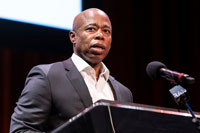
Mayor Eric Adams At the beginning of the year, prior to taking office as the Mayor of New York, I took a trip to Ghana and I went into the dungeons and saw the small spaces where our ancestors were held for many days, sometimes for 2-3 months, living in their own waste, eating one meal a day. Not seeing the sunlight, being ripped apart from their families, never to see them again. Only to understand that leaving that that horrific place, the pain and uncertainties would increase when they reached south central America, Cuba, only to come here to America and watch the continuous devastation. I needed to do that because it must reignite my spirit and be clear on what the journey lies ahead of us and what we must accomplish.
I’ve heard over and over again how hard it is to be the Mayor of the City of New York. I said no, hard is living in that dungeon. Hard is watching your wife or your mother have the baby ripped from their stomach to send a message. Hard is working in the field all night, deliver your baby and going back to work again. Hard is watching someone kick in the cabin door and sodomize and rape your children and have you still stay on that plantation. Hard is building America, only to watch yourself relegated to a position where you will never participate in the prosperity that this country has to offer. That’s hard. That’s hard. Where we are now, no matter how challenging it is, we can become King-like. His name has transcended in identity and has become a message, a symbol.
How do we become King-like? We stop and educational system where we spend $38 billion yet 65% of Black and Brown children never reach proficiency in this city. That’s being King-like. King-like is doing dyslexia screening so we don’t have prisons where 30% of our children or dyslexic and 55% have a learning disability. Giving them the opportunity. If you don’t educate, you will incarcerate and we need to stop that incarceration that takes place at childbirth.
Being King-like is having housing that people can afford to live in, where NYCHA residents are not seeing the conditions that don’t allow them to have a safe environment. Being King-like is making sure people who are dealing with mental health crises will have the support that they deserve, so we don’t have 48% of our prisoners at Rikers don’t have mental health crises. Being King-like is insuring that as we recover as a city, we don’t recover for some and ignore others. We end the inequality that we have seen persistent in our city over and over again. Being King-like is dealing with the gun violence, that would take a 19-year-old child working in Burger King to provide for her family, and now we have lost her. Stopping the flow of guns from the southern part of the country into our cities in the northern part. Ther are no gun manufacturers in Chicago, there’s no gun manufacturers in New York, there’s no gun manufacturers in Detroit. Being King-like is stopping the source. That’s’ what I must do as the mayor of this city. If I am just the second African American Mayor of the City of New York, and I fail to stop the systemic problems we have been facing, then I’ve failed that journey I took in Ghana. I’ve failed those who laid the path for me to be here. I’m committed and dedicated to getting this job done.
EQUALITY FIRST Huge amounts of public money, poured into our economies, have inflated stock prices dramatically and in turn boosted the bank accounts of billionaires more than ever before. Huge amounts of public money, poured into vaccines, have in turn boosted the profits of pharmaceutical firms, to the tune of tens of billions of dollars. Governments must turn this around and refuse to spiral deeper into a dangerous, deadly, and self-defeating downfall into levels of extreme inequality human history has never seen before.
There is no shortage of money. That lie died when governments released $16 trillion to respond to the pandemic. There is only a shortage of courage to tackle inequality, and the wealth and might of the rich and the powerful, and a shortage of the imagination needed to break free from the failed, narrow straitjacket of extreme neoliberalism. Responding to the power of social movements and of ordinary people around the world, and learning from the ambition of progressive governments, both historically (such as in the wake of the Second World War), and in the wave of liberation from colonialism in many countries, governments must pioneer ambitious strategies fit for the 21st century.
They must actively promote far greater economic equality and pursue gender and racial equality, supported by explicit, timebound, and measurable milestones. Governments have huge scope to radically change course. Only systemic solutions will do to combat economic violence at its roots and lay the foundations for a more equal world. That requires ambitiously changing the rules of the economy, to more fairly pre-distribute power and income—ensuring that the market, the private sector, and globalization do not produce greater inequality in the first place—to tax rich people, and to invest in proven public measures.
Claw back extreme wealth into the real economy to tackle inequality All governments should immediately tax the gains made by the superrich during this pandemic period, in order to claw back these resources and deploy them instead in helping the world. For example, a 99% one-off windfall tax on the COVID-19 wealth gains of the 10 richest men alone would generate $812bn. This must evolve into implementing permanent progressive taxes on capital and wealth to fundamentally and radically reduce wealth inequality. These efforts must be accompanied by other fiscal measures, including rich countries channeling significant portions of their collective $400bn worth of IMF Special Drawing Rights to vulnerable economies in a way that is debt and conditionality-free.
Redirect that wealth to save lives and invest in our future All governments must invest in evidence-based and powerful policies to save lives and invest in our future. The legacy of the pandemic must be quality, publicly-funded, and publicly-delivered universal healthcare—nobody should ever have to pay a user fee again—and universal social protection that offers income security for all. Governments must invest in ending gender-based violence through prevention and response programs, ending sexist laws, and financially backing women’s rights organizations. Rich governments must fully finance climate adaptation, and back the loss and damage mechanisms necessary to surviving the climate crisis and creating a fossil-free world.
Change rules and shift power in the economy and society Governments must rewrite the rules within their economies that create such colossal divides, and act to pre-distribute income, change laws, and redistribute power in decision-making and power in the economy. That includes ending sexist laws, including those which mean that nearly 3 billion women are legally prevented from having the same choice of jobs as men. It includes rescinding laws that undermine the rights of workers to unionize and to strike, and setting legal standards to protect them. It includes addressing monopolies and limiting market concentration. It must include tackling the barriers to representation for women, racialized groups, and working-class people. Women still make up only 25.5% of parliamentarians globally. The single most urgent priority is to end the pandemic, and to do this governments must end the monopolies held over vaccines and technologies through the World Trade Organization (WTO). They must insist that these vaccine recipes, and any new vaccines developed in the face of new variants, are an open-source public good, available to be made by every qualified vaccine manufacturer in the world through the World Health Organization. Until this happens, the pandemic will be prolonged, millions will needlessly die, and inequality will continue to spiral. It has been said that the definition of insanity is doing the same thing over and over again and expecting different results. As the third year of this pandemic begins, there is an overwhelming feeling of this insane treadmill in the world today. The leaders of rich nations above all have a choice. They can choose a violent economy in which billionaire wealth booms, in which millions of people are killed, and billions of people are impoverished due to inequality; in which we burn the planet and our future human existence on the altar of the excesses of the rich; in which the rich and powerful double down on the privatization of vaccines with self-defeating greed, allowing the pandemic to mutate and come back to haunt us all. Or we can choose an economy centered on equality, in which nobody lives in poverty, and neither does anyone live with unimaginable billionaire wealth; in which billionaires are something children read about in history books; in which inequality no longer kills; in which there is freedom from want; in which more than just survive, everyone has the chance to thrive—and to hope. That choice is the choice facing this generation, and it must be made now.
OXFAM BRIEFING PAPER JANUARY 2022 The wealth of the world’s 10 richest men has doubled since the pandemic began. The incomes of 99% of humanity are worse off because of COVID-19. Widening economic, gender, and racial inequalities—as well as the inequality that exists between countries—are tearing our world apart. This is not by chance, but choice: “economic violence” is perpetrated when structural policy choices are made for the richest and most powerful people. This causes direct harm to us all, and to the poorest people, women and girls, and racialized groups most. Inequality contributes to the death of at least one person every four seconds. But we can radically redesign our economies to be centered on equality. We can claw back extreme wealth through progressive taxation; invest in powerful, proven inequality-busting public measures; and boldly shift power in the economy and society. If we are courageous, and listen to the movements demanding change, we can create an economy in which nobody lives in poverty, nor with unimaginable billionaire wealth—in which inequality no longer kills.
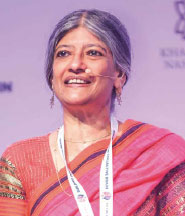
Jayati Ghosh
From the Forward By Jayati Ghosh
Here’s a hard truth that the pandemic brought home to us. Unequal access to incomes and opportunities does more than create unjust, unhealthy, and unhappy societies: it actually kills people. Over the past two years, people have died when they contracted an infectious disease because they did not get vaccines in time, even though those vaccines could have been more widely produced and distributed if the technology had been shared. They have died because they did not get essential hospital care or oxygen when they needed it, because of shortages in underfunded public health systems. They have died because other illnesses and diseases could not be treated in time as public health facilities were overburdened and they could not afford private care. They have died because of despair and desperation at the loss of livelihood. They have died of hunger because they could not afford to buy food. They have died because their governments could not or would not provide the social protection essential to survive the crisis. And while they died, the richest people in the world got richer than ever and some of the largest companies made unprecedented profits.
The hundreds of millions of people who have suffered disproportionately during this pandemic were already likely to be more disadvantaged: more likely to live in low- and middle-income countries, to be women or girls, to belong to socially discriminated-against groups, to be informal workers. More likely, therefore, to be unable to influence policy.
Now it appears that inequality is not just killing those with less political voice; it is also killing the planet. This makes the strategy of privileging profits over people not just unjust but monumentally stupid. Economies will not “grow,” and markets will not deliver “prosperity” to anyone, no matter how powerful, on a dead planet.
It’s now essential to change course. We need systemic solutions, of course: reversal of the disastrous privatizations of finance, of knowledge, of public services and utilities, of the natural commons. But we also need accessible fiscal policies like taxation of the wealthy and of multinational corporations. And we need to undo the structural inequalities of gender, race, ethnicity, and caste, that feed into the economic disparities.
This sharp and effective note from Oxfam makes it clear that inequality is deadly—and that the solutions are within our grasp. It can still be done, with greater collective imagination and public mobilization. Jayati Ghosh taught Economics at Jawaharlal Nehru University, in New Delhi, India, and is now Professor of Economics at the University of Massachusetts at Amherst, USA. She is a member of the World Health Organization’s Council on the Economics of Health For All.
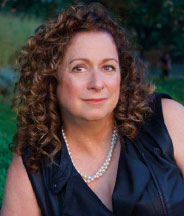
Abigail Disney
By Abigail E. Disney We have just spent nearly two years, over and over again, watching people die—they’ve died of neglect, of carelessness, of a lack of empathy, of ennui. Yes, of course, it was actually Covid that killed the people I am talking about, but just as every famine is political and man-made, so is every Covid death. When Covid first hit I, and a lot of other naifs, thought that maybe, just maybe, the way our structures had been so starkly revealed as unjust and downright cruel would wake us up and give us new energy to think differently about the way resources are distributed. In fact, the opposite has happened. New billionaires were minted while the old billionaires added more and more billions to their stakes.
Businesses like Amazon, rather than feel shame, saw opportunity and doubled down on the strategies that had left 40% of American workers unable to rely on even the smallest amount of savings to address the hunger, Homelessness, and poor healthcare that presented all the more immediate threats to them and their families. Society was riddled with cracks when we started this pandemic—cracks which have widened into fault lines. These fault lines threaten social cohesion and democracy, and perhaps more importantly, present an almost insurmountable barrier to any cogent or effective approach to addressing the climate crisis, which is quickly turning very real for even the most hardened deniers.
None of this just “happened.” Decades of coordinated assault upon the laws, regulations, and systems that protected the common person from those that would exploit them have left us with a hobbled civil society, a union movement on life support, and a government so starved for resources it is barely able to simply collect the taxes it needs just to keep operating. The solutions, therefore, must be just as deliberate. We must undo the structures that are perpetuating a deadly status quo and build new ones that will redistribute both wealth and power in a more equitable manner. Systemic issues require systemic solutions, not piecemeal attempts at treating symptoms rather than the disease itself. The answer to these complicated problems is ironically simple: taxes. Mandatory, inescapable, ambitious tax reform on an international level—this is the only way to fix what is broken. Without high-functioning governments actively using plentiful resources to redress these injustices, we will head yet further down the rabbit hole the wealthy class has dug for us all.
There is more than enough money to solve most of the world’s problems. It’s just being held in the hands of millionaires and billionaires who aren’t paying their fair share. We can start by clawing back some of the frankly absurd growth in billionaire fortunes over the course of the pandemic. It isn’t complicated, and it shouldn’t be controversial. Virtually everyone else on the planet has sacrificed in some way over the last two years; it’s time for billionaires to do the same—and quickly. As this report so clearly lays out, there isn’t any time to waste.
Too many of my too-wealthy peers treat inequality as an abstract issue, but it has devastating, real-world consequences. Our wealth does not come to us in a vacuum: it is directly linked with our country and our world’s failure to provide for those with the most need. Billionaires alone have made an astronomical amount of money in just the last two years—they can easily afford to pay more.
We can make our world a better place. We just have to find the political will to do what it takes. Abigail E. Disney is a documentary filmmaker, activist, co-founder of Fork Films, and podcast host of “All Ears.” She is a member of the Patriotic Millionaires.
NEW YORK, NY The field of candidates for the 2022 NYS Governor’s race is narrowing. Governor Kathy Hochul, who recently submitted her $216 billion budget, will face two major Democratic contenders for her job, NYC Public Advocates Jumaane Williams and Congress member Tom Souzzi. Former NYC Mayor Bill de Blasio will not run. Energetic Eric Adams seems to enjoy his freshman outing as the new sheriff in town. He continues announcing a stellar group of people to occupy top City Hall posts. Former NYPD brass Philip Banks was named Deputy Mayor for Public Safety. Chaplain Ingrid Lewis-Martin, who was Adams’ Deputy Brooklyn Boro Prexy, was named Chief Advisor to the Mayor. Barbados-born NYS Appellate Court Judge Sylvia Hinds- Radiz was appointed Corporation Counsel, a first for a Caribbean-American attorney. The foregoing heritage info was lifted from City Hall press releases. One appointment, however, remains under media scrutiny. Adams named his brother Bernard, a retired NYPD sergeant, as an NYPD deputy commissioner, then demoted him a week later to Executive Director of Mayoral Security with a $210,000 salary.
There are notable promotions and demotions under NYPD Commissioner Keechant Sewell. Juanita Holmes, Chief of Patrol since 2020, whom media concluded would be Adams’ NYPD Commish choice, named Chief of Training and is expected to retire. Assistant Chief Kathleen O’Reilly is designated Chief of Patrol. Community Affairs Chief Jeffrey Maddrey was named Chief of Housing. David Barrere will lead Internal Affairs. Assistant chief Philip Rivera and Staten Island Patrol Borough Executive Officer Gin Lee have been promoted to commanding posts. Diana Richardson, NYS Assembly member from Brooklyn, daughter of Arubian parents, was named Brooklyn Deputy President by Boro President Antonio Reynoso, whose parents are from the Dominican Republic.
HEALTH WATCH Biden Administration COVID19 updates. The government will give away 400 million N95 masks at health care facilities and pharmacies across the country. On January 19, order free COVID19 Test Kits courtesy of the US government. Visit https://www.Covidtests.gov
The COVID19 Omicron variant is in retreat! New COVID19 cases are plummeting in many states, including New York. The percentage of cases causing severe illness is much lower than it was with the Delta variant.
DEMOCRACY 101 The Winter 2022 issue of Foreign Policy Magazine is single themed, “Democracy is On the Defensive. Here’s How to Fix It and The Reasons Are As Deep As They Are Familiar”
Will the Voting Rights bill see the light of day in the US Senate this year? Makes a Black person worry about the landmark Voting Rights Act of 1965, the states ((Texas, Georgia, Florida) voter suppression laws, and the current US Supreme Court. It seems so important this year as we celebrate Dr. Martin Luther King’s holiday.
BBOOK NEWS: Black Lives still matter in book publishing. “The 1619 Project’ edited by Nikole Hannah-Jones, about the history of slavery in America, and “Will,” the Will Smith memoir, place 1 and 2 respectively on the recent NY Times best seller non-fiction list.
Bibliophiles are celebrating the Alex Haley centennial. Born on August 11, 1921, Haley, the dean of American bestseller books. Author of “The Autobiography of Malcolm X” and “ROOTS,” two major 20th Century classics, included in many HS and college curricula. Read the 12/17/21NY Times piece about his literary prowess, “Alex Haley Taught America About Race- And A Young Man To Write” by Michael Patrick Hearn. “The Autobiography of Malcolm X” is literary magic for young men of all ethnicities, traveling that fine line from adolescence to adulthood. Multiple Grammy winner Dionne Warwick begins 2022 with a new single, “Power In The Name,” featuring Krayzie Bone and NomaD, with its uplifting message of hope for a bright future. Proceeds from the single will benefit charities which provide shelter and clothes. “Power In The Name” is available on most streaming services.
NEWSMAKERS Happy Birthday Aquarians, the fixed air sign, whose natives include Brandy; Antigua Barbuda Prime Minister Gaston Browne; Wall Streeter Sanjenetta Harris; Jaime Harrison, Chair, National Democratic Committee; billionaire Michael Jordan, retired NBA icon; actor Michael B. Jordan; Alicia Keys; 2021 NYC mayoral candidate Ray McGuire, former Citigroup executive; Kenya Moore; Omarosa Manigault Newman; OPRAH; NY Carib News Associate Publisher Faye Rodney; Derek Perkinson, National Action Network; Joy Reid, MSNBC anchor; Chris Rock; Rick Ross; Economist and journalist Lena Sherrod; Jeweler and fine arts photographer Coreen Simpson; Don Thomas, NY Beacon Entertainment Editor, turns 80; Dr. Deborah Willis, NYU Professor; Kerry Washington; and The Weekend. RIP: Andre Leon Talley, 73, died on January 18 in New York, Trailblazing fashion journalist, Talley worked for NY-based Women’s Wear Daily, the fashion world bible, in the mid 70s before being assigned its Paris bureau chief. A striking figure at 6’6” figure, he favored capes and baroque accessories when making a fashion statement. He knew French culture and fashion history. He was an exalted presence in the world of haute couture. Back to America, he lands job as Vogue Magazine creative director, a first for an African American. By the turn on the century, he was a household name in fashion circles. He was a staple during NY Fashion Week. Raised in Durham, NC by his grandmother, whom he credits for his sense of style, Andre graduated from NC Central University and from Brown University. The 2018 documentary, “The Gospel According to Andre” and his memoir “The Chiffon Trenches” are good experiences to visit his storied life.