Home Blog Page 351

From T. Thomas Fortune to Black Women TV Executives: Black Victorians are Celebrated in HBO’s The Gilded Age

By Fern Gillispie

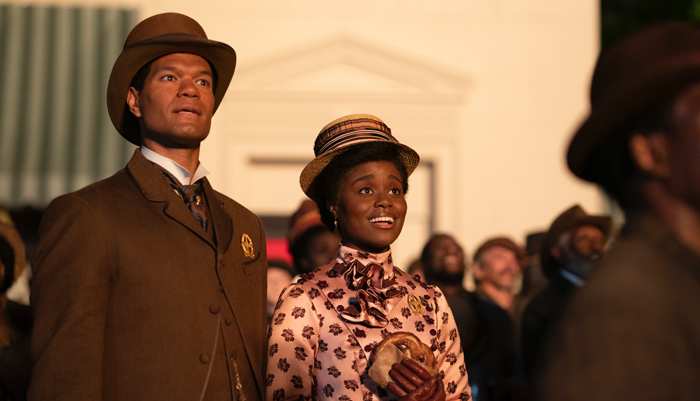
The Gilded Age is HBO’s lavish, opulent drama that not only tells a saga of New York City’s wealthy robber barons during the 1880s, but also explores the White Victorian Era middle class and the emerging Black American elite, entrepreneurs and intelligentsia.


“The Gilded Age is one way of thinking about that period of time in New York, but it’s really Reconstruction post-Civil War. Black people can finally participate,” explains actor Sullivan Jones, who portrays legendary Black journalist T. Thomas Fortune. “So, there’s this unleashing of energy among Black people want to get into politics, science, engineering and journalism. We haven’t been able to participate in any realm or any capacity, so let’s get after it. T. Thomas Fortune was at the tip of that sphere.”
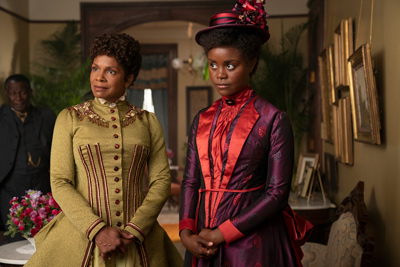
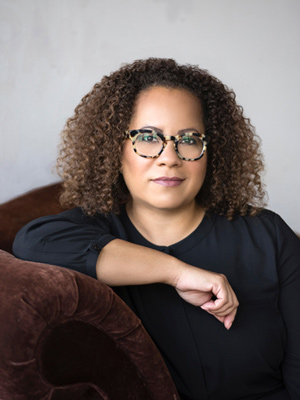
Audra McDonald and Dene E. Benton


For inspiration, Jones journeyed from his home in Brooklyn to Red Bank, NJ to visit the Victorian mansion that was once the home of Fortune from 1901 – 1911. Fortune had been helming The New York Globe, the largest and most influential Black newspaper since the 1880s. At the T. Thomas Fortune Cultural Center, Jones was inspired by the magnificently restored home that still had the aura of Black Victorian wealth and achievement. The home is listed as a National Historic Landmark. Fortune, who was born in slavery in 1856 and studied journalism at Howard University, was friends and colleagues with W.E.B. DuBois, Ida B. Wells and Booker T, Washington. Jones was born and raised in the San Francisco Bay area and earned a bachelors at the UCLA School of Theatre, Film and Television and a masters in drama from Brown University. In recent years. he has fascinated audiences with his stand-out performances in TV miniseries “Harlem” and “Halston” and in the Broadway drama “Slave Play.” For Jones, portraying activist-journalist Fortune, a sometimes forgotten giant in Black history, was a dramatic challenge that he embraced.
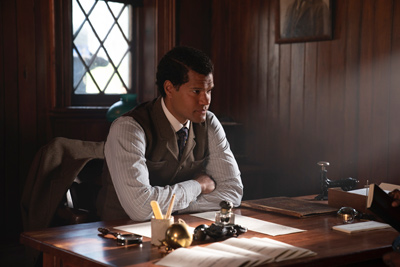
Sullivan Jones as T. Thomas Fortune Photo: Alison Cohen Rosa, HBO


“During the Gilded Age, Fortune is making noise. He’s in organization mode. He was railing against Reconstruction, because he saw it as what it really was–a total failure as it applied to African American people and the economics of that time,” explained Gilda Rogers, award-winning journalist and executive director of T. Thomas Fortune Cultural Center, who met with Jones. “Yes, we were able to get our way into some places, but he’s still fighting. That’s when he starts using his newspaper as a bully pulpit to speak out. In 1887, he was the founder and organizer of the National Afro American League. It was precursor to the Niagara Movement and to the NAACP. Fortune is a trailblazer in this time. He is really opening the doors. He’s been called the bridge to modern day civil rights movement for that reason.”

 Achieving the right voice and tone for Fortune was a sensitive issue for Jones. He is a sought after book narrator and winner of the Earphones Award. He immersed himself in Fortune’s books. “I did bring in a little bit of the southern flavor. He’s from Florida, so he has to have some of that drawl. He’s obviously a man of letters, so he has to think fast and he thinks quickly. I thought of him as a teacher and an educator,” he said. “I was also inspired by the voices of Cornell West, Ta-Nehisi Coates, Stokely Carmichael and Bobby Seale. There’s a crispness and a clarity and incisiveness with how they speak.”


Black women are instrumental in HBO’s “The Gilded Age” The co-writer, co-executive producers and director are Black women, who make it a point to showcase Black Victorians. One of the primary characters, actress Denee Benton has a family storyline with mother Audra McDonald, wife of a noted Black businessman. Benton becomes the only woman writer for Fortune at The New York Globe newspaper.


Julian Fellowes, the creator of “Downton Abbey” and “The Gilded Age”, tapped Sonja Warfield, to be his co-writer and executive producer of “The Gilded Age.” Warfield is a television writer known for the Emmy Award-winning NBC sitcom “Will & Grace” and BET’s hit comedy “The Game.” “When they offered me the part, I had a Zoom chat with Sonja and asked are we going to do him Fortune justice,” recalled Jones. “I could just tell she cared in the same way feeling like your custodian of the history. She was instrumental in shepherding the project along.”


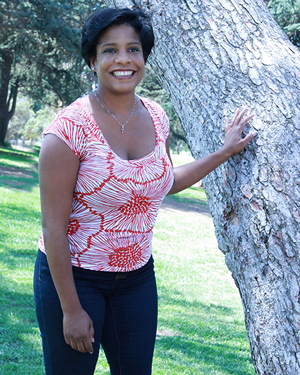
Dr. Erica Armstrong Dunbar, noted Rutgers University history professor and an award-winning author and 18th and 19th century scholar, was the official historian on set and a co-executive producer of “The Gilded Age.” “She was the etiquette person,” he said. “One time I went to shake my co-star’s hand, she ran in and said ‘no, no, no, that’s not how they shook hands.’ During that time, you grabbed the tip of the fingers with your thumb on top.”


Salli Richardson-Whitfield, director and executive producer of “The Gilded Age,” is known as an actress, but she’s directed episodes of “Eureka,” “Queen Sugar,” “Underground,” “Scandal” and “Luke Cage.” “She directed half of the season,” said Jones. “She was also really instrumental, being there and setting the tone and making us feel comfortable, fielding questions and being a go between us and creative team.”


Working on “The Gilded Age” made Jones closely study and admire the post-Reconstruction Era that introduces Black Victorian strivers and activists. “In the 1880s, Booker T. Washington, W.E.B DuBois, Ida B. Wells and T. Thomas Fortune are surviving by the skin of their teeth,” he said. “And there’s no lure of popularity and richness. They’re just trying to make it work for Black people.”

-Bernice Elizabeth Green is editorial curator of Our Time At Home.
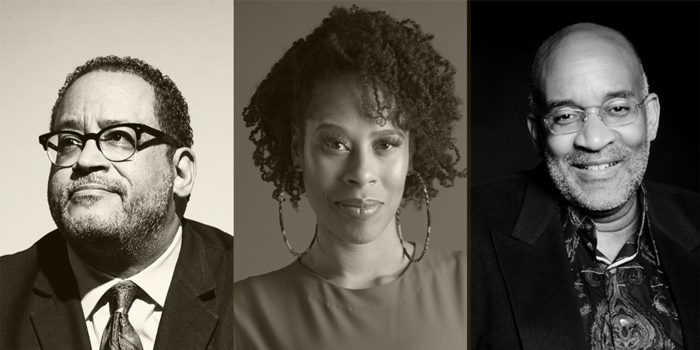
LIVE VIRTUAL CONVERSATION
BLACK THEATRE: RADICAL LONGEVITY

The Billie Holiday Theatre and Manhattan Theatre Club present Black Theatre: Radical Longevity, a conversation where Detroit-born luminaries Tony-nominated playwright Dominique Morisseau and NYT best-selling author Dr. Michael Eric Dyson (“Entertaining Race: Performing Blackness in America”) come together once again to discuss the role of Black Theatre amid the health, racial, and economic pandemics.

Playwright, NYU Associate Professor and fellow Detroiter Michael Dinwiddie will moderate this marquee virtual event on Sunday, February 6th at 5p.

This event will be streamed live on The Billie Holiday Theatre and Manhattan Theatre Club’s Facebook page. Register for this free event today

Helping Address COVID-19 Learning Loss: Winners of 4th Annual TD Ready Challenge Announced

0

Jan. 26, 2022 /PRNewswire/ — TD today announced that six U.S. organizations will be awarded grants through the 2021 TD Ready Challenge totaling $3,025,000 USD. The recipients are developing innovative, scalable solutions to assist disproportionately impacted students in grades K-12 across the Bank’s Maine-to-Florida footprint who are experiencing pandemic-related learning loss in math and reading.
Shelly Sylva, TD Bank, SVP, Head of Social Impact, answers OTP questions about the program.

How did this idea move from an idea to reality? What inspired it?
TD has always had a strong commitment to giving back to the communities we serve, and what we saw four years ago was that the world was changing really quickly. Change can bring enormous opportunity, but it can also cause disruptions and increase exclusion. So, we created the TD Ready Commitment, our corporate citizenship platform, to help guide our community and philanthropic investments in a way that helps people feel more confident about their own future while also helping to create a more inclusive future.
The TD Ready Challenge is a key component of our corporate citizenship platform and is focused annually on addressing an issue connected to one of the four drivers of the TD Ready Commitment. COVID-19 has continued to change our world and create uncertainty in our future, particularly for children. That’s why this year we felt it was so important to focus on addressing learning loss. The solutions presented by this year’s TD Ready Challenge recipients will be critical to ensuring an equitable COVID recovery in these communities and mitigating the negative impact learning loss could have for generations to come. 

 Why is it important to meet the people where they are and not just at your door?
I think what makes TD really different is the longstanding relationships we have with community-based organizations across our footprint. The constant touchpoints we have with these trusted community partners allow us to have a pulse on the pain people are experiencing or the challenges people are struggling with. When you have these kinds of relationships, you know that your support isn’t just going to what you think the problems are, but what the problems actually are.
 We know from research and conversations with our partners that learning loss will have a disproportionate impact on students from low-income households, students with limited internet access, indigenous and racialized students, as well as students with disabilities. Because each community is different, the support each TD Ready Challenge recipient will provide to help students overcome any learning loss will be tailored to the community.

 Can you give us one or two success stories in central Brooklyn related to TD Bank’s commitment to the community?
 TD has a strong commitment to the communities we serve, including in New York. Last year alone, we provided 167 grants across the state and 113 directly in New York City.
 In response to the devastation caused by Hurricane Ida, we provided a grant to the Brooklyn Chamber of Commerce that supported small businesses across Brooklyn. One of those recipients was Berta Hernendez-Villa, the owner of La Petit Chambre. La Petit Chambre was barely open four months before the hurricane hit and the relief funds we provided helped her replace furniture, fixtures and other damaged merchandise.
 
Submitted in 2020 and awarded in 2021, the TD Charitable Foundation awarded a grant through the 2020 TD Housing for Everyone competition to IMPACCT Brooklyn for their eviction prevention initiative. This initiative helped families in Central Brooklyn find safe housing and avoid eviction by creating a Tenant Engagement Specialist position to provide information and coordinate resources for the community.

What’s Going On – 2/3

HAPPY FEBRUARY 2022
To be sure, February will be better than January, which was a very dark month augmented by a Mercury Retrograde. February is the month for celebrations. Some of its tenants include Black History Month; Lunar New Year, the Tiger (1) Super Bowl, 13; Valentine’s Day, 14; Presidents Day, 21. By month’s end, President Biden will nominate a Black woman to the US Supreme Court.

NEW YORK, NY
There are so many moving parts in NY, NY. The Governor is downstate daily. In Albany, the legislators are busy with redistricting chores, a momentous undertaking. They will announce new election district configurations and what NY Primaries will look like this year. It looks like Downstaters will get two additional seats in the Senate. Downstate congress members should be a tad nervous about their future and those who are running against incumbent Governor. Manhattan District Attorney Alvin Bragg, first Black to head that office, has been under attack by local and national media and high ranking NYC/NYS electeds, most of whom did not read his first-day-on-the-job guidelines to staff in its entirety. Last week, he was summoned to Gov Hochul’s office about the same memo. This week, Bragg and the other four NYC DAs had an audience with Mayor Eric Adams. It is hard to determine if Bragg’s detractors are racists or just politician opportunists.

The current issue of CITY AND STATE NY Magazine includes its 50 OVER 50 List which does not include the usual suspects. Read about the African American leaders who made the cut. They include Hazel Dukes, NYS NAACP; Anthony Wells, President, Social Service Employees Union Local 371; Natasha Cherry-Perez, Community Engagement Manager, NY Charter Schools Association; Sonia Daly, Executive Director Operations, IDNYC, a municipal identification program aimed at allowing undocumented and homeless residents to access social service; Lawrence Hammond, Senior Vice President Director of ACCESS (Acquiring Capital and Capacity For Economic Stability and Sustainability), a $20 million fund; Juanita Holmes, NYPD Chief of Training, who was on short list to be named NYPD Commish by Eric Adams; Christian Hylton, Partner Phillips Nizer, LLP, lawyer specializing in land use; Ida Landers, Sr. Director of Domestic Violence Emergency Shelters, Urban Resource Institute; Kerron Norman, Chief Program Officer, Lutheran Social Services of NY and Darlene Williams, President/CEO Opportunities for a Better Tomorrow.

THE NATION
Supreme Court Justice Stephen Breyer made it official that he will retire at the end of this term, in June or July. President Joe Biden has said that his nominee to replace Breyer will be a Black woman. Republican Senators, assorted racists and others are protesting the Biden announcement. The United States has had 115 Supreme Court Justices in its short history. Only two of them were Black, Thurgood Marshall and Clarence Thomas. President is casting a wide net with as many as 14 Black women candidates. This is a sequel to last week’s Our Time Press cover story. The highly speculated short list of candidates includes 1) Ketanji Brown Jackson, US Court of Appeals, DC, Harvard Law School 2) Leondra Kruger, California Supreme Court, Harvard Law 3) Michelle Childs, Federal District Court, SC. She has support SC Congress members, Senators Tim Scott, Lindsay Graham, and Representative Jim Clyburn. 4) Candace Jackson-Akiwumi, US Circuit Judge, US Court Of Appeals 5) Sherrilyn Ifill, outgoing president, NAACP Legal Defense Fund 6) Eunice Lee, US Court Of Appeals Judge, Second Circuit, Law Yale School 7) Tiffany Cunningham, Federal Court Judge, N.C, Harvard Law School 8) Holly Thomas, Judge 9th Circuit Court Of Appeals, Yale Law School 9) Wilhemina Wright, US District Court, Minnesota 10) Melissa Murray, NYU Law faculty 11) Nancy Abdu, an 11th circuit nominee. Supreme Court watchers argue that women without judicial experience are unlikely candidates. President Biden promises a nominee by February 28.

ARTS AND CULTURE
Black History month began with untoward events. At least 17 historically Black college and university campuses were disrupted with bomb threats since January 31. Former Miami Dolphins head coach African American Brian Flores filed a lawsuit against the National Football League, Giants, the Denver Broncos and Dolphins alleging that the sport is “rife with racism.” The Flores claim was delivered on the eve of NFL’S big annual celebration, the Super Bowl on February 13. He has a compelling argument because numbers do not lie. He coaches teams that perform well but has little mobility in the NFL hierarchy.

THEATER TALK: The Manhattan Theatre Club and the Billie Holiday Theatre company present Black Theatre: Radical Longevity: A Continued Conversation on the role of Black theater in the midst of health racial and economic pandemics with Dr. Michel Eric Dyson, playwright Dominique Morriseau, moderated by Michael Dinwiddie, a virtual event on February 6 at 5 pm. Talk will be streamed live on MHTC and the BHT Facebook pages.

TELEVISION: Symone Saunders, former senior adviser and chief spokesperson for US Vice President Kamala Harris, joins the MSNBC network and will host a weekend show across cable and streaming beginning this spring. Saunders worked on the 2020 Biden presidential campaign and looked forward to the coveted White House press secretary job, which was not to be.

Whoopi Goldberg, was suspended for two weeks from co-host chores on THE VIEW TV show for her misinformed remarks about the Nazis and the Jewish holocaust.

ANCESTORS
RIP: Harlem businessman Wayne I. Charles Sr., 68, passed on January 17. Born in North Carolina, he grew up in Harlem. Charles attended NY public schools then earned a BS in Accounting at NYU and an MS in Education at the CCNY He did managerial stints at M&T and Con Edison and was a Borough of Manhattan Community College Adjunct professor. A student of pre Gentrified Harlem, he learned a lot from the large community of Uptown Black entrepreneurs including real estate developer Walter Edwards. Charles started the WIC Group of Companies, an umbrella for his diverse skills and perennial interest in real estate, buying, rehabbing, developing. He is survived by his children Danielle, Wayne Ivory II, Leland, Cherokee, Hannah and his four sisters. Homegoing arrangements: Wake: February 3, 1-4 pm Benta’s Funeral Home, 630 St. Nicholas Avenue. Funeral: February 4, 10 to 11:30 am officiated by Rejoice Ministries, The Church of Healing, at Ephesus SDA Church, 101 West 123 Street, Harlem

A Harlem-based management consultant, Victoria can be reached at Victoria.horsford@gmail.com

The Real Aim of Voter Suppression Laws

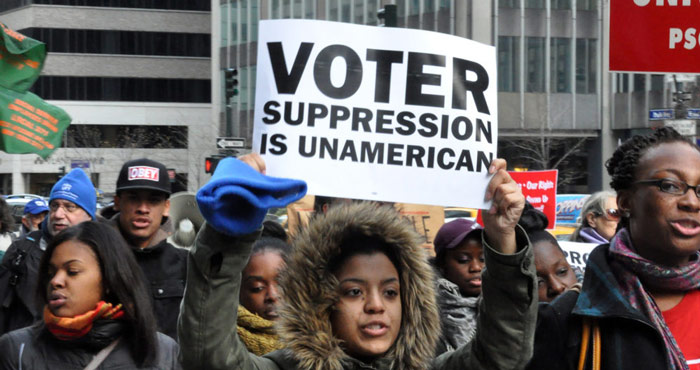
Rarely in United States history have the prospects for fair and honest elections that reflect the will of voters been so dim. That a significant segment of the citizenry, including many elected officials, do not want a truthful accounting and are working actively to prevent one exacerbates the problem, as do new, restrictive state laws and the expectation that they will be rubber-stamped by a sympathetic Supreme Court. This unfortunate scenario has played out before and ushered in one of the darkest episodes of America’s past.
By 1880, the advances of Reconstruction had been turned back and white supremacists had reasserted control in much of the South. Voter rolls were being purged of Black registrants, which in turn led to discriminatory legislation enacted by white-dominated state legislatures. Equal rights advocates saw the Supreme Court as their only hope. In two cases reported on March 1, the court made its position clear.
In the first, Strauder v. West Virginia, the justices ruled that a state law explicitly limiting jury service to white men violated the 14th Amendment and that Taylor Strauder, convicted by an all-white jury of murdering his supposedly unfaithful wife, must be granted a new trial. Although that case is often cited as an equal rights victory, it was anything but. Moments later, the court, in Virginia v. Rives, sustained the murder convictions of two African American brothers by an all-white jury because, although Black people were never called to serve on juries in Virginia, there was no specific law that prevented it.
Southern whites understood the roadmap the court had provided. So long as a law did not announce its intention to discriminate, it would pass judicial muster. During the next two decades, white supremacists attacked voting rights, drafting laws and new state constitutions in which the language was “facially neutral” but, using literacy tests, grandfather clauses, poll taxes, and residency or property holding requirements, specifically designed to keep Black Americans from the ballot box. In theory, these provisions applied to white people as well, but white registrars made certain that the laws were applied only selectively.
Some states employed methods sufficiently ludicrous to be worthy of “Saturday Night Live.” South Carolina, for example, introduced the “eight-box ballot,” equipped with eight separate slots, each designated for a specific candidate or party. To cast a valid vote, a person needed to match the ballot to the correct slot, but obscure labeling made doing so for anyone not fully literate virtually impossible. White people were assisted by poll workers, while Black voters, most of whom could read only barely or not at all, were left to try to decipher the system on their own.
None of this was done in the shadows. James Vardaman, later to be elected both governor and United States senator, boasted of Mississippi’s new Constitution, “There is no use to equivocate or lie about the matter. Mississippi’s constitutional convention of 1890 was held for no other purpose than to eliminate the [obscenity] from politics … let the world know it just as it is.”
Court tests of these new state constitutions went nowhere. In June 1896, Henry Williams was indicted for murder in Mississippi by an all-white grand jury. His attorney sued to quash the indictment based on the systematic exclusion of Black people from voting rolls. Yet although virtually none of the state’s 907,000 Black residents were registered, and state officials had publicly announced their intention to disfranchise them, the court ruled that the burden was on Williams to prove, on a case-by-case basis, that registrars had rejected African American applicants strictly because of race. Justice Joseph McKenna wrote that the Mississippi Constitution did not “on [its] face discriminate between the races, and it has not been shown that their actual administration was evil; only that evil was possible under them.”
The final blow was struck in 1903 in Giles v. Harris, when the court, in a grotesque opinion written by Oliver Wendell Holmes, rejected a challenge to the registration provisions of Alabama’s 1901 Constitution. Holmes agreed that the Alabama Constitution was “a fraud upon the Constitution of the United States,” but observed that if the court ruled in Giles’ favor it would become “a party to the unlawful scheme by accepting it and adding another voter to its fraudulent lists.” By this reasoning, any law that was discriminatory would be a “fraud,” and the court would become party to that fraud by protecting the plaintiff’s right as a citizen.
And so, with the court’s complicity, by 1906, more than 90 percent of African American voters in the South had been disfranchised. The horrors of Jim Crow were quickly sucked into the vacuum.
Similarities to the reasoning of the Roberts Court are both eerie and disquieting. In such decisions as Shelby County v. Holder, disemboweling the Voting Rights Act, and Hawaii v. Trump, upholding a Muslim travel ban, the majority relied on the same tortured logic and the same willing blindness that perverted justice in the past. And, as in the Jim Crow era, dozens of states have recently followed the court’s roadmap and initiated legislative efforts to suppress Black voting. Nonetheless, despite its predilection to the contrary, there is evidence that the Roberts Court will be less successful in preventing votes being cast than its predecessors.
The Jim Crow contrivances, such as poll taxes, literacy tests and grandfather clauses, have since been struck down and, as a result, recent state voting laws lack the bite of previous efforts. Enhancing identification requirements, closing polling places, and limiting mail-in ballots and early voting can make casting a ballot massively inconvenient but, unlike Jim Crow laws, cannot prevent a motivated voter from either registering or going to the polls.
And that is the point. Those attempting to hijack the electoral process want to avoid court challenges entirely. They are attempting to make voting sufficiently cumbersome that enough opposing voters stay home to grant them victory outright, sort of a corollary to Mitt Romney’s “self-deportation” strategy for undocumented immigrants.
As such, the best way to avoid a collapse of the electoral process — and a collapse of American democracy — is for voters to endure any hardship, any inconvenience, to make their voices heard. African Americans in the Jim Crow South risked their jobs, their homes and even their lives to try to cast ballots. We all must do our parts as well.
Goldstone’s most recent book is “On Account of Race: The Supreme Court, White Supremacy, and the Ravaging of African American Voting Rights.”